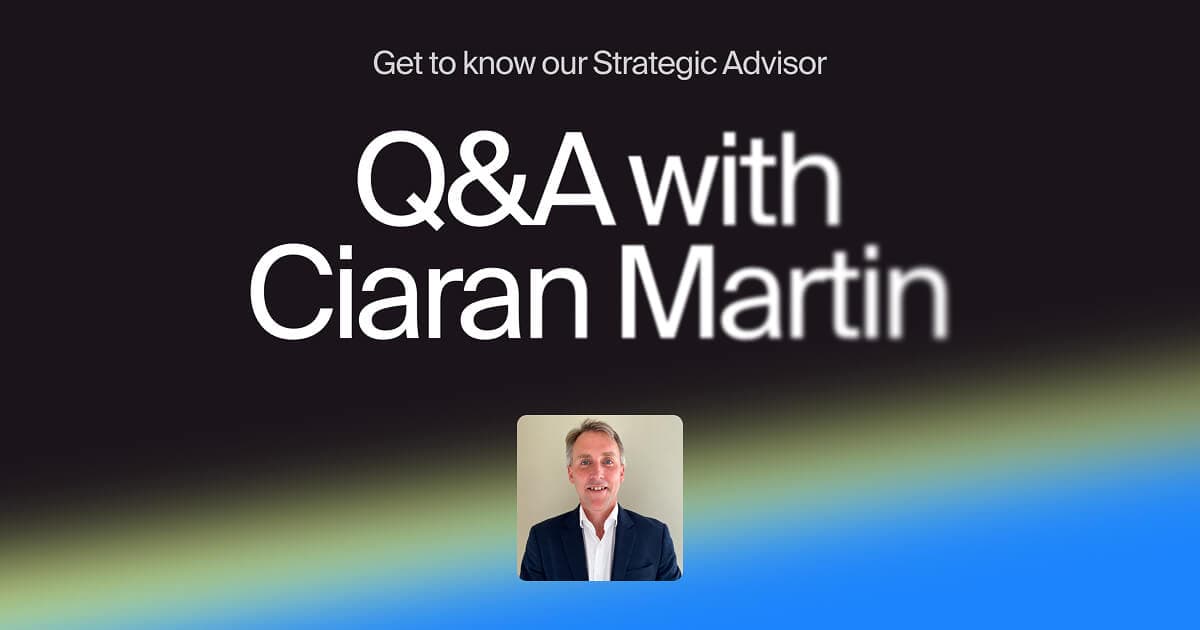
Ciaran Martin, founding CEO of the UK's National Cyber Security Centre (NCSC) (opens in new tab) and now a professor, author, and advisor to boards and governments on cyber resilience, recently joined Doppel as a strategic advisor.
We sat down with him to talk about why the AI security "apocalypse" narrative is mostly noise, what threats CISOs are actually underestimating, and what nation-states can teach the private sector about handling a crisis.
Q: What made you agree to become a strategic advisor to Doppel?
It came down to the problem. There's a collapse of trust in information happening right now, one of the earliest real consequences of the AI era. It's not a new observation. The UK's first AI Safety Summit in 2023 (opens in new tab) grouped AI risk into social risks like misinformation, mid-tier risks like cyber, and speculative "loss of control" risks. Information integrity sits in that first bucket, and I think it's the most underappreciated of the three.
What drew me in was the scope. This isn't an attempt to solve every AI risk at once. It's aimed squarely at people's ability to verify what's real, whether that's a communication, a brand, or an identity. That's a bounded, solvable problem, and it struck me as one of the clearer pieces of a very messy picture.
Q: Let’s talk about that noise you’re hearing around AI. What's actually changing?
Leaders at major frontier AI labs are warning about things like giant botnets seizing the internet. People assume they know what they're talking about because they're “good with computers,” but that's a different kind of expertise, and I think the warnings are actively damaging because they pull attention and budget away from what matters.
I break it into four buckets. Giant botnets: not happening. A "vulnerability apocalypse" is shaping up like Y2K: a threat we'll never know if we overhyped or successfully defused. Autonomous rogue agents: possible, but constrained by whether attackers can afford to run them. And then the one that's already certain: attackers using AI to make their existing playbook faster, better, and more voluminous. Same phishing, same brand spoofing, just with every tell we trained people to spot now erased.
Q: How are threat actors using AI for everyday things like reconnaissance, social engineering, and vulnerability targeting?
I'll give you the moment this became real for me. I was at a security conference in San Diego, and someone asked how I'd flown in.
“British Airways,” I said. “And yes, I have an Executive Club account.”
They typed a prompt: Ciaran Martin needs to reset his BA Executive Club account, used my publicly findable email, and started a stopwatch.
35 seconds later, a phishing email landed in my inbox. It was flawless. Correct branding, correct tone, no broken English, nothing to hover over that gave it away.
That's the actual shift. It's not some dazzling new attack technique. It's the same phishing email we've been training people to spot for twenty years, except AI has quietly removed every signal we told people to look for.
Q: Why is social engineering scaling so fast, and why don't traditional controls or awareness training stop it?
Because the entire model of awareness training was built around human error tells: bad grammar, mismatched domains, slightly-off branding. AI has closed all of those gaps. I genuinely wonder whether phishing-awareness training as we know it will still be worth the investment by 2030.
This doesn’t mean that traditional cybersecurity is dead. It's specifically phishing-awareness training that's losing some of its effectiveness. Identity and access controls, for example, remain critical.
If you look at incidents like the recent issues around agentic AI misuse, the common thread is often that better access controls would have limited the damage. So the honest answer is: basic training against phishing is a losing battle, but the fundamentals around identity and access are more important than ever.
Q: The industry is obsessed with data breaches. Where's that focus misplaced, and what should CISOs worry about instead?
A data breach is like finding a filing cabinet lock broken. Someone's been through your files. Violating, but you still go to your next meeting. A disruptive attack is someone breaking in and beating you with a baseball bat. You're not working tomorrow.
Both get called "cyberattacks," but ask any CISO who's lived through both which one was worse, and it's always the disruptive one. Nothing works, money's hemorrhaging, everyone's panicking. Data breaches function more like a pollutant, feeding a toxic pool of stolen data that fuels fraud downstream, and we should discourage adding to it. But the breached company itself rarely suffers. Customers almost never leave over it. Disruption is what actually threatens the business.
Q: How should boards reframe these issues as systemic business risks rather than isolated IT incidents?
The starting point is recognizing that resilience isn't a cybersecurity issue. It's a business issue.
Every major framework, whether it's NIST or ISO 27001, walks through the same five questions:
- What matters most to you? What's your risk profile?
- How strong is your perimeter?
- Can you contain an intrusion once your perimeter fails? (And it will, because all networks are porous.)
- If contained, can you expel?
- How resilient are you if all of that fails?
That last part isn't technical at all. It's whether you can operate at reduced capacity within 24 hours, or whether you end up like a lot of companies whose entire production shuts down.
Your customers, regulators, and the media don't care that it was a cyberattack rather than a flood. They care that you can't do the thing you exist to do. That's the framing boards need.
Q: How have threat actor groups evolved, and why track groups like Shiny Hunters?
The frontier AI narrative treats hacking capability like a magic wand, as if building a powerful enough model turns everyone into a master attacker. It doesn't work that way; you still need a threat model. Shiny Hunters, for example, are a loose Western European collective that monetizes data rather than disrupts, so an organization worried about them should focus on data protection specifically.
It also matters because different groups respond to different pressures. Shiny Hunters largely operate where the rule of law applies, so arrests are possible. We’ve just seen that with three arrests on three different continents. Russian criminal groups respond to infrastructure and financial disruption. Chinese state-linked actors care about public exposure in a way Russian actors don't. You have to know who's behind the keyboard to know what actually works against them.
Q: Having founded and led the NCSC, what's the biggest lesson enterprise CISOs can learn from how nation-states build resilience?
Two things. First, resilience has to be proportionate. Early British government guidance, before the NCSC was established, effectively asked every business, down to a six-branch hairdressing chain, to defend like it was facing a top-tier nation-state. That's unstaffable and unrealistic. CISOs need to calibrate what's actually achievable for their organization, not chase a standard only a handful of companies could meet.
Second: we've inverted the pyramid of responsibility. Junior staff get formally warned for clicking a bad link, while vendors who've shipped defective code for years face no liability at all. If your own security procedures are too cumbersome for you to run personally, without delegating to an assistant, they're too cumbersome for your junior staff too, and they don't have the luxury of a shortcut.
On incident response: human judgment has to override rigid scoring. We once ran real past incidents through a new formal triage scale, and the results were absurd, missing major attacks while flagging trivial ones. And organizations need to remember the outside world exists. The fastest way to break even a well-prepared team in a tabletop exercise is one unpredictable move from a supplier, regulator, or reporter they assumed they controlled. Plans are useless, but planning is essential.
Q: Where is public policy getting cyber defense right, and where is it falling behind?
Outside the US, policymakers are increasingly getting resilience right for regulated sectors like energy and telecoms, partly because those companies want the regulation; it's easier to justify security spend to shareholders when it's the law. There's also growing attention to product liability. The IoT "digital apocalypse" predicted a decade ago didn't materialize partly because governments banned default passwords after incidents like the Mirai botnet. The EU's Cyber Resilience Act (opens in new tab) extends that logic: treating technology as a liable product, not just a service.
This becomes urgent with AI. US officials have suggested recently that AI companies bear responsibility for how their systems are used, but my understanding is that US law hasn't settled this question. It may take a landmark court case, or new legislation, but it's one of the biggest open questions in the space right now.
The internet was built without security in mind. That's the bug. A whole ecosystem of people exploits that fact, and that's the thugs, the spies, and the lies. We've muddled through for decades because the resulting harm, while real, was never quite severe enough to force a genuine reckoning.
AI is likely to change that. It probably represents a decisive shift in that long-running balance, either toward the people causing harm or toward the people defending against it. The stakes in making sure it tips the right way have never been higher.
Interested in how Doppel is helping organizations get ahead of AI-driven social engineering and impersonation threats? Get in touch with our team.