Take a tour through almost any SOC. You’ll find dashboards filled with rules designed to block newly registered domains (NRDs) (opens in new tab).
On paper, the logic feels bulletproof. When threat syndicates spin up infrastructure for a massive phishing wave or credential-harvesting campaign, they need digital real estate. So they buy a domain to host counterfeit login pages and send malicious emails.
If your secure email gateway (SEG) (opens in new tab) automatically blocks any domain registered within the last 30 days, you cut off the attack before it ever starts, right?
One problem: Cybercriminals figured that out long ago.
Legacy threat feeds and perimeter filters rely on static domain age to determine trust. Adversaries know these rules inside and out, so instead of battering down the front door with fresh infrastructure, they simply manipulate the calendar.
Palo Alto Networks’ Global Incident Response Report shows that just 7% of active phishing domains are under 30 days old (opens in new tab).
Attackers aren't running sloppy, frantic smash-and-grab operations. They operate patient, highly capitalized syndicates. They buy domains in bulk, park them in complete silence for months, and simply wait out your security filters. By the time they attack your workforce, the domain has aged past every static threshold your security stack uses to flag danger.
If your team is still relying on legacy threat intelligence lists to spot social engineering, you’re fighting a ghost.
The art of strategic hibernation
The lifecycle of an advanced cyberattack doesn't start the morning a phishing lure lands in an inbox. It starts 6 to 12 months earlier in a phase of calculated, strategic hibernation.
Threat actors don’t want to trigger your alarms prematurely. Here’s the playbook adversaries use to manufacture digital trust out of thin air:
- Footprint reconnaissance: Threat actors map your external corporate footprint. They identify the internal human resources portals your staff logs into daily, your primary secure file-sharing services, and the third-party software vendors tied to your workflows.
- Bulk lookalike registration: The attacker deploys automated scripts to purchase dozens of lookalike domain variations. They use clever typosquatting techniques, hidden Unicode homoglyphs, and obscure top-level domains (TLDs).
- Parking the assets: Instead of setting up a fake Microsoft 365 login page or attaching a credential-harvesting payload, the attacker does absolutely nothing. They point the domains to a benign placeholder, a generic parked-page template, or a copied real estate blog.
- Accumulating unearned trust: For the next six to twelve months, the infrastructure sits in total silence. Search engines index the harmless placeholder content. Automated security scanners evaluate the site, find zero malicious code, and assign it a neutral or positive reputation score.
The attacker bypasses the entire concept of a newly registered domain filter by letting the clock run.
Day by day, the domain ages. It crosses the 30-day threshold, clears the 60-day mark, and eventually passes 90 days. It quietly transitions from a suspicious new asset into an established, trusted entity in the eyes of almost every traditional email security gateway on the market.
Weaponization in under 60 seconds
The real danger of an aged lookalike domain isn't just that it flies under the radar. It’s how fast an attacker can turn that benign parked page into a devastating weapon.
When the threat syndicate is finally ready to launch their high-velocity campaign, they execute a rapid series of technical state changes. This is the moment the attack goes live, and it’s exactly when legacy threat feeds fail completely.
The attacker logs into their registrar console and rewrites the domain's architectural reality on the fly:
- Instantaneous DNS swap: The attacker slashes the time-to-live (TTL) (opens in new tab) values to near zero. This ensures they can rapidly shift malicious traffic to backup servers if researchers close in. They update the A records to point away from the harmless placeholder and route directly to their hidden, malicious hosting infrastructure.
- Bypassing URL blocklists: They frequently implement CNAME redirections and wildcard DNS records. This instantly spins up hundreds of dynamic subdomains designed to confuse basic blocklists.
- Cryptographic trust on demand: To fool modern browsers, attackers use automated certificate authorities like Let's Encrypt (opens in new tab) or ZeroSSL (opens in new tab) to instantly mint valid TLS and SSL certificates. The site gets the reassuring padlock icon, completely disarming user suspicion.
- Mail exchange activation: The attacker then activates the MX records. Because the domain is seasoned, they easily publish strict Sender Policy Framework (SPF) (opens in new tab) and DomainKeys Identified Mail (DKIM) (opens in new tab) records, establishing perfect DMARC (opens in new tab) alignment.
This entire transformation, from a sleepy placeholder to a fully operational phishing engine, takes less than a minute.
Why legacy threat feeds always arrive late
Traditional cybersecurity relies on static lists and retrospective analysis. Threat intelligence vendors maintain massive databases of known bad domains and IP addresses.
But these lists are reactive. A domain only makes its way onto a legacy threat feed after a specific sequence of events:
- The domain is weaponized and used in an active live attack.
- A security researcher manually analyzes the infrastructure and flags it as malicious.
- The vendor packages the update and pushes the new list to enterprise customers.
That process takes hours (or sometimes days).
When an attacker weaponizes a dormant domain, that domain isn't on any threat list anywhere in the world. The legacy threat feed checks the domain registration date from 9 months ago, sees a positive reputation score, and lets the traffic flow directly into your network.
By the time a static feed pushes an alert to your manual ticketing queue, the attack is already over. The threat actor has dropped their payloads, harvested the administrative credentials they need, and burned down the campaign.
Relying on manual triage to catch dynamic attacks is an unwinnable math equation. You cannot manually refresh registrar data every five seconds, hoping to catch the exact moment a dormant domain suddenly sprouts active MX records.
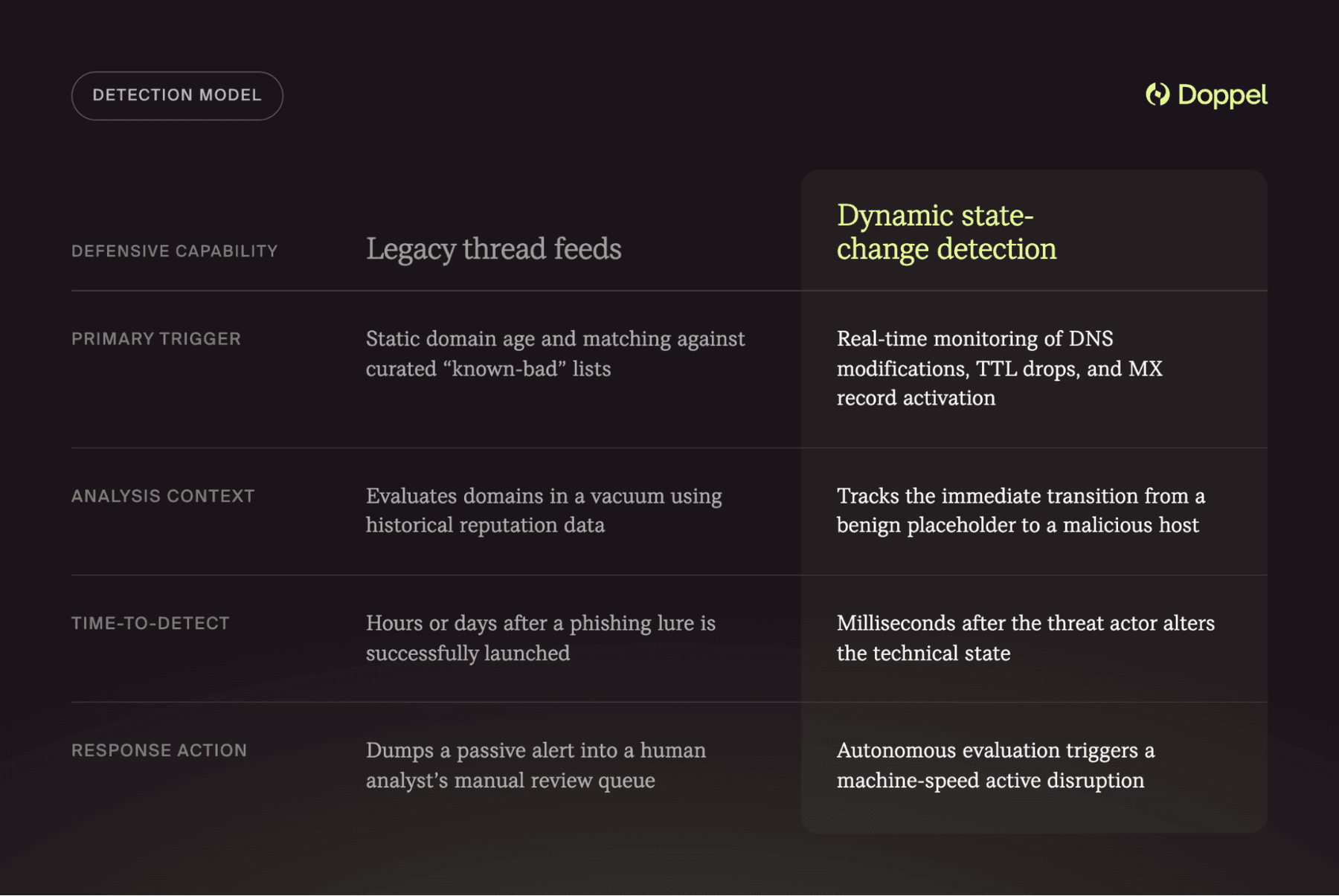
Static feeds vs dynamic state-change detection
Stopping an adversary who uses time as a shield requires shifting away from brittle, list-based security. Move toward dynamic, reasoning-based detection.
Here’s how the two approaches compare:
Neutralizing the threat with the Doppel Threat Graph
Adversaries use agile, automated infrastructure to build attacks, and you need native, agentic AI to dismantle them: Enter Doppel.
Instead of relying on easily manipulated metrics like domain age, we engineered the Doppel Threat Graph to map the open web and track the continuous, holistic state of external infrastructure.
- Continuous discovery: Our AI-native platform continuously monitors the dark web, global domain registrars, and hosting providers. When a threat actor registers a typosquatted domain and parks it, Doppel sees it.
- State-change tracking: Our agents don't wait for the domain to appear on a delayed threat feed. Doppel tracks that domain's state indefinitely. The absolute second the attacker updates the DNS records, generates a rapid TLS certificate, or publishes MX records, the Doppel Threat Graph detects the state change.
- Machine-speed takedowns: The moment the malicious state change occurs, Doppel initiates a machine-speed takedown. Our agents autonomously strike the attacker's registrar and hosting infrastructure, shutting down the campaign before a single email reaches your employees.
- Closing the loop: Intelligence from these external takedowns can be fed instantly into your human risk management (HRM) program, ensuring your workforce is trained on the exact payload-free dialogue lures attackers are attempting to launch.
Outsmarting the waiting game
Domain age isn’t a proxy for trust. As long as security tools rely on static NRD filters and retrospective blocklists, cybercriminals will happily buy domains, wait out the clock, and strike when your defenses assume they are safe.
Stop relying on legacy threat feeds that give attackers a massive operational head start.
By deploying an agentic defense that tracks dynamic real-time state changes, you neutralize the time, capital, and effort the attacker invested in aging the domain. You pull the rug out from underneath them the very moment they try to flip the switch.
Experience the structural difference of true agentic defense: Schedule a demo with Doppel to see how our Frontier AI Social Engineering Defense platform tracks dynamic state changes and executes multi-channel takedowns at machine speed, destroying attacker infrastructure before the damage is done.