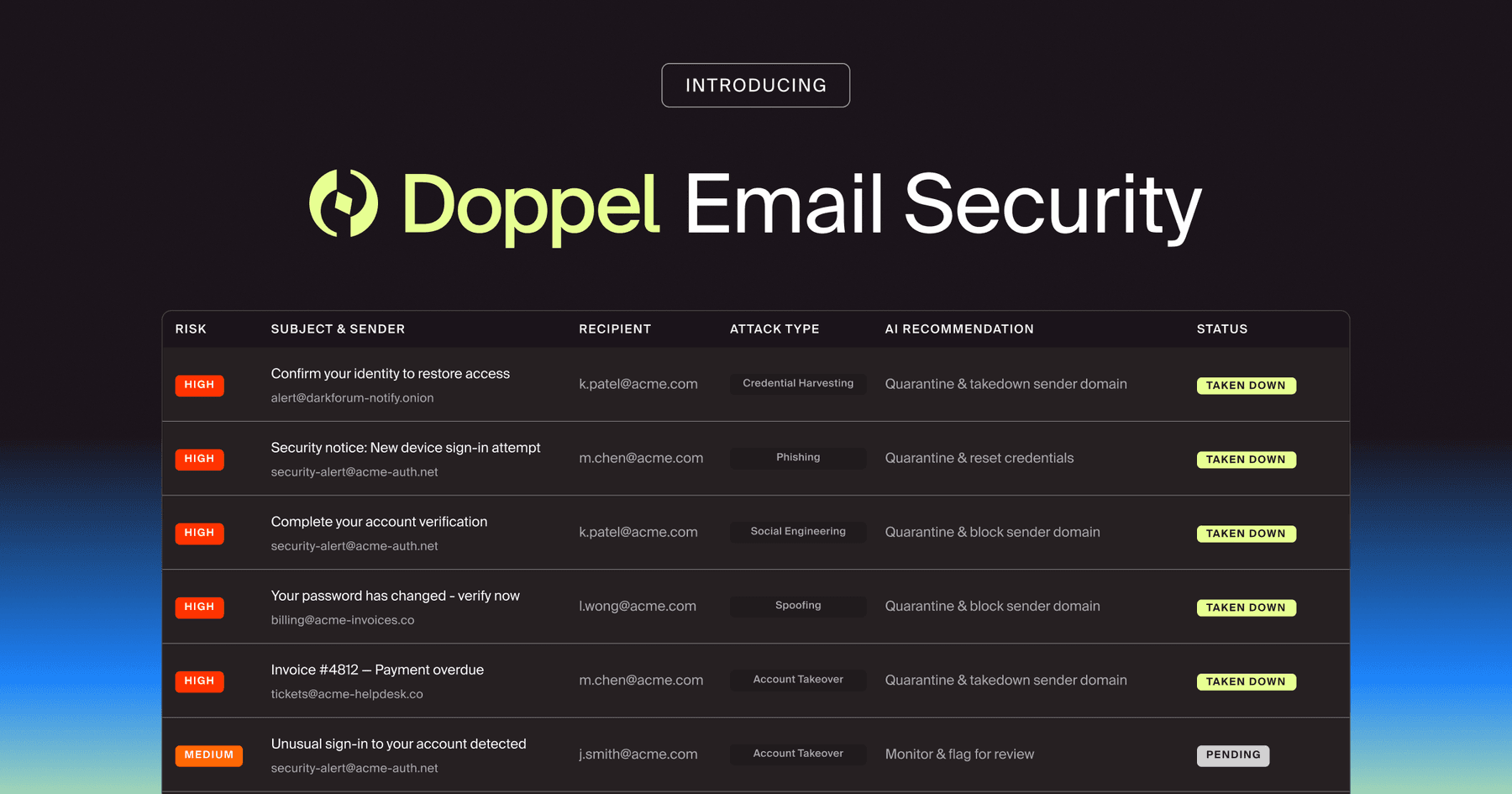
Doppel Email Security is now generally available
The agentic email security solution that empowers you to fight back against social engineering attacks. Detection isn't enough. Disruption is the difference.
The 2026 breaches at Match Group, Nike, and Stryker highlight a new era of data theft. Learn how attackers weaponize leaked credentials and how Doppel stops them.

The standard playbook for a data breach was simple: Clean up the mess, force a mass password reset, and assume the stolen database would collect dust in an obscure corner of the dark web.
That playbook doesn’t matter in 2026.
Your corporate perimeter is anchored entirely to identity. Threat actors aren't spending months hunting down zero-day exploits to crack open systems. Now, they're logging in with legitimate credentials stolen from third-party vendors, exposed cloud storage, or compromised employee devices.
Attackers use AI-powered tools to parse leaked corporate credentials in minutes, building hyper-targeted, multi-channel social engineering campaigns designed to bypass multi-factor authentication (MFA) (opens in new tab) and breach primary networks.
There’s a clear pattern in the high-profile breaches of 2026. But to break this cycle, security leaders and their teams need to understand how threat syndicates operate (and how to dismantle their staging infrastructure before the first phish lands).
2026 has offered a masterclass in how fragile the identity perimeter really is. Major incidents highlight how devastating a compromised credential can be when placed in the wrong hands.
In January 2026, ShinyHunters (opens in new tab) claimed responsibility for a massive security event (opens in new tab) involving Match Group, the parent company behind Tinder, Hinge, and OkCupid.
The group stole more than 10 million records. They didn’t get in by burning a zero-day exploit, though.
Here’s a breakdown of the tactics used:
Nike launched an investigation (opens in new tab) into a possible data breach in 2026 after ransomware group World Leaks (opens in new tab) said it obtained 1.4TB of data from the apparel and footwear giant.
Here’s what the exfiltrated dataset of over 188,000 files contained:
This highlights how attackers target the subtle, trusted workflows between a primary brand and its external manufacturing partners. When third-party vendors are compromised, your internal IP can go out the door with them.
In March 2026, Iran-based hacktivist group Handala (opens in new tab) pulled off a destructive cyberattack (opens in new tab) against medical technology manufacturer Stryker.
The scope of destruction was severe:
By stealing a high-privilege credential, the threat actors turned the company's own management software into a weapon of mass disruption.
There’s a misconception that a database leak is the final act of an attack. In reality, it's just the launchpad for the next phase.
When a misconfigured cloud environment or a third-party vendor exposes employee data — like names, job titles, direct phone numbers, and internal SaaS usage — it becomes high-octane fuel for social engineering:
Automation, meanwhile, has condensed the attack lifecycle from weeks down to a matter of hours.
Here’s the path a leaked credential takes from exposure to full breach:
If adversaries are weaponizing your leaked data in hours, manual triage and delayed intelligence reports won't cut it. You need a closed-loop system that operates faster than the threat actor.
Doppel's agentic SOC disrupts the attacker's supply chain.
Doppel continuously monitors the dark web, hacker forums, and external messaging channels for active threats against your brand. The moment fresh credential leaks, session tokens, or impersonation assets surface, Doppel's platform ingests the intelligence automatically.
Playing defense inside the inbox is a losing battle. Doppel automatically executes takedowns against the attacker’s external staging infrastructure.
If threat actors register lookalike domains or build fake social profiles using your leaked data, AI agents initiate immediate registrar-level and host-level takedowns to neutralize the campaign before it reaches your staff.
Intelligence is most valuable when applied immediately. Doppel takes live threat data from real-world external leaks and converts it into safe, internal simulations.
If we detect attackers preparing a vishing lure based on a leaked vendor list, we launch a simulated version to test employee readiness in real time, hardening your human perimeter against the exact tactics in play.
The major breaches of 2026 reinforce a clear lesson: Building higher firewalls won't protect you if attackers already have the keys to the front door.
When credentials leak, the clock starts ticking immediately — and fast.
Threat syndicates rely on speed, AI parsing, and trust to turn exposed data into initial access. Relying solely on manual review and standard quarterly security training leaves your organization trailing behind.
By adopting a closed-loop defense, you can neutralize staging infrastructure externally, train employees dynamically against real-world threats, and turn leaked data into your strongest defensive asset.
Schedule your demo with Doppel to see how our agentic AI ingests threat intelligence, executes automated takedowns, and proactively hardens your human perimeter.
BLOG
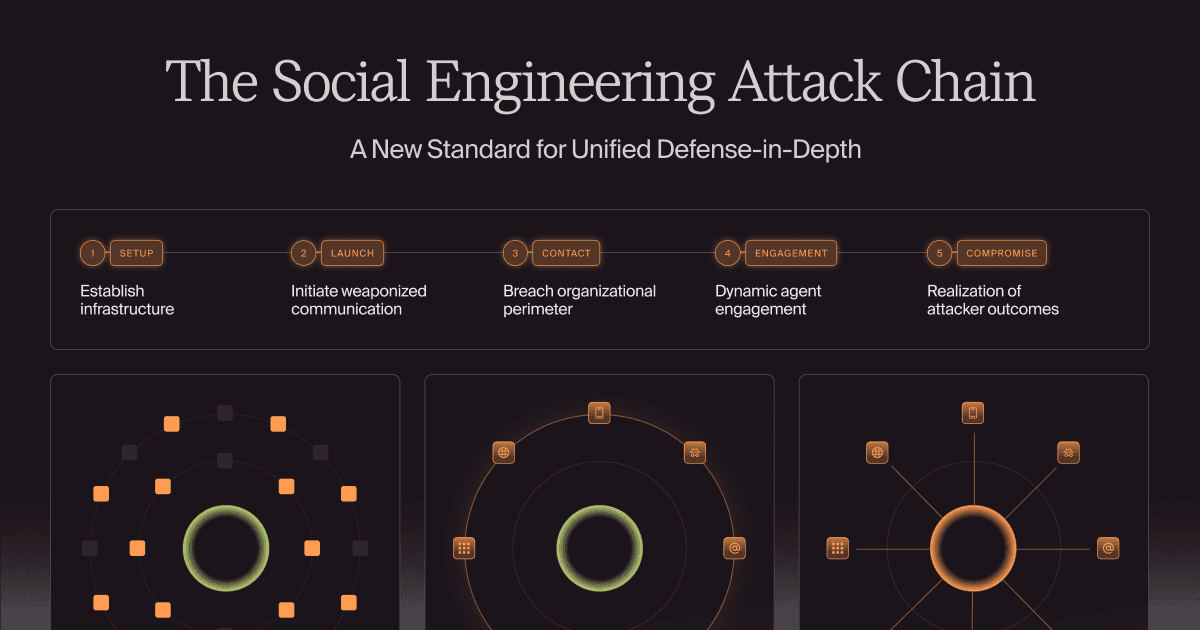
Modern social engineering is a relentless, AI-orchestrated lifecycle. Learn how to map the five-stage attack chain—from setup to contact—and why a unified defense platform is the only way to outpace AI-driven social engineering attacks.



by Bobby Ford, Rahul Madduluri, and Alvin Lin