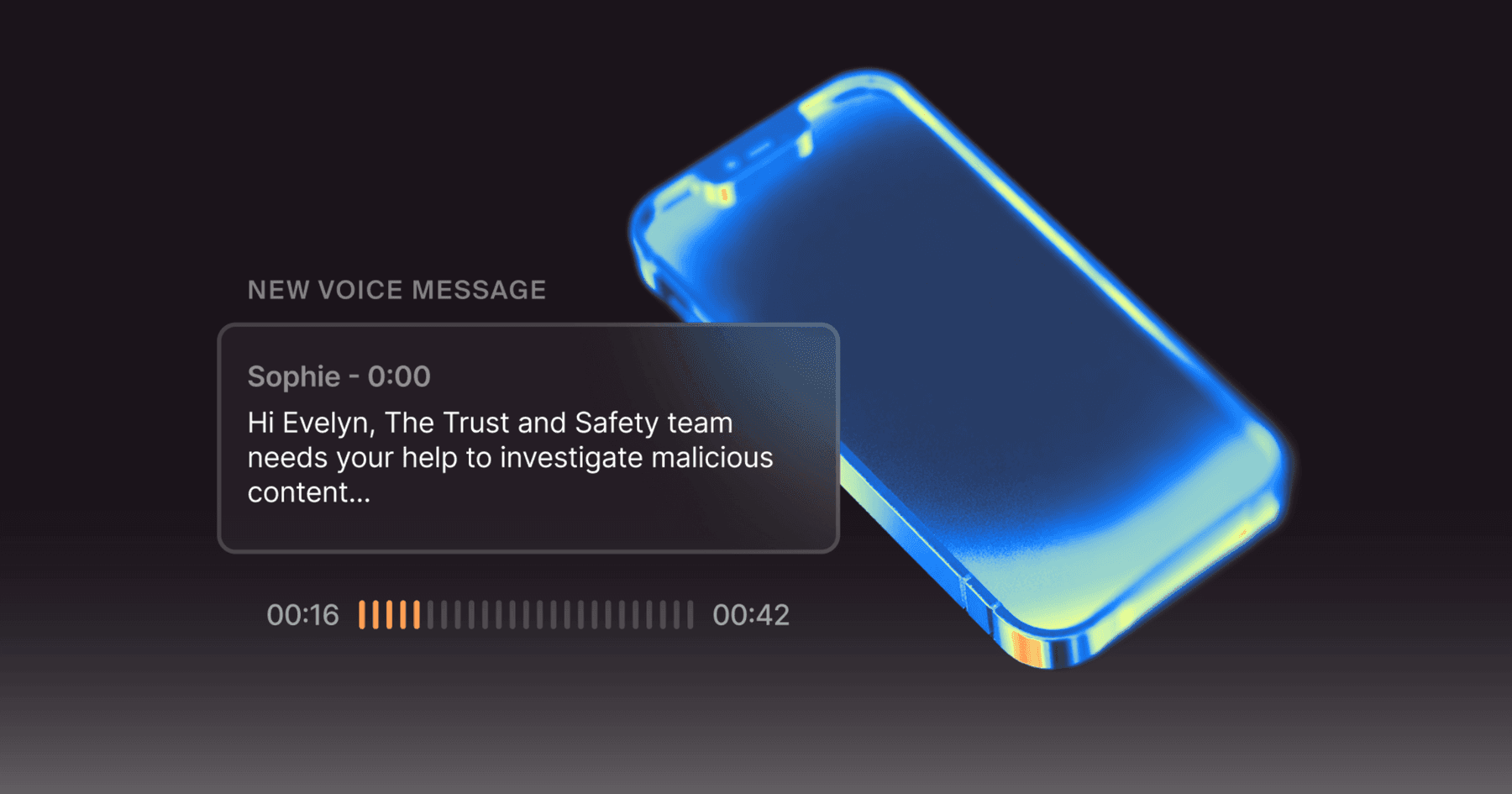
Every control in a security program is built to inspect a “thing”: a file, a link, a sender, a page. Engagement is the stage where there is no “thing.” The target replied, the call connected, and the attack is now a live exchange that adapts to whatever your employee says next. This piece walks through Engagement, the fourth stage of the social engineering attack chain: what the Interactive Payload actually is, why an exchange that can run minutes to months gives point-in-time controls little to score, and what defense looks like when the attack is a conversation instead of a payload.
The security stack is very good at answering one question: is this artifact malicious? Hand the stack a file, a link, a sender, or a login page, and a verdict comes back in milliseconds. Two decades of defensive investment have gone into that one question. At this stage of the chain, there are few, if any, artifacts left to inspect.
The target replied. The call connected. The chat window is open. From that point, the attack is a live exchange, composed in real time and different for every person it reaches. There is little to detonate, because little was sent. There is little to fingerprint, because the conversation is largely unique to each target.
That exchange is Engagement, the fourth stage of the chain, and it is where much of our existing defensive logic comes apart.
The first piece in this series argued that social engineering is a chain, not an event. The second followed the money. The three that came after walked the buildout, the moment it went live, and the crossing that put the operation in front of a person. This piece follows what happens once that person answers.
What Engagement actually is
In Doppel’s five-stage Social Engineering Attack Chain (SEAC) model, Engagement is the stage where the target is drawn into an exchange. The canonical model gives that exchange a name: the Interactive Payload, the transition from a static lure to a live, multi-channel exchange. A companion piece from Doppel states the shift more bluntly: the dialogue is the payload.
The wording matters more than it looks. A payload used to be a noun you could hold: a macro, an executable, a credential page. At Engagement the payload behaves like a verb. It is generated per target, adjusted per turn, and it exists only while the conversation is running. Two employees worked by the same operation on the same afternoon may never see a single identical string.
That is the structural fact of the stage, and it is worth stating plainly. There is rarely a sample.
How attackers run it
Strip out the mystique, the way we did for the earlier stages, and Engagement is sales. Not a metaphor for sales. The same motions, in roughly the same order.
They handle the objection instead of hoping for a click. A static lure gets one attempt and no recovery. An operator in a live exchange hears the hesitation and answers it: a callback number, a supervisor who joins the call, an apology for the confusion followed by a smaller and more reasonable ask. Every objection the target raises is information the adversary did not have a moment earlier.
They use a second channel to vouch for the first. The email says a text is coming, and the text arrives. The caller offers to confirm in a Teams message, and the message appears from an account that renders correctly. The target is not checking the impersonator’s story. They are watching the impersonator satisfy every check they know how to make.
They put a face and a voice on it. The advice we have given people for years is to verify by voice or video, and live meetings are now a contact surface of their own. A synthetic voice on the call and a synthetic face in the meeting turn the verification step into the delivery step. By Doppel’s published estimate, the cost of a high-fidelity deepfake has fallen by more than 99 percent, so the expensive part of impersonating an executive is no longer the impersonation.
They wear the control down rather than defeat it. Push notifications arrive until one is approved, and a helpful voice on the phone explains why the prompts keep appearing and what to tap to make them stop. Multi-factor authentication worked exactly as designed. The approval was genuine.
They run many exchanges at once. Rapport used to be the hardest part of an operation to scale, because holding a convincing conversation took a skilled human. That constraint has largely lifted. Language models hold the exchange in any language, stay in character, and hand off to a person when the target is close. The economics that made the lure cheap now apply to the relationship.
Why engagement is hard to see
Three reasons, and they compound.
There is rarely an artifact to inspect. You cannot detonate a conversation in a sandbox or write a signature for rapport. That is the argument this series opened with, and the conclusion is easy to nod past: the detection model we built, the one that scores an object and returns a verdict, has little to operate on here.
The content does not repeat. Correlation rescues you at earlier stages because the same domain, the same kit, and the same persona show up across many targets. Generated dialogue does not repeat that way. What still repeats is the infrastructure underneath the conversation and the shape of the behavior on top of it.
It happens where the traffic is normal by definition. A WhatsApp thread on a personal phone is usually invisible to your security stack. A chat from a federated tenant, a meeting invite from outside the organization, a LinkedIn exchange with a recruiter: these are ordinary business traffic. The channels most exposed at this stage are the ones the business runs on.
Engagement runs on a clock you do not control
Engagement has no fixed duration. It can run minutes to months. A vishing call is finished before the ticket is opened. A recruiting long-con can run past a quarter close. Point-in-time controls score a moment, and an exchange that lasts for weeks rarely presents one. Each turn is individually unremarkable. Often only the trajectory is hostile.
That cuts both ways, and the second edge is the one worth building on. A long exchange is also a long window of observable behavior. Weeks of contact from a party your organization has never transacted with, asks that escalate as the exchange matures, a conversation that has moved to a personal messaging app: a program can spot all three without reading a word of the exchange. Duration is the adversary’s asset only while nobody is watching the relationship.
What is still observable
Watch the boundary conditions instead of the content. A first-time external party inside a collaboration channel, a meeting invite from outside the tenant, a vendor contact arriving on a messaging app instead of the account team’s usual thread, a callback number that does not match the record: none of these require reading the exchange, and all of them can be recorded.
Give people a way to pull the security team in while the conversation is still running. Reporting today assumes the attack is over: forward the message, file the ticket. A live exchange needs an escalation path that works mid-call, in the ninety seconds when the employee is uneasy and the person on the other end is waiting for an answer. That is the highest-value detection moment in the chain, and most programs have no route for it.
Correlate the exchange back to the campaign. The persona in the conversation is standing on infrastructure staged during Setup: a domain, a number, a profile, a tenant. When those are already correlated into one campaign view, an employee’s uneasy question about a vendor resolves into a known operation instead of an isolated judgment call.
From Engagement to Compromise
Engagement ends when the target does the thing the exchange was built to produce: approves the prompt, reads the code aloud, sends the wire, resets the credential, opens the access. That handoff is Compromise, the subject of the next piece. The boundary is worth marking because nothing technically breaks at that moment. The session is legitimate, the approval is real, the payment is authorized by someone who holds the authority to authorize it. For the operation, Compromise is not a break-in. It is the moment the target hands over their own authority.
What defenders get wrong
Two mistakes, and the second one is expensive.
The first is waiting for an object. A program organized around artifacts asks whether the message was malicious, and at this stage that question rarely has an answer, so little moves until the money is gone. The question that fits the stage is a different one: is this exchange with a party we have a real relationship with, and is the ask consistent with that relationship?
The second is treating verification as something the employee performs inside the conversation. Call the number back, ask a question only the real person would know, get them on video: that advice made sense when the channel was neutral. In a live exchange, the adversary owns the channel and has prepared for every check offered inside it. The callback number is theirs. The face on the call is generated. Verification counts only when it runs through a path the employee chose, against a record the organization already held, outside the conversation.
Training deserves the same precision. It helps, and rehearsal is one of the few things that measurably changes what a person does inside a live exchange. Rehearsing against a static lure, though, prepares someone to spot an artifact that is no longer the weapon. If your entire practice for Engagement is a quarterly test where the right answer is not to click, your people have rarely rehearsed the situation they will actually meet: a courteous, competent, patient stranger who has an answer for most objections.
Why inspection cannot reach this stage
Engagement is the stage where the attack stops being something you can hold and becomes something you have to observe. The instinct it punishes is waiting for evidence in a form this stage does not produce. The posture that works accepts that the conversation itself will not be inspected, and spends the effort on what can be: who the party is, how identity gets confirmed, and how quickly an employee can bring the security team into an exchange that is still open.
What leaders should take away
- The weapon leaves little to inspect. At Engagement, the payload is the conversation, generated for one target and rarely repeated. A program whose detection depends on scoring artifacts has little coverage at this stage, and the gap does not close with a better filter.
- Verification inside the adversary’s channel is not verification. Callbacks, security questions, and video confirmation all run on the surface the impersonator controls and has rehearsed. Identity confirmation belongs in a defined out-of-band process that does not rest on the judgment of the person being pressured.
- Duration is the adversary’s advantage only while nobody is watching. An exchange that runs minutes to months gives point-in-time controls little to score, and gives a program that tracks relationships weeks of observable behavior. Which of the two it becomes is a design decision.
The next piece in the series follows the exchange to its end: Compromise, the stage where the adversary gets what they came for, and where the damage is done by an action your systems were built to allow.