
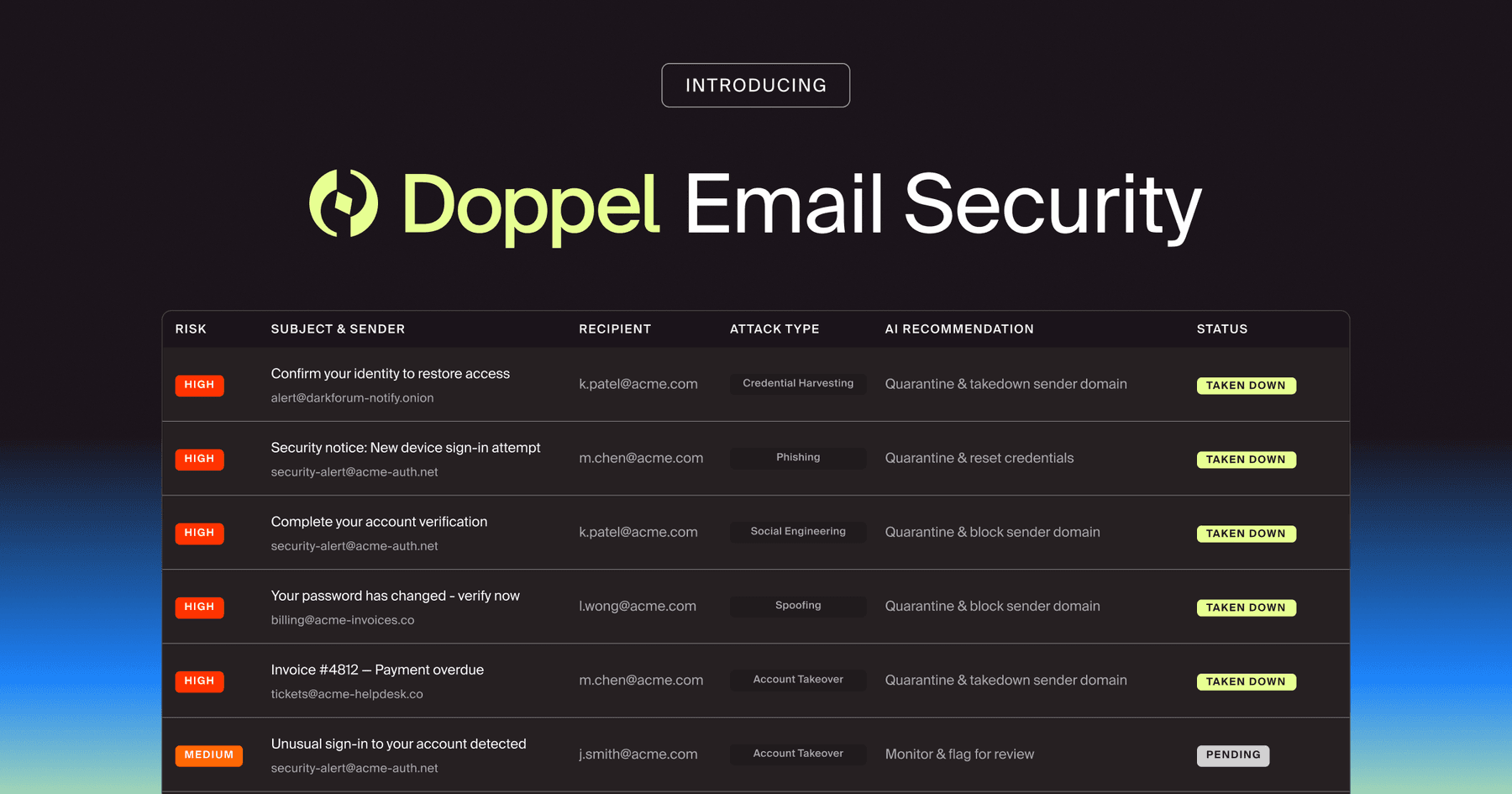
Doppel Email Security is now generally available
The agentic email security solution that empowers you to fight back against social engineering attacks. Detection isn't enough. Disruption is the difference.
Here’s how to protect your workforce from real-time, conversational social engineering in live Zoom meetings.
Zoom is where multi-million-dollar deals are negotiated and confidential business strategies are debated. The videoconferencing platform has over 300 million daily active users (opens in new tab) who rely on it for direct, trusted communication.
But it’s also one of the most unprotected attack surfaces in your entire company.
Video calls were the ultimate verification tool. If an email looked suspicious, employees could jump on a quick Zoom meeting to confirm it visually. Seeing a face and hearing a voice made the transaction secure.
That view is obsolete in 2026.
Threat actors weaponize Zoom, Microsoft Teams, and other collaboration platforms that security leaders build their cultures around. Yes, adversaries are walking directly into your organization’s Zoom meetings.
Dialogue, not a link, is the payload for these social engineering attacks.
‘Zoombombing’ (opens in new tab) was the initial security concern after the videoconferencing platform turned into an everyday part of life (opens in new tab) in 2020.
The tactic involved internet trolls guessing meeting IDs and disrupting unpassworded calls with inappropriate content. It was frustrating, but ‘Zoombombing’ was largely treated as an internet prank.
In 2026, unauthorized access to meetings has evolved into sophisticated corporate espionage.
Attackers aren’t guessing passwords just to yell obscenities. They’re infiltrating recurring staff meetings, vendor syncs, and daily stand-ups. They’re even hosting one-on-ones with employees under the guise that they’re colleagues.
In many cases, attackers obtain remote access during these live Zoom meetings (opens in new tab) to install malware and steal money.
This isn’t passive eavesdropping. The real danger is interactive, real-time deception powered by deepfakes for these AI voice and video scams.
Take the engineering firm that lost more than $25 million in 2024. A finance employee received an urgent message regarding a financial transaction. Following strict corporate protocol, the employee requested a video call to verify the massive request.
The employee joined a Zoom meeting and saw the chief financial officer and several familiar colleagues. Everyone looked correct. Everyone sounded correct.
The chilling reality? Every single person on that call — except the victim — was an AI-generated deepfake. The employee authorized the massive transfer without hesitation.
Here’s why this live, deepfake-driven approach used by attackers is devastating:
Attackers figured out that they don’t need to hack your network. They just need to trick your workforce into handing over the keys.
Threat actors use a systematic process that relies on open-source intelligence (OSINT) (opens in new tab) and widely available AI tools. They don’t need to hack a webcam or exploit complex zero-day vulnerabilities.
Here are the steps adversaries take to execute a live video takeover in Zoom:
Most security programs are still preparing employees for threats that arrive in an inbox.
We teach our workforce to hover over URLs. We teach them to check sender domains for typos. We instruct them to never open unexpected ZIP files from unknown senders.
But how do you train an employee to hover over a live conversation? Your security awareness training (SAT) and phishing simulations need to mirror today’s attacks, including those that occur over Zoom.
Area | Legacy Email Phishing | Live Meeting Intrusion |
Lure | A static message containing a malicious link | A dynamic, real-time conversation |
Payload | A credential-harvesting portal or malware download | Verbal compliance, unauthorized screen sharing, or data transfer |
Pressure | Artificial urgency | Social pressure from a ‘colleague’ staring at the target on video |
Defense | Automated email filtering and visual anomaly detection | Behavioral resilience and strict out-of-band verification |
Traditional SAT and simulations break down completely when applied to a live video meeting.
Decisions in Zoom are made live. They’re made under immense time pressure, often with incomplete information. There’s no red flag to analyze. There’s only a conversation that feels perfectly legitimate — until it isn’t.
When an employee is trained only to look for malicious code, they’re completely defenseless against psychological manipulation delivered via live video.
Your security stack likely has robust defenses for external threats trying to breach the perimeter. You have firewalls (opens in new tab), endpoint detection and response (EDR) (opens in new tab), and identity and access management (IAM) (opens in new tab) in place.
But what happens when the threat is already inside a trusted, internal collaboration platform?
This is the blind spot. Security leaders must bridge the gap between external risk and internal vulnerability by protecting the collaboration layer where employees actually work.
Social engineering is happening in real time through impersonation, deepfakes, and carefully orchestrated meeting scenarios.
To defend against this, you can’t rely on static multiple-choice quizzes. You can’t adapt email-based training to a video format and expect it to work. You have to meet employees where work actually happens.
You need social engineering defense (SED).
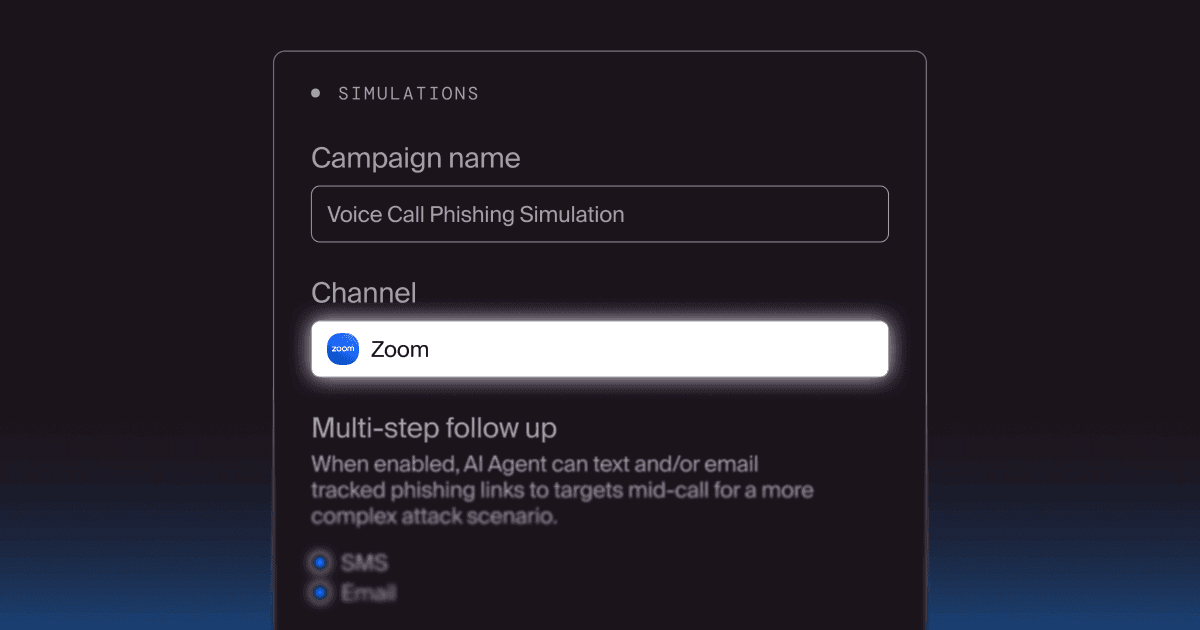
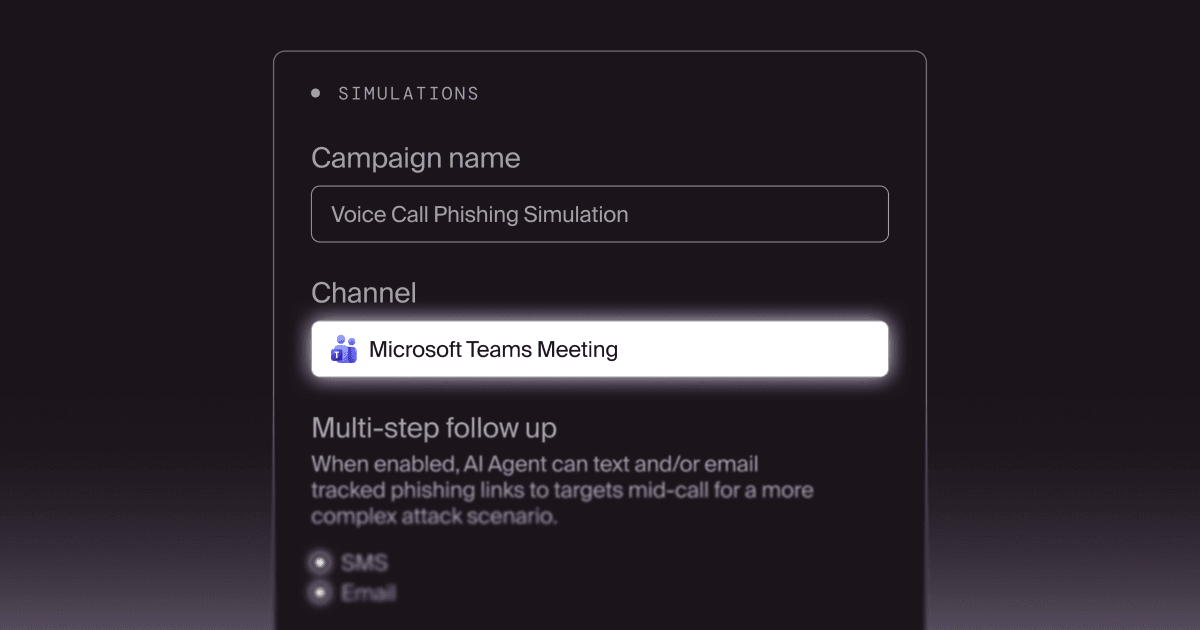
Doppel’s AI-native SED platform simulates real-world attacks within live video meetings, including in Zoom.
No, it’s not another training module. Doppel recreates the exact dynamics of an actual Zoom meeting environment, testing for live conversation, social pressure, ambiguity, and the subtle behavioral cues that attackers exploit.
Instead of asking employees to identify suspicious emails, Doppel places them in realistic meeting scenarios where they’re forced to make high-stakes decisions in real time.
Here’s how Doppel’s Zoom meeting simulations actively test your human perimeter:
In every scenario, the user naturally wants to be helpful and cooperative. The simulation tests whether their desire to be helpful overrides their security training.
Doppel’s live Zoom meeting simulations allow security teams to safely test how people respond to high-stakes scenarios.
The experience is fully immersive — but entirely controlled. And it surfaces critical behavioral data that would otherwise go completely unseen by your security team.
You can finally measure hesitation. You can track compliance under pressure. You can identify an employee's tendency to trust familiar faces without requiring secondary, out-of-band verification.
Treat meetings as a primary attack surface, not an edge case.
By leveraging these deep behavioral insights, security leaders can identify precise vulnerabilities across the organization. You learn exactly which types of requests are most effective against your workforce.
You discover how social dynamics and authority bias influence your team's decision-making. This enables a highly targeted, realistic approach to strengthening your human defenses.
The shift from the inbox to the meeting room is already underway. Attackers are ruthlessly exploiting the trust we place in video calls.
With Doppel, you can finally prepare your workforce to survive it.
Are your employees ready to face a deepfake in their next meeting? Get a demo to see how Doppel’s live Zoom meeting simulations secure your collaboration ecosystem.