3.4 billion phishing emails (opens in new tab) are sent daily. But it’s far from the only channel cybercriminals use anymore. In 2026, social engineering attacks feel far more conversational.
One afternoon, a senior developer at your company receives a direct message on LinkedIn. The sender’s profile is impeccable. They’re listed as a technical recruiter at a top-tier startup. They even have shared industry connections and a timeline full of relevant, professional posts.
The initial message doesn’t contain a suspicious link. It doesn’t ask for a password reset, either. It just asks: “Your recent work on container orchestration is impressive. Are you open to discussing a principal architect role?”
Flattered, your developer replies: “I’m not actively looking, but I’m always open to a conversation.”
Over the next few weeks, they chat. They discuss system architecture. They debate coding philosophies. They share complaints about cloud hosting costs. The rapport feels genuine.
“We have a unique technical assessment for this role. To skip the first round of interviews, could you run this standard npm package on your local environment to test your compilation speed?”
It’s a benign-sounding command. The developer, feeling comfortable and eager to impress, types the command into their terminal.
Your perimeter security scanned every single message and found nothing. There was no malicious URL to block. There was no macro-enabled Excel document to quarantine.
The payload wasn’t a link. The payload was the dialogue.
This is the reality of conversational social engineering.
From Links to Language: Conversational Social Engineering Explained
Decades ago, the cybersecurity industry started training employees to act as human malware scanners. Everyone was drilled with rigid, rules-based directives.
Hover over the URL. Check the sender’s domain for typos. Don’t open unexpected PDF attachments.
This training was necessary because, historically, the attacker needed the victim to interact with a malicious digital asset. They needed a gateway to deliver their code.
Secure email gateways (SEGs) (opens in new tab) and endpoint detection and response (EDR) (opens in new tab) tools became proficient. They caught bad links. They filtered blacklisted domains. They neutralize known malware signatures before an email ever hits an inbox.
When the digital perimeter hardened, cybercriminals realized that trying to sneak a malicious link past an enterprise-grade firewall was a losing battle. It was too expensive and too easily caught.
So, they adapted. They stopped sending code, and they started sending conversations.
In conversational social engineering, the objective is to build enough trust over time for the target to willingly perform the attacker's desired action. This bypasses technical controls entirely.
If an attacker can convince a finance manager that they’re an executive in a rush, the manager will authorize the wire transfer themselves. No malware is required when the human becomes the exploit.
Traditional Phishing vs Conversational Social Engineering
Traditional phishing relies on a smash-and-grab methodology, whereas conversational social engineering relies on the ‘long con.’
Feature | Traditional Phishing | Conversational Social Engineering |
Payload | A malicious link, a credential harvesting portal, or a malware-laden attachment | The dialogue itself, leading to a human-executed action (like wiring funds or changing routing numbers) |
Timeline | Immediate; the attacker relies on artificial urgency to force a click right now | Extended; the interaction can take days, weeks, or even months of back-and-forth communication |
Detection Rate | High; automated security tools easily flag suspicious URLs and known bad sender domains | Extremely low; pure text containing natural language effortlessly bypasses almost all technical filters |
Primary Channels | Corporate emails | Unmanaged channels, including LinkedIn, WhatsApp, SMS, and Microsoft Teams |
Because the attack relies on natural language, legacy security awareness training (SAT) and phishing simulations that focus on spotting grammatical errors or pixelated logos are rendered entirely useless.
Going Inside the ‘Long Con’: A Step-by-Step Process
Conversational social engineering is highly structured. Attackers follow a predictable, multi-step methodology designed to bypass cognitive defenses and establish artificial trust.
Here’s how the attack unfolds step-by-step:
- Benign Opener: The attacker initiates context without any urgent demands or malicious payloads. It’s often a simple message or a casual connection request. The sole purpose is to bypass spam filters and prompt a human response.
- Rapport Build: Once the target replies, the attacker goes to work. They mirror the target’s tone. They reference shared professional interests. They establish credibility. This phase relies heavily on open-source intelligence (OSINT) scraped from the internet to make the fabricated persona feel authentic and familiar.
- Contextual Pivot: The attacker introduces a scenario that naturally requires the victim to take action. It might be a fake IT vendor asking for a diagnostic screenshot that inadvertently reveals API keys, or a new ‘vendor’ requesting an update to their payment portal.
- Actionable Payload: The attacker makes the request. Because the victim has been psychologically primed over several conversations, they execute the task. They might transfer funds, execute a command line, or alter access controls. They do this willingly, without triggering their internal threat radar.
AI is Unscaling the Unscalable
Isn’t this highly inefficient for the attacker? Why spend three weeks chatting with a mid-level engineer?
Five years ago, this type of highly targeted spear phishing was reserved for high-value targets, known as whaling. It required fluent language skills, cultural context, and a significant time investment from a human attacker. It wasn’t economically viable at scale.
Generative AI completely shattered that barrier.
Threat actors don’t have a human sitting at a keyboard typing out LinkedIn messages. In 2026, they’re using LLMs configured as autonomous AI agents.
These AI agents manage tens of thousands of concurrent, context-aware conversations simultaneously. They operate flawlessly in any language. They never sleep. They never break character. They never make the grammatical errors of 20 years ago.
This conversational technology has expanded into voice, too. AI voice cloning, for vishing attacks, brings conversational social engineering to phone calls and video meetings.
An attacker can scrape 10 seconds of a CFO’s voice from a public earnings call, feed that audio into an AI-powered tool, and have a real-time, completely synthetic conversation with an unsuspecting employee.
The dialogue is synthetic, but the breach is very real.
How to Defend Against Conversational Social Engineering’s Invisible Payload
You can’t patch human empathy, and you can’t configure a firewall to block a polite, professional conversation.
Defending against conversational social engineering requires a shift in how your organization approaches human risk management (HRM). Transition from legacy compliance training to social engineering defense (SED), with a platform like Doppel.
Here are the tactical actions every security leader must take:
- Expand Phishing’s Definition: A threat is no longer just a bad link in an email. Update your security policies and training to explicitly cover social engineering across unmanaged channels.
- Verify the Action: Stop training employees to only look for typos. Train a single, overriding behavioral reflex known as out-of-band verification.
- Mandate the Verification Channel: If anyone asks for an action involving data, access, or funds, the employee must verify the request through a secondary, trusted channel.
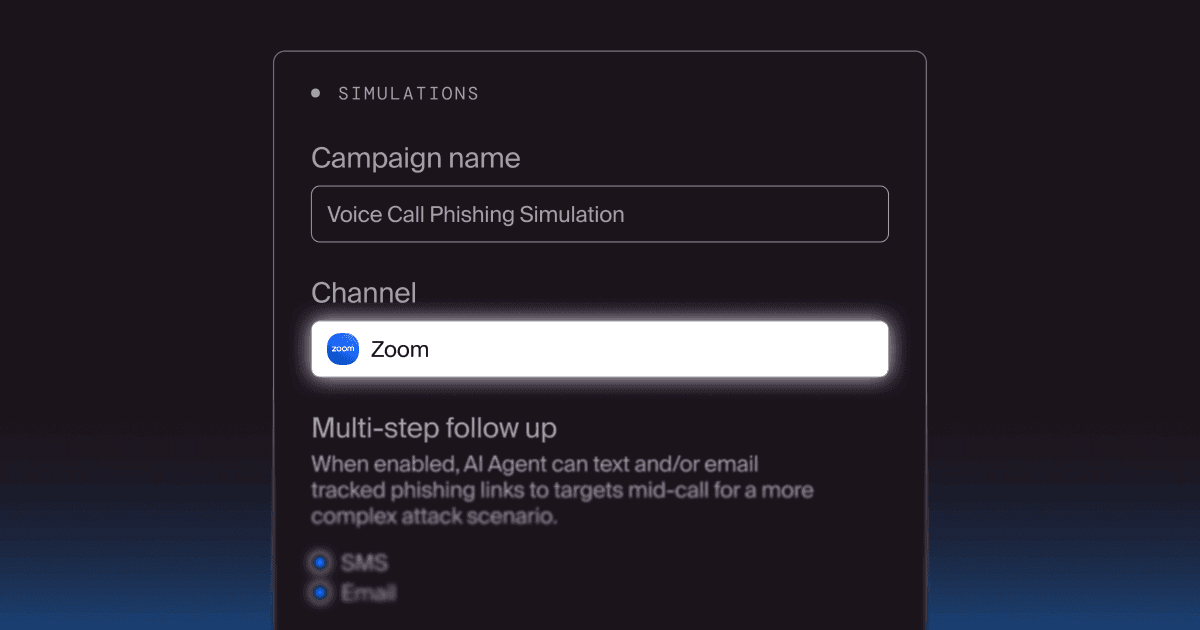
- Simulate the ‘Long Con’: Point-in-time phishing tests are obsolete. Run multi-step simulations that stretch over days and require dialogue.
- Build a Zero-Shame Culture: Deliver micro-coaching at the exact moment an employee fails a simulated attack. Explain how the manipulation worked, so they can spot the pattern next time.
Disrupt the Dialogue with Social Engineering Defense
As attackers pivot from exploiting software to exploiting human trust, organizations need to adapt their mindset. Recognize that your workforce is the primary attack surface.
Doppel’s AI-native social engineering defense platform empowers organizations to run a unified human risk management strategy that prepares every employee for the real-world conversational tactics used by today’s adversaries. It combines AI precision, human expertise, and real-time intel across domains, social media, ads, the dark web, and other channels to protect against evolving threats.
Ready to test your organization’s resilience against conversational social engineering attacks? Get a demo with Doppel today.