
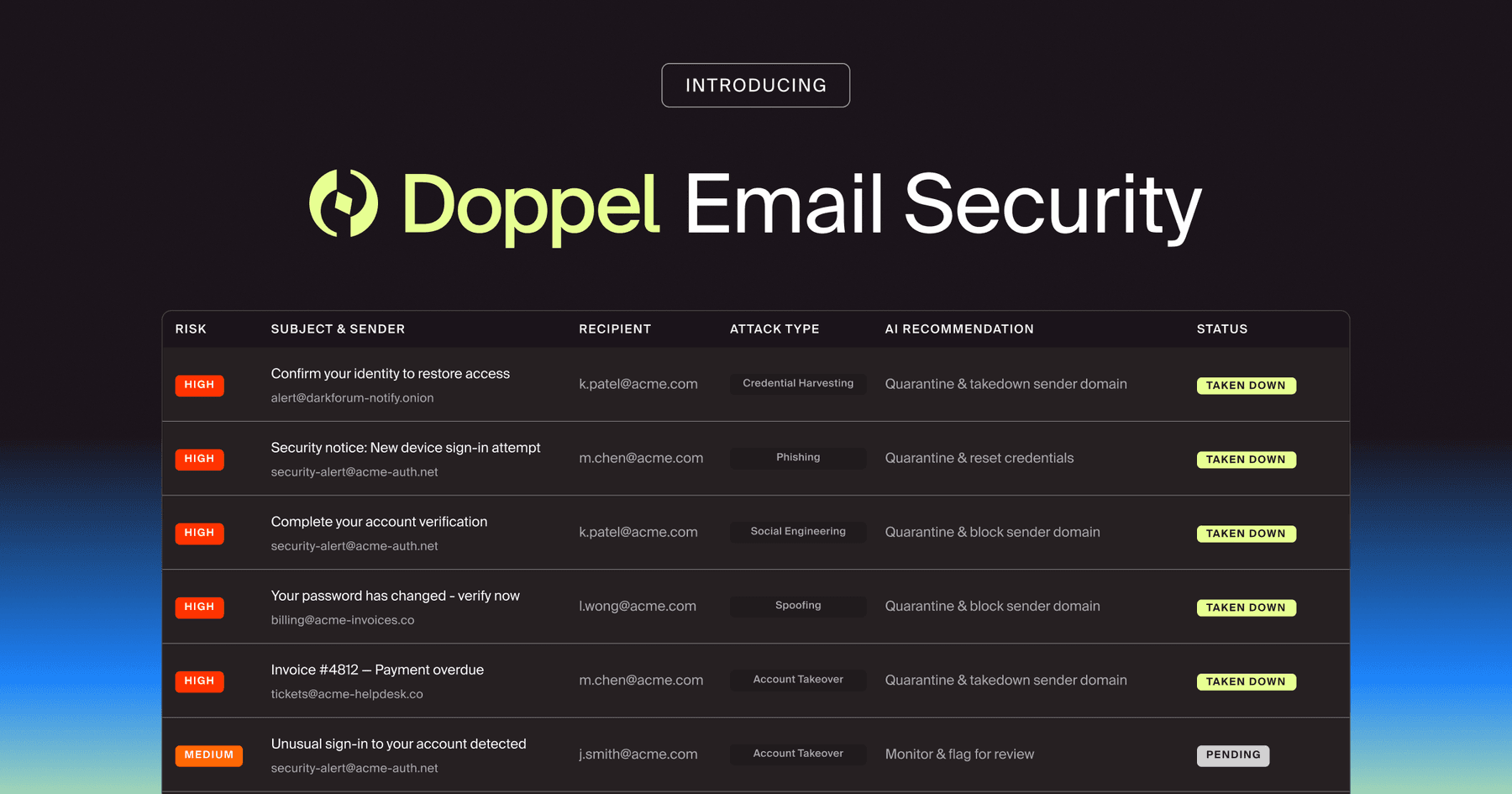
Doppel Email Security is now generally available
The agentic email security solution that empowers you to fight back against social engineering attacks. Detection isn't enough. Disruption is the difference.
A $5 voice-cloning tool can bypass a $1M security perimeter in seconds. Learn how the era of the deepfake executive is weaponizing trust and how to defend it.
What do a $5 voice-cloning tool and 30 seconds of audio from a CEO’s recent keynote speech have in common?
They can bring down your $1,000,000 security perimeter in just seconds.
It’s a scary reality. By mimicking the executive's voice in real time, an attacker only needs to convince one team member to bypass standards for an “urgent” request.
This is the era of the deepfake executive. We have moved past the age of low-effort phishing. Today, generative AI has weaponized the most fundamental element of business operations: trust.
This blog will cover why this type of attack is on the rise, how it happens, and most importantly, what you can do to defend yourself.
Traditional security focuses on the "what,” like malicious links, malware, and brute-force attempts. Modern Social Engineering Defense (SED) focuses on the "who."
For an attacker, compromising a single C-level executive is more valuable than compromising a thousand entry-level employees.
Here’s why:
An executive’s personal identifiable information (PII) is the bedrock of a successful social engineering campaign.
When PII, such as personal cell numbers, home addresses, and private email addresses, is leaked, it provides the context that makes a deepfake believable.
From there, attackers harvest a specific set of data points:
Most organizations rely on security awareness training (SAT). But this model is siloed and reactive, designed for a world that no longer exists.
Here are just a few of the reasons legacy training falls short:
Defending against the deepfake executive means shifting to unified Social Engineering Defense (SED). Rather than focusing solely on training, SED disrupts the economics of the attacker.
Let’s take a look at a breakdown of how SED works.
The first step in executive protection is removing the PII that fuels the fire.
Standard phishing tests (sending a fake "package delivered" email) are useless against deepfakes.
Threat actors launch campaigns nowadays, not just individual attacks.
Ultimately, the goal of unified SED is to shift the question from "Did everyone watch the training video?" to "Can our finance team detect and report a real-time voice clone in under 60 seconds?"
By integrating automated PII scrubbing with deepfake-aware simulations, you protect the entire brand's trust. You shift the burden from the employee to a system designed to see the whole campaign, not just the message.
Don't wait for a high-fidelity breach to test your defenses.
See how Doppel’s AI-native SED protects your leadership and your bottom line. Schedule a demo today.
BLOG
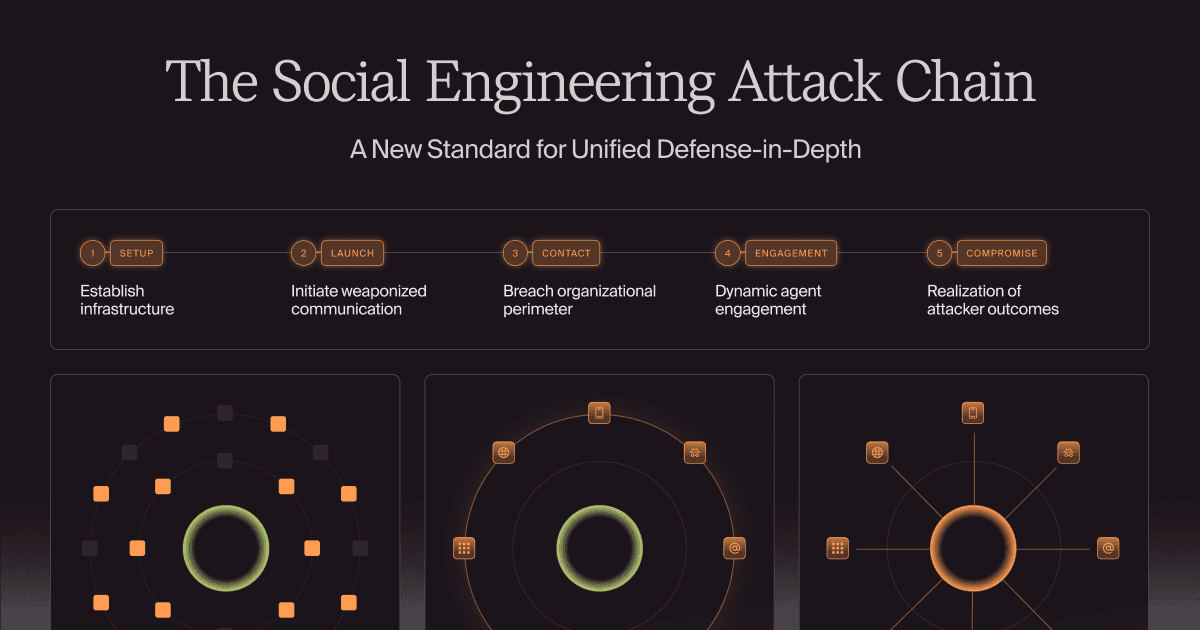
Modern social engineering is a relentless, AI-orchestrated lifecycle. Learn how to map the five-stage attack chain—from setup to contact—and why a unified defense platform is the only way to outpace AI-driven social engineering attacks.



by Bobby Ford, Rahul Madduluri, and Alvin Lin