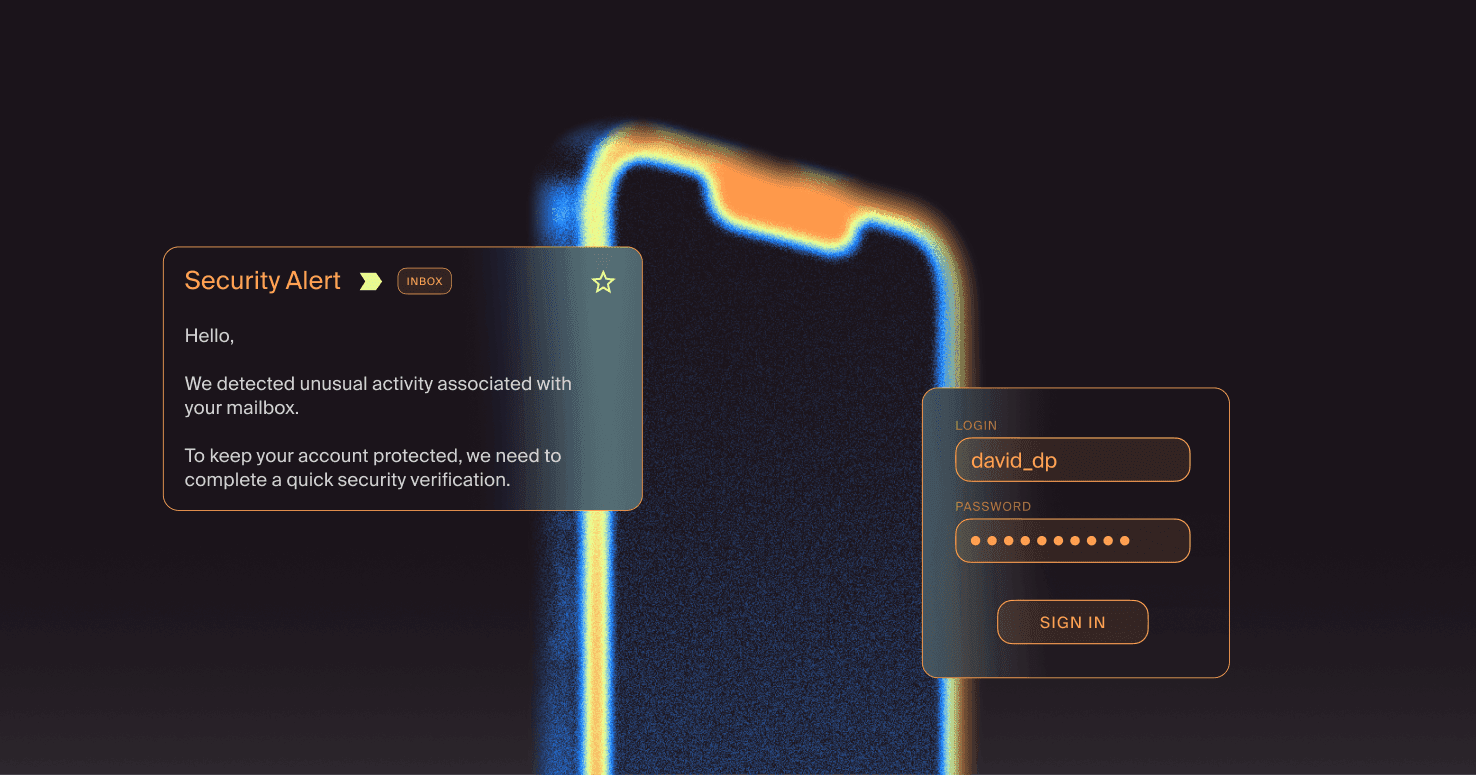
Attackers can launch a fake version of your brand on a social platform in the time it takes to upload your logo. A handle costs nothing, leaves no registration record, and carries no dispute process independent of the platform; impersonating a brand on social media is a private policy violation, judged in that platform's own review queue.
Meanwhile, the fake reaches your customers through the audience you spent years building. Social media brand protection shortens the window between a fake going live and coming down.
This article covers which assets get copied, how an attack unfolds, why platform review cannot carry the defense, and the seven-step playbook that closes the gap.
Key takeaways
- Social media impersonation copies the signals your audience uses to recognize you: your handle, your service desk, your org chart, your ad creative, and your real account.
- Platform reporting runs through private review queues, leaving a live window in which a fake converts customers.
- One suspension removes one handle while the campaign keeps running on sibling accounts, a lookalike domain, and paid ads.
- Social media brand protection runs as seven moves, from claiming your handles to escalating through brand-rights routes.
Social media impersonation is any account, post, or paid placement presenting itself as your brand, your executives, or your employees to deceive the people who trust you.
It is the social leg of a broader brand impersonation problem that also runs across domains, ads, and app stores, and it takes five forms.
- Cloned brand profiles borrow your recognition signals so the account reads as established before it asks for anything.
- Fake support accounts work because the customer starts the conversation. One answers a complaint before your team does, or runs a fake "official" Telegram, Discord, or WhatsApp group with no public record. After a $7 million wallet drain (opens in new tab), attackers impersonated the company's support accounts and ran scams through Telegram ads.
- Fake executive and employee profiles carry your authority into fraud you never see: supplier and procurement scams, recruitment fraud, and business email compromise outreach that runs better under a real name.
- Scam promotions buy the distribution the fake never earned. Giveaways, token launches, and discount offers reach your customers on day one, because fraudulent ads (opens in new tab) clear Meta's ad review at scale.
- Hijacked real accounts are the one form no external takedown can resolve for you. With the real credentials, the attacker inherits the handle, the follower list, and the posting history. In July 2026, verified X accounts tied to a major technology and aerospace brand pushed a memecoin (opens in new tab) to millions of followers in under an hour.
Every one of these forms has to reach your audience first.
The attack moves through the five stages of the social engineering attack chain:
- Setup. Attackers scrape the real account's imagery, bio, and posting cadence, register the handle they need, and often stand up a matching lookalike domain for the bio link.
- Launch. The fake builds a history, reposting real brand content and farming followers so it does not read as new. A paid placement can give it distribution on day one.
- Contact. The fake reaches your audience through your own distribution: it replies inside your comment threads, follows your followers, and answers the complaints customers tag to your handle, often on evenings and weekends when your team runs thin. Your own channel delivers that audience to the attacker.
- Engagement. Familiar branding and a manufactured deadline push a fast decision, and the conversation moves to a direct message or an off-platform channel with no public record.
- Compromise. Harvested logins, fraudulent transfers, diverted supplier invoices, malware from the bio link, and applicant data from a fake recruiter, and the brand the customer trusted absorbs the reputational cost.
Contact is the stage that runs on infrastructure you built.
Platforms remove fake accounts at enormous scale, and automation catches most before anyone reports them. Those classifiers are tuned to the bot-and-spam population a platform can identify without knowing your brand. A careful clone with a real photo and posting history is obvious only to someone who knows your genuine presence, and a review measured in days runs against an account that converts in one conversation.
An impersonation report claims identity, a trademark claim asserts registered rights, and a copyright notice reaches specific assets. Each runs through a separate queue inside the platform, and brand impersonation takes a 58-day industry average to come down.
A dozen platforms means a dozen unrelated processes with no shared record of what you have filed. Facebook's impostor report can require a government-issued ID (opens in new tab) of the person being impersonated, while YouTube's trademark complaint (opens in new tab) wants a registration number, a full legal name, and a statement of your authority.
One suspension removes one handle while the campaign keeps running
The campaign behind the account holds more than one asset. Suspend the handle and the domain still resolves, the same creative keeps running, and what survives is enough to start again.
Most brands already run social listening software, built to track mentions and sentiment for marketing. A fake account posting under your name registers there as one more mention, and the private messaging channels where the compromise happens do not register at all.
A verified badge no longer proves the account is yours
A blue check on X signals an active X Premium (opens in new tab) subscription, which X's own help center calls separate from ID verification (opens in new tab). Meta Verified (opens in new tab) does check a government ID, so badges carry different weight platform to platform, and a hijacked real account arrives already verified either way.
A social media brand protection program runs on seven moves: claim the handles you should own, harden the accounts you control, enroll in each platform's brand program, monitor continuously, correlate each fake into its campaign, escalate through brand-rights routes, and give customers one place to verify.
Marketing and communications hold the handle inventory; security owns detection and escalation. Name the decision-maker for a contested takedown before you need one, because split ownership is where these programs stall. Steps one to three need no new tooling.
Four through seven need continuous, campaign-aware defense and a named owner:
1. Inventory and claim every handle your brand should own
An unclaimed handle is the cheapest fake an attacker can build. Register your name and its obvious variants across the platforms you use and the ones you do not, plus handles for executives, product lines, support, and careers.
2. Lock down the accounts you already control
A hijacked real account is the one impersonation no external takedown can undo for you. Require multi-factor authentication (MFA) on every admin, keep a current access list, remove dormant admins, and document a recovery path.
Purge stale third-party app connections, since OAuth tokens can stay valid (opens in new tab) for years unless you revoke them.
Enrollment raises the floor on report quality and review speed, and it stays a floor. Meta's Brand Rights Protection (opens in new tab) tool needs a registered trademark and an approved application, and centralizes reporting across ads, accounts, Shops, and Marketplace.
TikTok runs an Intellectual Property Protection Center through TikTok Shop, and X sells business tiers (opens in new tab) that monitor affiliated accounts for impersonation.
Continuous brand monitoring has to set an honest bar: the platforms your customers use, the surfaces where attackers target your executives, the messaging apps where conversations move off-platform, and the paid ad networks.
A monthly sweep of your three biggest accounts misses the complaint threads and messaging channels the highest-converting fakes work.
5. Correlate each fake account into the campaign behind it
Before you file, map what the account is attached to: the sibling handles, the lookalike domain in the bio, and whether the same creative is running as a paid ad. Shared images and reused hosting tie those assets to one campaign, so enforcement lands on all of it.
Start at the platform's brand-rights portal, where your filing reaches a reviewer trained on rights claims, with document upload and case tracking. If your report is rejected, the realistic next move is a refile with new evidence, then outside counsel.
Cut the internal handoffs too: every hour a screenshot sits in an inbox, the account keeps converting.
7. Give your followers one reliable way to check what is real
Publish your official handles on a page customers can reach from your own site, state plainly what your support team will never ask for in a direct message, and pin both to your top accounts.
Then measure the program on two numbers: time from a fake going live to detection, and detection to removal. Decide who notifies affected customers, and send those warnings without hyperlinks (opens in new tab) so they do not read as phishing.
Doppel's AI-native Social Engineering Defense (SED) platform closes the 58 days down to hours. Brand Protection and Executive Protection run continuous detection across social, messaging, and paid ad surfaces, pairing visual and semantic AI with infrastructure signals, so a careful clone reads differently to a defense platform than to a passing customer.
The Doppel Threat Graph correlates each fake account to the campaign behind it, so enforcement lands on the whole footprint. Takedown agents dismantle it across registrars, social platforms, ad networks, and telcos, and Doppel reports a 90%+ takedown success rate across social, ads, and domains.
Shrink the window a fake account gets to work
The live window, from first post to removal, is the number worth managing. Shrinking it is what makes a campaign against you a poor use of an attacker's time. Request a Demo and measure that window against your own brand.