Cyberattacks don’t end the moment your technical controls quarantine a phishing email. They don’t end when an employee correctly reports a suspicious text message or phone call, either.
The attack only ends when the malicious infrastructure hosting the payload is completely destroyed.
Until that spoofed domain is seized, or that fake social media profile is banned, the threat remains active. Your brand equity bleeds, and your customers and employees remain dangerously exposed.
The industry average for dismantling a malicious domain or a fake social media profile is a staggering 58 days. During that nearly two-month window, attackers operate with impunity.
Relying on manual triage and legal cease-and-desist letters guarantees a loss.
To survive brand impersonation in 2026, you need agentic AI to dismantle attacker infrastructure at machine speed.
Here’s Why There’s a 58-Day Bottleneck
The takedown delay you’re familiar with is caused by unbearable friction. Legacy takedown processes force security teams to fight an automated enemy using manual paperwork.
When an analyst identifies a spoofed domain, the clock starts. But the finish line is hidden behind layers of bureaucracy.
The security team manually looks up the domain registrar. They locate the specific abuse inbox for that hosting provider. They draft a legal takedown request, often requiring them to prove trademark infringement or malicious intent.
Then, they wait.
They wait for a response from a hosting provider that might be located in a jurisdiction completely hostile to international copyright law. If the request is rejected, the process starts over.
In the meantime, the attacker is unbothered by this friction. The social engineering continues.
Cybercriminals use automated scripts to spin up hundreds of spoofed domains, fake mobile apps, and fraudulent advertisements in a matter of minutes. They use fast-flux hosting networks (opens in new tab) to constantly shift their IP addresses, keeping their sites online even when under pressure.
So it’s clear: You can’t fight an automated, programmatic adversary with a manual ticketing system.
What Brand Impersonation Looks Like Across Channels
Compounding the problem is the fact that today’s attacks are rarely isolated to a single website.
When a security team spends two weeks trying to take down one spoofed domain, they’re often just playing an unwinnable game of whack-a-mole. Attackers build resilient, multi-channel social engineering campaigns designed to outlast manual takedowns.
A modern, coordinated social engineering campaign typically flows across several distinct channels:
- Initial Hook (Social Media): The attacker deploys a hyper-targeted, AI-generated advertisement on LinkedIn or Facebook, impersonating your brand's official account.
- Lure (Messaging Apps): The ad directs the victim to a Telegram or WhatsApp channel, where a chatbot masquerading as an ‘account executive’ builds trust.
- Payload (Spoofed Domain): The chatbot eventually provides a link to a flawlessly cloned, malicious version of your corporate login page to harvest credentials.
- Persistence (Alternative Hosting): If the primary spoofed domain is flagged, the attacker automatically redirects traffic to a dozen backup domains on standby.
Traditional security tools monitor these channels in silos.
Your security team might eventually take down a spoofed domain, but they lack visibility into the social media ad that drove traffic to it. The ad keeps running, and the attacker simply points it to a new, active domain.
Agentic AI: From Alerting to Eradicating
Close this massive window of exposure by changing how you handle threat intelligence.
Move past systems that simply generate alerts. Security operations centers (SOCs) are already drowning in notifications, so telling an analyst that a fake domain exists doesn’t solve the problem; it just adds to their backlog.
The solution is agentic AI.
But understand the difference between traditional artificial intelligence and agentic AI. Traditional AI analyzes data, spots anomalies, and summarizes findings. It’s a powerful analytical tool, but it requires human intervention to actually do anything with the data.
Agentic AI makes decisions and executes complex workflows autonomously.
When an agentic AI platform, like Doppel, confirms a threat, it does not just send an email to the SOC. It autonomously executes the exact steps required to neutralize the threat.
Agentic AI generates the legal takedown request. It interacts directly with the specific APIs of domain registrars, social media platforms, and telecommunications providers. It manages the follow-up communications until the infrastructure is offline.
To visualize the operational advantage of this approach, look at the difference in execution:
Takedown Phase | Legacy Manual Triage | Agentic AI Defense |
Threat Discovery | Relies on delayed threat feeds or employee reporting | Continuously scans billions of data points across the open, deep, and dark web |
Evidence Gathering | Analysts manually take screenshots and document trademark violations | Automatically captures, logs, and formats forensic evidence in real time |
Workflow Execution | Drafting emails and navigating confusing abuse portals | Direct API integration with registrars and platforms for instant submission |
Time to Resolution | Averages 58 days due to legal friction and human delay | Often completed in minutes or hours, entirely without human intervention |
You Need a Threat Graph, Not Just Threat Intelligence
Taking down a single domain in five minutes is a massive victory. But to really secure your brand, you have to tear out the attacker's entire infrastructure, dismantling the entire multi-channel campaign simultaneously.
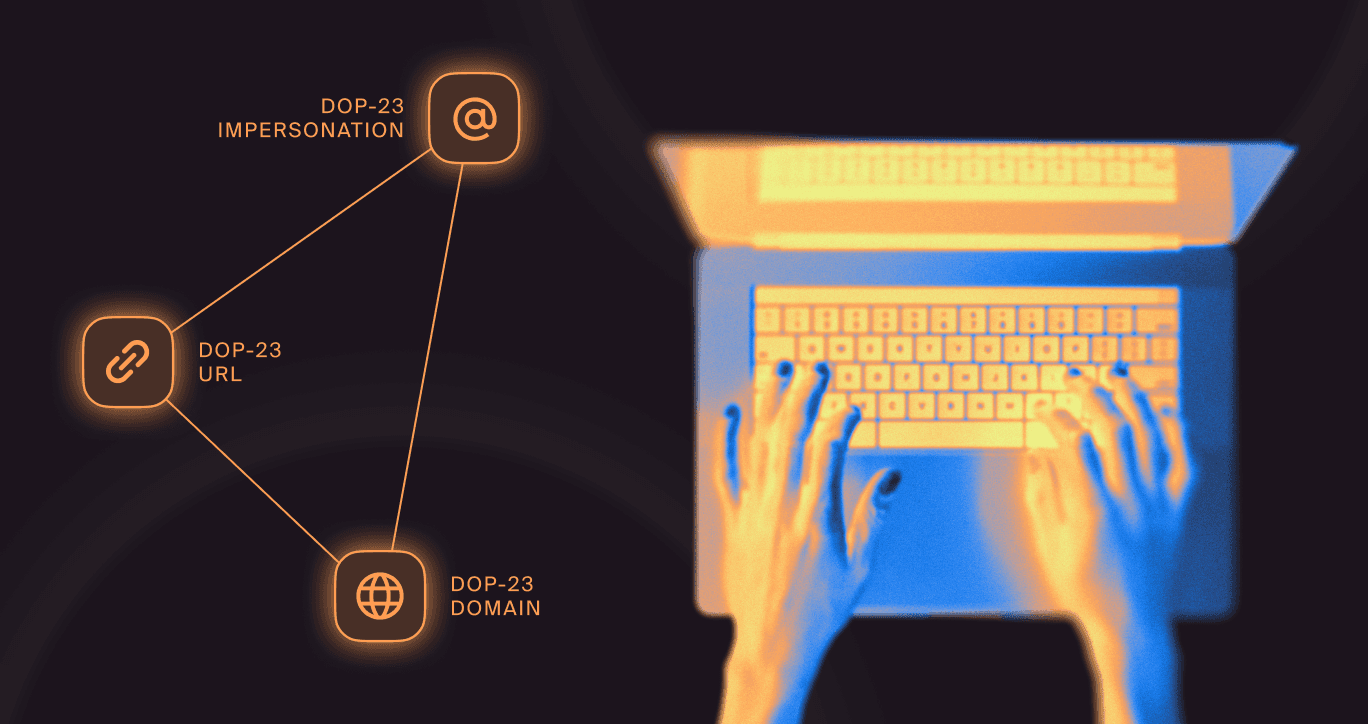
This is where agentic AI leverages the power of a unified threat graph. A threat graph is a visual, data-driven map that connects seemingly isolated indicators of compromise (IOCs) (opens in new tab).
When an AI-native social engineering defense (SED) platform ingests live threat data, it looks for shared attributes. It detects that a fake Instagram profile links to a specific spoofed domain. It then identifies that the spoofed domain shares a unique IP address with five other dormant domains that haven't been activated yet.
By connecting these dots, the threat graph reveals the attacker's hidden infrastructure.
Instead of treating these threats as separate incidents, AI clusters them into a single, cohesive campaign. The agentic workflow then targets the entire cluster.
It issues simultaneous takedowns for the social profile, the active domain, and the five dormant backup domains. It eradicates the entire campaign in a single swift motion, leaving the attacker with no fallback options.
How You Win the Takedown Race in 2026
Speed and scale are the only metrics that matter in digital risk protection. The longer the attacker’s infrastructure stays live, the higher the financial and reputational cost to your organization.
This is exactly why Doppel built an AI-native platform centered entirely around automated takedowns.
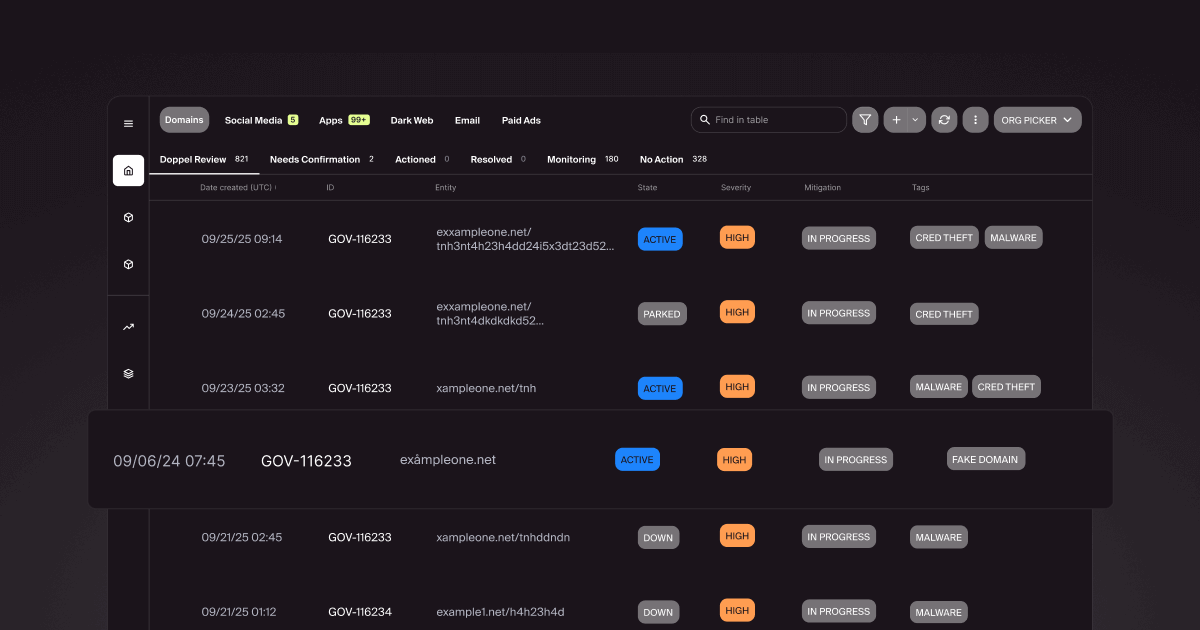
Doppel continuously ingests and analyzes over 1 billion indicators across traditional and emerging channels. The platform monitors the open web, the dark web, social media platforms, and collaboration tools like Microsoft Teams and Telegram.
When our system identifies an impersonation attempt, our proprietary threat graph immediately maps the full extent of the campaign.
Then, the automated takedown engine goes to work.
The results completely rewrite the industry standard. While legacy solutions leave brands exposed for an average of 58 days, Doppel achieves a median takedown time of under 10 hours for domains, social media profiles, and paid advertisements.
In many cases, the infrastructure is dismantled before it can ever reach your customers or employees.
Close the Attacker’s Window with Social Engineering Defense
You can’t wait two months to solve a problem that attackers launch in two minutes.
The manual takedown process is a relic of a slower era. As cybercriminals leverage generative AI and programmatic scripts to scale their attacks, defenders must adopt tools that operate at the same velocity.
By implementing agentic AI and unified threat graphs, security teams finally break free from the ticketing backlog. You can stop playing whack-a-mole with isolated domains and start neutralizing entire cybercrime campaigns before they cause material damage.
The race is already happening. It’s time to ensure your organization has the engine required to win.
Tired of waiting weeks to remove spoofed domains? Get a demo to see how Doppel’s agentic AI automates infrastructure takedowns at machine speed.