Doppel Email Security is now generally available
The agentic email security solution that empowers you to fight back against social engineering attacks. Detection isn't enough. Disruption is the difference.
Lookalike domains activate fast and borrow brand trust to harvest credentials. Learn how continuous monitoring and campaign-level detection stop them first.

by Jordan Evers

An attacker can register a domain that reads as a near-perfect copy of your brand's real address, swapping a single letter or switching to a different extension. Behind that domain, a convincing clone can go live quickly, hosting credential harvesting and fraud operations while borrowing the brand trust customers and employees expect.
Reported cybercrime losses reached $16.6 billion (opens in new tab) in 2024, and phishing and spoofing generated 193,407 complaints, more than any other reported cybercrime type. Lookalike domain defense depends on detecting registrations, activation signals, campaign infrastructure, and takedown paths before the domain reaches victims.
Key takeaways
Attackers register lookalike domains so people mistake them for a brand's real address, exploiting the split-second way people read a URL. They build these domains with four primary techniques: typosquatting, combosquatting, homograph and internationalized domains, and alternate TLDs.
Each targets a different gap in human perception.
A typosquatted domain introduces a single character-level error into a brand's real address. That error can be a swapped letter (amzon[.]com), an omitted character (gogle.com), a doubled letter (googgle.com), or an adjacent-key substitution (opens in new tab) (googke[.]com (opens in new tab)).
These permutations are systematically enumerable, so attackers register many variants at once for almost nothing, and even mistyped traffic (opens in new tab) converts into credential capture.
Combosquatting appends words to a correctly spelled brand name. The brand string remains intact, and added terms such as "security" and "verification" resemble the service URLs enterprises legitimately use.
Attackers often register patterns like [targetname]-okta[.]com and oktalogin-[targetcompany][.]com, pairing the brand name with a helpdesk reference or a single sign-on (SSO) provider name to make the domain look credible.
IDN homograph attacks exploit Unicode characters from non-Latin scripts that look identical to Latin characters in most typefaces. A domain displaying аpple.com with a Cyrillic "а" encodes as xn--pple-43d.com in DNS.
Browsers apply browser defenses to reduce this class of attack, using IDN display policies that show detected homograph domains in Punycode rather than Unicode.
Registering the exact brand name under a different top-level domain exploits TLD blindness. Abusive registrations (opens in new tab) occur heavily in new gTLDs, and many of the extensions with the highest proportions of abuse cost very little. With a rapidly expanding set of delegated gTLDs, users cannot maintain a reliable mental model of which extensions are legitimate for any given brand.
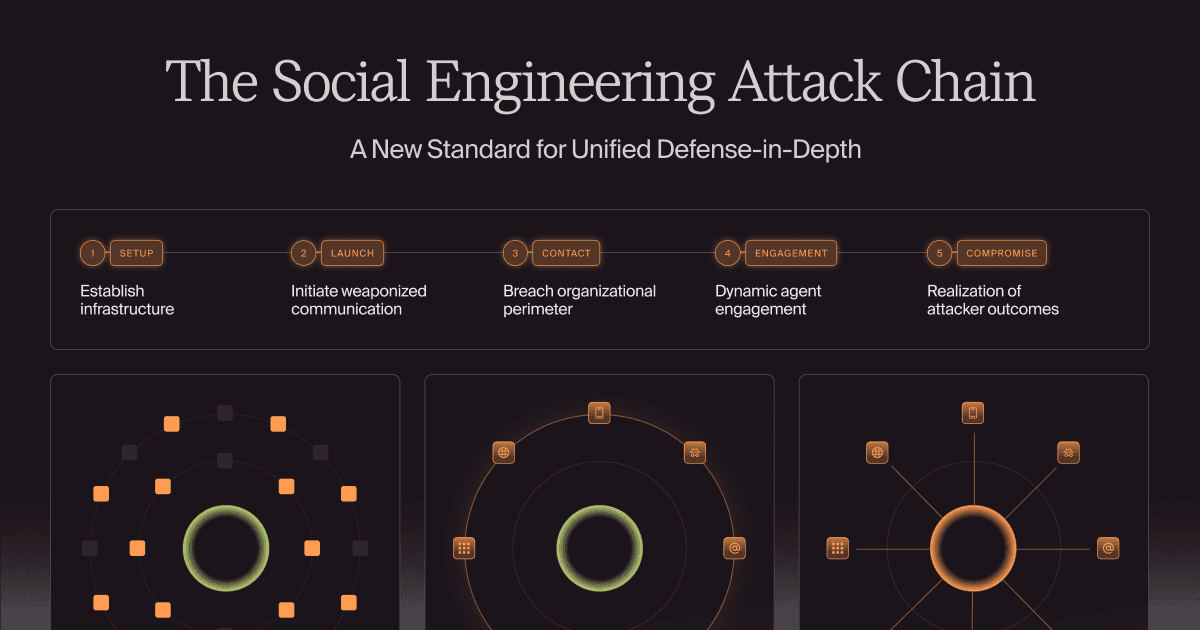
A lookalike domain attack moves through five stages: reconnaissance, weaponization, delivery, persuasion, and execution. Each stage produces a signal a defender watching the right surfaces can catch before customers reach the page.
Before registering anything, adversaries map the target's digital footprint. DNS reconnaissance, including MX and TXT records such as SPF, reveals indicators of third-party services such as Microsoft 365 or Google Workspace and other SaaS platforms through mail-routing, verification, and authentication records.
Attackers use those records to choose which login pages to clone. Threat actors have also registered domains that mimic popular free software tools, then allowed them to build positive reputation (opens in new tab) as innocuous sites before converting them for credential harvesting, a technique that defeats reputation-based domain filtering.
That reconnaissance feeds the infrastructure attackers build, from page cloning and SSL certificate acquisition to MX record configuration and redirect chain construction. Weaponization can follow registration quickly. Because attackers acquire domains (opens in new tab) outside the reach of enterprise defenses, defenders need detection upstream at domain registration and certificate transparency monitoring.
The weaponized domain reaches targets through email, paid search ads, social media posts, and messaging platforms. Rising DMARC adoption (opens in new tab) has pushed attackers toward lookalike domains, because a lookalike domain sends an email that passes DMARC authentication. Brand-similarity detection requires controls beyond DMARC.
Legitimate enterprise workflows routinely send employees to external SSO and helpdesk domains, and attackers exploit that familiarity. Threat actors now use generative AI to craft personalized lures (opens in new tab) from public information, with some campaigns going further by using cloned executive voices in callback scams.
Credential capture on a lookalike domain is now real-time adversary-in-the-middle interception, with threat actors combining credential phishing and social engineering to capture one-time-password codes as users enter them. The longer the domain stays live, the more victims it reaches.
Most domain monitoring confirms a registration and raises an alert, then leaves activation detection and removal to a slower manual process. The brand stays exposed during the exact hours the domain is live and active.
A program that scans daily or weekly misses the domains that go live and vanish between runs, because newly identified threat domains are often short-lived (opens in new tab). Resurgence behaviors (opens in new tab) also appear after temporary deactivation, so a monitoring program that drops dormant domains from its watchlist stays blind to reactivating threats.
Organizations struggle to scale cybercrime detection and takedowns across domains, applications, and social media. Without workflow automation, security teams resolve these cases far more slowly than the threats evolve, and each open case competes for the same analyst bandwidth.
Enforcement speed determines whether exposure shrinks or stays live.
Watching one domain at a time misses its place in a connected campaign. Attackers reuse server configurations and fingerprint patterns across campaigns, so alert-by-alert monitoring forecloses the proactive identification that known attacker-infrastructure patterns make possible.
The agile, shifting infrastructure behind campaigns like Tycoon 2FA shows why organizations need controls beyond email filters (opens in new tab) and defense across the full ecosystem of tools these campaigns run on.
Lookalike domain defense requires four capabilities working together. It must watch the full permutation space continuously, catch the state change that turns a parked domain into a weapon, connect each domain to the wider campaign it belongs to, and trigger fast enough enforcement to shrink the live window.
Lookalike domain exploitation is a classified DNS threat category under NIST SP 800-81r3 (opens in new tab): "A common best practice is to monitor new DNS registrations to detect this." With large volumes of new threat domains appearing daily and very short persistence windows, scanning must run in hours, not days.
Certificate transparency log monitoring detects newly issued SSL/TLS certificates in near real time, providing an early signal that periodic scam website monitoring misses.
Most permutations of a brand's address are not malicious at the moment of registration. They sit parked, dormant, or unconfigured, and treating each one as an alert at discovery drowns analysts in noise, while treating none of them as alerts misses the moment they go live.
In documented adversary-in-the-middle operations, attackers let a domain sit parked for an extended period, then provision a new SSL certificate and stand up a live phishing page on it.
That certificate lands in certificate transparency logs (opens in new tab) hours before the first phishing email goes out, so the activation of a previously dormant domain opens a detection window that DNS-only monitoring would miss. Catching that state change is the difference between continuous coverage and periodic inventory.
Shared or clustered infrastructure often spans related domains (opens in new tab), and removing a single domain from that cluster does little to disrupt the campaign. Replacement domains (opens in new tab) appear quickly after disruption. Campaign-level mapping turns one alert into visibility across the entire connected infrastructure.
Domains spin up quickly, which creates a narrow enforcement window, and manual takedown workflows often move too slowly for short-lived malicious domains. Enforcement requires pre-built relationships with domain registrars, hosting providers, DNS providers, and browser safe-browsing platforms, with submission workflows that move at machine speed.
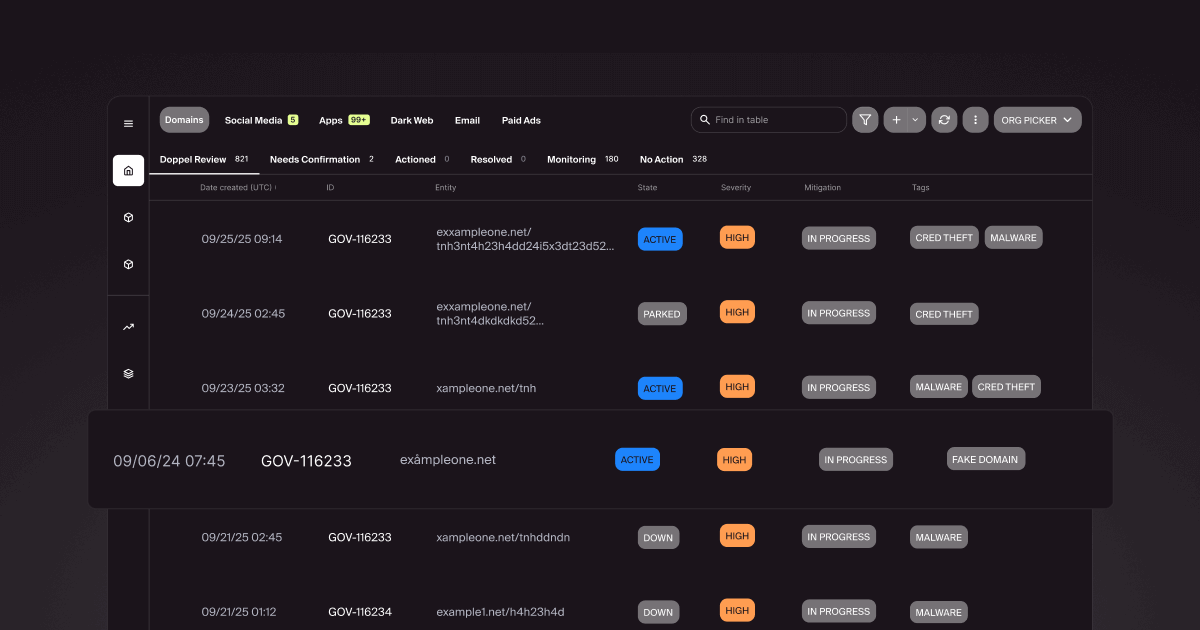
Doppel, the AI-native Social Engineering Defense platform that unifies Digital Risk Protection and Human Risk Management, detects impersonation campaigns across domains, social channels, messaging apps, paid ads, and the dark web, maps the attacker infrastructure behind them, and dismantles malicious infrastructure through automated enforcement.
The Doppel Threat Graph connects each flagged domain to the wider campaign it belongs to, including linked fake profiles or accounts, scam ads, associated phone numbers, and other related attacker assets. The platform's agentic AI detects, correlates, prioritizes, and executes enforcement at scale, dismantling the connected campaign in a single coordinated action while analysts focus on the complex escalations that require human judgment.
Instead of submitting takedowns one by one while the threat actor stands up six more, Doppel pushes the entire connected campaign for removal in one action across registrars, hosting providers, DNS, social platforms, ad networks, and telco infrastructure at the same time. Legacy domain takedowns most often miss the telco leg, and leaving the WhatsApp and SMS infrastructure live lets the same campaign respin from the messaging side even after the domain comes down.
Coordinated enforcement closes those side doors at once and leaves the attacker's standing infrastructure worthless.
Coverage that spans channels matters because Financial Services and Fintech campaigns increasingly combine ads, messaging apps, phishing sites, and private channels in coordinated funnels that move victims from initial exposure to compromise.
Domains are often the hosted pages or spoofed destinations later in those multi-channel campaigns, which is why defense has to follow attackers across every surface they use.
Lookalike domain monitoring is the front end of an enforcement loop. Alert-only detection leaves the campaign live during the highest-risk window. Continuous monitoring that feeds directly into campaign-level takedown changes the economics. Every dismantled campaign raises the cost and lowers the payoff of the next attack until the brand becomes too costly to attack.
Brands that run that loop continuously shrink an attacker’s opportunity. Brands that do not leave more time between detection and disruption.
Request a Demo to see how Doppel detects and dismantles lookalike domain campaigns before they reach your customers.

BLOG
Modern social engineering is a relentless, AI-orchestrated lifecycle. Learn how to map the five-stage attack chain—from setup to contact—and why a unified defense platform is the only way to outpace AI-driven social engineering attacks.



by Bobby Ford, Rahul Madduluri, and Alvin Lin