Finding a job is hard enough. Between navigating automated resume screeners and surviving multi-round interview panels, candidates already feel exhausted.
But a darker threat has industrialized: the fake recruiter.
Meta, for example, recently issued an urgent warning (opens in new tab) after discovering scammers impersonating hiring teams to defraud candidates.
There’s been a massive surge (opens in new tab) in sophisticated recruitment fraud. Between May and July 2025, job scams grew more than 1,000% (opens in new tab), according to a McAfee report.
This is social engineering weaponized against hope. Scammers are stealing millions in data and cash by exploiting the anxiety of job seekers and the chaos of the layoff-filled job market.
For candidates, the cost is financial ruin. For companies, the cost is a shattered reputation.
Here’s what you need to know about recruitment scams — including the rise of deepfake interviews — and how to spot a fraud before it’s too late.
Why Recruitment Fraud is Increasing Rapidly
Recruitment fraud is spiking right now. Attackers realize that the hiring process is a high-stress, high-trust environment. And when candidates are desperate for a role, their guard is down.
Several factors have collided to create a ‘golden age’ for recruitment fraud:
- Financial Scale: According to the Federal Trade Commission (FTC), losses from job scams rose from $90 million in 2020 to over $501 million in 2024 (opens in new tab). Scammers are making half a billion dollars a year targeting job seekers, and they’re reinvesting those profits into better technology (opens in new tab).
- Rise of AI: Creating a fake profile, career portal, or offer letter used to take days. Now it takes moments, with attackers easily cloning identities, websites, and documents.
- LinkedIn Battlefield: Professional networks have become a primary attack surface. Given that LinkedIn is the top professional social network and the platform’s trust signal is high, it’s no surprise that attackers have flocked there. LinkedIn now accounts for over 74% of all job scams (opens in new tab) on social media.
The combination of high ROI and low barrier to entry has turned recruitment fraud into a booming dark industry. It’s an automated, scalable threat to your company’s public face.
What a Job Scam Looks Like
Job scams look terrifyingly realistic in 2025. Attackers might ask for money, but they’re really after a job seeker’s identity.
Here are a few of the top methods used by scammers:
- Deepfake Recruiter Interview: Scammers use real-time AI face-swapping software to impersonate a recruiter or hiring manager on a video call. The individual looks professional, but subtle discrepancies — like unsynchronized lip movements or strange lighting artifacts — give them away.
- Casual Communication: AI is used to mimic the casual, friendly tone of a startup. The interview might start on Signal or Telegram, asking deep questions to build trust before pivoting to identity verification, including a Social Security number (SSN).
- Fake Career Portal: Candidates apply on a site that looks exactly like the company’s real Greenhouse, Ashby, or Lever page. It scrapes resumes, addresses, and passwords, which are then tested against other accounts.
Fake Recruiter vs Real Recruiter
| | Fake Recruiter | Real Recruiter |
Email Domain | Uses generic providers (@gmail.com) or lookalikes (@meta-careers-jobs.com) | Matches the company exactly |
Communication | Pushes to share personal information immediately, often through encrypted apps | Uses professional email, LinkedIn, or other corporate communication accounts |
Video Interview | Face glitches when turning head, audio lags, and/or avoids profile views | Natural movements, clear audio sync, and/or professional background |
Urgency | ‘Hires’ instantly without an interview or after one conversation, demanding immediate action | Respects your time, with scheduled conversations occurring over days |
Financial | Asks for ‘training fees,’ ‘equipment deposits,’ and/or ‘software licenses’ | Never asks you to pay for anything |
Internal Defense: Hardening the Hiring Process
Along with automated takedowns, organizations can reduce the attack surface by tightening internal protocols.
Scammers thrive on ambiguity, and by standardizing your hiring footprint, you’ll make it harder for impostors to operate in grey areas.
Centralize & Verify Communication Channels
Social engineers love moving targets to unmonitored channels like WhatsApp, Signal, and Telegram because they bypass corporate filters.
The Fix: Make it a hard policy that all candidate communication occurs via official corporate email or your applicant tracking system. Explicitly state on your careers page: “We will never conduct interviews via Telegram or WhatsApp.”
Watermark the Official Process
If candidates don’t know what your hiring process looks like, they won’t know when they’re being deceived.
The Fix: Publish a ‘How We Hire’ guide on your official site. Detail the number of rounds, the software used, and the domains from which emails will come. This transparency acts as a verification key for candidates.
Implement Vendor Verification
Fake recruiters often claim to be external agencies or contractors to explain why they aren’t using a corporate email address.
The Fix: If you use external staffing agencies, list your approved partners publicly or provide a mechanism for candidates to verify if a third-party recruiter is authorized to represent your brand.
5 Tips for Job Seekers to Avoid Being Scammed
Hiring teams aren’t directly responsible for preventing job seekers from falling victim to scams, but it’s easy to keep everyone informed on potential threats.
Share the following tips (and these from Doppel co-founder and CEO Kevin Tian) (opens in new tab) with job seekers to ensure they’re familiar with recruitment fraud.
Ask a recruiter to email you from their corporate address. If they claim their corporate email is down or that they’re a freelance worker, walk away immediately.
#2. Check the Official Careers Page
Go directly to the company’s website and search for the role. As Watershed noted (opens in new tab) in a recent warning: “All legitimate job openings appear on our careers page.”
If the job isn’t there, it almost certainly doesn’t exist.
#3. Verify the Person on LinkedIn
Find the recruiter’s profile. Does it have any activity? Connections? A history at the company?
Scammers often create ghost profiles. And if their profile picture looks AI-generated (too smooth or with an odd background), use a reverse image search.
#4. Test the Fake Recruiter
If you suspect you’re talking to a deepfake during a video meeting, ask it to do something dynamic. Ask the ‘person’ to turn their head to the side, wave a hand in front of their face, or adjust something in the frame.
Real-time deepfake models often exhibit tiny glitches, such as a blur, when an object crosses the face or during rapid movement.
#5. Report the Suspicion
If you find a fake listing or engage with a fake recruiter, report it to LinkedIn or an actual employee at the company. You’ll save yourself (and other potential victims) from financial ruin.
Every Brand Needs to Stop Recruitment Fraud Right Now
When a candidate gets scammed by someone pretending to be your HR team or a hiring manager, your brand takes the blame. You receive a not-so-kind LinkedIn post, and there’s probably a Glassdoor review right behind it.
The volume of attacks is overwhelming for the platforms, too. In the first half of 2025, LinkedIn stopped or restricted 84 million fake accounts (opens in new tab) and removed over 117 million instances of spam and scams.
While these numbers show that platforms are fighting back, they also reveal the magnitude of the siege.
If 117 million scams were caught, millions more slipped through the cracks to reach candidates. And that’s just for LinkedIn. Businesses need a social engineering defense platform, such as Doppel, to operate across all channels, from social media platforms like LinkedIn and X to paid ads, domains, and the dark web.
How Doppel Defends Your Employment Brand
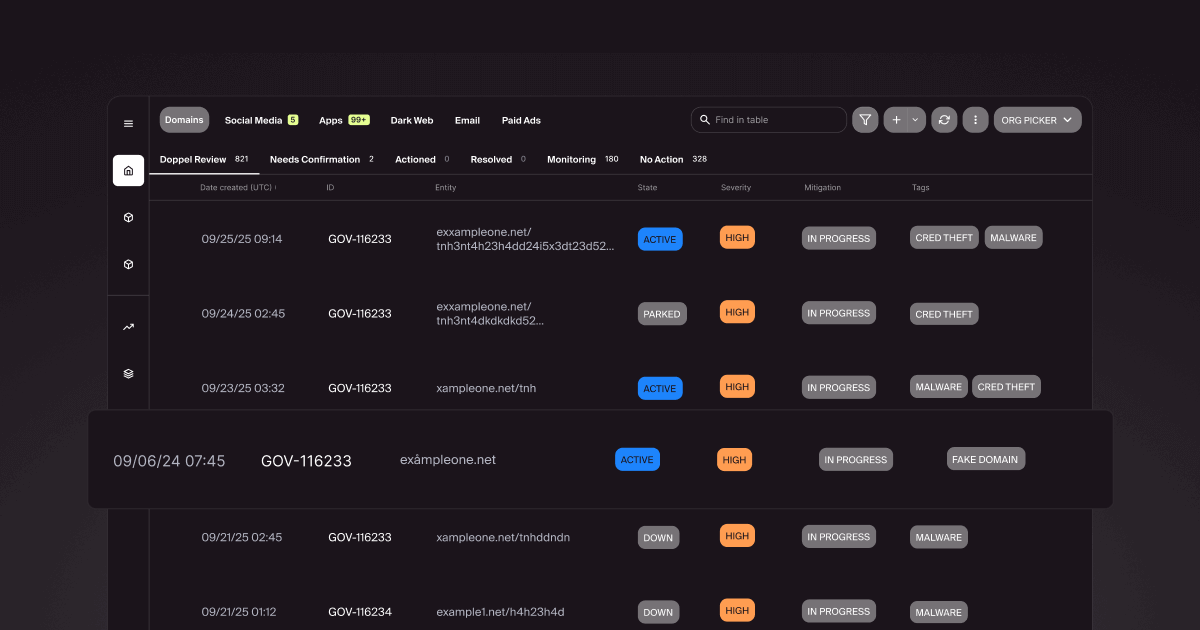
Doppel automates the detection and takedown of recruitment fraud, protecting your business so the talent team can focus on hiring.
- Domain Monitoring: Our platform detects lookalike domains the moment they’re registered and takes them down before they host a fake career portal.
- Social Media Patrol: AI agents scan LinkedIn, X, Telegram, and other platforms for fake profiles impersonating your recruiters and executives.
- Takedowns in Minutes: Doppel doesn’t just flag. Doppel removes, too. Our platform automates the takedown process with registrars and platforms (including LinkedIn), significantly reducing the lifespan of a scam.
Protecting your candidates is as important as protecting your customers. When a job seeker gets scammed by an imposter using your brand identity, they don’t blame the thief. You take the blame.
Right now, you need to get ahead of the scams swindling job seekers and ruining your brand’s reputation. Get a demo with Doppel to start securing your hiring process against rampant recruitment fraud.