
A phishing campaign used to carry the fingerprints of the human running it. An operator picked the targets, wrote the lures, registered the domains, and worked the phone one call at a time. That constraint capped how many people any single attacker could reach, and how fast.
Agentic AI phishing removes the constraint. It differs from AI-generated phishing by moving from content creation to autonomous execution across the five stages of a social engineering attack: reconnaissance, weaponization, delivery, persuasion, and execution. Autonomous systems now profile targets, stand up infrastructure, launch across channels, and hold adaptive calls with less human direction at each step. The employee on the other end has fewer reliable cues that a machine is running the exchange.
The economics favor the attacker. AI enables highly targeted attacks at minimal cost (opens in new tab), and reported cybercrime losses reached $16.6 billion (opens in new tab) in 2024, a record, with phishing and spoofing the most-reported crime. This guide covers what makes agentic AI phishing different, how agents run each stage of the attack chain, why it breaks defenses built for human-run campaigns, and how to defend.
Key takeaways
- Agentic AI phishing turns content generation into autonomous campaign execution across the full attack chain.
- Attackers gain speed when one system coordinates email, SMS, voice, and video as a single adaptive campaign.
- Security teams need AI-native correlation and cross-channel disruption that keep pace with autonomous campaigns.
- Trusted-channel verification and simulations based on live attacker tactics help employees handle the moments detection misses.
What makes agentic AI phishing different from AI-generated phishing
Agentic AI phishing hands the whole operation to a self-directed system. It differs from the AI-generated phishing most security teams already track by turning a content assistant into a campaign operator. The agent generates the lure, reasons over the next step, invokes tools, and runs the work that used to take a team.
Agentic AI adds autonomy on top of content generation
Generative AI handles message creation; agentic AI controls campaign execution. Generative AI creates content (opens in new tab) in response to prompts, while agentic AI plans and takes actions to meet a defined objective. In most phishing kits today, the AI still sits in the content layer while a human controls targeting and monetization. Agentic phishing adds goal-pursuit on top, so the system can create context-aware messages (opens in new tab) across email, chat, and voice without a human designing each one.
Agents reason, use tools, and act across multiple steps
Agentic systems integrated into workflows (opens in new tab) pursue objectives over time, planning steps, invoking tools, evaluating outcomes, and adapting without continuous prompting, though attacker use of this at scale is still emerging. Autonomous scam agents can conduct multi-turn calls (opens in new tab) that adapt to user responses while evading safety guardrails and completing end-to-end fraud pipelines with memory-backed planning and speech synthesis. That autonomy reaches well beyond a well-written email.
One agent replaces what took a team of operators
One agent can do the work that once required a whole operator team. Attackers are already experimenting with automated business email compromise (BEC)-style workflows that draft lures and watch engagement with little operator involvement. LLM-based agents let limited-skill attackers (opens in new tab) run complex operations with minimal human intervention. Fully autonomous campaigns at scale remain nascent, and attackers still typically keep a human in the loop (opens in new tab). The capability is already in the wild, though, and the barrier to entry is dropping fast.
How autonomous agents run the attack chain
Attackers now deploy autonomous agents at every stage of the social engineering attack chain. Once a campaign kicks off, agentic AI compresses the attack lifecycle (opens in new tab), assembling, launching, and adapting far faster than a human operator ever could.
reconnaissance: agents profile targets and choose who to hit at scale
Before a single lure goes out, the agent already knows who to target, and it has spent no human hours getting there. Autonomous systems research and profile targets (opens in new tab) at scale, gathering executive background and summarizing the angles most likely to land.
More advanced workflows combine public profile data (opens in new tab) with exposed breach data to shape a pretext with little manual research. In one documented April 2026 campaign, threat actors used automated enrichment (opens in new tab) of public profiles and corporate directories to single out people in financial and executive roles, then concentrated follow-on activity on the highest-value subset.
Weaponization: agents stand up infrastructure and generate per-target assets in minutes
Once the agent knows the targets, it builds the campaign to reach them, and it builds fast. AI-assisted tools now generate in minutes what once required skilled manual work. One threat actor operationalized a fully AI-enabled workflow (opens in new tab) spanning lure development, fake company website creation, and infrastructure provisioning. AI has also made convincing fraudulent sites (opens in new tab) quick to spin up with minimal technical knowledge. Each lure comes out linguistically unique and calibrated to its target, which erases the shared signature defenders once relied on.
Delivery: one agent sequences the lure across email, sms, voice, and video
A lure no longer arrives on one channel and waits. Attackers now turn a single email (opens in new tab) into a multi-channel campaign: an email plants the seed, a follow-up SMS adds urgency, and a voice call closes, with deepfake video held back as the final-stage closer. Agentic AI is the orchestration layer that runs the sequence, coordinating channels simultaneously, using response data to pick the next recipient, and adjusting timing and follow-up. The later stages favor mobile, where a convincing message or deepfake call on a small screen is harder to scrutinize (opens in new tab) than an email on a monitor.
Persuasion: voice and chat agents hold a live conversation that adapts in real time
Picture the employee who picks up the call. A calm voice references a real project, answers a clarifying question, and asks for the one action that completes the fraud. Modern AI vishing can run through a real-time pipeline (opens in new tab) that listens, transcribes, reasons through an LLM with persona context, and synthesizes a spoken reply with conversationally low latency. The attacker no longer needs a fixed script, and multi-turn calls adapt to responses, hold memory, and carry the fraud flow through the conversation. Because the agents run autonomously, the per-conversation burden on the attacker keeps falling.
Execution: agents complete the fraud and move to the next target
Fraud completes at the last step, and the agent does not pause to celebrate. Autonomous agents mimic user behavior and bypass verification (opens in new tab) to take over accounts through scripted, high-volume interactions. At scale, those interactions gather account data and feed follow-on fraud without an operator working each attempt. The highest-stakes version is deepfake executive fraud, which has pushed the problem into the boardroom. In a survey of 302 cybersecurity leaders (opens in new tab), 62% (opens in new tab) of organizations reported a deepfake attack involving social engineering or automated processes in the 12 months before mid-2025. When one target closes, the agent moves to the next without fatigue.
Why agentic phishing breaks defenses built for human-run campaigns
Once an autonomous agent runs the campaign, human-paced, single-channel, static defenses fall a step behind at every turn. So how does a defense designed for human attackers hold up against one that never sleeps, never tires, and never repeats itself? It doesn't. Machine-speed volume buries human triage, cross-channel movement slips tools that each watch one surface, real-time adaptation defeats fixed tells, and a lure regenerated for every target carries no known-bad signature.
Machine-speed volume buries human triage queues
The traditional SOC model waits on a human to make the call, and the queue sets the pace. The gap between alert volume and analyst capacity creates a structural mismatch between machine-speed detection and human-speed investigation that hiring alone won't fix. Manual triage of user-reported email can consume a significant share of analyst time. Agentic systems exploit the gap directly, adapting follow-ups (opens in new tab) autonomously, faster than manual triage can keep up.
Multi-channel campaigns slip past single-channel tools
Email gateways watch one channel, which leaves the blind spots multi-channel campaigns exploit. A deepfake voice call gains credibility when it follows earlier trust-building messages, and single-channel systems lack the temporal context to catch campaigns that span surfaces. A tool watching only the inbox misses the SMS, the call, or the video that complete the sequence.
Real-time adaptation defeats the fixed tells training drills
AI-generated content weakens awareness training that relies on surface tells. Large language models can produce native-fluency lures personalized to the target's role and history. That personalization removes the poor grammar and clumsy phrasing training programs drilled. Agentic systems compound this by probing defenses and iterating in real time, outpacing quarterly training refreshes. As deepfakes improve, teams need caller verification (opens in new tab) to back employee vigilance.
Lures regenerated per target carry no known-bad signature
Signature-based filters match against known-bad patterns, and per-target polymorphism gives them nothing to match. AI creates unique variations (opens in new tab) in subject lines, body content, and metadata for every recipient. Those per-recipient variations defeat header-based filtering and the old habit of a colleague warning others about "the same suspicious email." Attackers can iterate variants quickly, leaving defenders to close a moving gap.
How to defend against agentic AI phishing
Meeting an autonomous, multi-channel, machine-speed attack takes AI-native defense that treats attacker infrastructure across every channel as one campaign, not a stream of isolated alerts. Four moves matter. Detect and dismantle that infrastructure wherever it appears. Correlate scattered signals into a single campaign view. Verify high-stakes requests through a channel a cloned voice cannot satisfy. And rehearse your workforce against the live lures attackers already circulate.
Detect and dismantle attacker infrastructure across every channel
Teams need to dismantle infrastructure because the agent can respin phishing assets faster than a queue can process them. Behavioral analytics (opens in new tab) and anomaly detection give teams a baseline for spotting abnormal access and unusual workflow behavior before content matches a known-bad pattern. Teams should disrupt the source by taking down the sending infrastructure and connected assets such as the lookalike domains and hosted pages, so the same campaign can't retarget the organization. Attackers already redeploy phishing pages after takedowns at minimal cost, so takedowns have to reach the connected campaign assets in one motion.
Correlate scattered signals into one campaign view
Defenders understand a campaign that moves across email, voice, and video only when they join the signals. SOC teams should correlate signals (opens in new tab) across identity, device, and workflow telemetry, then layer in content-authenticity checks so analysts can treat manipulated media as part of a broader campaign pattern. Correlation turns disconnected messages and calls into the one campaign your analysts can act on.
Verify high-stakes requests through a separate, trusted channel
When detection fails, employees need a verification path outside the suspected channel. Pre-agreed verification codes and caller identity verification (opens in new tab) through a separate, trusted channel are the controls that cloned voices and synthetic video can't satisfy on their own. Help-desk and identity-recovery workflows deserve special attention, because attackers have used layered social engineering (opens in new tab) over repeated calls to gather reset information and defeat weak processes. Train your employees to recognize when a decision requires verification through a trusted channel.
Rehearse the workforce against live, agent-run lures
Training has to match the email, voice, SMS, and video lures attackers already circulate. Cross-channel attacks defeat single-tool defenses, which is why multi-channel simulation matters more than email-only testing. Security teams should train employees on social engineering and spearphishing attempts, including caller identity verification across voice, SMS, and collaboration channels. Employees trained only on email phishing stay vulnerable to the phone scam and the deepfake video call.
How Doppel defends against agentic AI phishing
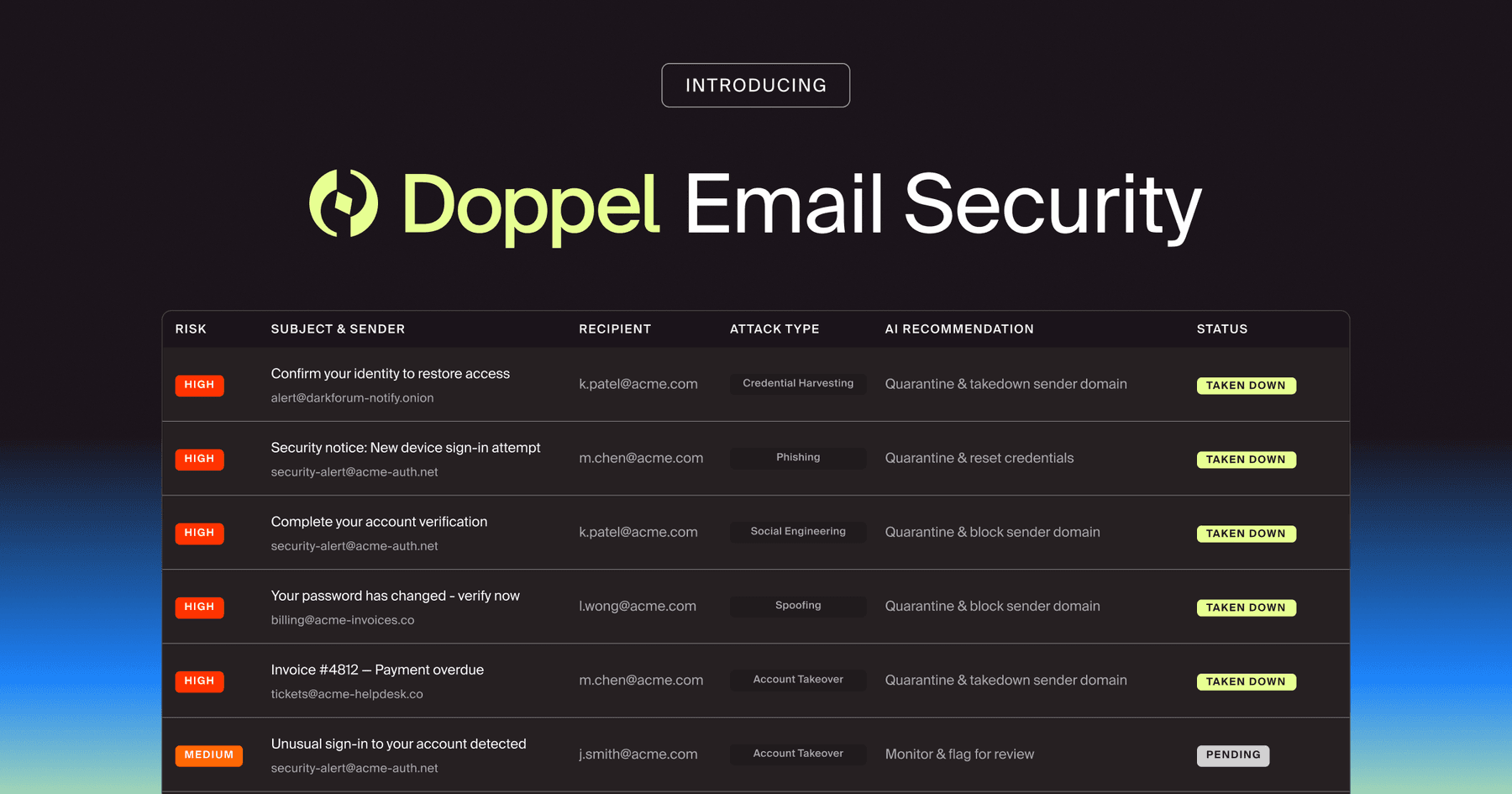
Doppel, the AI-native Social Engineering Defense (SED) platform, unifies Digital Risk Protection and Human Risk Management, and meets agentic attacks at machine speed. Its agentic AI detects autonomously and grounds every verdict in the Doppel Threat Graph of external attacker infrastructure, so it catches the novel campaigns and zero-days that pattern-matching misses. The agents reason over malicious intent and infrastructure context, which lets them catch the per-target polymorphic lures that defeat filters.
The Threat Graph correlates signals across domains, social, messaging, and email into a single campaign view from isolated alerts. When the platform surfaces one impersonation domain, the graph maps the connected telco numbers, WhatsApp accounts, social profiles, and ad campaigns, then executes autonomous multi-channel takedowns that dismantle the whole campaign in one action. Telco is the channel legacy takedown workflows most often miss, which leaves the SMS and voice channels live; provider relationships bring that channel down in the same action. Agentic AI correlates, prioritizes, and executes takedowns at scale, so analysts focus on the complex escalations that require human judgment.
The platform then converts the real campaigns it observes into employee simulations through one-click threat-to-simulation conversion. Those simulations rehearse the workforce on the exact lures in play and the verification reflexes that defeat them across email, voice, SMS, Microsoft Teams, and Zoom. Platform telemetry shows the shift toward multi-channel design: by April 2026, email had emerged as a leading source of attacker activity against financial services and fintech brands, alongside continued activity across social and messaging.
Meet machine-speed attacks with machine-speed defense
As attackers hand more of the campaign to autonomous agents, the teams that stay ahead pair autonomous detection with autonomous disruption. They build verification into every high-stakes workflow and keep human judgment on the decisions that carry real risk. Fraud runs on a ratio: as long as attack cost stays below expected gain, the abuse continues. The goal is to detect, correlate, and dismantle the infrastructure behind a campaign in one motion, so the cost of rebuilding outweighs the return, until running the attack against your brand is no longer worth it.
Request a demo to see the platform meet agentic attacks at machine speed.
Frequently asked questions about agentic ai phishing
What is agentic AI phishing?
Agentic AI phishing is a phishing campaign run by a self-directed AI system rather than a human operator. The agent pursues a goal across the full social engineering attack chain: it profiles targets, builds infrastructure, launches lures across channels, holds live conversations, and completes the fraud with little human direction at each step.
How is agentic AI phishing different from AI-generated phishing?
AI-generated phishing uses AI to write the message; a human still controls targeting, delivery, and monetization. Agentic AI phishing moves the AI from the content layer to the operator layer, so the same system reasons over the next step, invokes tools, and executes the campaign end to end. The difference is autonomy, not just better copy.
Can agentic AI run a phishing phone call?
Yes. Autonomous voice phishing agents can run a real-time pipeline that listens, reasons through a language model with persona context, and speaks back with low enough latency to sustain a natural conversation. The call adapts to what the target says and holds memory across turns, so it moves beyond a fixed script.
How do you defend against agentic AI phishing?
Defense takes four moves that match the attacker's speed and reach. Detect and dismantle attacker infrastructure across every channel, correlate scattered signals into one campaign view, verify high-stakes requests through a separate trusted channel, and rehearse the workforce against the live lures attackers already circulate.