

An autonomous agent profiles the target from LinkedIn and earnings calls, registers a lookalike domain, clones an executive's voice from a conference recording, and launches across email, SMS, voice, and social in a compressed window. It adjusts the script every time the target hesitates. What once demanded sustained analyst effort now assembles with far less manual work.
The exposure is measurable. Cybercrime losses reached $16.6 billion (opens in new tab) in 2024, a record high, with phishing and spoofing the most-reported crimes. Security programs built on human triage queues and single-channel monitoring struggle to match machine-speed attacker workflows.
Autonomous AI agents answer these attacks at machine speed, from detection and investigation through dismantling.
Key takeaways
- Agentic AI security uses autonomous agents to detect and dismantle social engineering campaigns, with investigation running through each step.
- Attackers already use agents to profile targets, build impersonation infrastructure, coordinate delivery, and adapt persuasion in real time.
- Effective defense needs autonomous detection and campaign-level disruption, with explainable investigation behind every verdict.
What is agentic AI security?
Agentic AI security uses autonomous AI agents to detect and dismantle social engineering attacks, with investigation sitting inside the response loop. Attackers weaponize autonomy, so defenders need autonomy to answer them.
When a single operator can run adaptive phishing conversations at scale and voice-enabled agents can reproduce end-to-end phone impersonation scams, a defense that pauses for human triage on every event falls behind by design.
Agentic AI acts across multiple steps without a human in the loop
An agentic system pursues a goal across many steps without a person prompting each one. It can accomplish goals (opens in new tab) with limited supervision, reasoning, and adapting as conditions change. Answering an attacker that works this way takes a defense that reasons about the actor behind a campaign.
Agentic AI security runs detection through dismantling
Agentic defense runs the full response loop past the alert. A detection agent flags a lookalike domain, an investigation agent correlates it with connected phone numbers, ad campaigns, and social profiles tied to the same actor, and a disruption agent takes the whole campaign down.
Pairing detection with correlated enforcement raises the cost of rebuilding the operation.
How agentic AI differs from earlier security AI
Security AI advanced through generations that each took on a larger part of the workflow: rules that matched known patterns, predictive models that scored risk, generative models that drafted and summarized, and agentic AI that closes the loop by reasoning through a problem and acting on it end-to-end:
- Rules and signatures match only known patterns. The first generation relied on static rules (opens in new tab) and signatures that flag threats already in a database. As attackers learned to deliver malicious instructions without a matchable file, the industry moved toward behavioral approaches.
- Predictive models score risk and leave the action to people. The second generation applied machine learning to score risk and flag anomalies from historical data. It surfaced more threats and left the action with a human analyst, and when the underlying data shifts, these models can miss threats or flood the queue with false alarms.
- Generative AI supports analyst workflows. The third generation produces content where analysts need it: summaries, incident reports, and drafted responses. It reacts to user input (opens in new tab) and produces outputs without making autonomous decisions, so monitoring, alerting, and independent action stay outside its role.
- Agentic AI reasons, decides, and executes end-to-end. The fourth generation closes the loop. When a signal crosses a risk threshold, an agent gathers related alerts and telemetry, identifies the entities in play, checks for spread, and moves to contain, escalating higher-stakes decisions for human authorization.
That last step, autonomous action, is what answers an attacker who has already gone agentic.
How attackers run agentic AI through the attack chain
Attackers deploy autonomous agents at every stage of the social engineering attack chain. Campaigns that once took sustained manual effort now assemble and adapt rapidly, and each stage compounds the next.
1. Reconnaissance: Agents profile targets and mine open sources at scale
Agents automate open-source intelligence collection at a scale human teams cannot match manually. That expands the attack surface they can probe in parallel. AI accelerates persona development (opens in new tab) and infrastructure discovery, collapsing the time between target selection and first contact.
Public data from code repositories and professional networks becomes a behavioral profile; a short public recording becomes material for a voice clone; an org chart becomes a pretext.
2. Weaponization: Agents stand up lookalike infrastructure and synthetic media in minutes
That reconnaissance feeds the infrastructure attackers build to impersonate trusted brands. Agents register lookalike domains, deploy phishing pages that mimic legitimate sites, and generate synthetic media (opens in new tab) on demand.
Voice cloning now draws from brief public recordings, and convincing video deepfakes come from widely available software.
3. Delivery: One agent coordinates the campaign across email, sms, voice, and social
Once attackers arm the infrastructure, a single agent pushes it across channels at once. AI-automated phishing emails achieved a 54% click-through rate (opens in new tab), compared to 12% for standard phishing attempts, because AI localizes content and adapts messaging to specific roles.
Delivery now spans email, SMS, voice, and social, landing on the same target inside the same window.
4. Persuasion: Agents adapt the script in real time to borrow authority and manufacture urgency
At contact, agents adapt in real time (opens in new tab) rather than run a fixed script. When a target pushes back on a call, the agent pivots to an email or SMS follow-up, borrowing the authority of a known brand or executive to keep pressure on.
5. Execution: Fraudulent transfers and stolen credentials clear before a human can respond
The payoff clears faster than a defender can react. In one documented case, a finance director contacted on WhatsApp joined a deepfake video call (opens in new tab) where the CEO, CFO, and colleagues were all AI-generated, then authorized a US$499,000 transfer before the fraud surfaced.
AI changes the tempo and iteration speed (opens in new tab) of the attack, and the window for detection and containment shrinks with it.
Why human-speed defense can't match machine-speed attacks
When attacks run autonomously across channels, defenses that rely on human triage and single-channel monitoring lose ground while alerts wait for action.
Human triage queues can't clear machine-speed volume
Analysts cannot investigate what they cannot get through. SOC teams face overwhelming daily alert volumes (opens in new tab), and a single phishing alert can demand investigation across email logs, endpoint data, and threat intelligence.
The old Tier 1 model (opens in new tab) of waiting for alerts, clicking through scripted steps, and forwarding possible threats no longer holds up. SOCs move past alert fatigue when automated correlation and triage complete each investigation before the queue grows.
Single-channel tools miss campaigns built to move across channels
A tool watching one surface sees a fraction of a campaign that crosses several. Phishing campaigns increasingly span channels, and voice phishing has become a central social engineering vector.
An email gateway lacks coverage for the lookalike domain attackers registered earlier, the social profile they spoofed, and the vishing call they placed to the helpdesk. Each of those legs lives in a channel single-purpose tools do not watch.
Alerting without action leaves the attacker infrastructure standing
A high-confidence alert that waits for a person to act does not change the campaign. The infrastructure keeps working while the alert sits in the queue, and detection that stops at the alert leaves it standing to keep earning.
What agentic AI security requires
At machine speed, defense has to operate as one loop, and it takes three capabilities working together: autonomous detection grounded in attacker infrastructure, agentic investigation that explains every verdict and escalates the novel cases, and autonomous disruption that dismantles the infrastructure so the same campaign is harder to reconstitute.
Detect autonomously, grounded in attacker infrastructure
Detection has to reason about intent and infrastructure. Autonomous attacks (opens in new tab) now adjust lures, timing, and delivery paths as they run, so agents evaluate the infrastructure behind a message, including domains attackers recently registered and the profiles or phone numbers connected to them.
They catch novel campaign pattern-matching defenses miss, because the infrastructure showed itself before the lure landed.
Investigate with explanation and human escalation
Autonomy without explanation is a black box a SOC cannot defend. Explainability has to be a core feature (opens in new tab) that surfaces the evidence and confidence behind every verdict. A human-in-the-loop model (opens in new tab) keeps that balance: agents correlate and prioritize evidence before execution, and humans handle the complex escalations that carry real risk.
Disrupt the campaign by dismantling its infrastructure
Disruption has to reach the infrastructure itself. Attackers can rebuild relatively quickly (opens in new tab) after a scam website takedown and reconstitute operations elsewhere. Dismantling the full connected campaign in one action raises the rebuild cost enough to change the actor's calculus.
How Doppel delivers agentic AI security
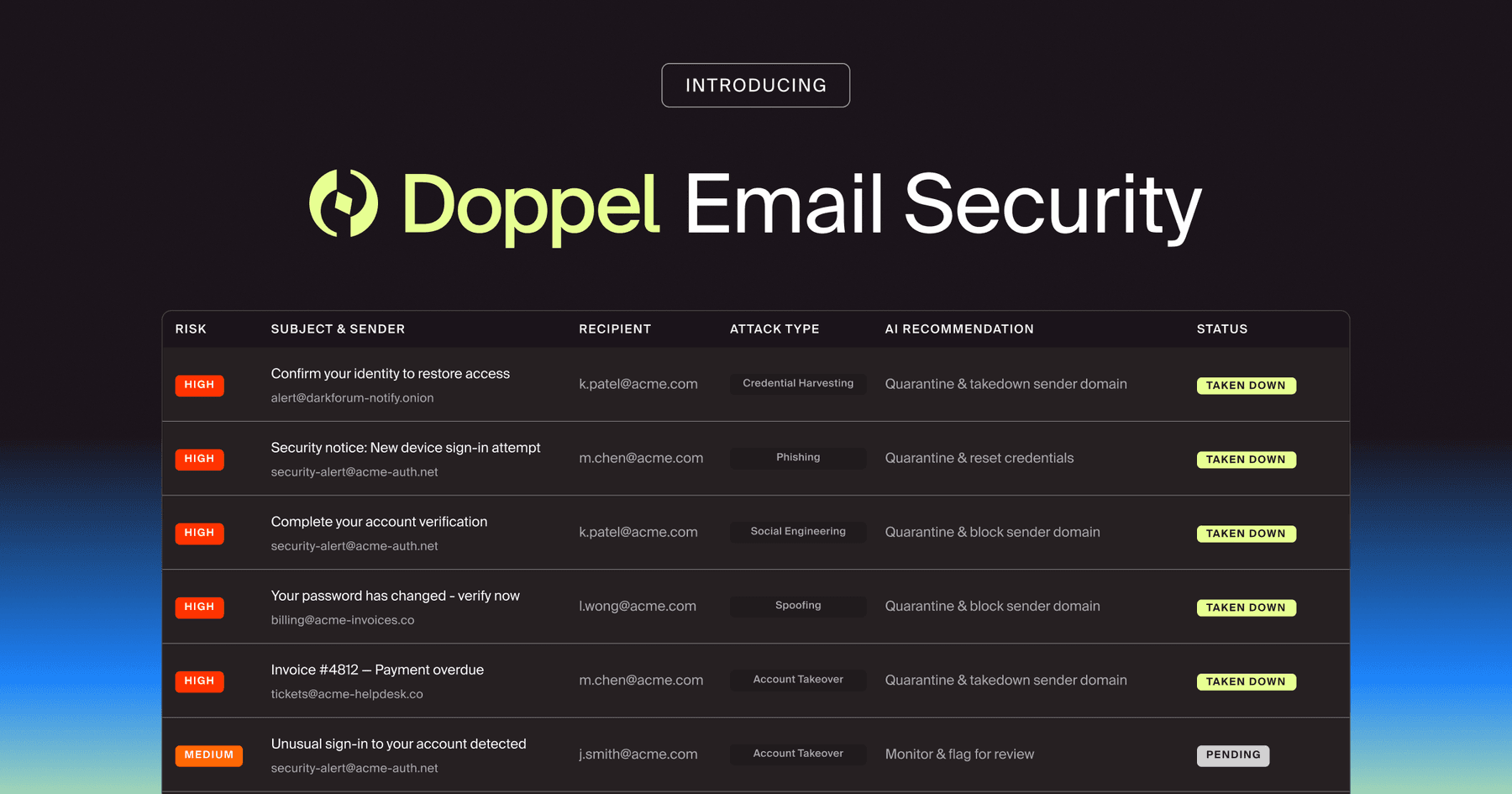
Doppel is the AI-native Social Engineering Defense (SED) platform that unifies Digital Risk Protection and Human Risk Management, and its Agentic AI Engine meets those requirements.
The agents detect autonomously and ground every verdict in the Doppel Threat Graph of external attacker infrastructure, reasoning over the domains, profiles, phone numbers, and ad IDs it links together. Each verdict comes with plain-language policy a SOC can read and audit.
For novel campaigns, Threat Graph Insights produces an AI-generated narrative that names the actor pattern, the platforms in use, and the techniques sustaining the operation, so analysts start with an investigation brief instead of raw indicators.
On confirmation, the agents execute autonomous multi-channel takedowns that submit the entire connected campaign for removal in a single action across registrars, hosts, social platforms, ad networks, and the telco leg most legacy takedown workflows leave standing.
The closed loop compounds. Each campaign the engine processes strengthens shared detection across customers, and one click converts a detected threat into an employee phishing simulation, so people train against the exact lures targeting them.
In Doppel telemetry, by April 2026, email had emerged as a leading source of attacker activity against Financial Services and Fintech brands, alongside social and messaging platforms, a shift toward multi-channel campaign design single-channel tools cannot see whole.
Judge security AI by whether it can act on what it detects
As attackers hand more of the campaign to autonomous agents across domains, social, telco, and messaging, the security leaders who pull ahead are the ones who pair autonomous detection with autonomous disruption and keep human judgment on the decisions that carry real risk.
Dismantling the infrastructure behind confirmed campaigns, faster and more completely than the actor can rebuild it, raises the cost of the whole operation. Attackers have moved into machine speed. Defense has to move there too.
Request a demo to see agentic Social Engineering Defense dismantle campaigns through one closed loop from detection to investigation.