

The old tells are gone: misspellings, clumsy grammar, generic greetings, reused templates. Generative AI stripped them out of the lure, and the messages now landing in cloud mailboxes read as clean, fluent, and written for the one person receiving them. AI-automated phishing emails reach a 54% click-through rate (opens in new tab), against roughly 12% for standard phishing, a 4.5x jump.
Security leaders running Microsoft 365 or Google Workspace still face business email compromise and credential attacks such as account takeover when their email defense scores the inbox and stops there. Native filtering and the tools bolted on top inspect the message that arrives. Attackers now make that message read as legitimate, send it through infrastructure they stood up weeks earlier, and often continue the conversation through a phone call the inbox never inspects.
This article covers what AI-generated phishing is, how it reaches a cloud inbox, why inbox-scoring detection misses it, and what catching it requires.
Key takeaways
- AI-generated phishing removes the language and template tells that trained users and many filters have relied on for years.
- Cloud email defense sees only the delivery stage, so detection must shift the signal to attacker infrastructure, sender behavior, campaign correlation, and source disruption.
- The useful signals sit before the message lands (attacker infrastructure and sender behavior) and after it leaves the inbox (the pivot to voice, SMS, and chat).
What Is AI-generated phishing?
AI-generated phishing is any phishing attack whose lure is produced with generative AI, and three traits set it apart from older phishing: the language is fluent, each message is built for one recipient, and both come at machine speed and volume.
Generative models write fluent, native-quality lures on demand
Generative AI removes the grammatical mistakes that once gave phishing away. LLM-generated phishing reads more fluent and conversational (opens in new tab) than template-based emails, which makes it harder for users (opens in new tab) to judge whether a message or password-reset request is genuine, regardless of security training.
Every message is built for one recipient from their own public data
AI-driven personalization turns a mass-blast into a message that reads like a colleague wrote it. Attackers use AI to scrape a target's public digital footprint across social and corporate sites so the lure can reference recent company news or a trusted colleague's writing style.
When an email names your actual manager and a project you worked on last week, familiarity does the attacker's work, and attackers now automate the research (opens in new tab) once done by hand.
Lures are produced at machine speed and campaign volume
LLMs compound fluency and personalization with speed. Where a human attacker crafts one email by hand, a model generates contextually unique variations at campaign scale, and criminal projects are moving toward autonomous agents that write, target, and adapt on the fly. That recipient-to-recipient variability breaks pattern-matching defense.
How an AI-generated phishing attack reaches a cloud inbox
An AI-generated phishing attack moves through five stages. Generative AI compounds every stage, while the cloud mailbox first sees the attack at Contact, after Setup signals already exist and before the Engagement pivot to other channels:
1. Setup: Attackers register lookalike domains and harvest the target's public footprint
The attack begins weeks before any message sends, on infrastructure the inbox never observes. Attackers acquire domains and servers during MITRE ATT&CK's Resource Development phase, then register lookalikes that exploit easily confused characters (company.com against cornpany.com) through typosquatting or homograph substitution.
In parallel, an AI-driven OSINT pipeline assembles tailored attack profiles at machine speed.
2. Launch: AI generates the lures and arms the sending infrastructure
Once the profile is built, the attacker feeds it into a language model to produce the lure. A single prompt drives it: write a professional email from a CFO to an accounts-payable manager requesting an urgent wire, citing budget constraints.
The attacker then sends through impersonation infrastructure: a spoofed domain, a freshly registered lookalike whose DNS records the attacker controls, or a compromised legitimate account.
3. Contact: The message lands in the cloud mailbox
Email defense first sees the attack when the message arrives. It lands with a subject engineered for urgency and a sender-and-body combination built to pass a display-name check while referencing a real project.
Operating inside legitimate cloud infrastructure, it slips standard filtering and domain-reputation controls: the message blends in because the attacker built it to.
4. Engagement: The lure manufactures urgency and pivots beyond email
Once the recipient engages, the attacker manufactures urgency and often moves off the monitored channel. In a finance-team attack, the target gets a personal-address message claiming corporate email trouble and rushing a wire.
Attackers increasingly pivot to voice or collaboration platforms: Teams voice phishing (opens in new tab) can impersonate support staff and talk a user into granting remote access, then push credentials into a spoofed form.
That traffic never routes through email security.
5. Compromise: Credential theft or broader cloud compromise
The payoff comes once trust and urgency are set. Threat groups now use employee-themed lures for cloud tenant compromise (opens in new tab) through phishing and OAuth token abuse. The same lures harvest credentials and feed MFA fatigue attacks, and stolen logins fuel credential stuffing downstream.
In mailbox-compromise variants, valid credentials make the sender's domain and authentication results look normal to filtering.
Why AI-generated phishing slips past cloud email detection
Cloud email defense inspects the message that reaches the inbox, scoring its content and delivery context such as the sending domain and links. AI-generated phishing is built to clear those checks, on campaigns that start before delivery and often continue outside email.
There's no signature or language tell to match when every message is unique
Signature-based detection compares incoming mail against known malicious patterns and hashes, and AI-generated phishing defeats it by making every message unique. Attackers use AI to create distinct email content (opens in new tab) for each recipient, collapsing the grouping campaign detection depends on.
Even widely used Bayesian spam filters can misclassify LLM-modified spam (opens in new tab) as legitimate. The language tell is gone: no misspelling to match, and the content scores clean because it is clean.
Reputation and authentication pass for freshly registered domains
SPF, DKIM, and DMARC stop domain impersonation only when the attacker reuses a domain you protect. A lookalike the attacker registers complies with the authentication records the attacker sets, so authentication passes on a fraudulent message. Reputation offers little help early in a new domain's life, before scoring systems have evidence.
Catching lures from lookalike domains or compromised accounts takes infrastructure context.
Inbox-bound detection can't see the channel pivot
The parts of the campaign that would give it away sit outside the mailbox. An attacker can stage a synthetic voice or support persona during Setup, then pivot to voice or Teams at Engagement. SMS phishing opens a visibility gap because it runs outside the systems security teams monitor, and collaboration platforms prioritize speed and trust over inspection.
How to detect AI-generated phishing in cloud email
Detecting AI-generated phishing means moving the signal from what the message says to who is behind it, and that takes four capabilities working together:
1. Ground each message in the external infrastructure behind it
Before the message sends, the attacker infrastructure behind the lure carries the strongest signal, and domain registration is where most impersonation campaigns leave their first footprint. Continuously scanning newly registered domains and Certificate Transparency logs, then comparing DNS behavior, surfaces the campaign while the attacker is still assembling it, including those aimed at your vendors and supply chain weeks before any lure lands.
Check whether your detection layer correlates those external signals against brand-targeting patterns before a message is delivered, or only after.
2. Score sender and account behavior as the primary signal
When content carries no tell, sender and account behavior become the primary signal. User and entity behavior analytics baseline login times, locations, device fingerprints, and sender-recipient relationships, then score deviations, flagging an unusual payment request or a tone shift even when the message reads well.
The test for your stack: can it score a behavioral deviation without a prior known-bad signature?
3. Correlate the inbox event with the wider campaign
A single inbox event is one node in a campaign-level view, and correlation reveals the rest. Rotating domains, sender IPs, and burner accounts are perishable, so durable detection tracks threat-actor tactics, not the indicators they discard.
Clustering inbound signals into campaigns and linking them to persistent threat-actor profiles by TTPs gives defenders the full picture, not isolated alerts.
4. Wire confirmed verdicts to source disruption
Detection without disruption leaves the attacker's infrastructure standing to retarget you. Takedown removes malicious content (opens in new tab) by notifying the host or registrar, cutting attacker ROI (opens in new tab). When your detection layer produces a verdict, it should route to a takedown workflow and track time-to-removal as a metric.
How Doppel detects ai-generated phishing across the attack chain
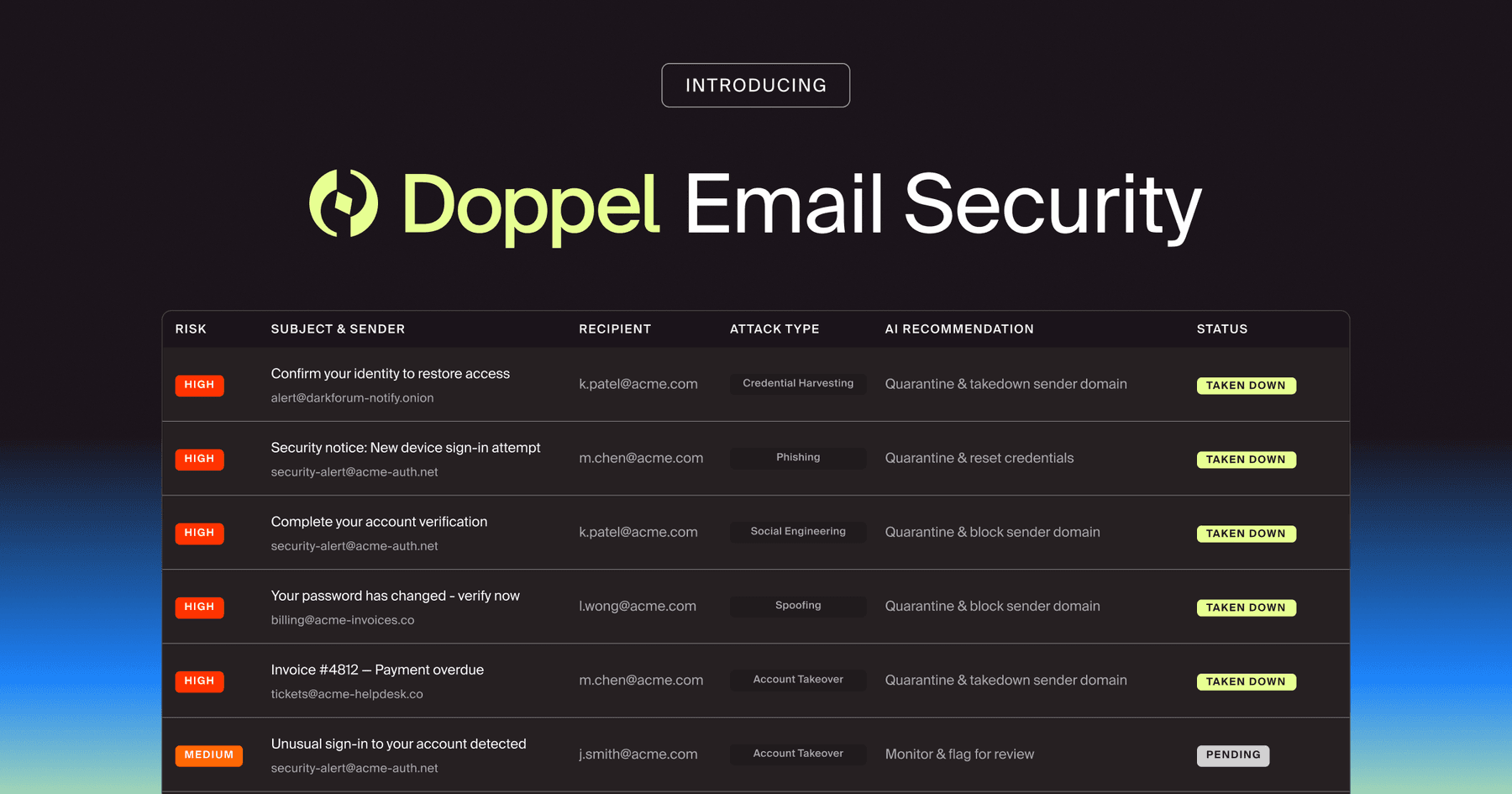
Doppel is the AI-native Social Engineering Defense (SED) platform, unifying Digital Risk Protection and Human Risk Management on one Doppel Intelligence Layer, with Email Security in a waitlist phase ahead of general availability later in 2026. It brings external attack-infrastructure intelligence into Microsoft 365 and Google Workspace through API deployment, applying attack-chain coverage end to end.
Doppel grounds every detection in the Threat Graph, its map of external attacker infrastructure across DNS registrations, certificate data, and multi-channel indicators. That grounding catches an AI-generated lure with no behavioral baseline, because the verdict comes from infrastructure context, not message content alone.
Doppel's agentic SOC then classifies and explains each verdict in plain-language policy a team can read and tune, not a black-box score or a sprawling rule set. Confirmed verdicts move into disruption: standalone Email Security triggers takedown of the sending infrastructure and malicious links; bundled with DRP, the same layer extends disruption across the campaign, including lookalike domains, fake profiles, and impersonation kits.
Because Email Security shares that intelligence layer with DRP and HRM, a detected phish becomes an employee simulation in one click, and the infrastructure behind it hardens detection across the platform.
Judge cloud email defense by how much of the attack it can see
Security leaders should measure cloud email defense by how much external infrastructure and inbox behavior it sees and disrupts, and whether it holds context when attacks pivot channels. By April 2026, email had become a leading source of attacker activity against financial-services and fintech brands, as attackers combine channels into multi-channel campaigns.
The teams that pull ahead treat every AI-generated message as the visible edge of a campaign, raising the cost of the whole attack until the adversary moves on. Doppel closes that loop by pairing explainable inbox detection with source disruption.
Take a guided demo to see it work against the infrastructure behind a live campaign.