

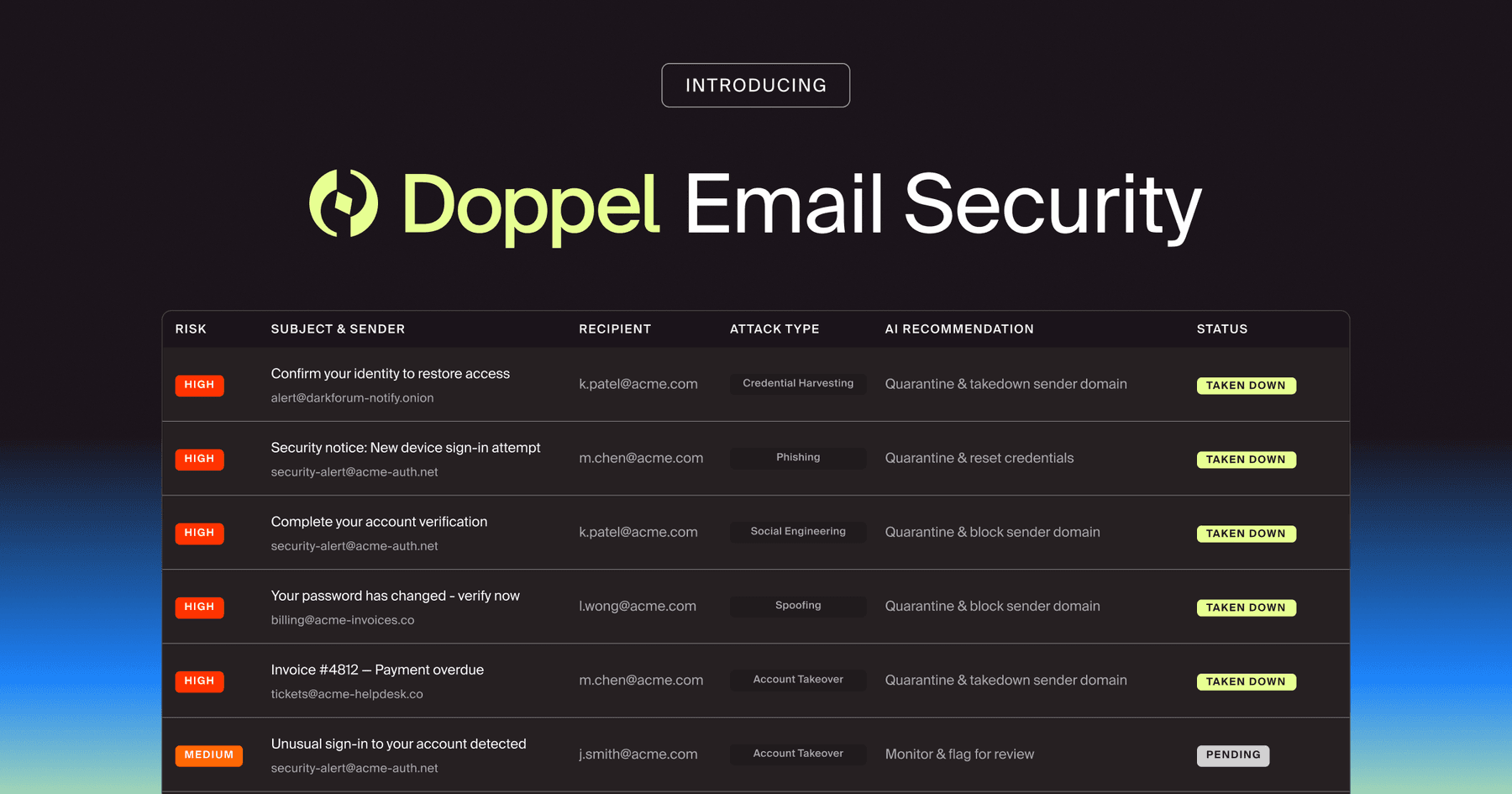
Doppel Email Security is now generally available
The agentic email security solution that empowers you to fight back against social engineering attacks. Detection isn't enough. Disruption is the difference.
Navigate your path to campaign-level social engineering defense. Choose your current email stack to see how agentic security closes structural gaps.
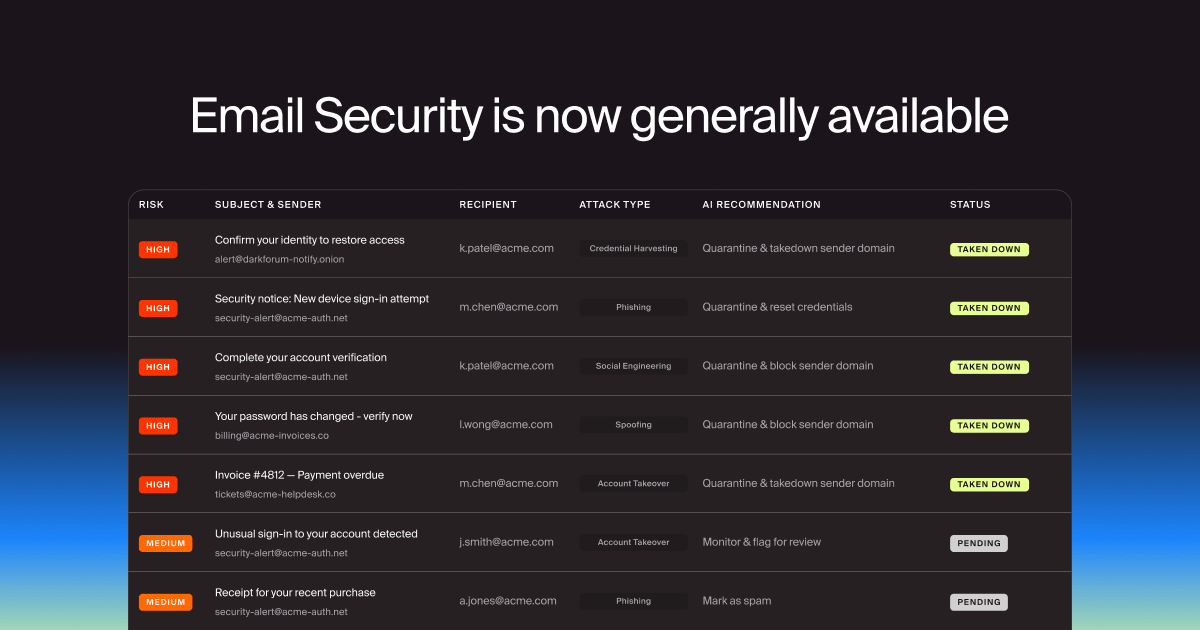
Email security architecture has spent the last 20 years getting progressively better at scoring the inbox, but the fundamental outcome hasn’t changed.
Attackers still succeed in seconds, and SOC teams are still trapped in a reactive loop of manual triage. The vulnerability comes from the rise of sophisticated, AI-powered attacks and a lack of visibility into the broader campaign sitting behind the message. With frontier AI, which includes highly capable models and autonomous agents, convincing fakes have become nearly indistinguishable from legitimate messages, and attack timelines have been compressed from days to minutes. And traditional platforms still don’t see the campaign infrastructure behind them.
By the time an AI-generated phishing lure lands in an inbox, the threat actor has already established an entire cross-channel apparatus, registering lookalike domains weeks in advance, building fake LinkedIn profiles, and warming up sending infrastructure. Legacy architectures score the text in isolation, leaving the underlying engine of the attack completely untouched.
Doppel Email Security is now generally available, and it’s built to close the gaps that legacy email defense has left behind. Rather than adding another security filter, it actually fixes the architecture inside each tool's blind spots and in the space between them using threat intelligence none of the existing layers have access to.
If you've been on the waitlist, watching from the sidelines, or just learning about Doppel Email Security, this blog is your quick-start guide: a practical breakdown of how Doppel layers into the email security stack you already have, based on what that stack looks like today.
Pick the setup that matches yours to see how Doppel Email Security fits:
Regardless of the path you take, Doppel is quick and easy to deploy. Because Doppel integrates via API directly with Microsoft 365 and Google Workspace, you can get up and running in minutes.
There are no MX record changes, no policy changes, and no mail flow rewrites required. Whether you are adding advanced defense for the first time, augmenting a legacy setup, or executing a full migration, the integration process is entirely frictionless.
If Google Workspace or Microsoft Defender for Office 365 is your primary line of defense, you're covering the basics, but there's room to do more. That's not a knock on the tools. They were built to catch known bad senders, malicious links, and flagged attachments, and they do that reasonably well.
What they weren't built for is a bad sender who's never been seen before, writing an email an LLM generated thirty seconds ago, from a domain that was registered last week specifically for this campaign.
That's the gap AI-powered social engineering lives in. The median user clicks a phishing email in under 60 seconds (opens in new tab), meaning an organization's time-to-compromise is practically instant. By the time a lure lands in the inbox, the threat actor has already completed the heavy lifting, using external infrastructure and hyper-personalized data that native tools have zero visibility into. Traditional tools are left scoring a single message in isolation, completely blind to the coordinated campaign operating right behind it.
Doppel Email Security fits as a layer on top of native security, not a replacement for it. Doppel keeps the block-list and reputation checks you already have, and adds:
If this is your stack, Doppel is the fastest, lowest-friction upgrade you can make.
If you've added a Secure Email Gateway on top of native protections, you've taken steps to address critical coverage gaps. SEGs add sender history and message-signature-based filtering that native tools don't have. But SEGs still lean heavily on the same fundamental approach: known bad indicators. Static IOC lists, established blocklists, signature matching. That works well against attacks that look like attacks that have been seen before. It works far less well against a polymorphic, AI-generated lure that's never existed in exactly that form.
There are two paths here, and which one is right for you depends on constraints outside of what any vendor can dictate for you.
Some organizations need to keep a SEG in place for compliance, procurement, or internal policy reasons. That's a legitimate constraint, not a reason to sit still. In this model, Doppel runs alongside the SEG and picks up what signature- and reputation-based filtering structurally can't catch: novel domains, first-seen senders, and messages that are semantically malicious but don't match any known pattern.
Then, it takes down the attack at the source, so you're not relying on the SEG catching it the second time around. You keep the SEG's coverage and compliance footprint, and you close the gap on the attacks specifically designed to slip past static detection.
For organizations without a hard requirement to keep a gateway in place, Doppel can replace that layer entirely. Rather than filtering against fixed rules and signatures, Doppel continuously tunes its detection through natural-language policies that adapt as attacker tactics shift—closer to how a human analyst would reason through an ambiguous email than to a rule engine matching against a known-bad list.
That reasoning is powered by an agentic, self-healing detection stack, which means less rule maintenance, less tuning debt, and detection that doesn't quietly go stale as attackers change their approach.
Neither path is objectively "more advanced" than the other. It's a question of what your organization is actually optimizing for. If regulatory or contractual obligations tie you to a SEG, augmentation gets you the best of both without a migration project. If you have the flexibility to consolidate, replacement means one less tool to maintain and one less place attackers can slip through the seams between systems.
If you're running native protections, a SEG, and an API-based Integrated Cloud Email Security tool like Abnormal or Sublime, you already have a layered, rules-based stack in place. This is a mature setup, and it catches a lot. The question at this point isn't "do we have coverage?" It's "what's still getting through? Can we prove it? And does this scale and empower my team?"
That's one way many organizations at this stage bring Doppel in: running in parallel, in observation or shadow mode. Doppel classifies every message that comes through, flagging what it would have caught, without quarantining anything itself. Your existing stack keeps doing exactly what it's doing today, nothing changes in production, and there's no risk to your current detection or remediation flow.
Shadow mode only applies to the inbox, though. Doppel still disrupts the infrastructure behind the campaigns it flags, taking down the domains, fake profiles, and impersonation kits attackers are running, even while it's staying hands-off in the mailbox itself.
Running in parallel delivers a direct, side-by-side view of what inbox-only tools miss: polymorphic attacks that mutate between sends, novel tactics with no behavioral baseline, and campaigns that only become visible when you connect the message to external infrastructure like fake profiles, lookalike domains, or out-of-band vishing attempts.
Shadow mode also surfaces something less obvious: how each tool handles the calls it gets wrong. Most email security tools rely on black-box machine learning or spaghetti rule logic that makes it impossible to understand detection reasoning after the fact.
When a behavioral-ML-based ICES tool flags a legitimate email as malicious or clears a malicious one, there's usually no real explanation for why, just a confidence score with no reasoning attached. Analysts are left re-litigating the call from scratch, and the miss doesn't teach the system anything you can actually see or audit.
Doppel's detection runs on natural-language policies instead of an opaque model, so every classification comes with human-readable reasoning attached: why a message was flagged, what specifically triggered it, and what would need to be true for the call to change. Doppel also learns from every decision and clarification with a self-healing architecture that tunes itself automatically, so it's less likely to miss the same scenario twice. In shadow mode, that means you're comparing whether you can trust why a tool made the call it made, not just whether it made the right one this time.
For most teams, shadow mode is an evaluation period rather than a long-term state. Once you can see what Doppel is catching that your current stack misses, the conversation shifts from "should we add another tool?" to "should Doppel take an active remediation role?" That means you can focus on actually disrupting the campaigns it flags instead of just classifying them for review.
True security resilience can’t come from continuously tuning filters to score messages more accurately. To permanently outpace the economics of modern, AI-driven deception, security leaders need to deploy an architecture that actively neutralizes the adversary's operational assets rather than playing whack-a-mole at the glass.
Doppel Email Security closes the structural loop between external threat intelligence and inbox defense. So, whether you’re adding a first real layer on top of native protections, deciding between augmenting or replacing a SEG, or running shadow mode against a stack that already includes an ICES tool, there’s a fit that’ll work.
If you want to see how Doppel would actually behave against your specific environment, the fastest way to find out is to look at it directly. Register for our live webinar or book a demo, and we'll walk through your current stack and show you what Doppel catches in it.
BLOG
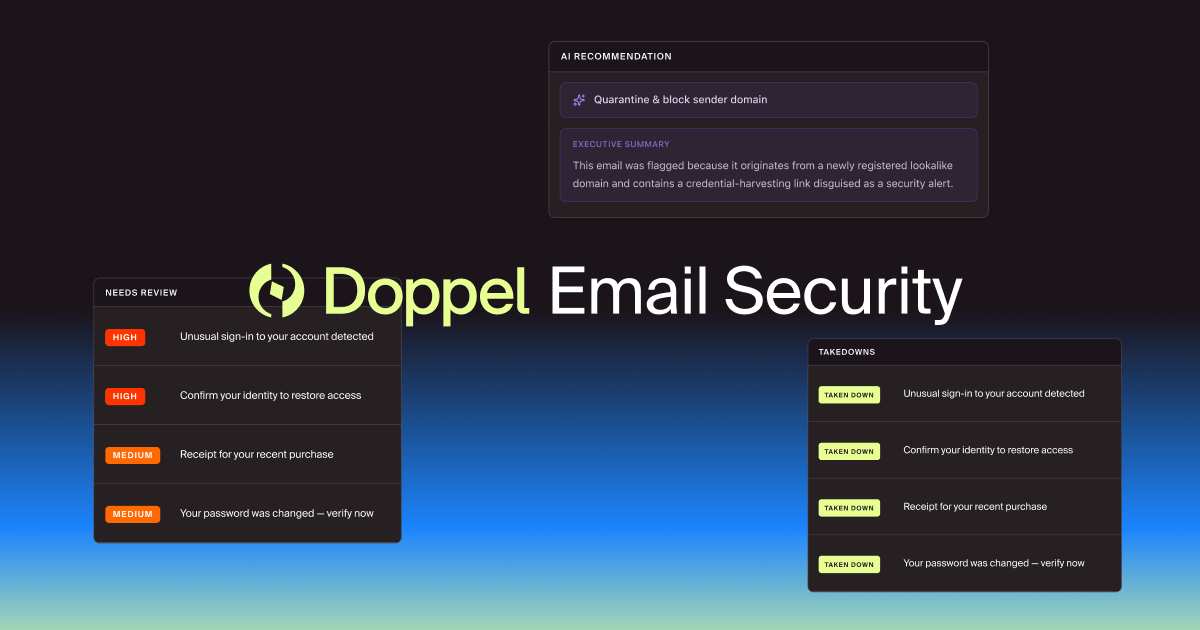
Detection isn't enough. Disruption is the difference. Meet Doppel Email Security: the most advanced agentic solution that progresses beyond blackbox ML and whitebox rule-based systems to detect, investigate, and disrupt social engineering campaigns end-to-end.


by Kevin Tian and Rahul Madduluri