
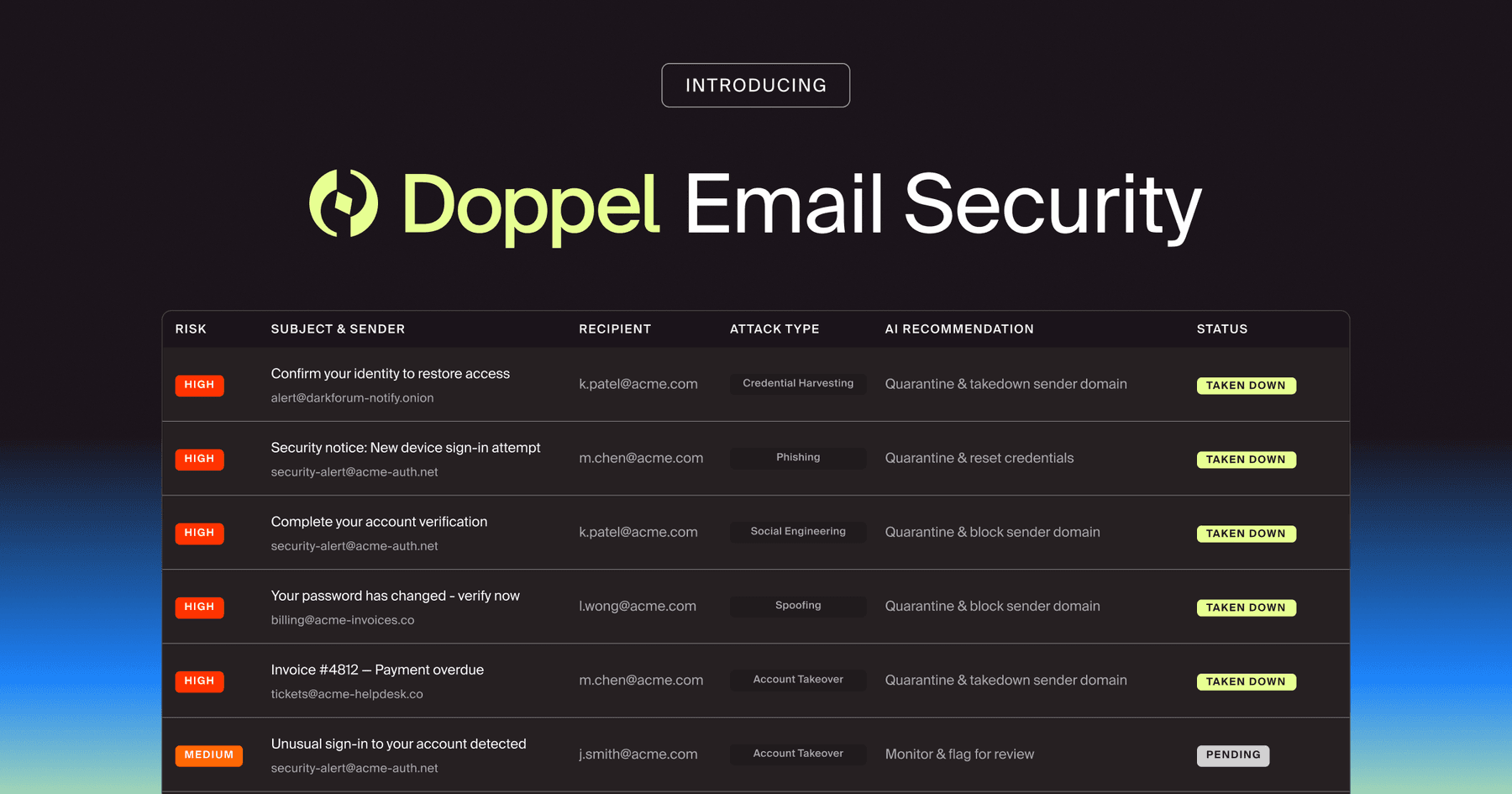
Doppel Email Security is now generally available
The agentic email security solution that empowers you to fight back against social engineering attacks. Detection isn't enough. Disruption is the difference.
A phishing email that lands in an employee's inbox exposes the visible edge of a campaign that attackers built beyond the inbox. Before the first email lands, attackers register lookalike domains, stage social impersonation assets, and open helpdesk pretexts (opens in new tab) by phone or SMS. By the time the message arrives, the attacker has already done much of the work, and generative AI (opens in new tab) compounds the problem by making preparation faster and lures harder to spot.
Cybercrime losses reached $16.6 billion (opens in new tab) in 2024, a record high, and phishing and spoofing remained the most-reported cybercrime type. The message that lands is the stage inbox-focused tools inspect most directly, which is why business email compromise, account takeover, and credential stuffing remain difficult to stop when teams score the message and stop there.
Email threat intelligence connects inbox evidence to attacker infrastructure before, during, and after delivery.
Email threat intelligence is the practice of identifying, analyzing, and acting on the attacker infrastructure and behavior behind email-borne threats. It connects the message in the inbox to the infrastructure that produced it, including sender and domain signals, and spans detection, investigation, and response.
Teams strengthen defense when they focus on stopping the attack cycle (opens in new tab) across email security, identity controls, browser controls, user reporting, and threat intelligence working together as one coordinated loop.
Email threat intelligence treats every inbox message as the visible end of the infrastructure attackers built before delivery. Inbox scoring inspects that message. The infrastructure that produced it is where the threat lives. Attackers develop domains, accounts, and other assets ahead of delivery, a pattern that ATT&CK's Resource Development (opens in new tab) tactic maps.
The value comes from understanding how attackers host, route, impersonate, and reuse the systems that make a campaign possible.
This intelligence emerges while attackers build that infrastructure. Newly registered domains, certificate issuance, DNS footprints, and compromised email accounts (opens in new tab) expose attacker preparation before a lure reaches a mailbox.
Email threat intelligence produces a campaign map that treats domains and compromised accounts as a pre-delivery attack surface. When a defender treats a message as connected to that infrastructure, a single alert becomes a view of the broader operation.
Inbox detection has improved across successive layers: block-lists and reputation, then YARA-based signatures, then behavioral and ML-based scoring. Each layer works, and those layers continue to matter. Each layer also reads the message after it lands, which leaves the campaign that produced it untouched.
Reputation and signature-based filtering are strongest when the threat has already produced known indicators, and weaker against threats that have clean reputations. BEC attacks can bypass these controls when they arrive as targeted, context-rich messages from clean infrastructure.
Phishing can use spoofing to fool human recipients and automated security tools (opens in new tab), and attackers routinely operate from compromised email accounts (opens in new tab) that pass authentication because the account itself is real.
Generative AI removes the signals that content-based scoring was tuned to catch. GenAI can already create convincing lures without the translation, spelling, and grammatical mistakes that often reveal phishing. The efficacy gap is measurable: AI-automated phishing emails achieved click-through rates of 54% (opens in new tab), compared to 12% for standard phishing attempts, a 4.5x increase.
AI-generated lures that lack a behavioral baseline are exactly the messages that content-only and behavior-only models struggle to flag.
Even a correct verdict at delivery leaves the attacker's infrastructure intact and ready to retarget. Attackers reuse tools and infrastructure (opens in new tab) to keep each campaign cheap to run. A message blocked today says little about the lookalike domain, the staged social profile, or the helpdesk pretext that will carry the same campaign tomorrow through a different vector.
Attackers use email as one stage of a multi-channel campaign modeled on the Cyber Kill Chain (opens in new tab) and MITRE ATT&CK concepts. Each stage generates intelligence that can help stop the campaign, much of it outside the inbox.
Reconnaissance starts before attackers send any message. They gather organizational data (opens in new tab), email addresses (opens in new tab), and target credentials (opens in new tab) from breach dumps, social media, and code repositories. They can also use AI to synthesize that information at scale and research business relationships to build plausible pretexts. Because this stage completes before delivery, inbox tools have no message-stage signal to read.
Weaponization turns that reconnaissance into impersonation infrastructure. Attackers acquire lookalike domains, use visual similarity and convincing subdomain structures, and can operate infrastructure that appears legitimate to recipients and some automated checks. This stage generates the strongest pre-delivery intelligence available.
A newly registered domain that obtains a TLS certificate produces a public Certificate Transparency log entry before attackers send any phishing email, and Certificate Transparency and passive DNS footprints become visible before the domain's content does.
Delivery is where the message reaches the inbox, the primary stage inbox-focused tools inspect. Adversary-in-the-middle phishing kits can intercept authentication flows in real time. Inbox-only defenses see the message, but they lack visibility into the staging behind it.
Persuasion begins after attackers make contact with the target. They engage the human and routinely jump channels, using SMS and messaging platforms to lure users into divulging credentials, or posing as IT or helpdesk staff to drive MFA reset abuse (opens in new tab), a pattern Scattered Spider activity has demonstrated.
Helpdesk social engineering has become a recurring entry point in identity-driven attacks.
Execution ends the campaign in compromise. BEC turns social engineering into direct financial loss. Attackers often launch it from a legitimate, trusted account they have already compromised, so the next victim sees a message that passes authentication checks because the account is real.
Acting on email threat intelligence end-to-end takes a loop of core capabilities: detection grounded in external infrastructure, investigation that explains verdicts at machine speed, and response that dismantles the infrastructure behind a confirmed attack.
Detection starts from attacker infrastructure. Shared registrars, hosting, and certificate patterns connect messages that a content scanner would treat as unrelated, so a single verdict can expose an entire campaign.
A verdict grounded in attacker infrastructure also catches the AI-generated lure that has no behavioral baseline.
Investigation has to run autonomously and stay auditable. Automated phishing workflows extract headers and artifacts, detonate attachments and URLs, search for other instances of the same email, and remove malicious messages before users engage.
A SOAR-based phishing workflow (opens in new tab) accelerates triage while keeping analysts in control of final mitigations. Automated recommendations need a visible path back to the underlying indicators, correlation logic, and readable policy, so confirmed verdicts stay defensible.
Response closes the loop by dismantling the infrastructure behind the message. Takedown removes malicious content by notifying the hoster or contacting a domain registrar to suspend a fraudulent domain (opens in new tab), and most cases proceed through voluntary provider action. Effective response reaches the core parties behind a campaign: hosting providers (opens in new tab), registrars, registries, and abused server or network operators.
Dismantling the sending infrastructure and malicious links behind a phish is what stops the same campaign from retargeting the organization.
Doppel is the AI-native Social Engineering Defense (SED) platform that unifies Digital Risk Protection and Human Risk Management. Email Security, announced in a pre-launch/waitlist phase with general availability planned for later in 2026, extends that intelligence layer into the inbox: detection at the inbox, disruption at the source.
Email Security delivers this through three capabilities: detection, investigation, and disruption.
Coverage follows the campaign off email: Phase 2 extends agentic detection and response to SMS, voice, and Microsoft Teams, and any confirmed phish becomes an employee simulation in one click through Doppel Human Risk Management.
Grounding every verdict in external infrastructure and dismantling the campaign behind a confirmed phish raises the cost of attacks until adversaries move on, a shift already in Doppel's telemetry as email became a leading source of attacker activity against financial services and fintech brands by April 2026.
Take a guided demo to see how Doppel ties email-borne threats to the infrastructure behind them.
Email threat intelligence is the discipline of tracing email-borne threats back to the attacker infrastructure that produced them, then acting on what that reveals. It links an inbox message to the domains, sender behavior, and compromised accounts behind it. The goal is to treat a single suspicious email as one visible part of a larger campaign and to disrupt the infrastructure behind it.
Traditional email security scores the message after it reaches the inbox, using reputation, signatures, and behavioral models to decide whether to block or quarantine it. Email threat intelligence starts from the attacker infrastructure that produced the message, connecting domains, certificates, and compromised accounts that a content scanner would treat as unrelated. That lets defenders see the campaign behind a single email and dismantle the infrastructure so it cannot retarget the organization. The two work together: the inbox verdict handles the message, and the intelligence handles the operation behind it.
Yes. AI-generated lures remove the spelling, grammar, and translation errors that once flagged phishing, which leaves content-based and behavior-based filters with little to catch. Email threat intelligence grounds its verdict in the attacker infrastructure behind the message, such as a recently registered lookalike domain or a certificate issued days earlier, so a convincing message with no behavioral baseline still gets caught. This infrastructure context is what lets defenders flag novel attacks that inbox-only tools were not built to see.

BLOG
Our graph-driven platform is built to collapse fragmented signals into a single, real-time view of active campaigns. Instead of surfacing thousands of unrelated alerts, our threat graph links domains, accounts, phone numbers, ads, and wallets into connected infrastructure maps.

by Doppel Team