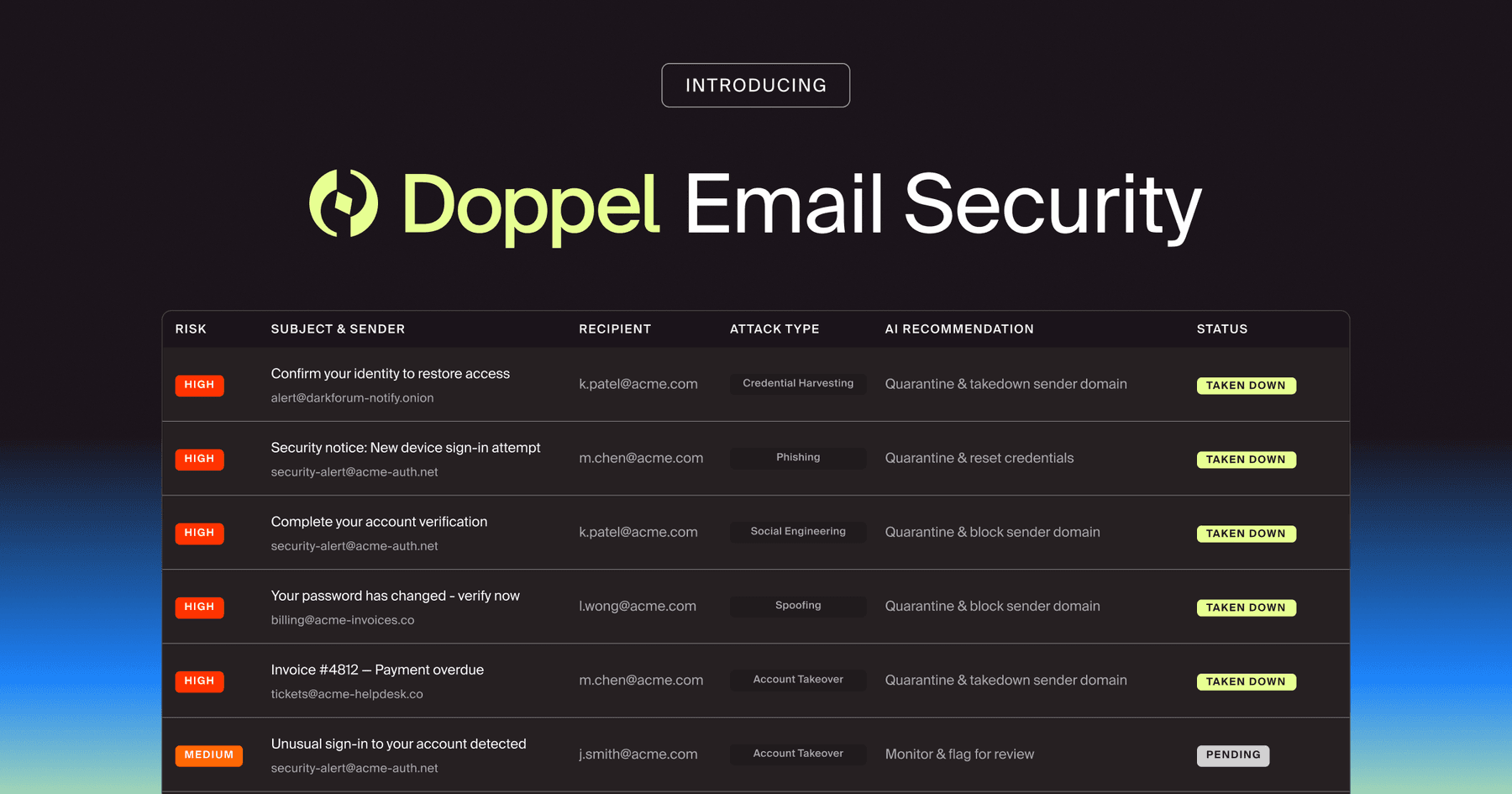
Doppel Email Security is now generally available
The agentic email security solution that empowers you to fight back against social engineering attacks. Detection isn't enough. Disruption is the difference.
Moving a phish to quarantine doesn't stop the campaign behind it. See how shifting to upstream infrastructure disruption (targeting registrars, sticky indicators, and core hosting accounts) breaks the social engineering attack chain.
For a long time, standard digital risk protection has followed a ticket-driven routine:
Meanwhile, the threat actors have already moved on.
Relying on manual, reactive takedowns is fundamentally mismatched to the adversary's speed and scale. Generative AI has collapsed attack timelines and dropped creator costs by 95% (opens in new tab). If your security posture relies on removing visible, individual artifacts one by one, you’re letting attackers run circles around your team while paying a permanent tax on your SOC’s time.
To protect digital trust, security teams must stop playing whack-a-mole with surface-level alerts. True defense requires moving upstream to execute automated, high-confidence infrastructure disruption that spikes the attacker’s cost of doing business.
Traditional security tools treat incidents as isolated alerts. This approach creates a massive operational vulnerability because it only addresses the visible symptom of an attack: the cloned webpage or the single phishing link.
Standard point tools fall short for a few reasons:
It’s not practical to alert-and-triage out of an infrastructure problem. Instead of chasing artifacts, enterprises need a strategy that targets the operational core of the campaign.
Upstream interruption focuses on the foundational components required to launch a multi-surface campaign: registrar relationships, persistent hosting setups, and the operational API endpoints that route stolen credentials or coordinate deepfake assets.
By shifting focus toward these critical nodes, security teams can proactively reduce risk. Let’s look at a few ways to accomplish this.
Instead of asking a host to delete a single page, upstream disruption targets the domain infrastructure itself. By submitting entire campaign graphs as evidence directly to registrars, teams can achieve coordinated, autonomous takedowns across complete clusters of lookalike domains before they are ever weaponized in an email loop.
Adversaries rely on specific infrastructure components that are far more expensive and time-consuming to rebuild than disposable web domains. These include specialized API endpoints, persistent phone numbers used for vishing or SMS coordination, synthetic voice modules, and ad network accounts.
When security automation identifies and takes down these sticky indicators, it breaks the ROI of the scam. The attacker is forced to spend time and capital re-engineering their core operational delivery systems.
Upstream intelligence shouldn't live in a silo. When external infrastructure is mapped and disrupted, that data must immediately feed internal controls.
Tying external brand intelligence directly to inline inbox defense means that the moment a threat is verified at the source, sending servers are blocked, malicious links are neutralized, and the entire campaign is eradicated across every inbox in the organization.
Executing upstream disruption at machine speed means taking a hard look at the underlying architecture. To take down the full campaign, security operations must move away from human-heavy ticketing and toward a unified intelligence layer powered by agentic automation.
The Doppel platform delivers this capability by unifying Digital Risk Protection (DRP), Human Risk Management (HRM), and Email Security on a single intelligence layer.
Here’s how it works:
The result is a compounding defense model. Every detection sharpens the Doppel Threat Graph, every automated intervention improves future accuracy, and the adversary is forced to move on to easier, less resilient targets.
Attackers run multi-surface campaigns at machine speed. Sending slow, disjointed abuse emails while threats move across channels is a losing battle. To protect your brand, your executives, and your users, your defense stack must operate at the root cause of the threat.
Moving upstream turns digital risk protection from a game of reactive cleanup into a scalable strategy of preventative risk reduction.
Ready to see how campaign-level correlation and agentic infrastructure disruption can harden your perimeter? Request a demo with the Doppel team today.
BLOG
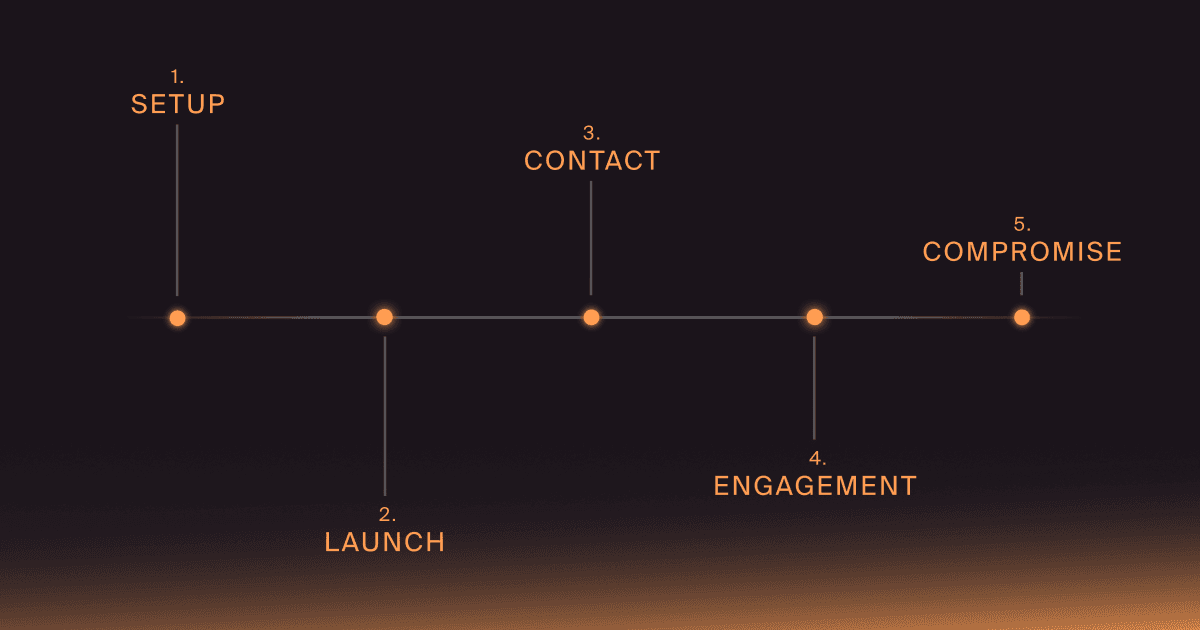
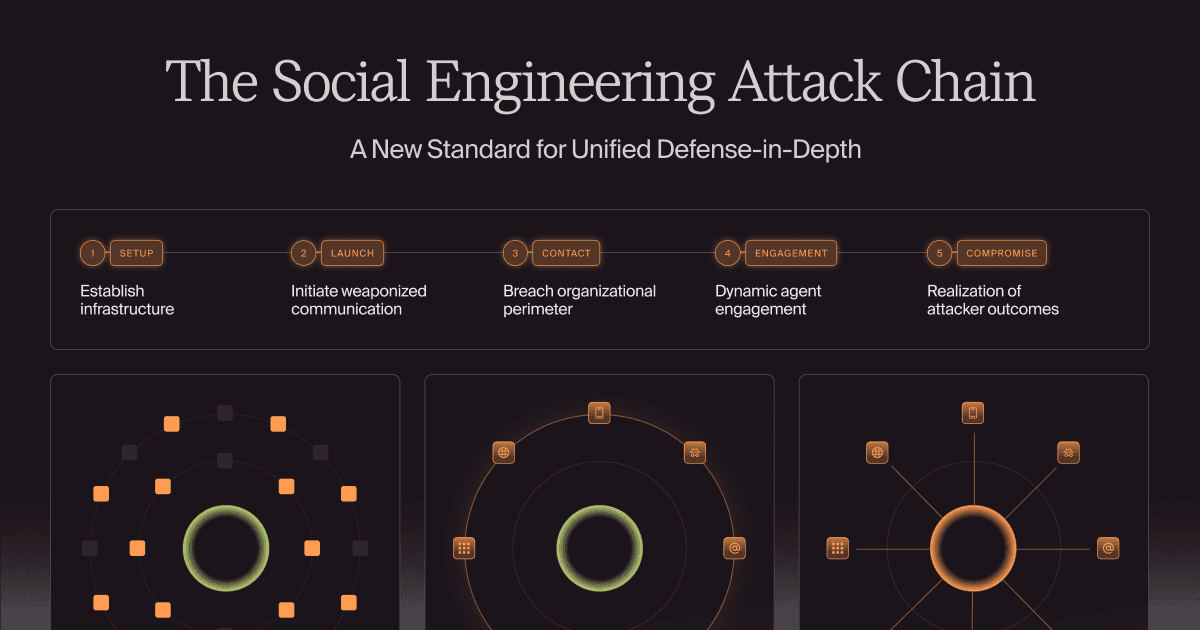
Modern social engineering is a relentless, AI-orchestrated lifecycle. Learn how to map the five-stage attack chain—from setup to contact—and why a unified defense platform is the only way to outpace AI-driven social engineering attacks.



by Bobby Ford, Rahul Madduluri, and Alvin Lin