The most dangerous shift is a collapse in the cost of production.
Over the last 24 months (opens in new tab), the security industry has witnessed a 1,000% increase in phishing volume while the cost to the average attacker has plummeted by 95%.
Deception has now become industrialized. In 2022, launching a high-fidelity, multi-channel campaign required a team of specialized operators and a significant capital outlay for custom infrastructure.
In 2026, an adversary can purchase a business-in-a-box via Phishing-as-a-Service (PhaaS) for less than the cost of a monthly SaaS subscription.
For groups like Scattered Spider, the goal is systematized exploitation that targets the single most vulnerable protocol in any enterprise: the human on the other end of a high-stress request.
This blog will cover commercialized AI-native deception, the specific "help desk gambit" used by groups like Scattered Spider, and how a unified SED framework disrupts attacker ROI at machine speed.
Why the Math Favors the Attacker
To defeat an adversary, you must first understand their balance sheet.
The traditional security model assumes that attackers have finite resources. However, generative AI and automated reconnaissance have inverted the Cybersecurity Poverty Line (opens in new tab).
Previously, "Nigerian Prince" scams were easily spotted due to poor syntax. Today, LLMs allow attackers to generate pixel-perfect, culturally nuanced lures in 100+ languages with zero manual effort.
Cloud-native attackers use automated scripts to spin up 1,000 typosquatted domains in seconds. If a legacy DRP tool blocks one, the attacker has 999 more ready to rotate.
When the cost of failure is near $0, and the potential payout for a ransomware deployment or a fraudulent wire transfer is $1,000,000, the attacker can afford to be wrong 99.9% of the time.
The Profile: Anatomy of a Scattered Spider Campaign
Scattered Spider (opens in new tab) represents the vanguard of modern social engineering. Unlike state-sponsored actors who may seek long-term persistence, these agentic adversaries prioritize velocity and multi-channel pressure.
They go beyond sending an email by orchestrating a symphony of psychological triggers.
1. The High-Stress Entry Point (The Help Desk Gambit)
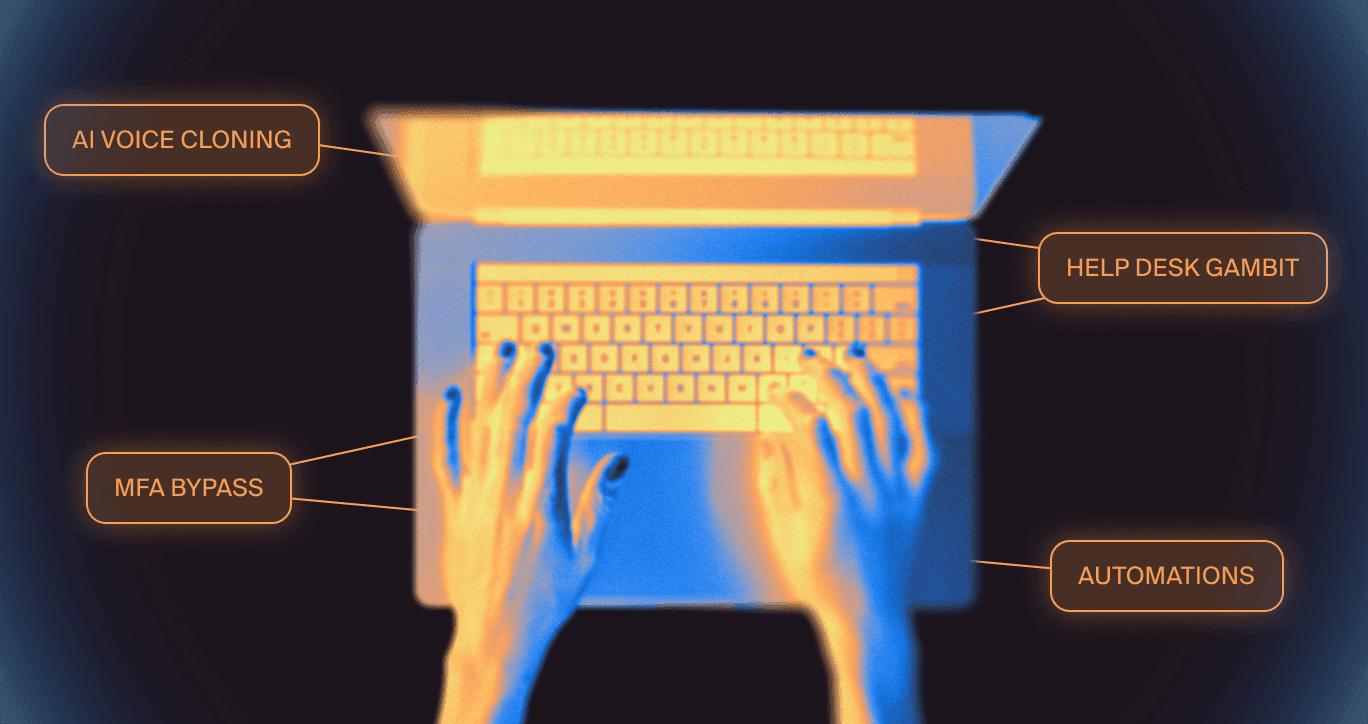
Scattered Spider specializes in the IT password reset lure. They identify an employee via LinkedIn, scrape their voice from a public speaking engagement or social media video, and use AI voice cloning to call the internal IT help desk.
The attacker creates a high-stress environment: "I’m at the airport. I have a board meeting in ten minutes, and my MFA device is broken. I need a bypass code now." In 2025, vishing (voice phishing) attempts grew by 442% (opens in new tab). Why? Because human empathy is a vulnerability that can’t be patched with a software update.
2. Bypassing the Unbeatable Controls
When the help desk analyst grants that bypass code, the attacker isn't just "in"—they have effectively neutralized a million-dollar investment in phishing-resistant MFA.
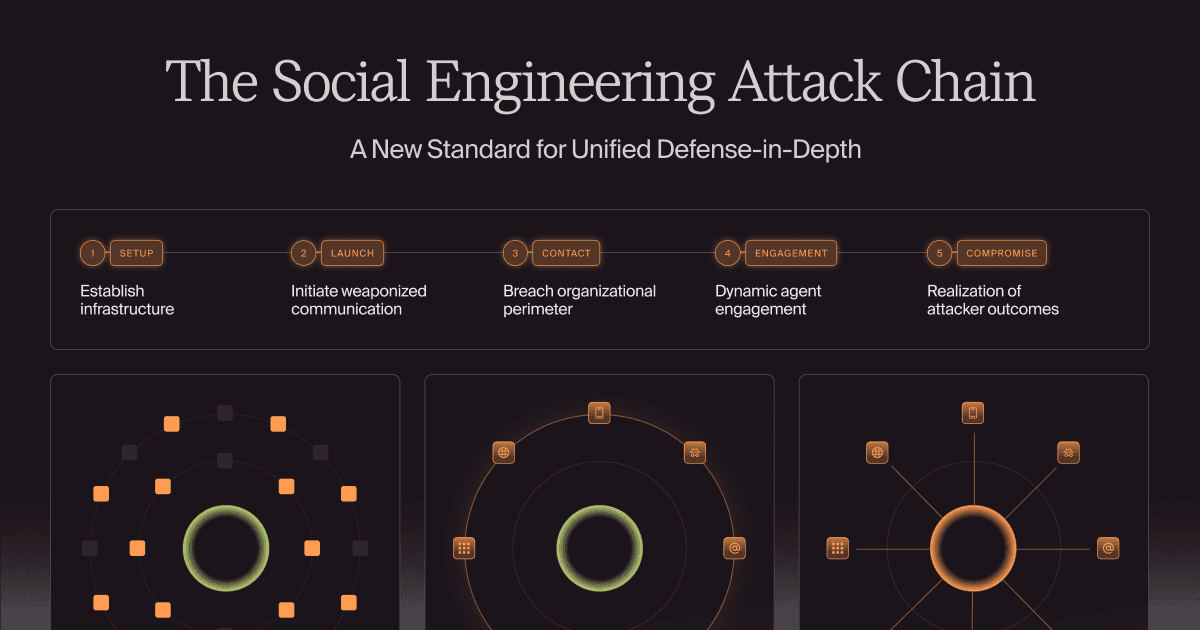
This is the social engineering attack chain in action. The attacker pivots from the help desk call to a session-hijacking proxy (Adversary-in-the-Middle) to intercept SSO tokens in real time.
3. Industrialized Persistence
Once inside, they don't stop. They use agentic AI to scan internal Slack channels and documentation for further credentials.
If they are detected and a domain is taken down, their infrastructure automatically "heals," spinning up new redirected nodes on Telegram or encrypted messaging apps to maintain communication with the victimized employees.
Why Don’t Normal Defenses Work? (+ What Does)
The reason groups like Scattered Spider remain successful is that most enterprises are defending against them using a fragmented, reactive toolkit.
Legacy Tools | Unified Social Engineering Defense (SED) |
Reactive Triage Teams wait for a user to report a phishing email to start an investigation. | Proactive Hunting Agentic AI scans the open, deep, and dark web to find infrastructure before the first email is sent. |
Whack-a-Mole Deleting one domain at a time while the attacker spins up ten more. | Infrastructure Disruption The real-time Threat Graph identifies the entire campaign cluster and dismantles the registrar, host, and social handles simultaneously. |
Static Training Employees get a compliance certificate once a year that doesn't reflect real-world stress. | Threat-Informed Simulation Doppel HRM uses live campaign data to create "high-stress" simulations that harden behavioral responses. |
Harden the Human Perimeter
Technical controls are necessary, but they’re no longer sufficient.
When an attacker can clone a CFO’s voice for mere dollars and bypass MFA via a tired help desk agent, the perimeter has moved from the firewall to the human mind.
To defend against the increasing number of attacks, CISOs must move away from security awareness and toward Human Risk Management (HRM).
This means:
- Knowing exactly which departments (e.g., finance, help desk) are being targeted.
- Using AI-native tools that disrupt the economics of deception by making every attack attempt expensive and short-lived for the adversary.
- Feeding real-world threat intelligence directly into your simulation engine so your team isn't training for yesterday’s threats.
Schedule a demo to see how Doppel’s AI-native defense can disrupt the infrastructure of deception and protect your organization from industrialized social engineering.