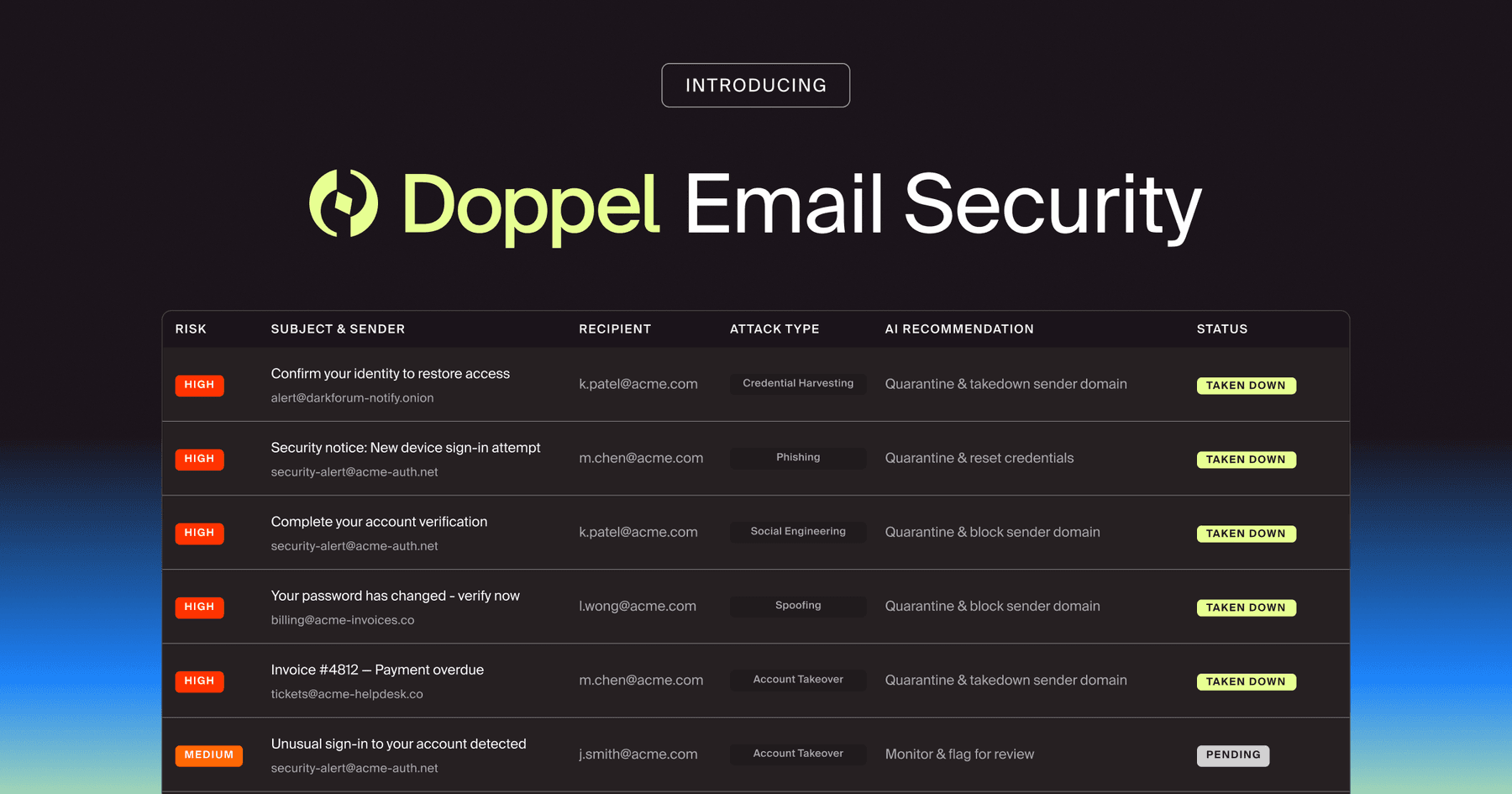
Doppel Email Security is now generally available
The agentic email security solution that empowers you to fight back against social engineering attacks. Detection isn't enough. Disruption is the difference.
Generative AI now operates on both sides of every security program. The same model families that triage alerts and draft detection logic also write spear-phishing lures and stand up lookalike sites in hours. AI-automated phishing emails achieve click-through rates of 54% (opens in new tab), compared to 12% (opens in new tab) for standard phishing attempts, a gap that reflects how quickly attacker tooling matures.
Your security team carries a double mandate: capture the technology's defensive gains while defending against attacks built with it, because the distance between those two adoption curves shows up as fraudulent wires and harvested credentials.
This article covers what generative AI means in cybersecurity, the use cases security teams deploy it for, the risks that attackers and ungoverned adoption each create, and what it takes to come out ahead on both sides.
Generative AI in cybersecurity is the application of models that produce novel text, audio, video, and code to security work. Dual use is its defining property. The capabilities defenders adopt are the same capabilities attackers weaponize.
Large language models, image generators, and audio synthesizers share a core mechanic: they learn statistical patterns from massive training data and produce new outputs that match those patterns.
In a security context, this means an LLM can draft a phishing email that resembles legitimate corporate correspondence, and an audio model can clone a voice from a short sample.
A model that summarizes threat intelligence feeds for an analyst can summarize an executive's public statements and build a convincing pretext. A voice synthesizer that powers vishing simulations for employee training can impersonate a CFO on a live call.
The technology reflects the intent of the operator and the controls around it.
Agentic systems chain reconnaissance, content generation, delivery, and adaptation into autonomous workflows that pursue a defined goal. A generative model produces one output per prompt, while an agentic system plans, executes, and adapts until it reaches that goal.
Attackers and defenders are both building these workflows, and the side that deploys them faster sets the operational tempo for the other.
Security teams apply generative AI where pattern-matching defenses stall. The highest-value use cases concentrate in four areas: reading the intent behind novel lures, compressing alert triage and investigation, converting live attacks into simulation material, and turning threat intelligence into decisions.
Signature-based detection fails against AI-generated lures because attackers construct those lures to be novel by default. LLM-based detection reads semantic intent and recognizes that a message manufactures urgency around a financial transaction even when every surface-level indicator appears legitimate.
Generative AI compresses triage by correlating threat intelligence with related activity that might not trigger a traditional alert on its own. The fastest observed incidents (opens in new tab) in 2025 achieved lateral movement and data exfiltration within minutes, and a SOC that measures manual triage in hours cannot contain threats inside that window.
LLM-assisted triage cut ticket completion time (opens in new tab) on live SOC tickets, with the most pronounced reductions on tickets requiring cross-tool correlation.
Static, template-based phishing simulations teach employees to spot last quarter's attacks. Generative AI closes that gap by converting live threat intelligence into simulation content. The lure copy and landing page visuals from a real campaign become a defanged employee exercise the same week.
AI-powered attackers generate large volumes of customized phishing variations quickly, and simulation programs that cannot produce variations at a comparable rate train against an incomplete threat model.
LLMs convert raw threat intelligence feeds into prioritized, contextualized briefs. Enterprise security teams subscribe to more concurrent feeds than any analyst team can process by hand, and indicators lose their value while they sit in a queue.
The models extract indicators of compromise from unstructured data and map each one to your organization's specific environment and exposure.
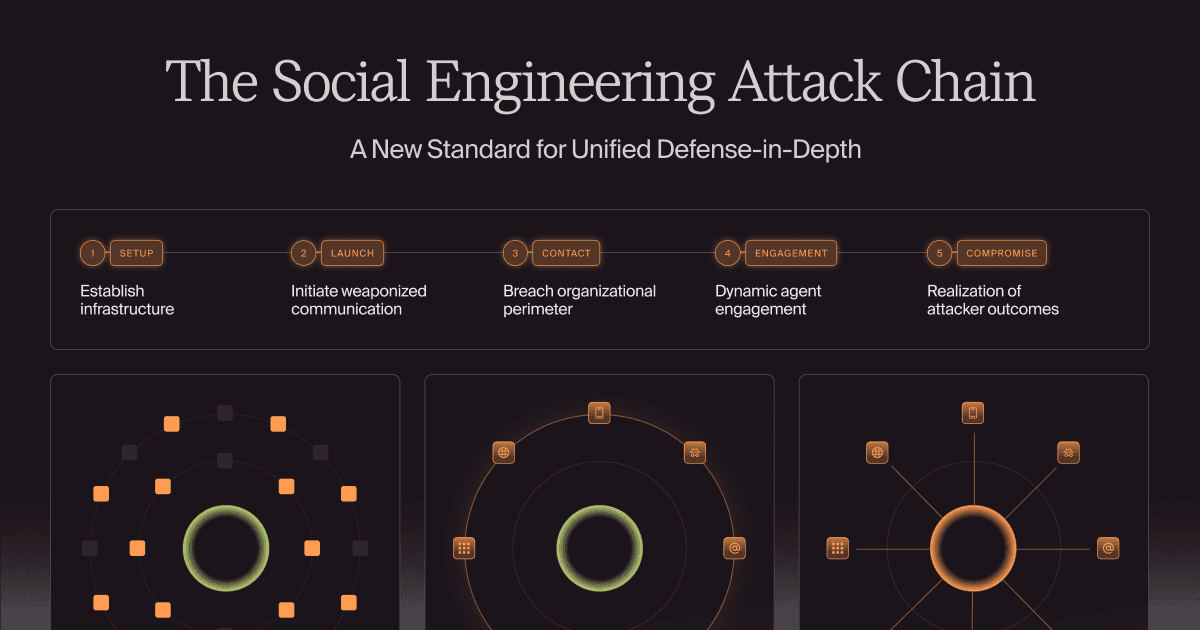
Attackers apply the same generative capabilities at every stage of the social engineering attack chain: reconnaissance, weaponization, delivery, persuasion, and execution. Campaigns that once took weeks of manual effort now take hours of machine output, and the five-stage chain maps where each capability lands.
Each stage feeds the next, with reconnaissance data shaping the lure and delivery channel before the persuasion play drives execution.
Attackers use LLMs to profile organizations (opens in new tab) and find high-value targets at a scale manual research cannot match. Conference recordings and LinkedIn profiles become raw material: a short audio clip becomes a voice clone, and an org chart becomes a pretext.
That reconnaissance feeds the infrastructure that attackers build next. Underground channels advertise tools such as FraudGPT and WormGPT (opens in new tab), and paid services commercialize jailbreak techniques. Attackers use them to produce phishing emails, clone login pages, and generate deepfake media on demand.
A single campaign now runs across email, SMS, voice, social media, and messaging apps simultaneously, with lures tuned per channel and per target. Attackers already operate inside enterprise collaboration workflows. In one documented attempt (opens in new tab), they created a fake WhatsApp account and set up a Microsoft Teams meeting using voice cloning and edited YouTube footage of a senior executive.
Voice clones generated from short audio samples sound real enough that employees act on direct instructions that appear to come from their own leadership. The technique reaches the highest levels of authority.
Attackers sent text messages and AI-generated voice messages impersonating senior U.S. government officials, as a May 2025 advisory (opens in new tab) documented.
Once persuasion lands, the payout moves faster than the controls meant to stop it. Deepfake meeting fraud has already put employees on video calls where every other participant appeared to be a known colleague, and one multinational engineering firm (opens in new tab) approved transfers worth millions before the fraud surfaced.
Attackers who execute within the verification window, or who use stolen session tokens that bypass authentication entirely, face no automated check.
Generative AI carries risk on the defender's side of the ledger as well. Three failure modes erode the advantage the technology promises: ungoverned use, AI features bolted onto single-channel tools, and adoption constraints that attackers ignore.
Ungoverned adoption leaks sensitive data before any attacker gets involved. 63% of breached organizations (opens in new tab) either lacked an AI governance policy or were still developing one in 2025. Shadow AI persists even when sanctioned alternatives exist, and employees paste proprietary source code and customer data into unauthorized tools that sit outside approved data-handling controls.
Hallucinations compound the problem: AI outputs carry confident errors that survive into response decisions when no one verifies the findings.
Adding AI capabilities to a domain-only monitor produces a domain-only monitor with AI. Legacy security awareness training tools that add AI-generated phishing simulations while remaining email-centric leave the workforce unprepared for voice cloning and deepfake video impersonation.
The AI accelerates a single-channel capability while attackers operate across voice, SMS, social media, and messaging apps simultaneously.
Every defensive deployment carries prerequisites that attacker tooling skips. Organizations subject to GDPR (opens in new tab) must account for regulatory requirements when they design and operate AI-driven decision systems, and compliance and data-quality obligations apply before any defensive model ships. Attackers face none of this. They deploy immediately, iterate without prerequisites, and use uncensored models with no governance cycle.
The result is a structural asymmetry (opens in new tab) that favors offense.
Your security program earns generative AI's upside by meeting three requirements at once: detection and response that run at machine speed across every channel, human judgment on the decisions that carry risk, and a training loop fed by the attacks AI generates. The program weakens when any one of the three is missing.
The opening stages of an attack form outside the infrastructure you monitor. Lookalike domains, fake profiles, and scam ads go live before any message lands in an inbox, so detection must extend beyond email to voice, SMS, social media, messaging apps, paid ads, and domains.
Speed matters as much as coverage, because attacks that achieve lateral movement in minutes demand detection and response on the same timescale.
Autonomous triage and containment work for high-volume, well-characterized, reversible actions. Novel threats, high-stakes environments, and irreversible consequences require human analysts who understand business context.
Build tiered autonomy (opens in new tab) into the program, and match the level of human involvement to the risk and reversibility of each decision.
Simulations change behavior when they mirror the campaigns attackers are running right now. Wiring external detection into the training pipeline turns each detected campaign into a role-based exercise, with invoice fraud scenarios going to finance teams and deepfake impersonation scenarios going to executives.
The moment someone makes a mistake is when they are most receptive to learning, and just-in-time intervention delivers the lesson within hours.
Doppel is the AI-native Social Engineering Defense (SED) platform that unifies Digital Risk Protection and Human Risk Management against exactly this dual-use problem. The Doppel Threat Graph continuously ingests signals across domains, social media, paid ads, telco, dark web, and messaging platforms, then correlates them into campaign-level views of attacker infrastructure.
Agentic AI executes takedowns at scale, so analysts focus on the complex escalations that require human judgment.
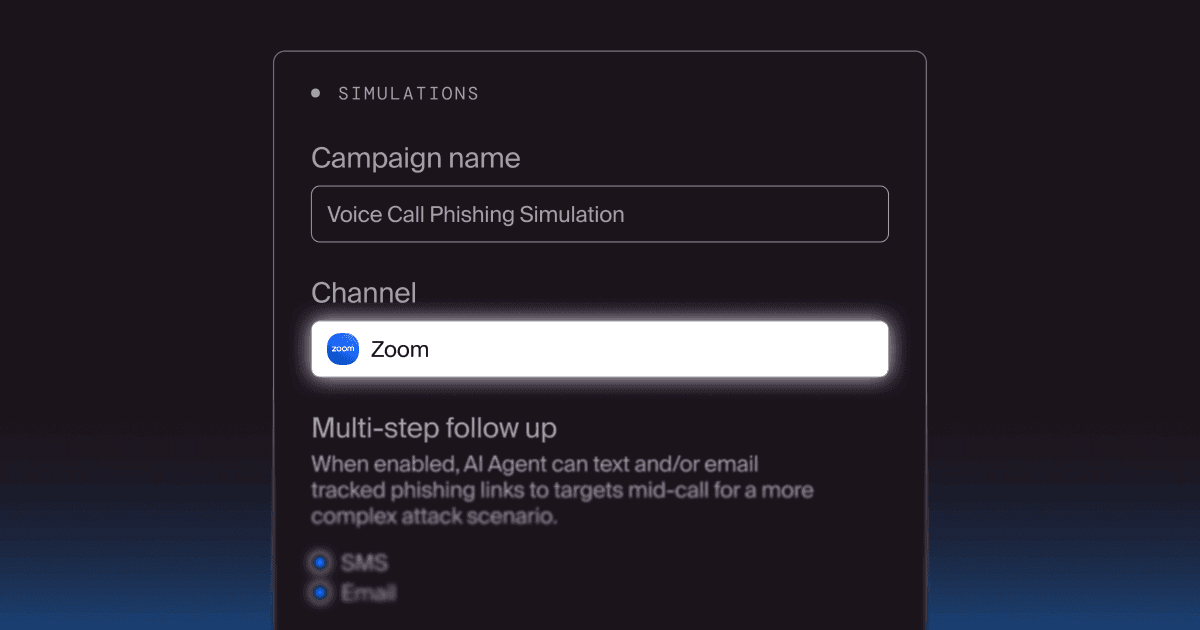
The closed loop between external detection and internal training gives security teams a structural advantage. When Doppel's DRP pipeline identifies a real campaign, Dynamic Simulation converts that campaign's content into an employee simulation across email, voice, SMS, and other conversational channels.
Coinbase used Doppel to dismantle large volumes of fraudulent social media accounts and domains.
The defensive workflow mirrors the attacker tooling described earlier, stage for stage:
Reconnaissance machinery, content generation, and campaign conversion all now run on the defender's side.
Generative AI keeps compounding on both sides of the fight. The security leaders who pair AI-native defense with governed adoption set the pace that attackers have to answer. The goal is to make every campaign more expensive to run than the return it generates, until targeting your brand stops paying.
Request a demo to see how Doppel puts generative AI to work across detection and dismantlement, with employee training connected to both.
BLOG
Attackers don’t need days anymore — they need minutes. Our latest customer story with OpenAI shows how Doppel rebuilt social engineering defense for that reality, cutting analyst workloads by 80% and compressing response times from hours to minutes.



by Rahul Madduluri, Vinci Chen, and Kiran Arimilli
BLOG
Modern social engineering is a relentless, AI-orchestrated lifecycle. Learn how to map the five-stage attack chain—from setup to contact—and why a unified defense platform is the only way to outpace AI-driven social engineering attacks.


by Bobby Ford, Rahul Madduluri, and Alvin Lin