In 2025, the mean time to identify and contain a breach dropped to 241 days (opens in new tab), a nine-year low and a real improvement from the 287-day peak in 2021. The catch is that it's still more than eight months of attacker presence inside an organization, enough time to exfiltrate intellectual property, employee and customer PII, and financial data.
Attackers also generate lures, infrastructure, and impersonation campaigns in minutes across multiple channels, and a defense built on manual triage, ticket-based takedowns, and generic annual training can't match that velocity, regardless of how many analysts you add.
Agentic AI in cybersecurity compresses the threat-detection-to-takedown window by giving security teams autonomous defense that operates at the same speed attackers do. This article defines agentic AI, explains what it means in a cybersecurity context, and shows how the role of the security analyst is evolving.
Key Takeaways
- Agentic AI describes software that reasons about a situation, decides on a course of action, and executes it toward an objective with minimal human intervention.
- In cybersecurity, agentic AI observes signals across multiple channels, assesses whether they indicate malicious intent, and takes the necessary actions.
- Agentic AI reshapes four core cybersecurity workflows: detection, triage, response, and resilience into autonomous, end-to-end flows.
- Doppel applies agentic AI to social engineering defense, detecting impersonation across every channel, executing takedowns at scale, and turning live attacks into employee training in minutes.
What Is Agentic AI?
Agentic AI describes software systems that reason about a situation, decide on a course of action, and execute that action toward an objective with minimal human intervention. They operate through a continuous loop of perception, reasoning, and action, ingesting signals from their environment, weighing options against a goal, and taking steps that move the work forward themselves, instead of handing off intermediate steps to a human.
In a cybersecurity context, agentic AI is a system that observes a security situation across noisy, multi-channel signals. It assesses whether those signals indicate malicious intent, determines the appropriate enforcement path, and executes it via direct API connections to the relevant platforms.
Three Capabilities That Define an AI Agent in Cybersecurity
AI agents in a cybersecurity workflow have three capabilities that map to the stages of the perception-reasoning-action loop, framed around how security teams actually work.
- Reasoning about signals in context. An AI agent evaluates signals against behavioral patterns rather than matching them to a static database. When a newly registered domain uses a brand's logo, mirrors its login page, and links to infrastructure associated with known impersonation campaigns, an agent synthesizes those signals into a judgment about malicious intent.
- Deciding on the right enforcement path. Once the agent determines a domain is malicious, it selects the appropriate response. It picks which registrar to contact, which platform API to invoke, and whether to include connected social profiles and ad campaigns in the same action.
- Acting through direct API execution. The agent executes the takedown through direct API connections to registrars, social platforms, ad networks, and telco providers. The action completes without a ticket queue or a handoff delay, and the agent logs and justifies the decision in writing for audit purposes.
Together, these three capabilities separate an agent from a script. The agent reasons about whether a response is warranted, picks the right one, and carries it out.
How Agentic AI Differs From Existing Security Approaches
Most security teams already run some mix of rule-based automation and manual SOC workflows. Agentic AI is a different category from both, and the clearest way to see what it actually does is to compare it against each one.
Agentic AI vs. Rule-Based Automation
Rule-based automation follows a fixed script: if an X indicator appears, execute a Y response. That model handles known, repeatable scenarios well and powers most SOAR deployments. It predictably fails the moment an attacker introduces a variation that the playbook doesn't cover. Alerts that fall outside the scenario stop the workflow or send it down the wrong path.
Agentic AI evaluates context and adapts. Instead of executing a fixed branch, it reasons about the intent behind a signal, picks an enforcement path appropriate to the specific case, and handles new attack variations without constant manual playbook updates. The system improves as it processes more campaigns, so coverage expands without a proportional increase in engineering effort.
The practical implication is that rule-based automation scales the actions you've already scripted. Agentic AI scales the decisions in front of those actions, the part of security work that used to require an analyst.
Agentic AI vs. Manual SOC Workflows
Manual workflows are bounded by human throughput, human attention, and human consistency. Agentic AI isn't, and the gap shows up in three places.
Attacker infrastructure now goes from registration to live campaign in minutes, far faster than manual triage architectures built for hourly response cycles can intercept. The volume of AI-generated lures will only continue to grow faster than any team can process manually.
Human throughput also can't sustain simultaneous threat monitoring across domains, social media, advertising networks, messaging platforms, and telecommunications. Security teams must prioritize some surfaces over others, which means attackers can shift to the channels no one is watching.
Once alert volume consistently exceeds processing capacity, alert fatigue sets in. Analysts reduce response depth across the queue, including on genuine threats, and different analysts make different judgment calls on similar signals depending on experience, fatigue, and shift timing.
Agentic AI Is Reshaping Four Cybersecurity Workflows
Agentic AI is changing how core security workflows operate. The shift collapses steps that previously required separate teams and tools into autonomous, end-to-end flows.
1. Detection
AI agents evaluate observed behavior against cataloged adversary patterns instead of static indicators of compromise. The MITRE ATT&CK framework (opens in new tab) catalogs over 200 enterprise techniques and 470 sub-techniques used by more than 170 tracked threat groups across more than 50 documented campaigns, and it expands through regular release cycles as new adversary behavior emerges.
Agents can recognize a credential-harvesting pattern, such as phishing for information or a brand-impersonation lure tied to a spearphishing link, even when the specific domain, sender, or payload is brand new.
2. Triage
AI agents autonomously triage alerts by analyzing indicators of compromise and contextual data, then flag only the most critical for analyst review.
Phishing alerts are the ideal initial use case because the volume is overwhelming and the patterns are well understood. The agent correlates a spoofed domain with linked social profiles, connected phone numbers, and associated ad campaigns, producing a campaign-level view of the attack. Each decision comes with an AI-written justification that shows analysts and auditors why the agent took the action it took.
3. Response
When triage confirms a threat, the agent executes takedowns directly against the platforms that host the attacker's infrastructure, including registrars, hosts, social networks, and ad networks.
The entire connected campaign can be brought down in a single action rather than as a sequence of disconnected tickets. Defenses need to match the pace of AI-coordinated offensive campaigns that register domains, launch fake sites, and adapt evasion tactics dynamically through workflow automation.
4. Resilience
AI agents convert live threat data into simulation and training material, closing the gap between external defense and internal resilience. Legacy security awareness programs update quarterly or annually, using generic email templates that bear little resemblance to the multi-channel attacks employees actually face.
With agentic AI, a phishing campaign dismantled externally today becomes an employee simulation tomorrow, built from the same lures, landing pages, and infrastructure the attacker just used.
How Agentic AI Changes the Role of the Security Analyst
Agentic AI removes the routine work that drains analyst time and attention, concentrating their effort on the judgment-heavy work that actually requires human expertise.
Eliminating the Repetitive Triage That Causes Alert Fatigue
Alert fatigue is a degradation cycle. Alert volume overwhelms throughput; shallow triage increases false-positive rates; elevated false-positive investigation accelerates burnout; and burnout drives attrition that erodes institutional knowledge.
Agentic AI breaks that cycle by handling high-volume, lower-complexity triage autonomously, so analysts spend their time on the cases that genuinely require context, legal judgment, and complex reasoning.
Moving Analysts Up the Stack to Strategic Work
With routine triage handled, higher-value roles open up. Analysts can pursue sustained threat hunting across time horizons that reactive triage prevents, or build more precise detection logic from AI-surfaced patterns. They can also use the extra time to translate technical risk into board-level communication as strategic advisors.
Letting Small Teams Operate Like Larger Ones
The volume, variety, and velocity of modern attack surfaces shift faster than human teams can keep up with, and it isn't feasible to expand coverage by adding more headcount to the SOC.
When agentic AI handles detection, correlation, and enforcement quickly as threats emerge, a small team can focus its specialized skills on the highest-impact work.
How Doppel Puts Agentic AI to Work for Social Engineering Defense
Doppel is the AI-native Social Engineering Defense (SED) platform. It unifies Digital Risk Protection and Human Risk Management into a single defense platform that detects impersonation and social engineering threats, dismantles the attacker infrastructure behind them, and trains employees against the live tactics attackers use in the wild.
The platform runs on the Doppel Intelligence Layer, a shared architecture built on the Threat Graph, a multi-agent agentic AI engine, and the Agentic Security Surface for bidirectional integration with the rest of the security stack.
Agentic Detection and Triage Across Every Channel
Doppel's agentic AI detects impersonation across domains, social media, paid ads, app stores, messaging apps, telco, dark web, and crypto. The Doppel Threat Graph connects spoofed domains, fake profiles, scam ads, and malicious messaging into full attacker campaigns instead of isolated alerts. Because the agents evaluate intent and context instead of matching against a signature database, they also catch zero-day attacks that pattern-based defenses miss.
Agentic Takedowns at Scale
Doppel's agentic AI correlates, prioritizes, and executes takedowns across registrars, platforms, ad networks, and telco providers, with expert analysts on standby for complex escalations. The Threat Graph coordinates the takedown across the connected campaign, so the agent disrupts spoofed domains, social profiles, telco infrastructure, and ad campaigns together in a single action instead of chasing them asset-by-asset.
The economic effect on the attacker is that coordinated, repeated takedowns raise the cost of rebuilding a campaign and reduce the incentive to keep targeting the brand.
Simulation and Training From Live Attack Data
Doppel's one-click threat-to-simulation conversion turns a real phishing campaign dismantled externally today into an employee simulation tomorrow, built from the same lures and landing pages the attacker just used.
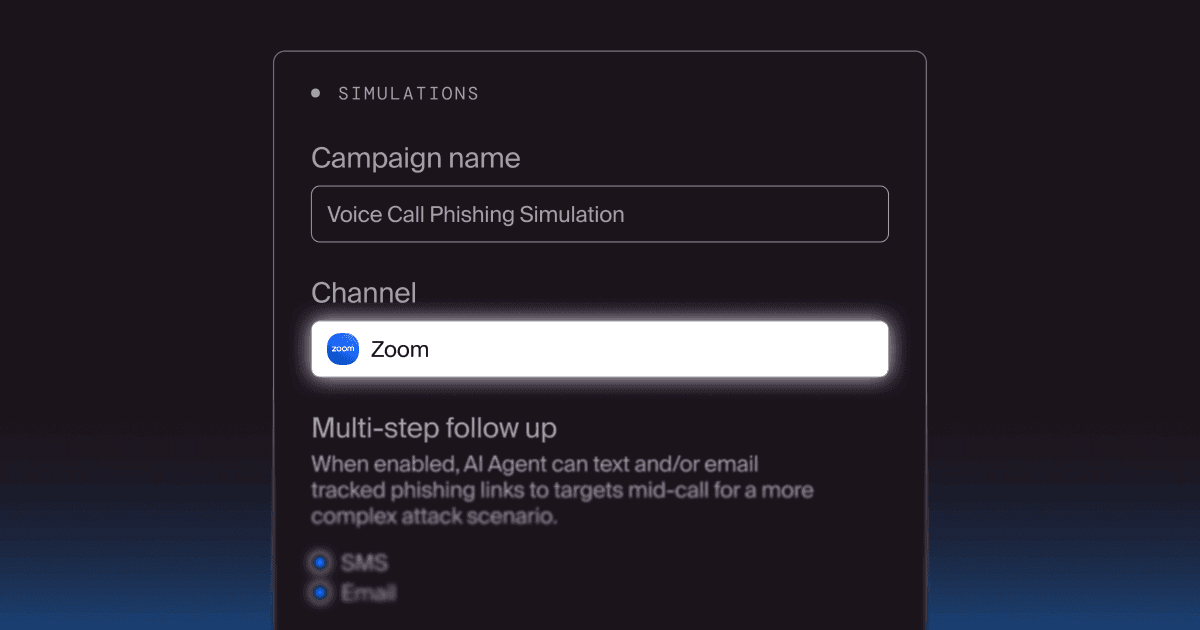
Doppel Simulation runs across email, voice, SMS, Microsoft Teams, Zoom, Telegram, and WhatsApp. Vibe Phishing generates complete multi-step campaigns from a natural-language prompt, and Recon AI Agents pull company-specific OSINT to make simulations realistic from day one. Every detection strengthens training, and every takedown strengthens the Threat Graph for every customer.
Getting Started With Agentic AI
The natural starting point for agentic AI is the workflow attackers are already automating: social engineering. Attackers use AI across multiple channels to run simultaneous impersonation campaigns, and a defense built on manual triage and ticket-based takedowns can't close that gap, regardless of how many analysts you add.
Detection, triage, takedown, and training all benefit from autonomous execution, and the feedback loop between external threat intelligence and internal resilience compounds over time.
Doppel detects impersonation early, dismantles the infrastructure behind it before attacks escalate, and builds resilience through training and simulation drawn from live attack data. Request a demo to see how Doppel uses agentic AI to protect individuals and brands from AI-powered impersonation.