

What Is Threat Detection and Response (TDR)?
Threat detection and response (TDR) is the continuous practice of watching an organization's endpoints, networks, identity systems, cloud services, and logs for malicious activity, then investigating, containing, and remediating whatever monitoring confirms.
Sensors surface suspicious activity for analysts to scope; response tools then contain the affected accounts, hosts, or external infrastructure.
How TDR works
TDR runs a repeating sequence: detect, investigate, contain, remediate, recover, then feed lessons back into detection. The detect half splits into continuous monitoring and adverse-event analysis (the DE.CM and DE.AE (opens in new tab) categories of NIST CSF 2.0); the respond half covers incident management, analysis, mitigation, and communication. Detection runs continuously, while response and recovery sit on standby until an incident starts.
The April 2025 revision (opens in new tab) of this lifecycle calls for teams to share lessons as soon as they surface, while the incident is still open.
In a SOC, the sequence maps onto analyst tiers. Take a credential-dumping attempt on a Windows host: an EDR sensor flags LSASS credential dumping (opens in new tab), an ATT&CK-documented behavior. A Tier 1 analyst triages the alert and collects context; a Tier 2 responder correlates it with identity logs to establish scope and impact.
A SOAR playbook isolates the device and disables the account, eradication removes the attacker's tooling, recovery restores the host, and the team tunes a detection so the next attempt surfaces sooner.
When the threat sits outside infrastructure the organization owns, the loop ends differently. A lookalike domain hosting a fake login page requires a takedown, since the organization does not control the infrastructure.
Under ICANN's DNS abuse obligations (opens in new tab), a registrar that concludes a domain is being used for DNS abuse must act promptly to mitigate it, including suspending the name via the clientHold EPP status code; ICANN's guidance gives a two-business-day investigation as one illustrative example, not a fixed deadline.
Why TDR matters
TDR exists because prevention fails. The discipline assumes determined attackers will eventually bypass preventive controls, so exposure depends on how long an attacker operates unnoticed: the longer attacker dwell time (opens in new tab) runs, the more data can leave, the higher the remediation cost, and the deeper the foothold.
Detection speed also affects regulatory reporting windows. Public companies must file Item 1.05 of Form 8-K (opens in new tab) within four business days of determining a cybersecurity incident is material. New York's Part 500 requires Class A companies (opens in new tab) to run endpoint detection with centralized logging, and gives all covered entities a 72-hour notification (opens in new tab) window after a cybersecurity event. Under DORA, EU financial entities send an initial notification within four hours of classifying an ICT incident as major.
The SEC clock starts at the materiality determination and DORA's at major-incident classification, so slow detection compresses the time left to investigate.
Detection must also cover attacks that start when an attacker manipulates a person. Social engineering bypasses technical controls by exploiting trusted workflows: attackers impersonate colleagues, spoof caller ID in coordinated phishing campaigns (opens in new tab), and route through help desks and poisoned search results.
Regulators now target the same pattern directly: attackers impersonating IT help desk staff to extract credentials and MFA codes by phone prompted a February 2026 vishing advisory (opens in new tab) to New York-regulated entities.
A SOC built on internal telemetry has no feed that sees brand impersonation infrastructure (opens in new tab), which typically never touches the company's own systems.
Core components of TDR
An enterprise TDR capability combines these layers:
- Telemetry sources. Endpoint sensors, network flow and DNS logs, proxy and firewall logs, identity provider logs, and cloud audit logs are the standard data sources for assessing ATT&CK coverage (opens in new tab); email adds another domain. External footprint monitoring adds lookalike domains, fake social profiles, scam ads, and dark web listings.
- SIEM. The correlation and alerting layer ingests logs, applies detection rules, and supports compliance and forensics; it commonly pairs with external SOAR capabilities to automate response, per joint SIEM and SOAR guidance (opens in new tab).
- Behavioral analytics (UEBA). Machine-learning baselines for users, servers, and applications flag deviations that indicate compromised accounts or insider activity.
- SOAR. Playbooks automate post-detection work: alert enrichment, escalation, IP blocking, account disabling, and device isolation, applying predefined playbooks (opens in new tab) to whatever SIEM, EDR, and other tools produce.
- Scoped detection tools. EDR (opens in new tab) covers endpoints, NDR (opens in new tab) applies behavioral analytics to network traffic, ITDR (opens in new tab) watches credentials and privilege escalation, and XDR (opens in new tab) correlates those layers with native response workflows.
- Analysts and delivery model. Tier 1 triages, Tier 2 investigates and advises on remediation, Tier 3 hunts and tunes detections. MDR delivers those SOC functions (opens in new tab) on a provider-operated stack.
- Detection engineering. Teams map detections to MITRE ATT&CK techniques (opens in new tab) so rules catch adversary behavior regardless of toolset, and manage the logic as detection-as-code, in formats such as Sigma.
How to implement TDR
Monitor continuously (opens in new tab) so an intruder has nowhere quiet to sit, across wired and wireless networks, flows, and services such as DNS and BGP. Collect, alert on, and retain audit logs (opens in new tab) long enough to reconstruct an intrusion after the fact.
Extend telemetry to the external attack surface, where the SOC has no sensors: watch for lookalike domains, brand impersonation, credential leaks, and impersonation infrastructure aimed at customers and employees.
- Assess coverage against MITRE ATT&CK. Run the coverage assessment (opens in new tab) first, layer threat intelligence to rank the gaps, then write analytics to close them.
- Build playbooks and automate selectively. Validate scoped playbooks (opens in new tab) on a schedule before automating them; noisy SIEM pipelines degrade SOAR performance.
- Exercise the plan. Run incident response exercises (opens in new tab) annually so the team can execute the plan under real pressure, not for the first time during an incident.
Together, continuous monitoring, tested coverage, and validated playbooks keep a TDR program effective as attacker tactics change.
How Doppel helps
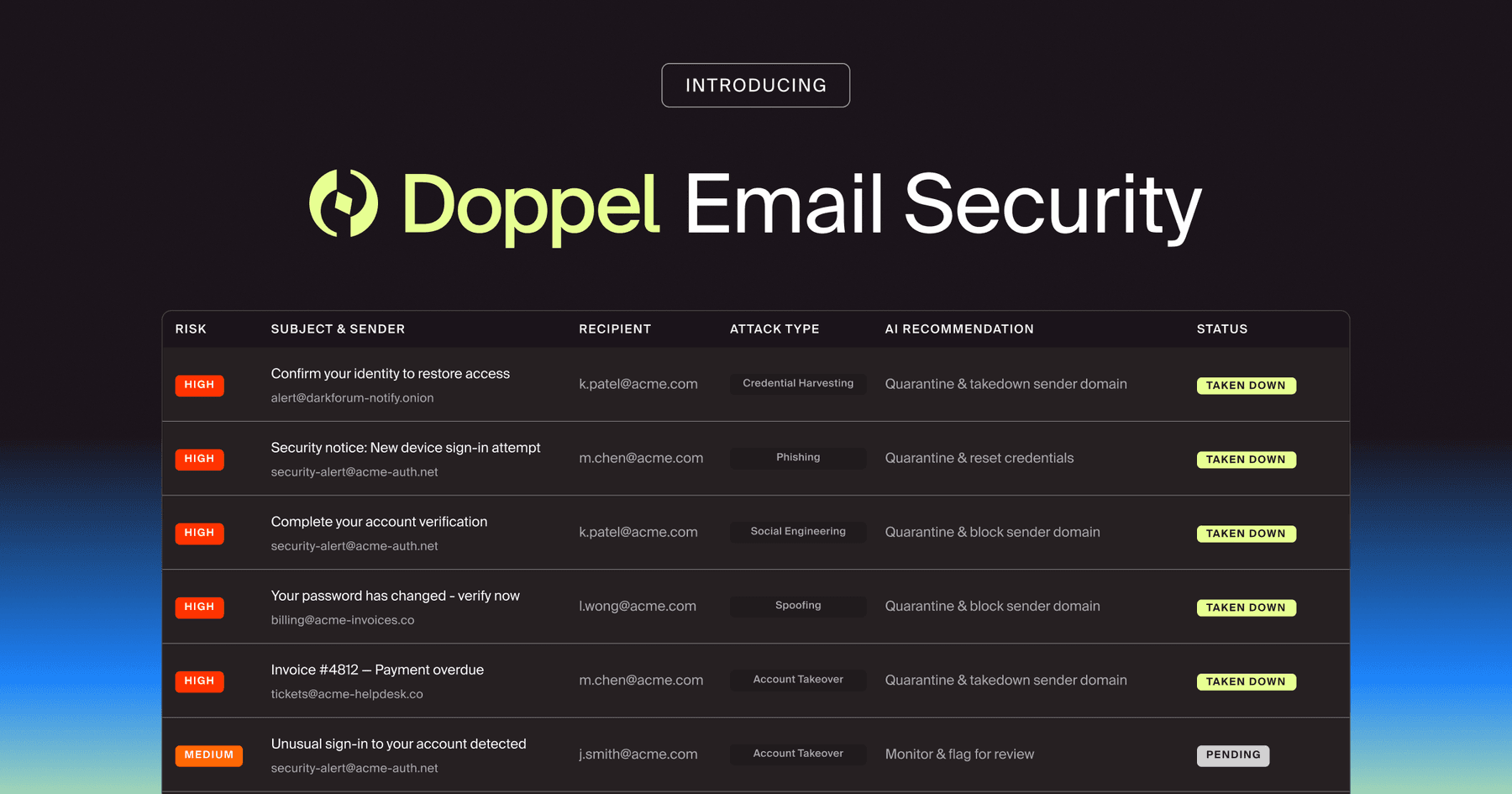
For the external half of this program, Doppel is the Frontier AI-native Social Engineering Defense (SED) platform unifying Digital Risk Protection (DRP) and Human Risk Management (HRM). It runs the detection, investigation, and takedown loop for impersonation infrastructure that internal sensors typically cannot observe.
For a lookalike domain, fake profile, or scam ad, TDR responds with a takedown workflow. The Doppel Threat Graph connects spoofed domains, fake profiles, impersonated ads, and malicious texts in a single, interactive graph, so teams investigate at the campaign level and dismantle the system behind the scam.
Doppel's agentic AI correlates signals and prioritizes campaigns, then executes multi-channel takedowns across registrars, hosts, social platforms, ad networks, and telcos, while analysts validate edge cases and escalations. Brand AbuseBox pulls employee- and customer-reported phishing and abuse emails into the same loop, and each completed takedown feeds campaign infrastructure back into the graph, sharpening detection of related assets and rebuild attempts.
Request a demo to get started.
Frequently asked questions about threat detection and response
What is threat detection and response?
Threat detection and response is the ongoing practice of monitoring an organization's systems for signs of malicious activity, investigating alerts to confirm a real threat, and containing and remediating it before it causes damage. It combines telemetry from endpoints, networks, identity systems, cloud services, and email with analytics platforms such as SIEM (security information and event management) and XDR (extended detection and response), automation through SOAR (security orchestration, automation, and response), and analysts who triage, investigate, and hunt. The practice assumes attackers will eventually bypass preventive controls, so its measure of success is how quickly analysts find and remove an intruder.
What is threat detection and response in cybersecurity?
Threat detection and response maps to the Detect and Respond functions of NIST Cybersecurity Framework 2.0 (opens in new tab) and to the NIST SP 800-61 incident handling lifecycle: detection, analysis, containment, eradication, and recovery. Detection covers continuous monitoring and analysis of anomalies and indicators of compromise; response covers incident management, investigation, mitigation, and reporting. Digital risk protection extends the same loop to threats outside the company's own infrastructure, such as lookalike domains and fake social accounts, where the response action is a takedown.
What is the difference between TDR, EDR, XDR, and MDR?
TDR is the umbrella discipline; the others add a scope or delivery model. EDR (opens in new tab) (endpoint detection and response) monitors and responds to threats on laptops, desktops, and servers. XDR (opens in new tab) (extended detection and response) correlates telemetry from endpoints, networks, identity, cloud, and email into one platform. MDR (managed detection and response) is a service in which an outside provider runs SOC functions remotely on a predefined technology stack. EDR and XDR are tool categories; MDR is a delivery model.
What is an example of threat detection and response?
An attacker registers a domain one character off from a bank's, copies its login page, buys a search ad against the bank's name, and texts customers a link. Detection starts with the domain registration, then connects the ad and SMS lure; investigation links all three to one campaign. Responders submit takedown requests to the registrar and ad network, then contact the carrier and verify that the content is offline. Inside the network, the equivalent sequence is an endpoint alert for credential theft, correlation with identity logs, isolation of the affected host, and revocation of the compromised account.