

What Is a Security Operations Center (SOC)?
A security operations center (SOC) is the centralized team and function that continuously monitors (opens in new tab) an organization's systems and networks, detects security incidents, and coordinates the response to them. It is the focal point for security operations and computer network defense, staffed by analysts and incident responders who run monitoring, correlation, and forensics tools against event data from many sources, supported by security engineers.
Organizations can run a SOC (opens in new tab) in-house, outsource it, or split responsibility between internal and external teams.
How a security operations center works
A SOC combines people, processes, and technology, a widely used three-pillar definition (opens in new tab). Telemetry from endpoints, identity systems, email, cloud services, and network sensors flows into a security information and event management (opens in new tab) (SIEM) platform, which correlates raw logs into alerts. Analysts triage those alerts, investigate the ones that look real, contain confirmed incidents, and document what happened.
SOC teams map this work to the CSF 2.0 functions (opens in new tab): preparation sits under Govern, Identify, and Protect, while detection and response maps to Detect and Respond.
A phishing report shows the cycle end to end. An employee clicks a report button, the message lands in a dedicated mailbox such as [email protected], and a SOAR workflow extracts URLs and sender IPs and checks them against threat intelligence. A Tier 1 analyst confirms the email is malicious and escalates it with a severity assessment and recommended containment.
A Tier 2 responder resets the affected credentials, revokes active sessions, and sweeps mailbox rules and forwarding addresses for persistence. If the lure pointed to a lookalike domain, the SOC files an abuse report so registrar abuse desks act quickly (opens in new tab), escalating to the Internet Corporation for Assigned Names and Numbers (opens in new tab) (ICANN) only if the registrar does not act.
The post-incident review feeds the finding back to detection engineering as a tuning candidate.
Why a security operations center matters
Social engineering remains the primary entry point into organizations, with phishing accounting for most observed cases and attackers now using large language models to automate it (opens in new tab). Those campaigns run across channels: an SMS or Teams message lands first, then an email or voice call references it and exploits the seams between tools that each watch one channel.
The SOC stitches those fragments into a single incident.
AI-accelerated attacks compress the window between first contact and credential theft, operating at machine speed while most defenses still run on a human timeline (opens in new tab): triage takes hours, remediation takes days, patching takes weeks. Regulators have turned that gap into a compliance floor.
Public companies must disclose material incidents on Form 8-K within the SEC's required disclosure window (opens in new tab) after a materiality determination, and New York's Part 500 (opens in new tab) and DORA reporting requirements (opens in new tab) impose accelerated notification obligations of their own. Meeting those deadlines requires the SOC to detect and assess incidents, then escalate reports rapidly.
Rapid assessment also requires visibility beyond the network boundary. Traditional SOC monitoring focuses on internal activity, while brand impersonation operates outside it, through lookalike domains and fake social profiles that put the risk on the brand owner.
Attackers use a company's name in phishing and malware to make fake campaigns credible (opens in new tab), and the harm reaches customers before any internal sensor fires.
Core components of a security operations center
Common SOC components include:
- People. Tiered analysts remain the common structure: Tier 1 triages alerts for priority and severity, Tier 2 owns escalated investigations and early containment, and Tier 3 handles deep analysis and threat hunting (opens in new tab). Some organizations are flattening those tiers (opens in new tab) so each analyst owns an alert start to finish. Around them sit a SOC manager, detection engineers, and incident handlers.
- Processes. Incident response playbooks, escalation paths, and the lifecycle in NIST SP 800-61 govern the work. Handling must preserve evidence while supporting active mitigation, and maintain operational continuity through a clear decision-making process (opens in new tab) tied to risk tolerance and legal obligations.
- Technology. A SIEM is the system of record (opens in new tab) that collects, normalizes, and analyzes event data. SOAR automates enrichment (opens in new tab) and phishing response. EDR, XDR, and NDR cover endpoint and network detection, alongside identity threat detection and case management that tracks each ticket from triage to closure.
- Threat intelligence. External context enriches triage, drives hypothesis-led hunting, and feeds blocklists. Analysts use ATT&CK behavior mapping (opens in new tab) to prioritize behaviors over indicators, which are perishable.
- Metrics. Mean time to detect, mean time to respond, dwell time, false positive rate, escalation accuracy, detection coverage against ATT&CK, and, for external threats, time-to-takedown to verified disruption.
- Operating model. In-house, outsourced to an MSSP or managed detection and response (opens in new tab) provider, co-managed hybrid, virtual, or follow-the-sun, often combining internal and third-party coverage.
How to build a security operations center
Start with the framework, then the model. Align the SOC's mission to all CSF 2.0 functions (opens in new tab) and measure maturity with SOC-CMM, which scores capability across the Business, People, Process, Technology, and Services domains (opens in new tab). Choose the operating model against data-handling constraints: regulated log data that cannot leave the environment favors in-house, while teams still building maturity can use remote MDR services instead.
Automate the first pass and keep humans on the decisions that carry consequences. The workflow shifts from alert, queue, analyst, investigation to alert, queue, machine investigation, evidence, human judgment, with escalated cases arriving at the analyst's desk with supporting evidence (opens in new tab) attached.
Build human-in-the-loop checkpoints (opens in new tab) where AI supports analysts, and keep their approval over containment and novel investigations.
Extend the perimeter outward. Route external signals, including impersonation and lookalike-domain intelligence, into the SIEM and SOAR so analysts can correlate attacker activity with exposed assets the SOC has already identified.
Report outcomes to the board with risk reduction metrics, since dashboards can show improvement while risk accelerates (opens in new tab).
How Doppel helps
Doppel is the Frontier AI Social Engineering Defense (SED) platform unifying Digital Risk Protection (DRP) and Human Risk Management (HRM). It supplies that external layer, mapping impersonation campaigns across domains, social, ads, and telco, then delivering the campaign context into the tools the SOC already runs.
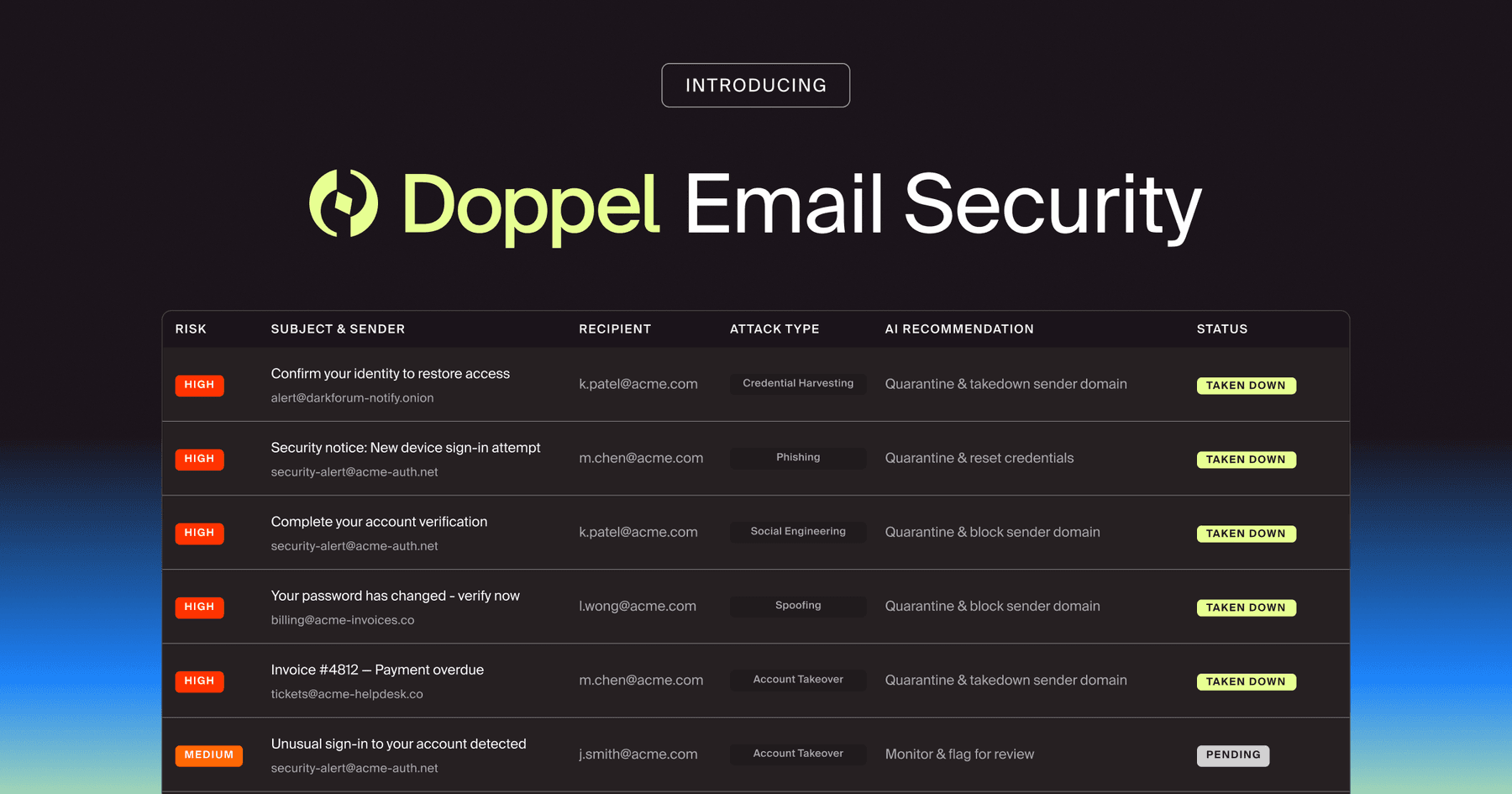
Brand AbuseBox ingests public abuse-inbox reports, extracts links, domains, and phone numbers, and correlates duplicates into attacker campaigns to cut duplicate review of the same lure. Phishing Triage does the same for employee-reported email: it classifies each report, remediates the clear malicious cases autonomously, and hands analysts the cases that need judgment with a recommendation attached.
Both draw on the Doppel Threat Graph, which connects spoofed domains, fake profiles, impersonated ads, and malicious texts into a single campaign view and syncs that context bidirectionally with Splunk, Microsoft Sentinel, and Elastic, with response steps routed through Tines.
The platform's agentic AI correlates and prioritizes threats, then executes takedowns across registrars, social platforms, ad networks, and telcos, while expert analysts handle the escalations that need human judgment.
Request a demo to walk through the Threat Graph and its SIEM integrations with our team.
Frequently asked questions about a security operations center
What is a security operations center?
A security operations center (SOC) is a team of security analysts and incident responders, supported by engineers, who continuously monitor an organization's networks and systems, investigate suspicious activity, and respond to confirmed incidents. The SOC works through a stack of tools, most centrally a SIEM platform that collects and correlates log data, and through documented processes for triage, escalation, containment, and post-incident review. Organizations can build a SOC in-house, contract it from a managed provider, or run it as a hybrid of both.
What is the difference between a security operations center and a network operations center?
A SOC watches for attacks; a network operations center (NOC) watches for outages. The SOC asks whether an event is a threat and protects data's confidentiality and integrity, while the NOC asks whether services are running optimally (opens in new tab) and protects availability and performance, with different skills, tooling, and escalation paths. Teams sometimes use the variant acronym CSOC (cyber security operations center) to make the security focus explicit.
What is a security operations center in cybersecurity?
It is the cybersecurity function that runs continuous monitoring, threat detection, and incident response for an organization. A SIEM platform correlates telemetry from across that environment into alerts analysts can act on. The function covers alert triage, escalation, containment, and the post-incident feedback that turns findings into better detections. Increasingly it also watches impersonation activity outside the network boundary, where lookalike domains and fake profiles target customers directly.
What is an example of a security operations center handling brand impersonation?
A bank's SOC receives abuse-inbox reports that customers are getting texts from a lookalike domain posing as the fraud department and asking for one-time passcodes. Analysts extract the domain and phone numbers, confirm the page is a cloned login, and file abuse reports with the registrar and hosting provider, escalating to ICANN if the registrar fails to act within a reasonable window (opens in new tab). The fraud and communications teams warn customers while the SOC adds the indicators to email and web filters. Because the scam never touched the bank's own network, catching it early depended on external monitoring feeding the SIEM alongside internal telemetry.