In late 2023, one of the world's largest hospitality companies was brought to its knees. The attack didn’t originate from a highly complex, zero-day vulnerability in their server architecture. It started with a polite, urgent phone call to the IT help desks.
Attackers, having gathered open-source intelligence (OSINT) from LinkedIn, impersonated a highly privileged employee. They called the support line, claimed their phone was broken or lost, and asked for a password reset and a new multi-factor authentication (MFA) (opens in new tab) token.
The help desk agent, hired to resolve problems quickly and provide excellent service, complied.
That single, helpful action bypassed millions of dollars' worth of technical security controls. It resulted in a catastrophic ransomware deployment.
This scenario is a waking nightmare for security and support leaders.
The help desk represents a unique and highly exploitable vulnerability. Attackers are weaponizing the exact traits that make support agents great at their jobs: empathy, urgency, and a desire to deliver high customer satisfaction (CSAT) (opens in new tab).
Pausing a service interaction to rigorously verify a frustrated executive, whether they’re real or not, feels like failing at the primary objective.
But you don’t have to choose between a secure organization and a happy user base. To secure the front line against voice phishing, also known as vishing, leaders need to change the protocol.
Here’s How Vishing Attacks Target the Help Desk
Understand why adversaries target the help desk with social engineering. Attackers view the IT support team not as a technical barrier, but as a human router that can be manipulated into granting access.
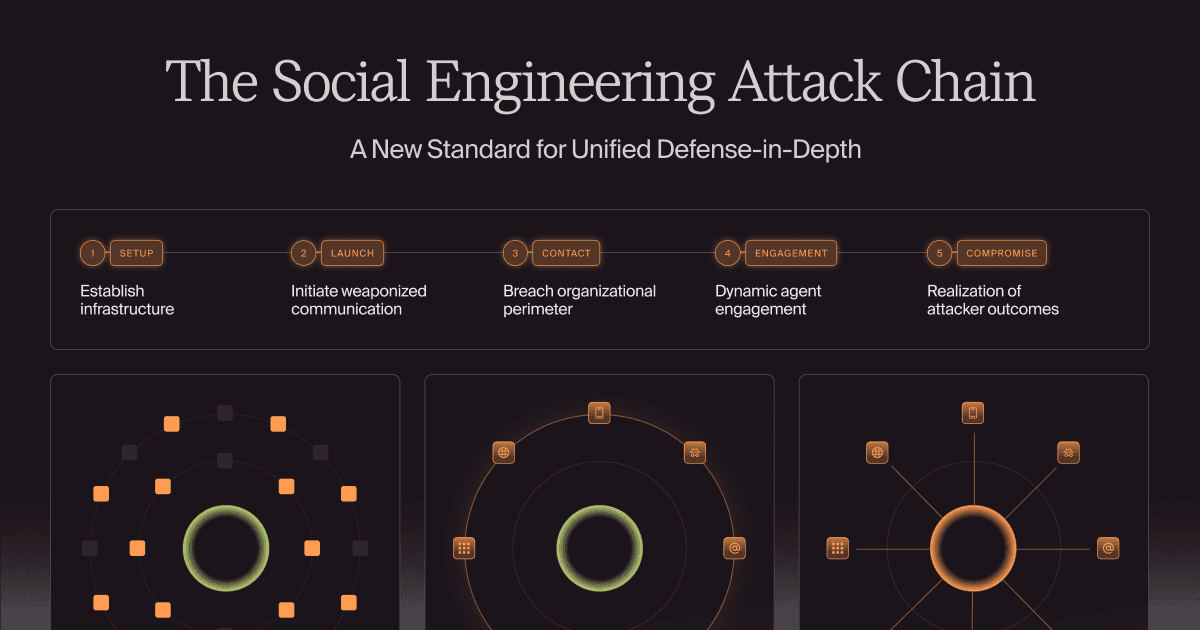
The playbook for these AI voice cloning attacks follows four phases:
- Open-Source Intelligence (OSINT): Attackers scrape platforms like LinkedIn and corporate directories, and videos to identify employees. They learn reporting structures, software stacks, and extract audio samples to train AI voice-cloning models.
- Pretext: An attacker calls the help desk, spoofing the caller ID to match the targeted employee. They use the gathered intelligence and the highly convincing AI-cloned voice to establish immediate, unquestionable credibility.
- Empathy & Urgency: Adversaries manufacture a high-stakes scenario to trigger the agent’s desire to help. Speaking in the exact tone and cadence of the real employee, they might falsely claim they’re about to step into a significant meeting and desperately need an MFA bypass to access a document.
- Bypass: Fearful of receiving a bad CSAT score or a reprimand for delaying an employee, the agent’s customer service instincts override their security training. They bypass the standard verification protocols and hand over the keys to the network.
Once this bypass occurs, the organization’s perimeter is rendered useless. This predictable attack pattern highlights exactly why the help desk needs to be fortified with system protocols, rather than relying on an agent’s ability to spot a lie under pressure.
False Tradeoff: Security vs Customer Satisfaction (CSAT)
When security teams propose stricter verification protocols at the help desk, support leaders understandably push back. There’s a fear that adding friction will infuriate users, tank CSAT scores, and drastically increase time to resolution (TTR) (opens in new tab).
This is a false tradeoff.
Employees and customers want their accounts to be secure. Frustration rarely stems from the existence of security. It stems from confusing, inconsistent, and arbitrary security.
Think of it like airport security. Everyone accepts taking off their shoes and going through the metal detector because the rules apply to everyone equally every single time. It’s a standardized process.
Friction only occurs when a user feels they’re being singled out, or when the rules change depending on which agent they speak to.
If your verification process is smooth, standardized, and confidently communicated by the agent, trust increases. High CSAT and high security are entirely compatible when the process is engineered correctly.
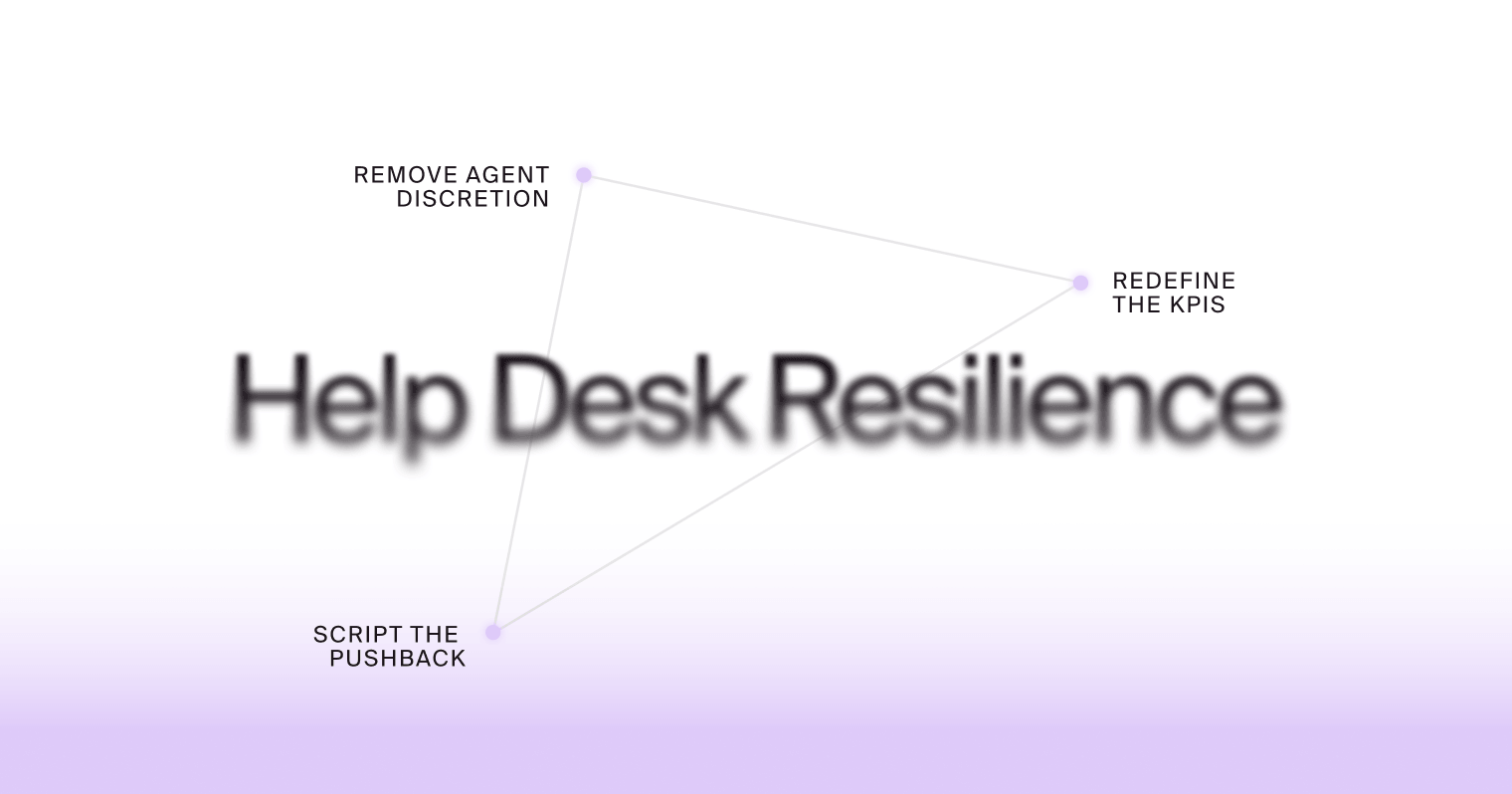
3 Steps to Help Desk Resilience
CISOs and support leaders need to collaborate to remove ambiguity from the help desk.
Here’s a playbook you can implement today to stop vishing attacks without punishing your agents.
#1. Remove Agent Discretion
One of the most dangerous phrases in a support center is, I’ll make an exception this one time.” Security protocols must be absolute.
If a caller requests a high-risk action (such as an MFA reset), the verification protocol must be identical whether the caller is a summer intern or the CEO.
Implement mandatory out-of-band confirmation.
If a user calls from a new number claiming they lost their phone, the agent can’t just ask for their employee ID or date of birth. That data is easily purchased on the dark web. Instead, the protocol must dictate an out-of-band check.
Here’s an example: “I see you need an MFA reset for a lost device. Per company policy, I must initiate a brief video call to your direct manager for visual verification before I can issue the temporary token.”
You remove the attacker’s ability to manipulate the agent by removing agent discretion.
#2. Redefine the KPIs
You can’t ask agents to be hyper-vigilant security sensors if you only pay and promote them based on how fast they get people off the phone. If TTR is your ultimate KPI, agents will naturally rush through security checks to keep their metrics green.
Support leaders need to actively praise and reward agents who pause a call to verify identity, even if the caller gets annoyed and leaves an unfavorable survey response.
Create a ‘Catch of the Month’ award. When an agent successfully identifies a social engineering attempt or rigorously follows the out-of-band verification protocol against a difficult caller, celebrate it publicly.
When leadership demonstrates that security compliance is valued as much as speed, the culture shifts immediately.
#3. Script the Pushback
Give agents the exact words to use so they don’t feel like they’re calling a customer a liar.
When an agent pushes back on a demanding executive, the power dynamic feels wrong. You need to script the de-escalation to protect the agent.
Teach agents to blame the system. Provide them with cheat sheets or pop-ups with exact phrasing.
Don’t let them say: “I don’t know who you are, so I need to verify your identity.”
Instead, have them say: “I understand this is incredibly urgent, and I want to get you into your account right away. However, the system prevents me from issuing a new token until I send a push notification to your manager. Let me do that right now so we can get this resolved.”
By making the system the ‘bad guy,’ the agent remains the helpful ally. This preserves the customer service dynamic while maintaining the security perimeter.
Training Gap: Why Reading a Policy Fails
You can write the best help desk security policy in the world and make every agent sign it. It’ll still fail during a live attack.
Why? Because of human psychology.
When a help desk agent is on a live call with someone who sounds exactly like the CFO, and that person is screaming that a multi-million-dollar deal will fall through if they don’t get access immediately, the agent experiences an adrenaline spike.
The brain’s fight-or-flight response kicks in, overriding logical policy recall.
In moments of high stress, humans don’t rise to the level of their expectations. They fall to the level of their training. If an agent has only ever read about a vishing attack, they’re completely unprepared to face one.
Prepare the Help Desk with Social Engineering Defense
Help desk agents need the tools, the scripts, and the psychological safety to say, “Let me verify that.”
But above all, you need to give them real-world practice.
You build this muscle memory through live, voice-based phishing simulations so that when the adrenaline hits, the secure protocol is their automatic reflex. This is where legacy security awareness training (SAT) fails, and modern social engineering defense (SED) takes over.
Doppel empowers security and support leaders to run safe, highly realistic vishing simulations directly against their help desk.
By simulating the exact AI voice clones, spoofed caller IDs, and urgent pretexts that attackers use in the wild, Doppel trains agents in the moment. When an agent encounters a simulation, they receive immediate micro-coaching that builds their resilience without harming real-world CSAT.
Your help desk agents are hired to be helpful. Implementing standardized protocols, redefining KPIs, and training with realistic simulations ensures that they’re helping your company — not the adversary.
Is your help desk prepared to face an AI voice clone? Get a demo with Doppel to start building vishing resilience across your front line.