

What Is Email Authentication?
Email authentication is a set of DNS-based standards, principally SPF, DKIM, and DMARC, that sending and receiving mail servers use to verify a message came from infrastructure authorized by the domain it claims to come from. The protocols associate a domain identity (opens in new tab) with a message by verifying that the domain authorized the sending infrastructure or signed the message. Authorship and content safety require separate verification. An attacker who registers a lookalike domain and configures its records correctly can pass SPF, DKIM, and DMARC.
How email authentication works
Each protocol publishes DNS verification data (opens in new tab), and receiving mail servers check inbound mail against it. The SPF standard (opens in new tab) lets a domain owner declare which hosts are authorized to use the domain in the SMTP HELO/EHLO and "MAIL FROM" identities. The DKIM standard (opens in new tab) attaches a cryptographic signature covering the message headers and body; receiving mail servers fetch the public key from DNS and confirm message integrity in transit.
The DMARC protocol (opens in new tab) layers on both. It requires the domain that passed SPF or DKIM to align with the domain in the visible From: header, publishes a policy telling receiving mail servers what to do with failing mail (none, quarantine, or reject), and returns reports to the domain owner. DMARC became a Standards Track protocol under RFC 9989 (DMARCbis) in May 2026, which replaced RFC 7489 and dropped the pct sampling tag.
For a message claiming to be from [email protected], the receiving mail server checks the connecting IP against the SPF TXT record (opens in new tab) example.com publishes, verifies the DKIM signature (opens in new tab) using the key stored at <selector>._domainkey.example.com, then looks up the DMARC policy (opens in new tab) at _dmarc.example.com. If that record reads v=DMARC1;p=reject and neither check passes with a domain aligned to example.com, the policy requests rejection. Passing DMARC requires one aligned pass (opens in new tab) from either SPF or DKIM.
Why email authentication matters
SMTP lets a sending host supply an arbitrary envelope-sender identity, so without additional authentication controls a host can forge a domain it does not own. The gap makes exact-domain forgery the lowest-effort impersonation vector, and it underpins business email compromise campaigns in which attackers modify From and Reply-To (opens in new tab) headers to redirect replies to accounts they control.
Domain owners must now enforce authentication at scale. Bulk and high-volume senders must pass SPF and DKIM and publish DMARC records for mail to personal Gmail and Yahoo mailboxes (opens in new tab). Microsoft applies the same requirements to high-volume senders (opens in new tab). U.S. federal civilian agencies must run DMARC at p=reject under CISA BOD 18-01 (opens in new tab).
Enforcement also moves attackers. The DMARC authentication boundary (opens in new tab) covers exact-domain forgery; separate controls must address cousin-domain attacks and display-name abuse. Attackers who compromise a legitimate email account send mail with genuine authentication signals end to end. Once p=reject closes exact-domain forgery, attackers can use authenticated lookalike domains under their own records. They can also pivot to SMS phishing and voice phishing, while social platforms provide another channel outside email authentication.
Core components of email authentication
Six standards make up the working set:
- SPF (Sender Policy Framework, RFC 7208). A single DNS TXT record listing the hosts authorized to send for a domain. SPF caps evaluation at 10 DNS lookups. Exceeding the limit returns PermError, which DMARC treats as an SPF failure.
- DKIM (DomainKeys Identified Mail, RFC 6376). A digital signature that travels with the message, so it survives forwarding paths that break SPF. Transit modifications to signed content cause validation to fail.
- DMARC (RFC 9989, DMARCbis, replacing RFC 7489). Adds identifier alignment to the visible From: domain, a published disposition policy, and two reporting streams: rua aggregate reports (daily XML summaries of authentication results by sending source) and ruf per-message failure reports.
- ARC (Authenticated Received Chain, RFC 8617). Records authentication results at each forwarding hop (opens in new tab) so a receiver can honor a message whose identifiers aligned before a mailing list modified it.
- BIMI (Brand Indicators for Message Identification). Displays a brand-controlled logo beside authenticated mail. It requires DMARC at policy enforcement (opens in new tab) (quarantine or reject) across the domain and its subdomains.
- MTA-STS and TLS-RPT (RFC 8461 and RFC 8460). Enforce TLS (opens in new tab) between mail servers and give the domain owner visibility into misconfigurations (opens in new tab) or attempts to intercept mail between hosts that support STARTTLS. They protect messages in transit (opens in new tab); origin authentication requires separate controls.
How to implement email authentication
A phased rollout begins with an inventory step:
- Inventory sending systems (opens in new tab) before publishing records: primary mail platform, marketing ESP, CRM, support desk, transactional APIs, and application servers that emit notifications.
- Publish one SPF record ending in ~all, or all for domains that send no mail, and keep nested includes under the 10-lookup ceiling. Multiple SPF records at the same name produce PermError.
- Sign outbound mail with aligned DKIM (opens in new tab). Use a 1024-bit minimum key (opens in new tab), rotate it at least twice per year, and prefer 2048-bit keys under updated DKIM guidance (opens in new tab).
- Start DMARC at (opens in new tab) p=none and study the aggregate reports to find legitimate senders that would fail, then step up to p=quarantine and p=reject. After monitoring and correcting their configuration, many organizations can move to reject (opens in new tab).
- Cover subdomains and non-sending domains. Apply enforcement across the entire domain (opens in new tab) and its subdomains, including parked domains attackers would otherwise forge freely.
How Doppel helps
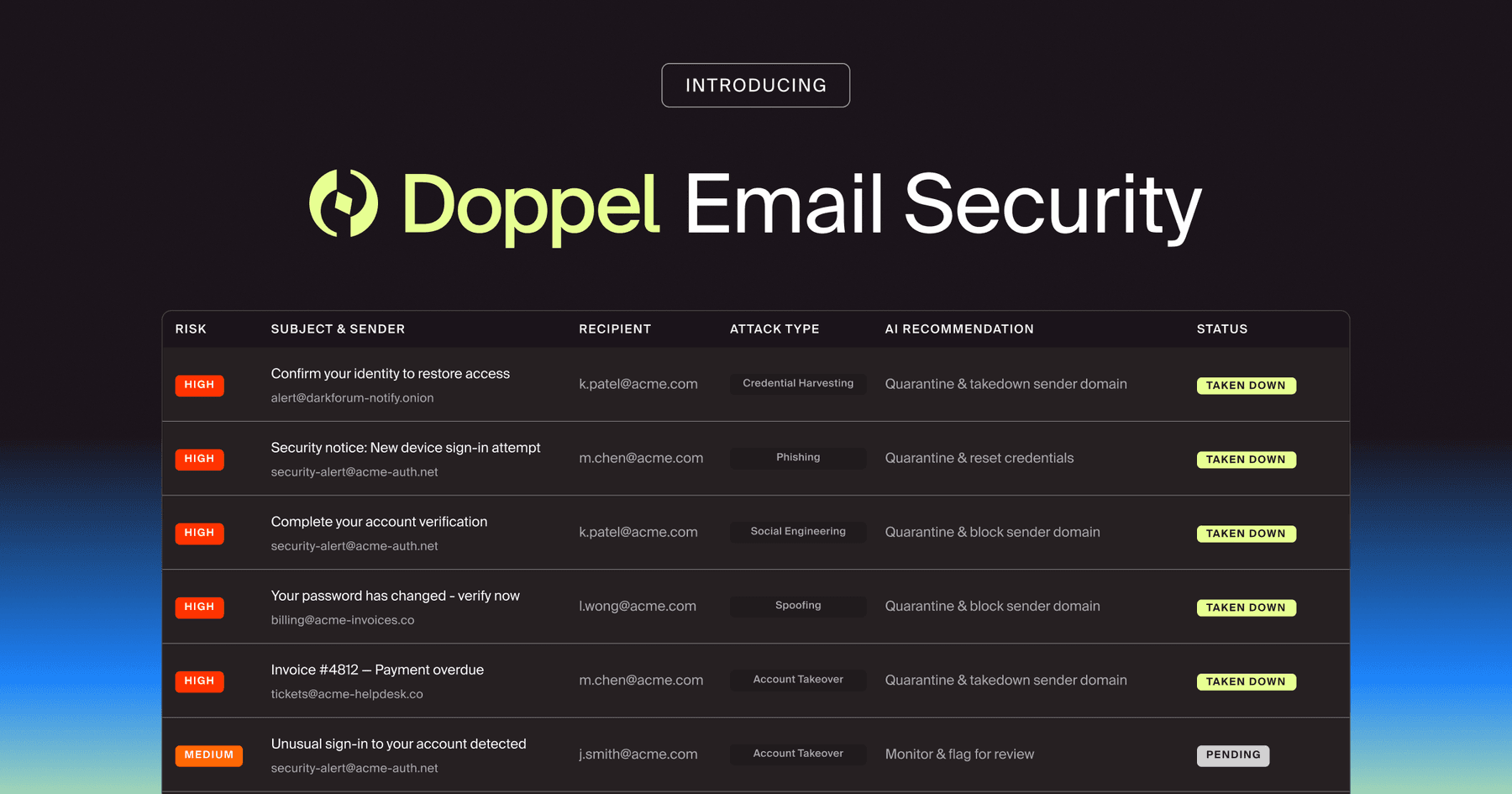
Enforcement closes exact-domain forgery, but it also pushes attackers toward impersonation that authenticates cleanly. Doppel is the AI-native Social Engineering Defense (SED) platform that unifies Digital Risk Protection (DRP) and Human Risk Management (HRM), and it covers that residual gap by detecting and dismantling the lookalike infrastructure attackers stand up under their own records.
Doppel Email Security builds its verdicts from external attack infrastructure intelligence mapped by the Doppel Threat Graph, so it catches impersonation-based attacks and AI-generated lures that clear SPF, DKIM, and DMARC. Paired with Digital Risk Protection, agentic AI correlates the campaign infrastructure and dismantles it at scale, reaching the sending and lookalike-domain infrastructure behind an operation at the source so the same campaign cannot retarget the organization.
A guided demo shows the impersonation that clears a DMARC policy at enforcement and the takedowns that dismantle it at the source. Request a demo to get started.
Frequently asked questions about email authentication
What is email authentication?
Email authentication uses DNS-based standards to let receiving mail servers verify a message came from infrastructure authorized by the domain in its sender address. SPF authorizes sending hosts, DKIM adds a cryptographic signature, and Domain-based Message Authentication, Reporting, and Conformance (DMARC) ties both to the visible From address and tells receivers how to handle failures. Major mailbox providers, including Google, Yahoo, and Microsoft, now require all three from high-volume senders. Authentication verifies domain authorization, not message content or sender intent, which need separate controls.
What is the difference between SPF, DKIM, and DMARC?
SPF is a DNS record listing the servers allowed to send mail using a domain's return-path address, and a forwarding server relays the message (opens in new tab) from an address the domain's record does not list, which typically causes SPF to fail. DKIM is a cryptographic signature over the message headers and body that travels with the message, so it usually survives forwarding (opens in new tab), and it fails if the signed content changes in transit. DMARC sits on top of both: it requires the domain that passed SPF or DKIM to align with the domain in the visible From: header, publishes a disposition policy for failing mail, and sends reports back to the domain owner. A message passes DMARC when either SPF or DKIM provides one aligned pass.
What is email authentication in cybersecurity?
In cybersecurity, email authentication is the control layer that stops exact-domain spoofing: mail forged to appear from the precise domain a DMARC policy protects. Attackers can register visually similar lookalike or cousin domains and authenticate them under their own DNS records. Display-name analysis and account-compromise detection require separate controls, because mail from a compromised legitimate account carries genuine authentication signals. Enforcement controls direct forgery; separate defenses address impersonation through adjacent domains and non-email channels.
What is an example of an attack that bypasses email authentication?
In a DKIM replay attack, attackers retransmit a legitimately signed message to new targets. The mail can appear to come from the signing domain and pass DKIM authentication even though a different party retransmitted it. If attackers leave the headers and body unchanged, the signature keeps validating and the message can pass DMARC. Replay attacks work (opens in new tab) because email authentication verifies the signing domain and message integrity, while identifying the retransmitting party requires separate controls.