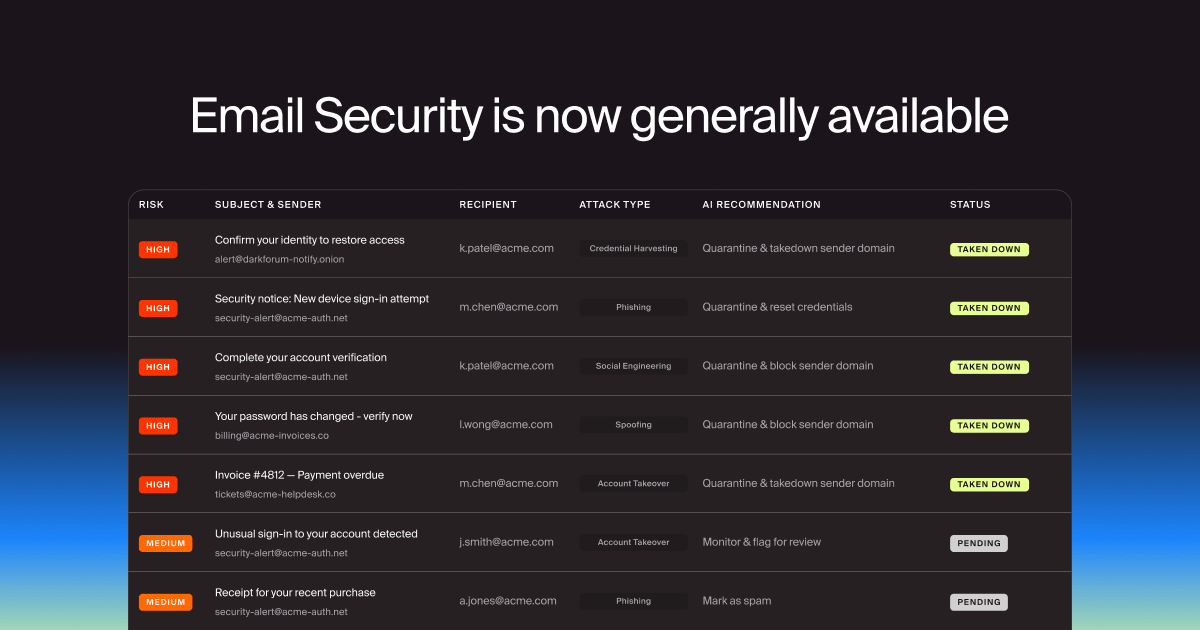
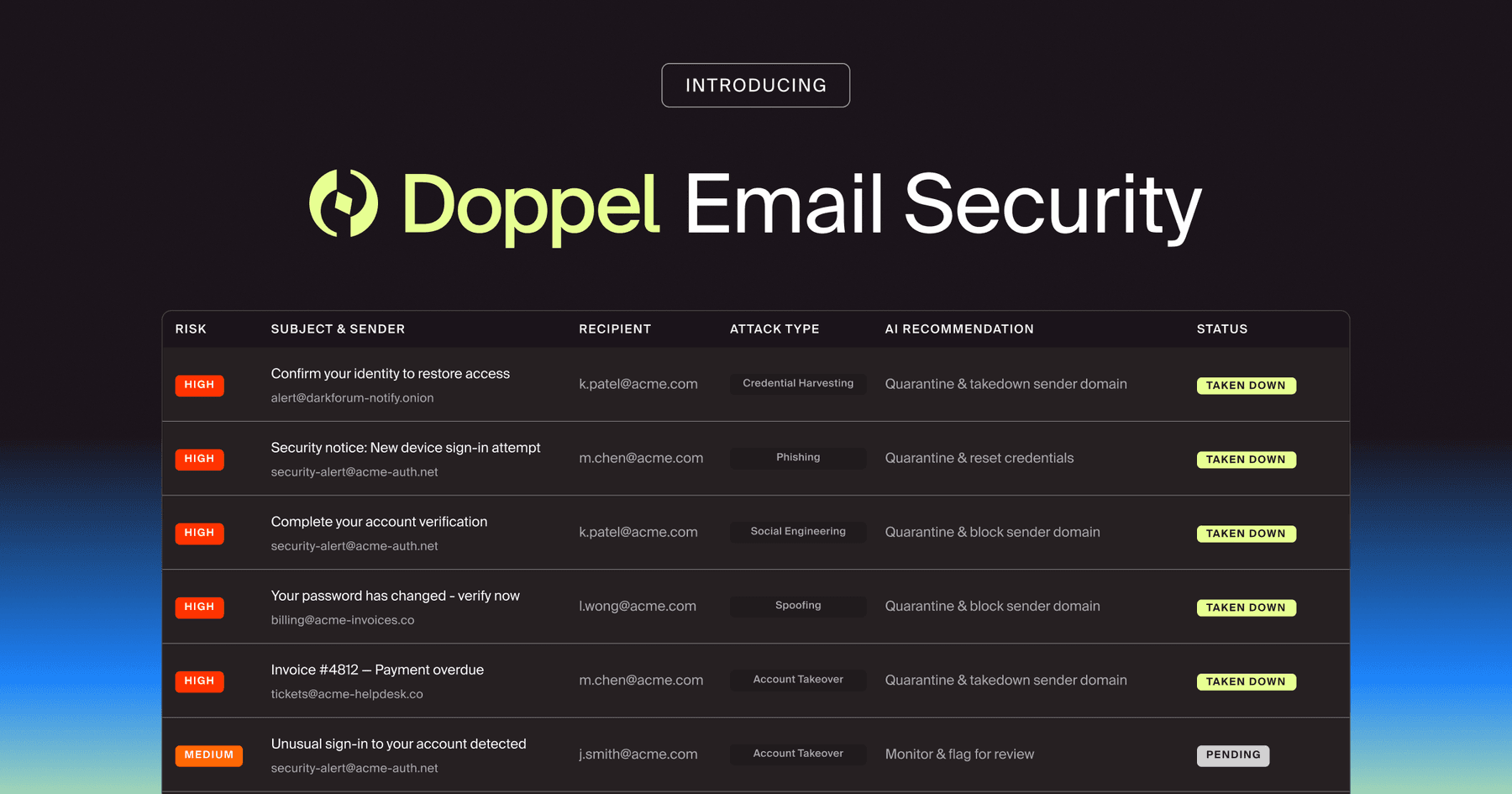
Doppel Email Security is now generally available
The agentic email security solution that empowers you to fight back against social engineering attacks. Detection isn't enough. Disruption is the difference.
See why unifying digital risk protection, email security, and human risk management under one threat intelligence platform eliminates security blind spots.
Every executive deck presented to a board of directors over the past year has featured the exact same trendline:
Despite record spending on enterprise security stacks, modern threat actors like LAPSUS$ (opens in new tab) and Scattered Spider continue to bypass legacy defenses with relative ease. Rather than relying on zero-day software exploits or complex malware, they exploit the gaps between fragmented security tools.
The modern enterprise perimeter isn’t collapsing because security products fail at their job. It’s because organizations are deploying separate vendors for digital risk protection (DRP), human risk management (HRM), and email security to fight unified, multi-channel campaigns.
The simple idea is this: Attackers don’t operate in single-channel silos, and your defense can’t afford to either.
When your DRP tool monitors lookalike domains, your Secure Email Gateway (SEG) scores inboxes, and your security awareness training (SAT) provider sends generic monthly simulations, no single operational team sees the full picture. Attackers exploit these operational chasms to execute complex, multi-channel campaigns with minimal friction.
In this blog, we’ll examine why a fragmented security stack can’t hold up anymore, unpack the five stages of the modern social engineering attack chain, and explore how consolidating DRP, email defense, and HRM into a single intelligence layer permanently alters attacker economics.
For decades, enterprise cybersecurity has been built on a strategy of domain-specific defense. Security operations established separate budgets, teams, and vendors to address distinct surfaces:
This legacy model assumes that attacks occur as isolated events within specific boundaries. But according to the IBM Cost of a Data Breach Report (opens in new tab), social engineering attacks suffer from an average dwell time of 260 days because disjointed security tools fail to communicate with one another.
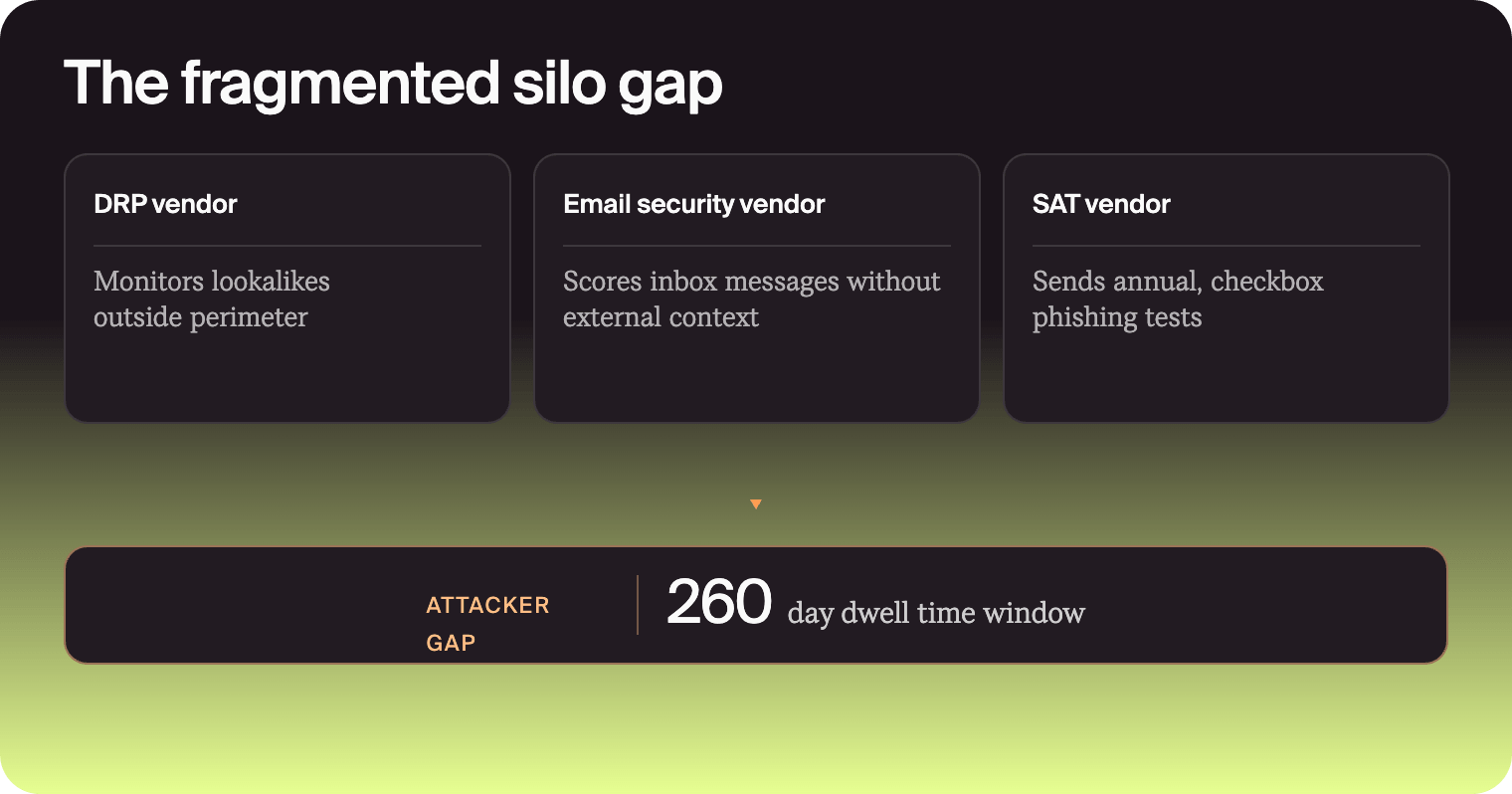
When an attacker registers a lookalike domain, builds an executive deepfake persona, and launches an urgent message targeting a privileged finance employee, the inherent weakness of the siloed stack becomes immediately obvious.
The inbox security layer scores the incoming email in absolute isolation. It evaluates the message's natural language, checks static IP reputation lists, and analyzes sender behavior. Because the sender domain was registered weeks earlier and uses clean infrastructure with no historical blocklist entries, the email bypasses traditional behavioral and signature filters. The email tool never sees the external infrastructure being staged outside the enterprise perimeter.
Simultaneously, the enterprise DRP platform may flag the lookalike domain or impersonation handle. However, because it operates as a monitoring-only tool, it routes an alert into a bloated security operations center (SOC) manual triage queue. By the time a security analyst reviews the ticket hours or days later, the target employee has already interacted with the threat.
Meanwhile, the employee has completed standard, annual compliance training. They passed a single-click email simulation last month, but their training offered zero preparation for an urgent, multi-channel attack sequence that transitions from an SMS lure to an AI-generated voice call or a spoofed meeting request.
When security tools operate in disconnected silos, your security team becomes the manual, burned-out middleware trying to stitch together disparate alerts while attackers operate at machine speed.
To stop modern deception, security teams must stop viewing attacks as single, isolated events, such as a bad URL or a spoofed email address, and instead address the full social engineering attack chain.
Modern adversaries run highly coordinated, multi-stage operations that span multiple digital surfaces.
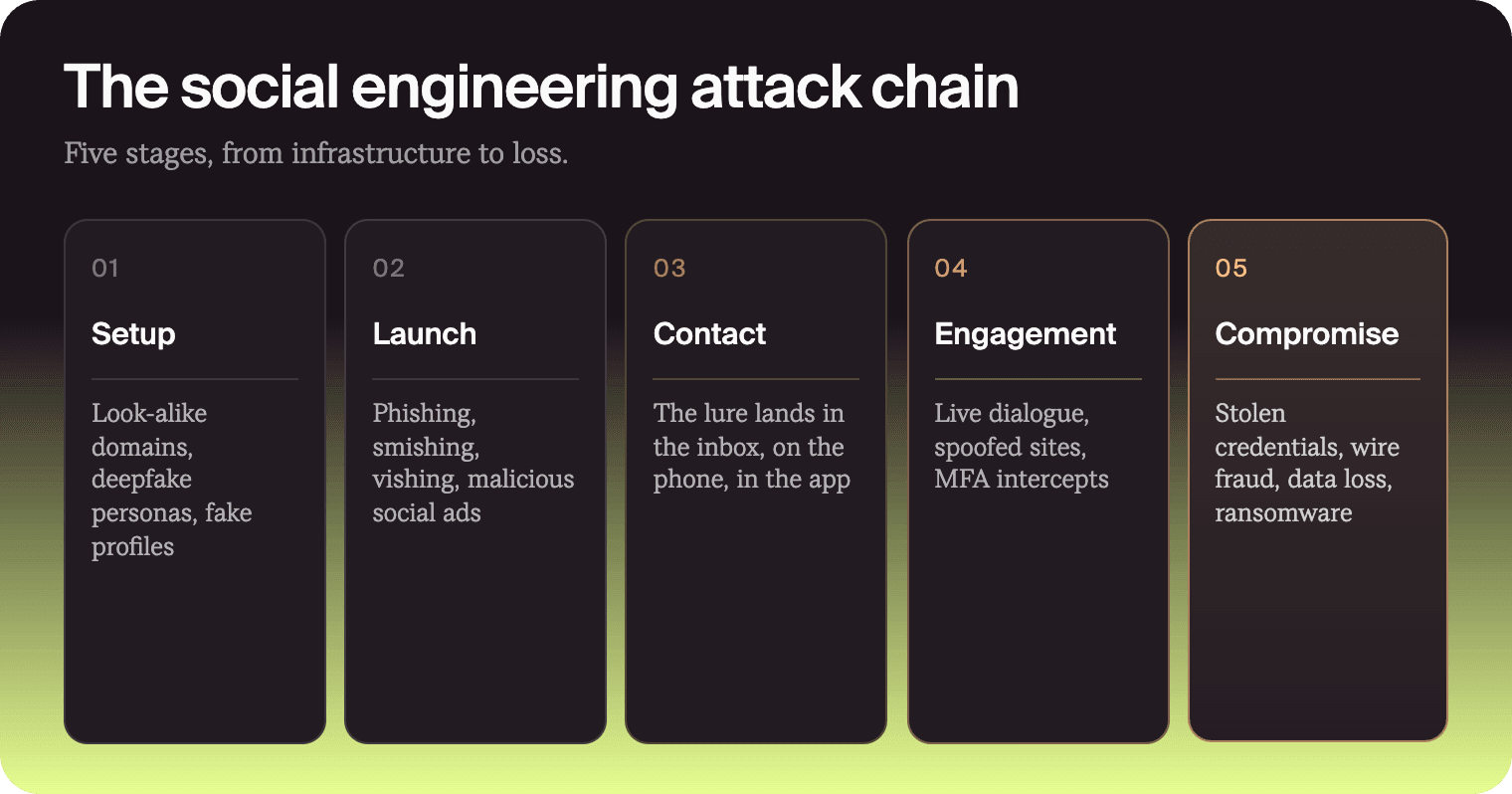
The adversary builds high-fidelity infrastructure engineered to mimic your corporate brand, executive leadership, or supply chain partners. This includes registering lookalike domains, creating deepfake personas, and configuring deceptive social media profiles or fringe channel handles.
The attacker activates their external infrastructure, deploying initial lures across various channels simultaneously. This vector goes beyond email to include malicious paid search ads, scam SMS campaigns (smishing), vishing, and messaging apps like Telegram or WhatsApp.
The lure arrives in the target environment. It moves from an external delivery vector to a live threat landing in an employee's inbox, an SMS inbox, or a corporate messaging workspace like Microsoft Teams.
The adversary enters the critical window, engaging the target through adaptive, multi-step dialogue. They deploy synthetic voice, deepfake video calls, or spoofed MFA intercepts to guide the victim toward executing a malicious action, such as executing a fraudulent wire transfer or approving an unauthorized password reset.
The attacker achieves their objective, resulting in stolen credentials, compromised corporate networks, unauthorized financial disbursements, or systemic ransomware deployment.
Point solutions typically address only a single stage of this lifecycle. An ICES email security tool attempts to catch stage 3. A traditional DRP vendor monitors stage 1. A legacy SAT vendor attempts to train for stage 4. When your defenses are split across three different platforms, the attacker easily maneuvers around them.
Consolidating DRP, HRM, and email security under one platform is an architectural requirement that shifts the enterprise from reactive mitigation to continuous, proactive threat disruption. At a glance, the differences are as follows.
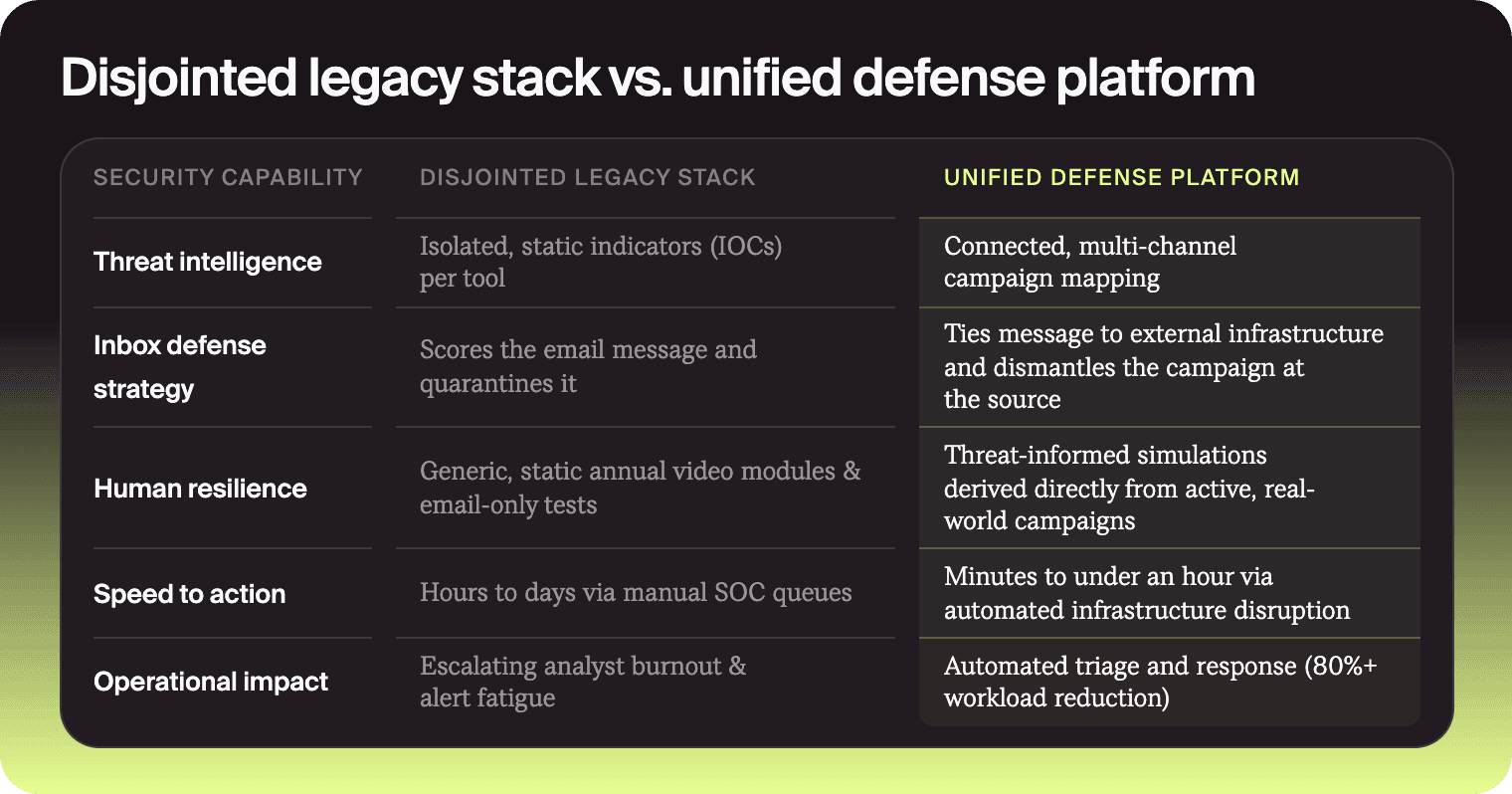
More precisely, when these three core disciplines run on a single, connected threat graph and share an autonomous, agentic intelligence engine, security teams gain three fundamental operational advantages.
Traditional email security tools evaluate the email message in front of them and stop there. An AI-native, unified platform connects incoming messages directly to external threat graph intelligence. When a phishing email lands in an inbox, the unified system identifies the message, maps the sending server, lookalike domain, and hosted payload back to the broader external attack campaign, and immediately executes a targeted infrastructure takedown.
Quarantining an email stops one message. Dismantling the underlying sending infrastructure and malicious links prevents that campaign from ever retargeting your organization.
Legacy security awareness training relies on canned, generic templates that teach employees to look for obvious, outdated clues like spelling errors or suspicious domain extensions.
In a unified ecosystem, live threat intelligence directly feeds employee training. When an active executive impersonation campaign or deepfake voice clone is detected across external channels on Monday, the system automatically converts those exact adversary tactics, techniques, and procedures (TTPs) into targeted, hyper-realistic simulations by Tuesday.
Employees are continuously trained and tested against the exact threats targeting their specific industry, role, and organization.
When employees report suspicious emails using a legacy stack, the submission lands in a bloated abuse mailbox, creating an endless manual triage queue for SOC analysts.
Under a unified framework, employee reports feed directly into an automated triage engine powered by multimodal AI agents.
When a user reports a suspicious email:
For years, security leaders have treated social engineering as an uncontrollable human liability that can only be managed through administrative policies and reactive alert monitoring.
It’s time to rethink social engineering as an infrastructure problem. Adversaries rely on scalable web infrastructure, registered domains, communications channels, and cloud hosts to launch AI-driven deception.
When you consolidate DRP, HRM, and email security onto a single, agentic intelligence layer, you collapse the attack surface. Every external detection sharpens your inbox filters, every takedown raises the adversary's operational costs, and every employee submission turns your workforce into an active, proactive defense grid.
Request a demo with Doppel to see how agentic AI and connected threat graph intelligence can dismantle attacker infrastructure before it impacts your business.
BLOG
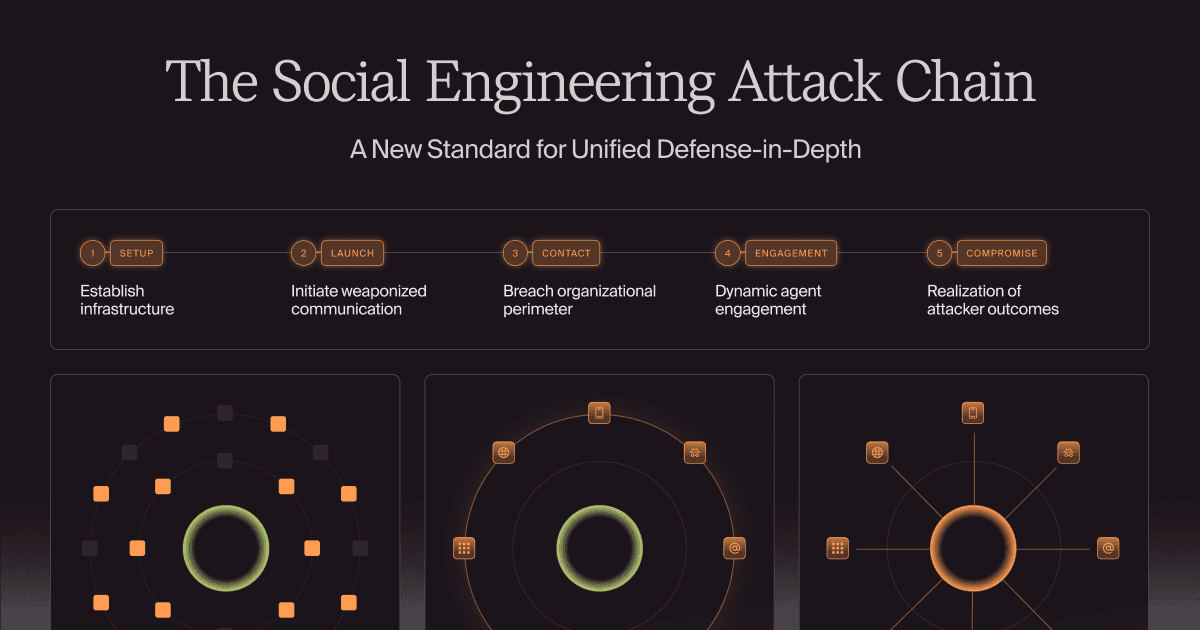
Modern social engineering is a relentless, AI-orchestrated lifecycle. Learn how to map the five-stage attack chain—from setup to contact—and why a unified defense platform is the only way to outpace AI-driven social engineering attacks.



by Bobby Ford, Rahul Madduluri, and Alvin Lin