Much of the phishing that matters now reaches the security operations center (SOC) as an employee report. Filters settle the obvious lures, and what survives is written well enough to pass. AI-automated phishing emails achieve a 54% click-through rate (opens in new tab) against 12% for standard attempts, at minimal cost per target.
Vendors compete on classification accuracy. The steps between a report landing and a threat closing belong to your analysts. AI phishing detection with SOC integration shortens that stretch by wiring report intake, triage, investigation, and response into the stack the team already runs.
Key takeaways
- AI-written lures clear the filter, so the defensive decision lands in the SOC queue as an employee report with no verdict attached.
- Report-to-decision time is the interval a security team controls. Integrated detection shortens it by carrying a report from capture through response without anyone rekeying.
- Judge a tool by what it removes from the queue: reports resolved without an analyst, escalations that arrive assembled, and verdicts that travel into the SIEM and SOAR without a handoff.
Why the SOC inherits the AI phishing problem
Everything downstream of the mail filter's score belongs to the security team. AI email security scores the message at the Contact stage of the social engineering attack chain, and three conditions then set how much work arrives: what clears the filter, what a report carries with it, and which clock the team controls.
Lures built to clear the filter reach the inbox
Filtering hands the hard cases forward. A surviving lure reads in clean, native language (opens in new tab), so the grammar tells that a decade of filters is no longer reliable. It sends from a fresh domain, or a lapsed one re-registered with its clean reputation intact.
It shares no template with the rest of its campaign, so there is no signature to match, and the URL it carries has no reputation history to check.
The employee report carries a signal with no verdict attached
A report opens an investigation. It does not close one. When it arrives, the verdict is still open across malicious, spam, benign, and training simulation, and settling it is the work the SOC inherits one report at a time, in a queue that mixes a benign majority with the hard cases the filter could not decide.
The exposure window runs from report to decision
The clock the team controls starts at intake. Once a message lands, the filter's miss rate no longer changes what happens to it. The compressible interval runs from an employee filing a report to someone deciding what it is, and every gap below stretches it.
Where the AI phishing workflow breaks inside the SOC
Under AI-generated volume, each of the four steps a reported phish passes through strains differently: intake, triage, investigation, and response.
Intake: reports arrive across disconnected paths
Reports reach the team through channels that share no queue and no metadata standard. The abuse mailbox collects whatever form employees send, and a plain forward (opens in new tab) strips the original headers, replacing the authentication results an analyst checks first with the reporter's own metadata.
A Slack message to the security channel often arrives as a screenshot with no headers at all. None of those paths link to each other, so one campaign produces many separate unlinked reports (opens in new tab) analysts work on individually.
Triage: volume rises while each judgment gets harder
Report volume and judgment difficulty move in opposite directions. Generative AI produces unique, native-language lures at almost no cost, and campaign sizes (opens in new tab) have collapsed toward one-off, per-target messages sent through legitimate platforms and DMARC-passing domains that inherit clean reputations.
The report stream grows while the tells that made fast triage possible disappear, so an analyst reads each message longer and decides with less.
Investigation: the deciding evidence sits outside the mail system
Settling a verdict pulls the analyst into systems the mail platform does not own. Domain age comes from registration records (opens in new tab), certificate history from Certificate Transparency logs, and related attacker infrastructure only from passive DNS (opens in new tab) pivots.
The list of who else received the lure takes a message-trace query (opens in new tab). No single signal closes the case, so the analyst runs all of them in separate consoles (opens in new tab) and reassembles the answer by hand, work email threat intelligence does at the campaign level.
Response: the verdict stops where the automation stops
A confirmed verdict waits on a human to carry it forward. Automation usually stops short of the steps that matter most: in a widely used SOAR phishing playbook (opens in new tab) template, mailbox search-and-delete and indicator blocking both default to manual rather than automatic.
So the analyst who already has the answer still purges the message from other mailboxes, pushes the indicators out, and opens the ticket and credential-reset request one system at a time, even on SOAR-equipped teams.
What integrated AI phishing detection has to deliver
Closing those four gaps takes four capabilities: capture reports inside the mail client, resolve the clear cases in both directions, deliver escalations already investigated, and route verdicts into the systems that execute them.
Capture reports where employees already work
A report button inside the mail client turns a suspicion into a structured submission in one click, preserves the original message and its headers, and lands every report in one queue. A separate portal adds friction, and each added step cuts the reporting rate.
The most convincing lures (opens in new tab) are already the least likely to be reported. That friction falls hardest on the submissions that matter most.
Resolve the clear cases without an analyst
High-confidence verdicts should trigger autonomous action in both directions, removing confirmed-malicious messages and closing confirmed-safe reports. Detection that acts in only one direction leaves either the benign majority for analysts to clear by hand or live threats sitting in inboxes.
Acting in both leaves the queue holding only judgment calls.
That autonomy depends on readable verdicts (opens in new tab). A security team can let a machine close cases once it can audit why the machine decided, set the confidence threshold at which it acts, edit the logic when a call goes wrong, and reverse it afterward.
Deliver the investigation already assembled
An escalation should arrive investigated: the domain and infrastructure behind the sender already resolved, the list of who else received the lure and who interacted with it attached, and a recommended action alongside both.
Assembled that way, the analyst's first move is a judgment call, with the lookups already done.
Route the response into the systems that execute it
A verdict has to trigger all four of those response steps without anyone rekeying. Detection that stops at the verdict hands the list back to a person, and the window stays open while someone works it.
How integration works across the SOC stack
Integration happens in four places, and each one is tested by which direction data moves through it: the email platform, the SIEM, the SOAR layer, and the API.
The mail platform connection runs both ways over an API, with no MX-record change and no mail-flow rewrite. Outbound, report events and message metadata leave the mailbox when an employee clicks.
Inbound, remediation comes back. In Microsoft 365, a confirmed verdict triggers mailbox-level remediation actions (opens in new tab) that purge or quarantine a message and restore a false positive.
In Google Workspace, a connected workflow calls the Gmail API for message deletion (opens in new tab).
The SIEM puts a phishing verdict next to everything else
Alone, a phishing verdict says one message was bad. Next to identity and endpoint telemetry, it shows whether anyone acted on it, such as a sign-in from an unfamiliar country in the hours after a click.
A bi-directional sync (opens in new tab) pushes verdicts and indicators in for correlation and pulls case status back, so an alert closed in one system closes in the other.
The SOAR layer turns a verdict into an action
In the SOAR layer, a verdict becomes the trigger condition for a playbook. A confirmed phish fires the credential reset through the identity provider and opens the ticket, with approval gates on whichever steps need a human signature.
A tool the orchestration layer can only read is a data source. One that accepts response actions executes the reset itself.
The API layer keeps measurement in the SOC's hands
The API serves the whole program, and program measurement belongs in the team's own reporting. Pull reporting rates and verdict distribution into the pipeline where the rest of the SOC's metrics (opens in new tab) already live, then connect them to escalation rate and resolution outcomes.
Reported there, the numbers you take to a budget review are numbers you produced.
How Doppel connects AI phishing detection to the SOC
Doppel is the AI-native Social Engineering Defense (SED) platform, and the piece that sits inside the SOC workflow is Phishing Triage.
It maps to the four requirements:
- Capture. Employees report a suspicious message from Gmail or Outlook without leaving the inbox. Submissions reach triage in the form they were received.
- Resolve. Agentic AI classifies every submission and acts in both directions, removing malicious email from inboxes automatically and greenlighting safe reports. The abuse mailbox stops being a backlog, and the queue holds only judgment calls.
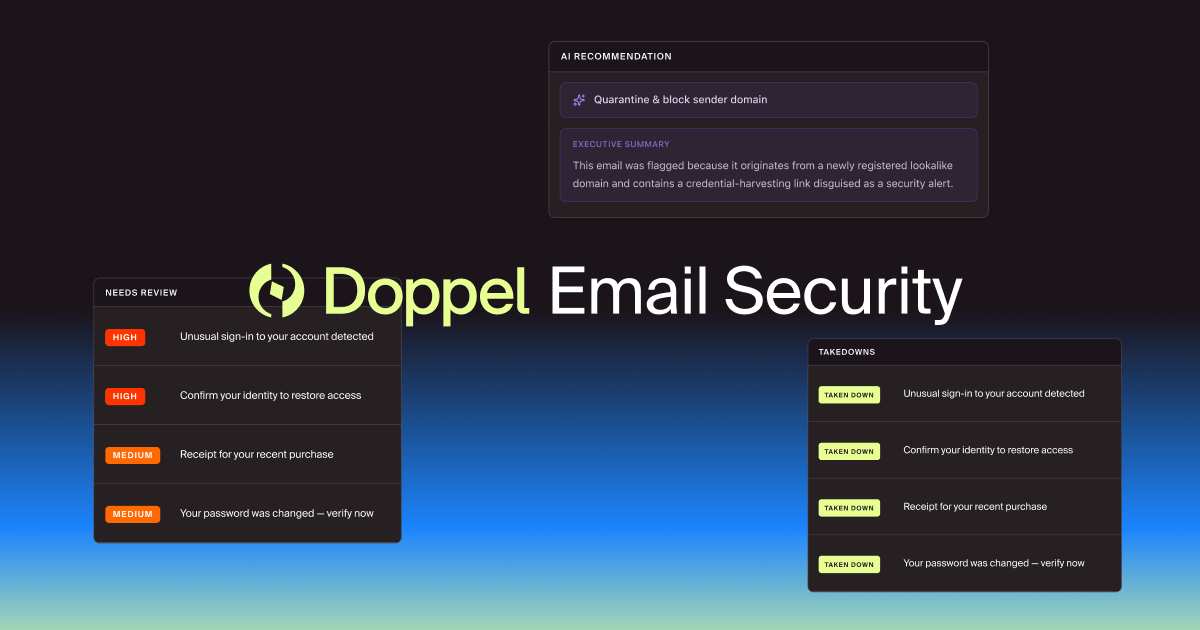
- Deliver. Escalations arrive with a recommendation and an executive summary attached, so the analyst opens an assembled case. Triage runs in seconds, not hours.
- Route. Verdicts reach the rest of the stack through the integrations layer: bi-directional syncs with Splunk and Elastic, SOAR orchestration in Tines, and APIs that pull reporting rates into the team's own tools.
Two parts of the platform do that work. The Doppel Threat Graph continuously maps sending infrastructure through DNS registrations, certificate history, and multi-channel indicators, so the campaign context an escalation needs usually exists before the reported message lands.
And Email Security, now generally available in AMER and APAC, is built to run detection on readable detection policies a security team can inspect and tune in plain language.
Reported email also feeds Human Risk Management, turning live campaigns into the simulations employees train against.
Judge detection by the work it removes from the queue
The measure is how much analyst work disappears in the first week after the integration lands. Count how many reported messages resolve without an analyst touching them, how much of each escalation arrives already assembled, and how far a confirmed verdict travels before someone has to type.
A team tracking those three numbers is buying for the workflow it operates, and the detection rate on a vendor slide stops being the deciding figure.
Request a Demo to see how Phishing Triage fits your stack, or read the Email Security deployment guide for stack options.