

ドッペルメールセキュリティが一般提供開始されました!| 詳しく知るためのウェビナーに登録しましょう

A consultative evaluation guide for security teams

Doppel vs. Hoxhunt

Hoxhunt turns security awareness into a game. Doppel builds your employees’ defenses.

What is Hoxhunt?

Hoxhunt is a human risk management platform focused on email phishing simulations, security awareness training, employee reporting, and behavior change through gamification.

Best for

Organizations seeking an email-first security awareness program that emphasizes frequent personalized simulations, positive reinforcement, multilingual delivery, and employee participation.

Where they're a strong fit

Hoxhunt is a strong fit for security awareness teams that prioritize gamification. Its personalized phishing program, leaderboards, reporting experience, and short-form training can help organizations build an active reporting culture, particularly where email is the primary employee communication channel.

Where buyers tell us they fall short

  • Buyers with broader social engineering exposure may find that Hoxhunt’s simulation capabilities are strongest in email, with more limited coverage beyond email.
  • Certain simulation channels may be more limited. Validate direct voice phishing simulations, smishing capabilities, and collaboration-tool coverage against your program needs.
  • Campaigns are personalized through templates and employee profiles, but are not directly informed by active external threats targeting the organization and detected by HoxHunt.
  • Organizations may also need separate products for brand impersonation, executive targeting, malicious domains, social scams, and attacker infrastructure disruption.

Side by side

Doppel vs. Hoxhunt feature comparison

Doppel
HOXHUNT
Multi-channel simulations
Simulates realistic attacks across email, voice calls, SMS, Telegram, Microsoft Teams Meetings, Zoom Meetings, QR codes, and chained attack scenarios. Supports live AI voice agents, deepfake voice, and multi-step attack flows that are designed to reflect real-world campaigns.
Limited. Strong email phishing simulations with limited support beyond email. Validate direct voice phishing simulations, smishing capabilities, and collaboration-tool coverage against your program needs.
AI-generated simulation campaigns
Vibe Phishing Simulation lets security teams create simulations with a natural-language prompt. Campaigns, landing pages, voice scripts, and messages are generated automatically and can be tailored by role, department, current events, and organizational context.
Yes. Strong personalization engine that adapts simulations to employees over time. Campaigns are primarily generated from existing templates and historical user behavior rather than active threat intelligence.
Training content & personalization
Library of hundreds of video, interactive, and immersive courses, plus AI Content Builder for creating custom training contents quickly. Organizations can upload internal documents to automatically generate branded courses tailored to their environment.
Limited. Robust learning experience with personalized micro-training, gamification, and multilingual content that adjusts to employee performance over time. Custom training course-building capabilities may be more limited for organization-wide deployment.
Threat-informed recommendations
Simulations and training recommendations are informed by real attacker activity observed across Doppel's Digital Risk Protection platform, allowing organizations to prepare employees for the tactics currently targeting their company, industry, and executives.
Limited. Recommendations are based on employee behavior and phishing outcomes rather. Doppel adds external attacker context from its DRP platform.
Risk signal ingestion
Combines simulation performance with signals from the broader security stack—including identity, endpoint, email security, and external exposure—to prioritize risk, tailor training, and guide remediation.
Limited. Strong behavioral analytics centered on training participation, reporting behavior, and phishing performance, but limited ingestion of external security telemetry.
Unified social engineering defense
Digital Risk Protection, Human Risk Management, and Email Security work together in one platform, connecting external attacker activity, threats reaching employee inboxes, and human risk signals. This shared intelligence helps teams identify real-world attack patterns, strengthen employee resilience, and take action against the infrastructure behind attacks.
Not supported. Organizations looking to connect employee risk with external threat detection, inbox-level protection, and infrastructure disruption may require additional security products and vendors.
Customer experience
Combines an agentic platform with dedicated solution architects and social engineering experts who help customers build simulations, develop custom training, and operationalize human risk programs.
Yes. Strong customer success organization with guided onboarding and best practices for deploying awareness programs. Customers generally retain primarily responsibility for designing and managing their own security awareness strategy.

Due diligence

Questions to ask any Human Risk Management vendor

These help security teams evaluate fit regardless of which solution they're considering.
  1. 01Which channels can you run outbound simulations on (direct to target users), and what is the deliverability rate?
  2. 02What is the process for running campaigns in multiple languages?
  3. 03Can you support concurrent voice calls, and what scale can you achieve?
  4. 04How do you measure and build resilience within the helpdesk or contact center?
  5. 05What is the process for creating custom simulations or training content?
  6. 06How do you ensure that the simulation campaigns, template library, and training content are grounded in actual attacker tactics?

Why security teams choose Doppel over Hoxhunt

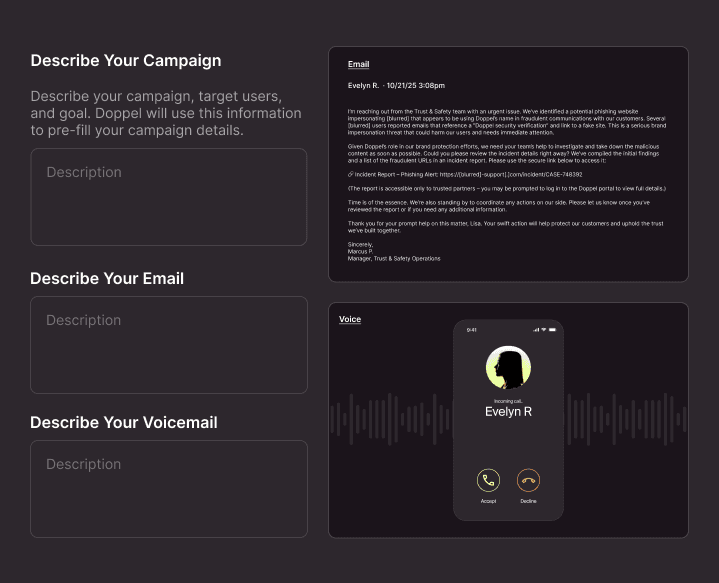
Doppel simulation builder generating a chained email and voice phishing campaign

Reliable, multi-channel phishing simulations

Doppel can run live, dynamic simulations across voice calls, SMS, email, video-meeting impersonation, and QR with configurable chained flows and a 95%+ deliverability rate.
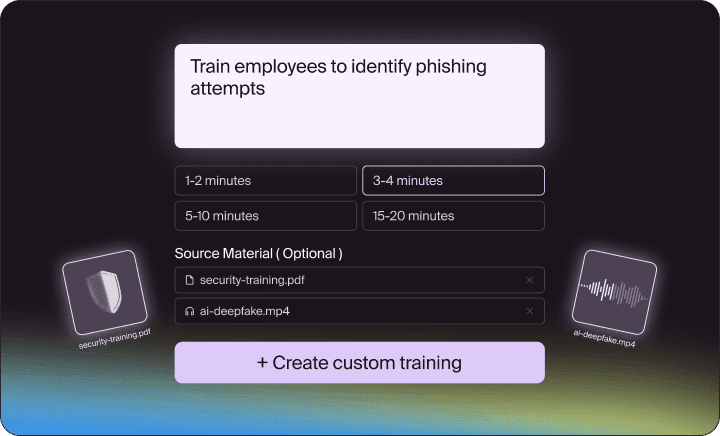
Doppel AI content builder creating custom training from source material

AI-powered personalization, at scale

Doppel provides OSINT-backed recommendations for an expansive range of organizations, roles, and tech stacks based on intel gathered by reconnaissance agents, and dynamically translates campaigns in 100+ languages.
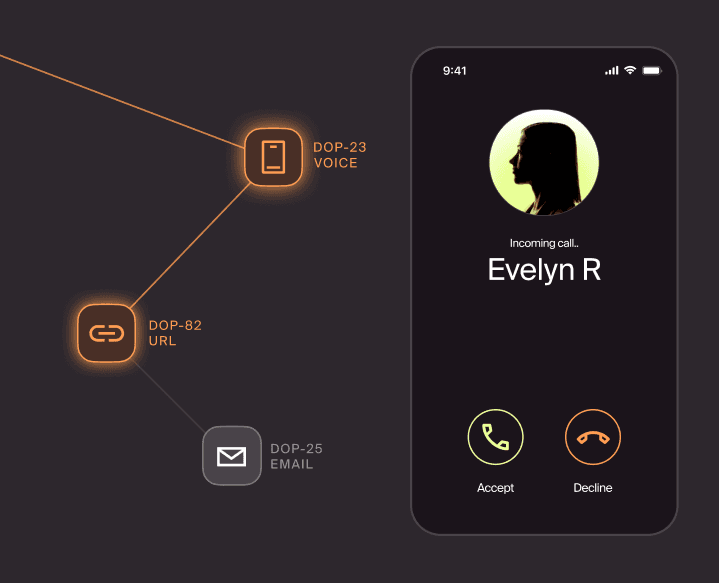
Threat-informed simulation campaign chaining voice, URL, and email steps

Threat-informed social engineering defense

As a unified agentic social engineering defense platform, Doppel proactively recommends training and simulation campaigns based on actual attacker tactics and ingests signals across the tech stack to model human risk, building resilience against modern threats.

What Doppel customers say

“Doppel fundamentally changed how we think about human risk. It’s not just about running better simulations; it’s about testing how attacks actually happen across channels. The Microsoft Teams simulation campaign showed us where our real exposure was, and gave us a way to measure and improve it. That’s the difference between a program that looks good on paper and one that actually reduces risk.”

Jason MartinCo-CEO & Co-Founder, Permiso

Permiso
“Compared with Hoxhunt, Doppel stood out for its broader channel support. SMS was a clear differentiator, and we also liked the short-form training experience and the depth of the insights and analytics.”

Technology Leader, Robotics & Technology

6+ Channels
Email, voice, SMS, Teams, Zoom & messaging apps
100%
Of targeted employees believed an AI voice clone was a real executive
442%
Increase in vishing attacks year over year

See how Doppel compares to Hoxhunt

See how Doppel builds resilience against multi-channel and modern social engineering attacks through threat-informed simulations and tailored training content.

FAQs

What is the difference between Doppel and Hoxhunt?
Doppel and Hoxhunt both help organizations manage human risk, but their strengths differ. Hoxhunt is particularly strong in email phishing, gamification, and employee engagement. Doppel combines security awareness training with human risk management and realistic simulations across email, SMS, voice, and collaboration tools such as Microsoft Teams and Zoom.
Is Doppel an alternative to Hoxhunt?
Yes. Hoxhunt can be a strong fit for organizations prioritizing an engaging, email-first awareness program with personalized phishing simulations. Doppel is designed for teams that want to test employees against a range of social engineering attacks, incorporate signals from across the security stack, and connect human risk programs with the threats targeting their organization.
How do Doppel and Hoxhunt compare for multi-channel phishing simulations?
Hoxhunt is well established in email phishing simulation and has expanded its capabilities beyond traditional email scenarios. Doppel supports live simulations across email, SMS, outbound voice calls, Telegram, Microsoft Teams Meetings, and Zoom Meetings, including multi-step scenarios. Buyers should compare not just channel availability, but also deliverability, realism, and whether simulations reproduce the way attackers actually engage employees.
How do Doppel and Hoxhunt approach human risk management?
Hoxhunt uses phishing behavior, reporting activity, and training engagement to personalize the employee experience and measure risk. Doppel combines employee behavior with additional signals from the security stack and external threat context. This is designed to give security teams additional context about potentially higher-risk employees and help them target simulations, training, and other interventions accordingly.
Which platform is better for security awareness training?
It depends on the organization's priorities. Hoxhunt is particularly strong in gamification. Doppel is designed to incorporate threat-informed insights, and reflect actual attacker tactics. Doppel combines a training library and custom content creation with multi-channel simulations and threat-informed human risk management. Organizations should consider whether their primary goal is maximizing awareness engagement or preparing employees for a range of modern social engineering attacks.