

What Is Barrel Phishing?
Barrel phishing, also called double-barrel or two-stage phishing, is a phishing tactic in which an attacker sends two or more sequential emails to the same target. The first is deliberately benign and exists only to establish trust: it carries no link, no attachment, and no sensitive request. The second delivers the payload and references the first to inherit its credibility.
Standard phishing has to succeed on first contact with a stranger; barrel phishing manufactures a prior relationship, so the dangerous email arrives feeling solicited.
How barrel phishing works
The opening email is built to look routine. It impersonates a colleague, a bank, or a known vendor and asks a low-stakes question such as "Are you free for a quick task?" or says a document is on its way.
Because it carries no link, attachment, or request to act on, a content filter has nothing to catch and the recipient has no obvious reason for suspicion. In many variants the attacker waits for a reply before continuing, since a reply confirms the target is engaged and turns a cold approach into an active thread.
That structure makes barrel phishing a form of conversational social engineering, where the exchange itself, not any single message, is the attack.
The follow-up carries the actual payload: a link to a credential-harvesting page, an infected attachment, or a request to authorize a malicious connected app through OAuth. It refers back to the first message, often apologizing for "forgetting to include an important link," so it reads as the natural next step in an exchange already underway.
The attacker controls the timing, sending the second email quickly to preserve continuity or after a delay when the pretext calls for it, and the tone frequently shifts from casual to urgent once the target is committed.
Why barrel phishing is hard to stop
A payload-free first email slips past content-based controls because it carries nothing malicious to inspect. Secure email gateways check URLs against blocklists and detonate attachments in sandboxes, so a plain-text message with neither looks clean.
Attackers can also send from legitimately registered, attacker-controlled domains that pass SPF, DKIM, and DMARC, because email authentication (opens in new tab) validates domain use, not sender intent. Once the thread exists, the weaponized second message lands inside a context the gateway has already cleared, so it tends to draw less scrutiny than a first-contact email would.
The same sequence defeats trained skepticism. Awareness programs teach employees to distrust unsolicited email, and the second barrel does not feel unsolicited because the target has already replied.
That reply is a small commitment, and Cialdini's commitment and consistency principle (opens in new tab) primes people to keep an interaction they have started. Attackers also run multi-channel attacks, opening a BEC sequence (opens in new tab) with a generic "Are you at your desk?" before any financial or document request, or building rapport over SMS, Teams, or a voice call before the email ever arrives.
The gateway then sees only the email portion of a much longer approach.
How barrel phishing differs from related attacks
What defines barrel phishing is its message sequence, not its target or objective, which places it as a delivery tactic within the phishing family.
The adjacent terms draw their boundaries differently:
- Standard phishing can rely on volume, sending one general message to a large population. Barrel phishing spends more effort per target in exchange for higher-trust payload delivery.
- Target specificity defines spear phishing, which can land in a single email. The two-email structure defines barrel phishing, and barrel attacks frequently overlap with spear phishing executed in stages.
- Business email compromise (BEC) pursues an unauthorized transfer of funds, often through executive or vendor impersonation. BEC can be the outcome of a barrel sequence; the terms are not synonyms.
- Conversation hijacking makes a malicious message appear to continue an existing exchange. Barrel phishing instead creates a fresh, attacker-controlled exchange.
- Pretexting builds trust through a fabricated scenario sustained across multi-turn, sometimes multi-channel dialogue.
Barrel phishing builds trust structurally, through the sequence itself, and its opener can be nothing more than a low-stakes question.
How to defend against barrel phishing
A genuinely clean first email can evade any single content-focused control, so layered defenses (opens in new tab) have to address the sequence and the request, and protect the credential when both get through:
- Behavioral and contextual analysis. Because the first message is payload-free and can pass authentication, baseline each user's and relationship's normal communication and flag deviations regardless of content.
- Out-of-band verification. Confirm unexpected wire or payment requests out of band (opens in new tab), by calling a number verified independently of the email.
- Email authentication, with its limits understood. SPF, DKIM, and DMARC are standard mitigations for phishing-for-information techniques (opens in new tab) and help stop spoofing of your own domain, but pair them with monitoring for lookalike domains an attacker registers legitimately.
- Phishing-resistant MFA. FIDO/WebAuthn provides widely available phishing-resistant MFA (opens in new tab) because it blocks authentication on fake websites even after the social engineering succeeds.
- Sequence-aware training and reporting. Train employees on the two-email pattern itself: the tone shift from casual to urgent, and a follow-up that references a thread they never saw.
Single-email red-flag training does not rehearse this, so teach staff to check for slightly altered sender domains, and give reported messages a fast triage path.
How Doppel helps
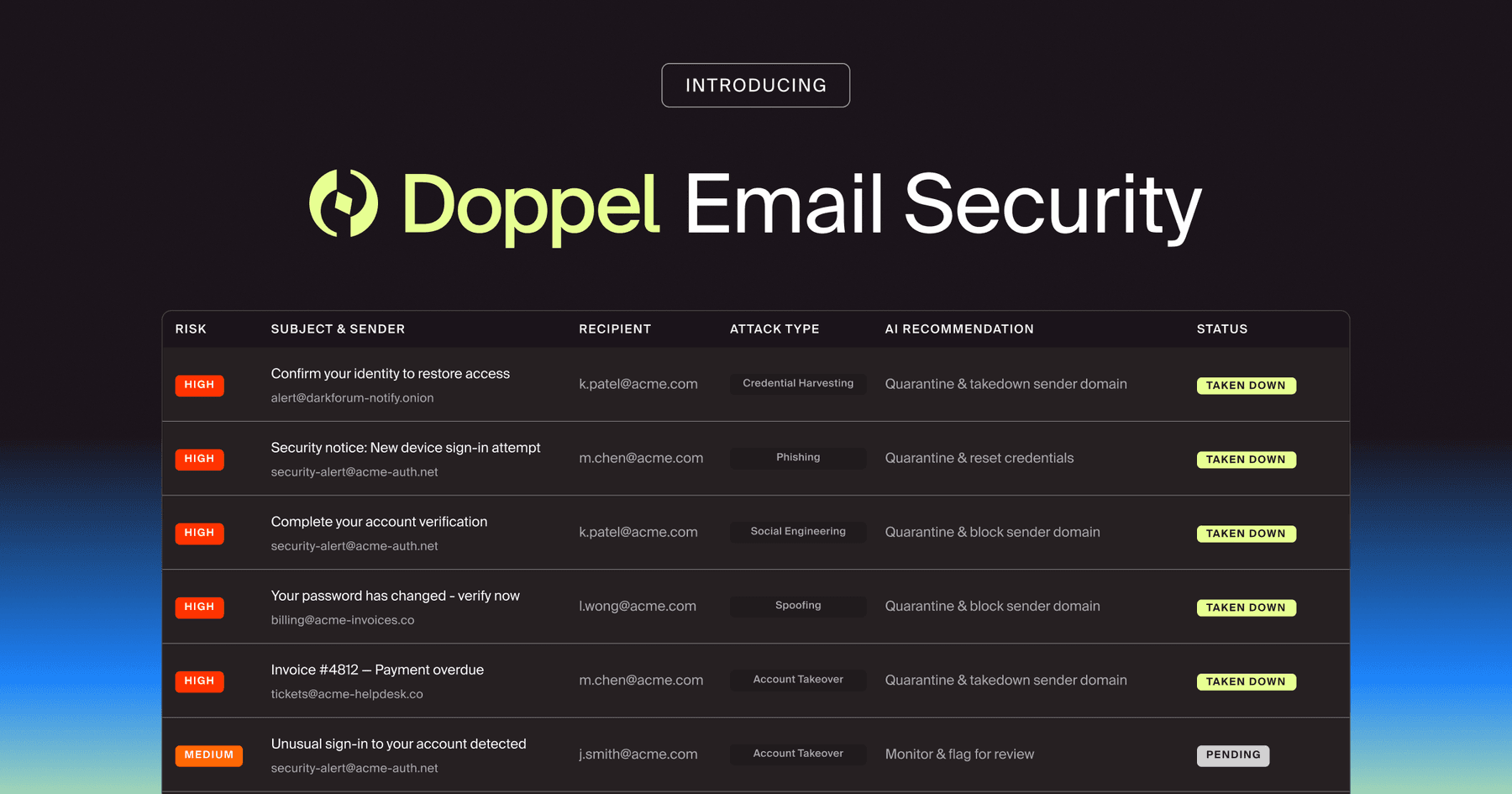
Doppel is the AI-native Social Engineering Defense (SED) platform that unifies Digital Risk Protection and Human Risk Management. Phishing Triage treats the benign opener and the weaponized follow-up as a single campaign, correlating reported messages against the attacker infrastructure the Doppel Threat Graph maps.
When the second barrel arrives, agentic AI correlates the sequence and executes takedowns of the sending infrastructure and malicious links, while analysts handle escalations that need human judgment.
Phishing simulation and Security Awareness Training run multi-step scenarios drawn from live campaigns, so employees rehearse the two-touch pattern before they meet it.
Correlating the benign opener and its follow-up as one campaign, then dismantling the infrastructure behind both, forces attackers to rebuild the delivery chain and makes running two-stage sequences against your brand and your people too costly to attack.
Request a demo to get started.
Frequently asked questions about barrel phishing
What is barrel phishing?
Barrel phishing is an email attack that unfolds in two or more stages. The first email is harmless by design, with no links, no attachments, and no sensitive request; its only job is to build trust. A follow-up then delivers the real attack, usually a credential-harvesting link, a malware attachment, or an impersonation-driven payment request, and references the earlier message so it feels like part of a conversation already underway. The "double-barrel" name captures the one-two sequence.
What is barrel phishing in cybersecurity?
In cybersecurity, barrel phishing is a two-stage email attack: a harmless first message builds trust and a second delivers the payload. It is a delivery tactic within the broader phishing (opens in new tab) family, not a discrete attack type, which is why standard phishing guidance (opens in new tab) covers it. Its defining trait is the multi-message, trust-building sequence that lets the first email pass filters keyed to malicious links and attachments.
What is the difference between barrel phishing and spear phishing?
Spear phishing targets a specific individual or organization researched in advance, and attackers can execute it in a single email. Barrel phishing is defined by message sequencing, a benign opener followed by a weaponized follow-up, regardless of how personalized either one is. The two overlap in practice, since many barrel attacks are spear phishing campaigns delivered in stages to make the malicious message harder to detect.
What is an example of a barrel phishing attack?
Tax-themed campaigns (opens in new tab) targeting accounting professionals show the pattern. A fabricated persona opens with a benign request for tax-filing help, with nothing malicious in the message. Only recipients who reply receive the second email, which carries a malicious PDF attachment. The payload succeeds because rapport from the first exchange makes the attachment look expected.