Social engineering fraud converts human trust into a payout, often through misdirected wires or stolen credentials. It now runs as a coordinated, multi-channel operation (opens in new tab), and single-surface controls catch only fragments of it. A single convincing email or cloned voice can move large sums before anyone thinks to verify, and the same playbook scales across employees with phones and inboxes.
Cybercrime losses reached $16.6 billion (opens in new tab) in reports to the FBI's IC3 in 2024, a record high. This guide defines social engineering fraud, breaks down how a campaign unfolds, and lays out how to identify it, prevent it across every channel, and respond when an attempt reaches your people.
Key Takeaways
- Social engineering fraud manipulates trust to move money, capture credentials, or gain access, often without malware or a traditional technical intrusion.
- The most common schemes include business email compromise, vishing and deepfake voice fraud, account takeover, vendor and invoice fraud, and pretexting against help desks.
- Modern campaigns unfold across reconnaissance, weaponization, delivery, persuasion, and execution, and those stages leave signals across email, voice, messaging, domains, telco, and social channels.
- Prevention depends on layered verification, hardened communication channels, workforce training against live tactics, and active disruption of attacker infrastructure.
- Response should prioritize freezing transfers, securing accounts, preserving evidence, filing reports, and feeding the incident back into detection and training.
What Is Social Engineering Fraud?
Social engineering fraud is deception that manipulates a person into authorizing a payment, surrendering credentials, or granting access for an attacker's financial gain. It succeeds by exploiting the human instincts that few technical controls govern.
Social Engineering Fraud Exploits People to Reach Money and Access
Manipulating trust (opens in new tab) is the mechanism, and fraud is the payout. Phishing, vishing, SMS phishing, pretexting, and business email compromise are all forms of it. Phishing is itself a form of social engineering (opens in new tab) tuned to trick someone into revealing information or taking an action that compromises systems.
Attackers often avoid technical intrusion and convince a person to open the door. In BEC, social engineering or computer intrusion lets attackers conduct unauthorized transfers of funds (opens in new tab) without relying on malware delivery. Prevention cannot depend only on link, attachment, or malware analysis.
Fraud Succeeds Because the Target Has No Reason to Doubt the Request
Most social engineering attacks succeed because the person on the other end has little reason to doubt the request. Organizations with strong technical controls (opens in new tab) remain susceptible, because the attack targets decision-making that policies do not govern. Even experienced security professionals (opens in new tab) fall for social engineering when they fail to distinguish deception from normal human interactions based on trust, kindness, and expected social norms.
The mechanics trace to common social-engineering levers (opens in new tab). Authority makes employees follow apparent superiors without question, and urgency pushes people into faster, worse decisions. Familiarity also matters: a caller who knows your role and relationships earns trust in the first few seconds.
Attackers assemble that familiarity from social media, prior breaches, and public filings, then use it to satisfy the verification process itself.
The Most Common Types of Social Engineering Fraud
Social engineering fraud shows up in a handful of recurring schemes that share one goal, moving money or access out of the organization. The five most common each target a different channel, role, and moment of trust.
1. Business Email Compromise and CEO Fraud Hijack Executive Authority
Business email compromise weaponizes hierarchical authority through corporate email. Attackers build target lists from LinkedIn and OSINT, then spend weeks. studying an organization's vendors (opens in new tab), billing systems, and a CEO's email style and travel schedule.
When the timing is right, often when the CEO is traveling, the attacker emails a finance employee requesting an immediate wire transfer to a familiar vendor account, with account numbers slightly altered. Attackers count on the employee's tendency to comply with apparent executive authority under urgency and confidentiality.
2. Vishing and Deepfake Voice Fraud Weaponize a Trusted Voice
Voice phishing attacks exploit the telephone, and AI voice cloning has made the trusted voice itself the weapon. Reported voice-clone schemes (opens in new tab) describe attackers calling company executives while impersonating parent-company leaders, reproducing accents and cadence, and demanding urgent transfers.
Recognizable audio or video (opens in new tab) does not prove identity on its own. Attackers now clone a known voice from short public audio and deliver it as a live phone instruction.
3. Phishing-Led Account Takeover Turns Stolen Credentials Into Access
Account takeover starts with a credential lure and ends with access. As MFA became widespread, stealing a password alone stopped being enough, so attackers adapted with Adversary-in-the-Middle phishing. Theyinsert themselves (opens in new tab) into the authentication circuit between the victim and the identity provider, proxying the genuine login page.
The victim enters credentials and an MFA code through a real-looking Microsoft 365 interface, and the attacker relays both to complete authentication and take over the account. The whole attack exploits a routine moment: re-authenticating to a corporate SaaS application.
4. Vendor and Invoice Fraud Redirects Legitimate Payments
Vendor email compromise targets the accounts payable workflow and the assumption that recurring transactions need minimal verification. Vendor fraud often starts with credibility-building through a compromised account or lookalike domain, then moves to a payment-change request through updated remittance instructions or a new bank account.
By the time the attacker redirects funds, the request can look like part of a normal vendor workflow. Attackers also insert themselves into real vendor email threads and ask for "outstanding invoices" to be paid to new accounts inside existing conversations.
5. Pretexting Builds a False Story to Justify the Ask
Pretexting constructs a fabricated scenario to justify an action, and the IT help desk is its favorite target. Threat actors posing as IT or help desk staff use documented help-desk playbooks (opens in new tab) to convince personnel to reset passwords and MFA tokens. They often carry employee details harvested from social media and prior breaches.
In one reported campaign, attackers impersonated finance leadership (opens in new tab) to the help desk, persuaded staff to reset the MFA device and credentials tied to a senior account, then enumerated privileged accounts from there. Attackers target help desks because they can deceive help desk representatives (opens in new tab) into resetting passwords, which turns the verification process into the attack surface.
How a Social Engineering Fraud Campaign Unfolds
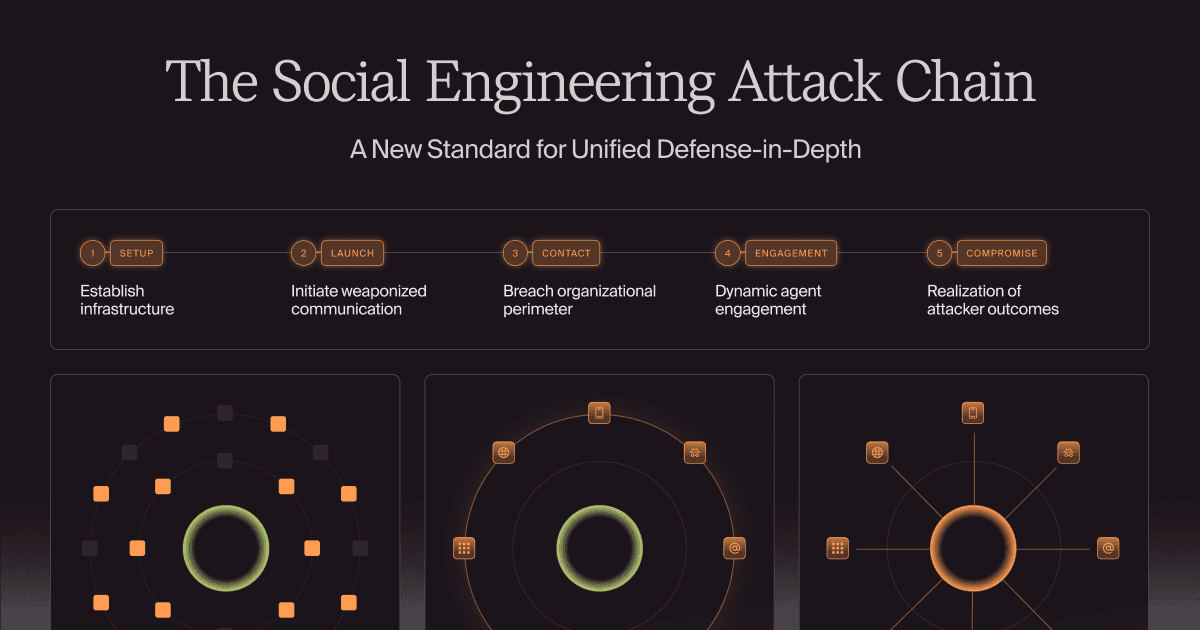
Whatever form it takes, a social engineering fraud attempt moves through the same five-stage attack chain. Each stage generates signals across multiple channels that aunified defense can catch and connect.
- Reconnaissance: Attackers profile the people and payment flows worth targeting. They gather victim identity details and organization information before they impersonate a target. Conference recordings, LinkedIn profiles, and earnings calls become raw material: a short audio clip becomes a voice clone, an org chart becomes a pretext. Recon happens largely outside defender visibility, so the primary tell is downstream, in the specificity of the lure.
- Weaponization: That reconnaissance feeds the infrastructure attackers build to impersonate trust. They register lookalike domains and other infrastructure to substantiate the false identity (opens in new tab), stand up typosquatted variants, and exploit weak or absent DMARC policies to spoof legitimate senders. Generative AI now crafts personalized lures and clones executive voices at this stage. Defenders can detect newly registered domains matching the organization's naming patterns, plus authentication failures on inbound mail.
- Delivery: The lure reaches the target across email, voice, and messaging. A spear-phishing email carries a malicious link, or a phone call elicits credentials from the help desk. These campaigns now move across email, telephone, text, videoconferencing, and online postings at once. Observable signals span SPF/DKIM/DMARC failures, unexpected help desk calls, and collaboration-platform messages from external accounts.
- Persuasion: Impersonated authority and manufactured urgency force a decision. Attackers reference current events (opens in new tab), threaten repercussions, or invoke a confidential acquisition to generate a sense of urgency strong enough to short-circuit verification. The voice channel conveys authority more convincingly than text, which is why cloned executives and impersonated IT staff dominate this stage. Urgency-themed requests, off-hours approvals, and callers who cannot be verified through standard callback expose the fraud attempt.
- Execution: The victim transfers funds, hands over credentials, or grants access. The attacker completes the wire, gains access through an AiTM proxy, wears down a target with repeated MFA push prompts, or intercepts an SMS code through a SIM swap. Some incidents reach beyond money and access to expose sensitive data as well. The signals at this stage are MFA push storms, logins from new devices immediately after a help desk interaction, and resets correlated with preceding calls.
How to Identify Social Engineering Fraud
Identifying social engineering fraud means catching the signals that betray a manufactured request. Because attackers spread those signals across channels, reliable detection pairs human red-flag awareness with automated correlation that sees the whole campaign.
1. Last-Minute Payment Changes, Channel Switching, and Unverified Urgency Are the Clearest Red Flags
The most reliable behavioral signals cluster around money and pressure. Requests to redirect payment or change bank details deserve out-of-band verification (opens in new tab) before action. A handful of patterns appear in nearly every fraud attempt, and they are worth surfacing for finance and AP teams directly:
- A payment or banking change request arriving with urgency or a confidentiality demand, especially outside normal business hours.
- A message from a private Gmail or personal address claiming the sender's corporate email is down.
- A familiar vendor invoice with updated remittance instructions and no prior notice through a trusted channel.
Treating any one of these as routine is how the wire goes out. Each is a moment to stop and verify through an independent method.
2. Lookalike Domains, Spoofed Profiles, and Cloned Voices Expose the Attacker's Infrastructure
The infrastructure side leaves its own tells. Unusual domains, like pavpal[.]com standing in for paypal[.]com, are a major red flag, and lookalike domains that fail authentication underpin most credential phishing. Defenders can often see spoofed social profiles built to establish executive credibility, and lookalike domains attackers register before a campaign launches, well before the lure lands.
Cloned voices and deepfake videos are now operational parts of fraud campaigns, so a recognizable voice or a live video call does not prove identity.
3. Correlating Signals Across Channels Reveals the Campaign Behind a Single Message
A single indicator has limited value on its own. BEC indicators gain power when defenders link them across identity and communication flows, and a defense built around a single surface, whether email filtering, domain monitoring, or an annual phishing quiz, misses most of the kill chain.
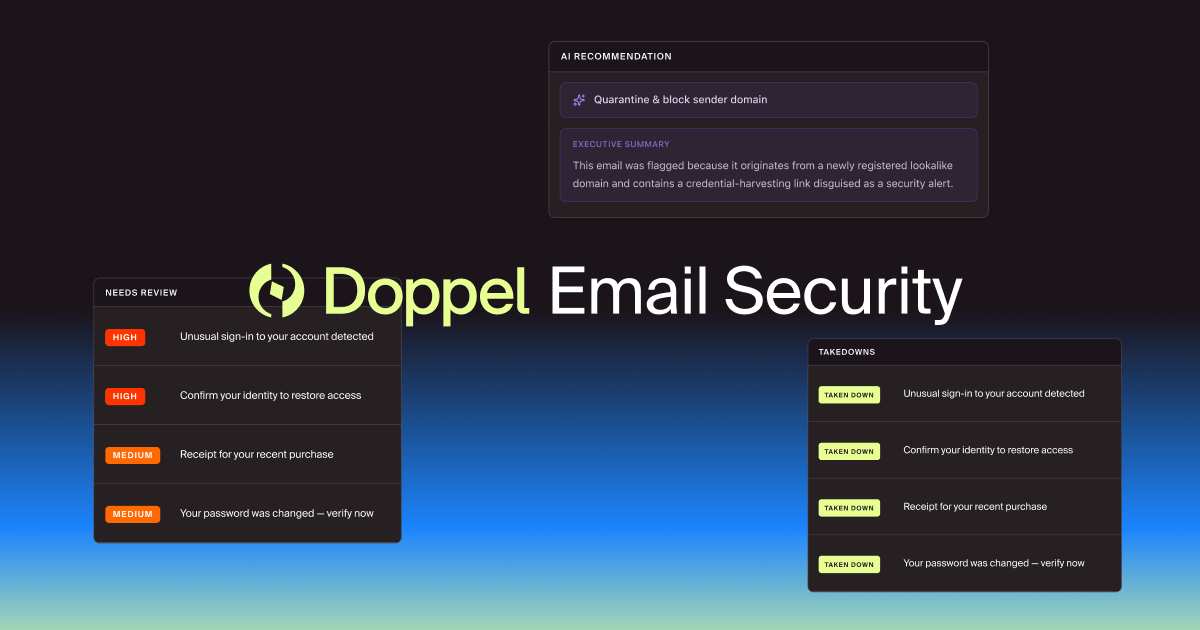
Doppel, the AI-native Social Engineering Defense platform, unifies Digital Risk Protection and Human Risk Management across those signals.
The Doppel Threat Graph ingests signals across domains, social, ads, telco, dark web, and messaging, then stitches a typosquatting domain, its linked telco numbers, the WhatsApp accounts tied to it, and the ad campaigns running off the same registrar into a single campaign view. The customer sees the full operation.
How to Prevent Social Engineering Fraud
Preventing social engineering fraud takes layered defense across the technical and human boundaries the attack crosses: verification that removes single points of trust, technical controls that close channels, a workforce trained against live tactics, and active disruption of the attacker infrastructure aimed at the organization.
1. Build Verification Into Every Payment and Access Request
Remove single points of trust from high-risk transactions. Financial institutions should avoid reliance on a single control for high-risk transaction authorization and institute layered security (opens in new tab).
In practice, that means out-of-band callback verification (opens in new tab) for wire requests and instruction changes, dual authorization through separate access devices, transaction value limits, and account validation that confirms the recipient name matches the account number before funds move. Do not sacrifice sound authentication for customer convenience.
2. Close the Technical Channels Attackers Use to Reach Employees
Harden the channels attackers exploit to deliver and execute. Enable SPF, DKIM, and DMARC set to "reject" (opens in new tab) across corporate email infrastructure, a direct control against phishing and BEC. Require MFA for remote access, privileged accounts, and third-party applications.
Given deepfake capabilities, covered entities should reconsider MFA that relies on voice, video, or text and consider digital certificates, physical security keys, or biometric authentication with liveness detection. Treat the help desk as a named attack vector and lock down identity verification for password and MFA resets.
3. Train the Workforce Against the Tactics Actually Targeting It
Train people against live attacker behavior. At least annual cybersecurity awareness training should include social engineering under the annual training requirement (opens in new tab), and teams can deliver deepfake-attack training through simulated phishing and voice and video impersonation exercises. Real practice matters most when an attacker is on the phone.
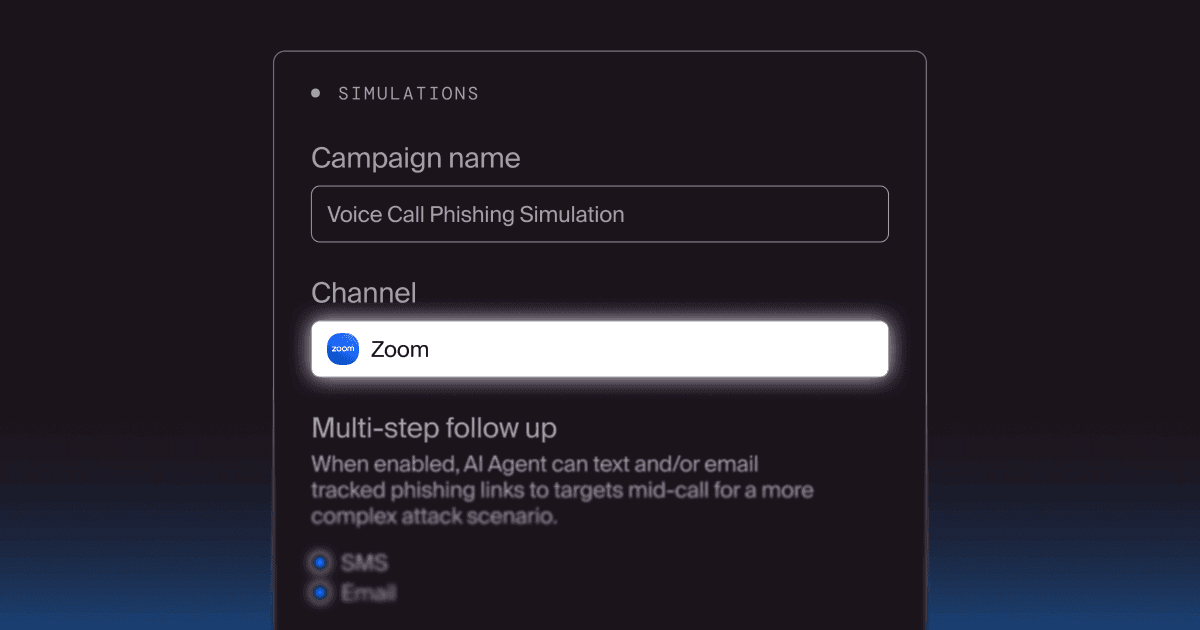
Doppel's Dynamic Simulation runs across email, voice, SMS, Microsoft Teams, Zoom, Telegram, and WhatsApp, using live AI voice agents that adapt mid-call and pivot to an SMS or email follow-up when a target pushes back, the same multi-step behavior real attackers use.
With one-click threat-to-simulation conversion, today's real lure detected against the brand becomes tomorrow's org-wide simulation, so finance and help desk teams train against the exact tactics attackers aim at them.
Two capabilities map directly to the attack patterns described earlier. Helpdesk Mode pre-trains the voice agent to navigate IVR phone trees, wait through hold times, and handle line transfers, so the same simulations that test internal staff also test outsourced helpdesks and contact centers at scale—the exact surface pretexting playbooks hit.
Custom voice clones built from short public audio of a named executive turn deepfake voice fraud into a controlled drill, so finance teams field a call that sounds like the CFO in a simulation before they ever take one from an attacker.
4. Dismantle Attacker Infrastructure Before the Lure Lands
Take down the infrastructure before it reaches employees and customers. Attackers can rapidly redeploy phishing pages after takedowns, which is why takedown-only strategies struggle to keep pace. Correlation plus speed closes that gap. Dismantle the connected campaign in a single action while the actor is still attempting to stand up more infrastructure.
Doppel's agentic AI engine correlates, prioritizes, and executes takedowns across registrars, social platforms, telcos, and ad networks at machine speed, so analysts focus on the complex escalations that require human judgment.
Legacy takedown workflows often miss telcos, which leaves the SMS and WhatsApp paths of a campaign live. Direct provider relationships bring that leg down in the same action.
How to Respond to Social Engineering Fraud
When the team catches an attempt in progress or confirms one succeeded, a fast, sequenced response limits the loss and converts the incident into a defense improvement.
- Contain the Damage: Freeze transfers and secure affected accounts. Move first on the money and the access. Contact the originating financial institution (opens in new tab) as soon as the team recognizes fraud to request a recall or reversal, and notify the receiving bank immediately. Secure compromised accounts by changing passwords and removing any forwarding or filtering rules the attacker set up, and isolate affected systems. Preserve all evidence (opens in new tab), including emails and text conversations, because law enforcement will request it.
- Investigate the Full Campaign Behind the Incident: Scope the whole operation from the first lure through the infrastructure behind it. Correlate mailbox access logs for unusual downloads or bulk deletions, anomalous access to contracts and invoices, and credential reuse across other systems, then identify which other accounts and departments interacted with the compromised mailbox. Determine which systems attackers compromised and whether someone bypassed a verification step, since that shapes who bears the loss.
- Recover Funds and Meet Regulatory Reporting Obligations: File a detailed complaint (opens in new tab) at ic3.gov immediately with complete banking information so the IC3 Recovery Asset Team can initiate the Financial Fraud Kill Chain. Report in parallel to law enforcement according to your incident response process. Regulated entities must file a Suspicious Activity Report (opens in new tab) within 30 calendar days of initial detection, and NYDFS-covered entities should also report suspected incidents (opens in new tab) to the FBI's IC3 and meet their separate DFS notification obligations under 23 NYCRR § 500.17.
- Feed the Incident Back Into Detection and Training: Convert the loss into hardening. Tighten verification procedures, such as mandatory callback confirmation for any wire instruction change, to prevent repeat losses, and turn the real lure into a simulation the workforce trains against.
Each detection should sharpen the next defense.
How Doppel Defends Against Social Engineering Fraud
Doppel operationalizes this playbook as a single Social Engineering Defense platform. Digital Risk Protection detects and dismantles the impersonation infrastructure behind these attacks across the major channels attackers use, including lookalike domains, spoofed profiles, scam ads, and telco-based smishing.
Human Risk Management trains employees against the live tactics targeting them, with simulations Doppel derives from real detected campaigns.
Underneath both, the Doppel Intelligence Layer ties detection, takedown, and training to the same campaign view. First-party telemetry showed indexed attacker activity targeting Financial Services and Fintech brands rose nearly fourfold from January to March 2026, with campaigns increasingly combining ads, messaging apps, phishing sites, and private channels into coordinated funnels, the multi-channel design single-surface tools miss.
Make Social Engineering Fraud Harder to Run Against Your Organization
The organizations that pull ahead treat social engineering fraud as an infrastructure-and-human problem they can actively disrupt. They feed campaign detection into both infrastructure takedown and workforce training, which raises the cost of attempts until attackers move on to easier targets.
Request a demo to see the Threat Graph correlate a live campaign against your brand.