For retail and e-commerce brands, the peak holiday shopping season represents the highest-stakes operational window of the year. It also represents the most lucrative window for cybercriminals. As consumer transaction volumes surge, attackers no longer rely on poorly written, mass-distribution phishing emails. Today, threat actors deploy sophisticated, multi-channel impersonation networks running at machine speed.
By leveraging generative AI and natural-language "vibe phishing" tactics, adversaries clone entire e-commerce environments, launch highly targeted malicious ads, and spin up automated consumer fraud campaigns in minutes. Legacy brand protection tools and siloed email filters are fundamentally unequipped to handle this automated velocity.
This blog exposes how modern threat actors use generative AI to scale multi-surface retail scams during peak shopping windows, why legacy point solutions leave enterprises exposed, and how a threat-informed Social Engineering Defense (SED) framework breaks the attack chain at the infrastructure level.
From Phishing Links to Full-Scale Engines
Historically, holiday fraud followed a predictable playbook: a basic lookalike domain sent via a generic email blast hoping to harvest login credentials. Today, the economics of attacks have fundamentally shifted. Generative AI has lowered the cost to attackers by 95% (opens in new tab), while generative phishing volume has risen over 1,000% (opens in new tab).
Adversaries now deploy AI-native impersonation engines that mimic a retail brand across the entire internet ecosystem.
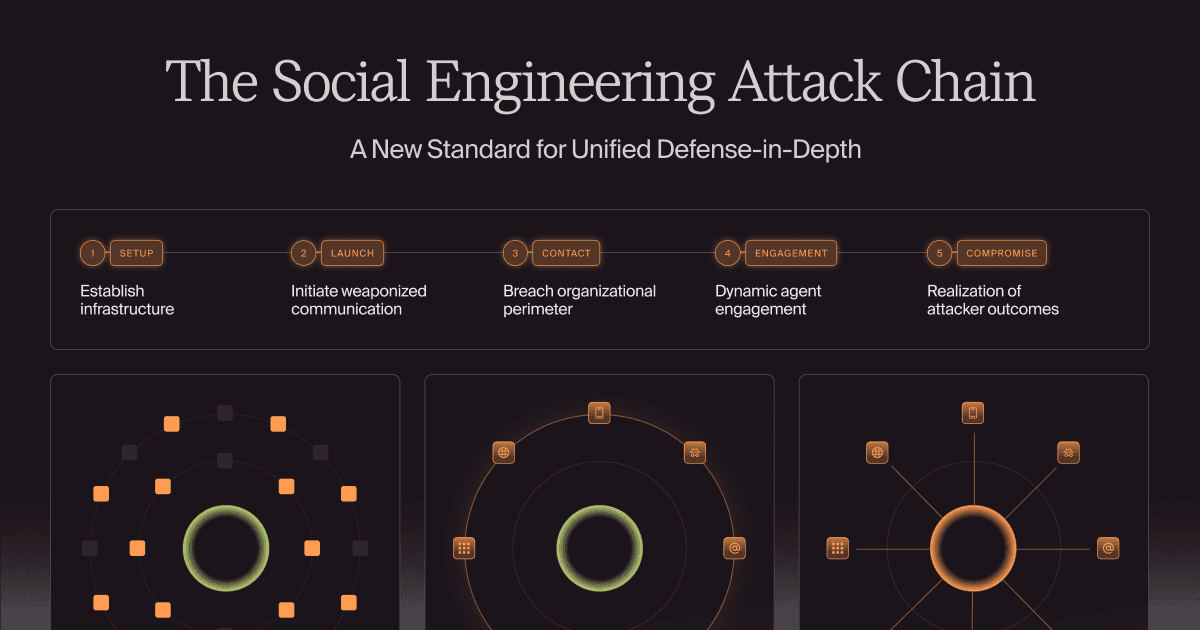
The modern holiday attack chain operates across five distinct phases:
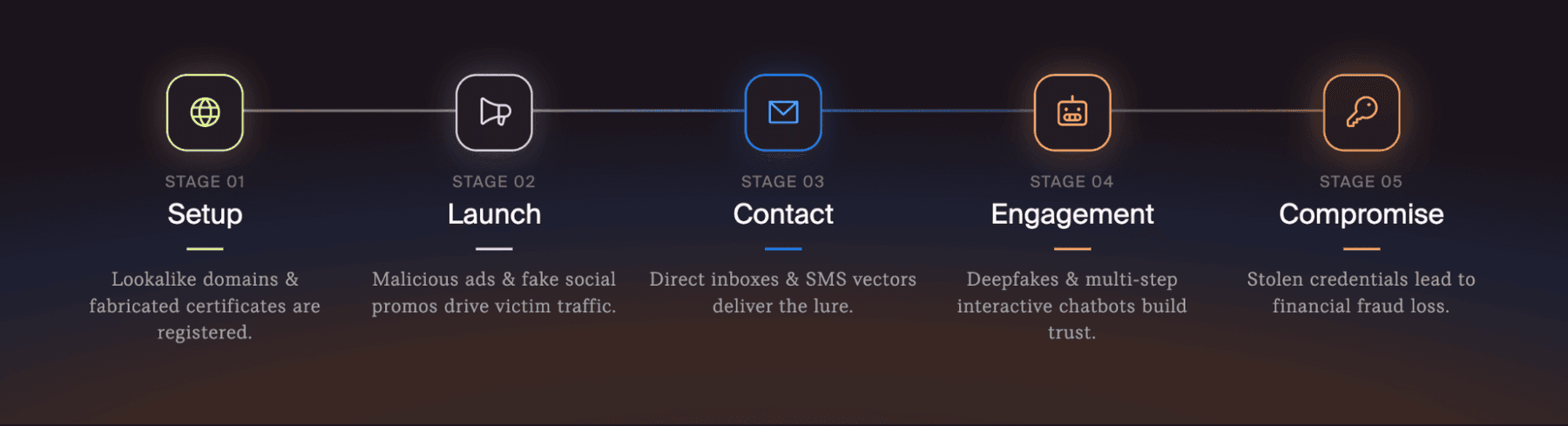
Generative AI and multi-channel orchestration have fundamentally altered how attackers execute these 5 phases. Rather than running slow, manual operations, modern threat actors scale their campaigns across the attack chain using two distinct operational strategies:
- Attackers use simple, natural-language prompts to generate flawless, branded copy, localized pricing, and contextual lures that match a brand's exact holiday marketing calendar. Because these AI-generated messages contain no behavioral anomalies, perfect grammar, and no known signatures, traditional security filters miss them entirely.
- Modern scams do not live in isolation. A single campaign may begin with a malicious search ad or a sponsored social media post, hop to a lookalike domain with automated SSL certificates, move into a consumer's SMS text thread, and ultimately land inside an employee’s corporate inbox via business email compromise (BEC).
Why Legacy Brand Protection Fails the Busy CISO
When a retail brand is targeted by a multi-surface scam network, the traditional response is a game of digital whack-a-mole. Fraud, SecOps, and Legal teams find themselves trapped in a reactive loop that assumes manual intervention can scale against automated infrastructure.
Traditional DRP Approaches | Modern Social Engineering Defense (SED) |
Artifact Detection Finds a single fake site or social media profile after it goes live, ignoring the wider campaign. | Infrastructure Disruption Maps the entire attacker core and dismantles lookalike domains, hosts, and ad accounts simultaneously. |
Manual Takedown Queues Relies on slow, ticket-driven legal outreach taking days or weeks while scams exploit consumers. | Autonomous Mitigation Achieves machine-speed takedowns (< 1-hour median mitigation on phishing infrastructure). |
Siloed Tooling Separates external brand protection from internal inbox filtering and employee training. | Unified Intelligence Connects external threat signals directly to inbox controls and live employee simulation training. |
When security tools fail to communicate, the data becomes stale before an analyst even reviews the ticket. With an industry average dwell time of 260 days (opens in new tab) to contain a social engineering breach, retail brands face severe customer churn, brand erosion, and direct revenue loss during their most critical financial quarter.
Dismantling the Operation
Defeating an AI-native impersonation engine requires moving beyond legacy "whack-a-mole" security strategies. If a security team only removes a single malicious link, the adversary can regenerate a parallel infrastructure asset in seconds.
Lasting risk reduction requires attacking the root-cause economics of the fraud network, raising the attacker's operational costs until the campaign is no longer profitable.
To dismantle a multi-channel retail fraud operation effectively, security and threat intelligence teams should implement a structured, campaign-centric blueprint:
1. Shift from asset triage to campaign correlation
Isolating a single rogue ad or lookalike domain provides an incomplete picture of an exploit. Security operations must actively aggregate telemetry across multiple digital surfaces to map the adversary's broader core.
- Correlate indicators of compromise (IOCs): Group distinct signals, such as passive DNS registrations, SSL/TLS certificate transparency logs, specific ad network tracking IDs, and phone numbers, into a single campaign view.
- Submit graph-based evidence: When requesting infrastructure mitigation from registrars, hosting providers, or ad networks, submit the entire interconnected threat map rather than a single URL. Providing proof of a broad, coordinated fraud ring significantly increases provider compliance and speeds up remediation timelines.
2. Implement automated multi-channel ingestion
Relying on manual discovery or retroactive customer support tickets creates a critical time delay that attackers exploit.
- Automate the inbound abuse pipeline: Configure programmatic parsing for corporate abuse mailboxes to instantly extract threat artifacts, domain names, and metadata from user-submitted lures.
- Continuous surface monitoring: Establish continuous, API-driven monitoring across high-risk vector points, including social media platforms, rogue mobile application stores, mainstream messaging applications (like Telegram and WhatsApp), and paid search networks.
3. Establish external-to-internal intelligence loops
The external threat landscape must directly inform internal security controls. If a brand protection team identifies an active external holiday scam targeting consumers, that intelligence should immediately be operationalized to protect employees.
- Dynamic content feeds: Feed external threat telemetry directly into internal email security filters. This ensures that the exact lookalike domains and sending infrastructures being used against customers are blocked at the perimeter before they can target internal staff via business email compromise (BEC).
- Threat-informed adversary emulation: Abandon static, outdated training templates. Use the tactics, techniques, and procedures (TTPs) observed in live, real-world holiday campaigns to build hyper-realistic internal phishing and social engineering simulations. Training employees against active, contextual threats builds localized, resilient human defense layers.
Protecting Brand Integrity at Machine Speed
The holiday shopping rush moves too fast for manual workflows, complex YARA rules, or siloed tools. To protect digital trust, enterprises must move from passive monitoring to proactive infrastructure elimination.
Governance is auditable disruption with proof, not a list of unhandled alerts. Don't let an AI-powered shadow network compromise your customers, your employees, or your revenue this season.
To see how Doppel can autonomously map and dismantle impersonation infrastructure targeting your enterprise, request a demo today.