
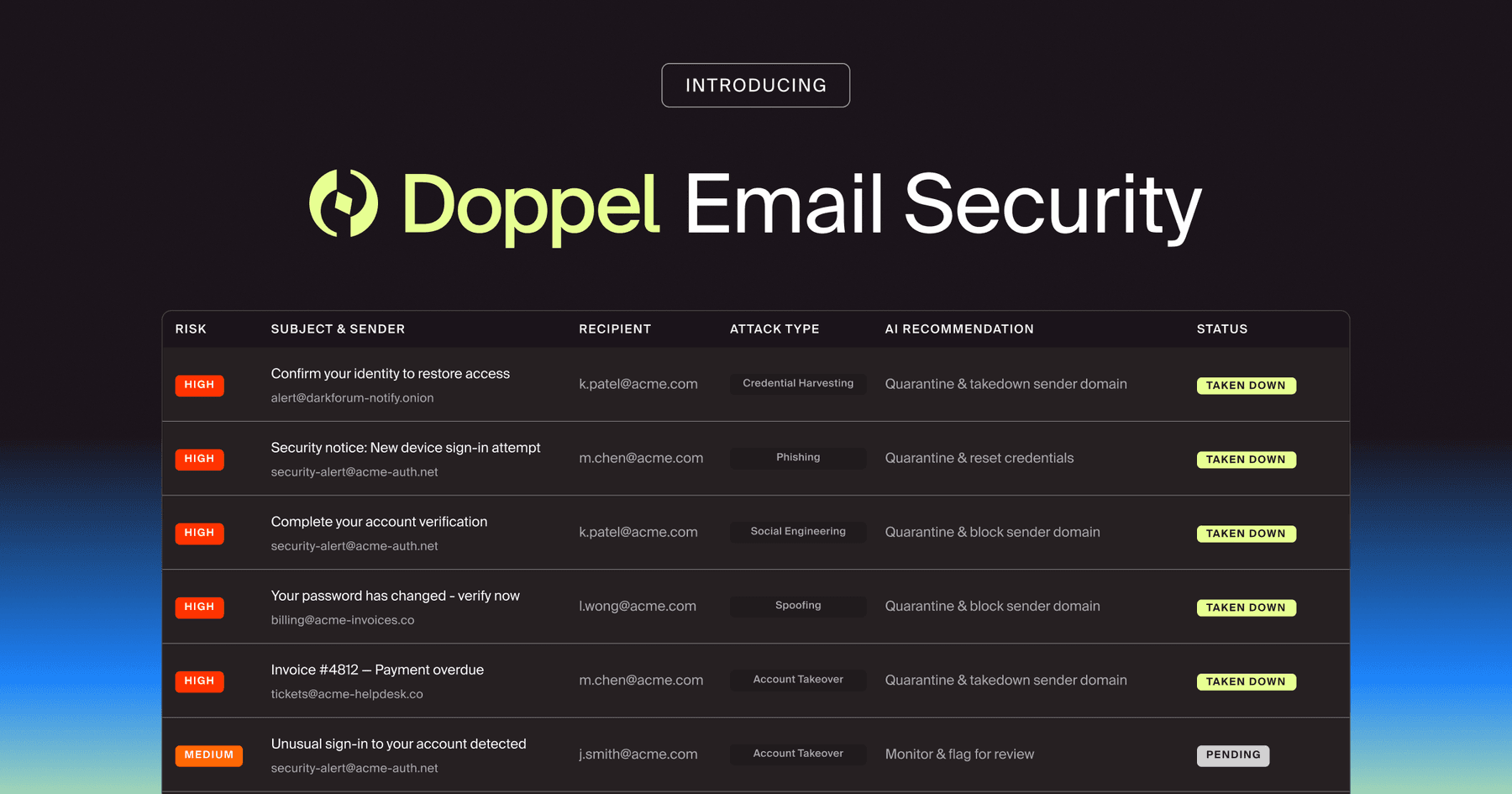
Doppel Email Security is now generally available
The agentic email security solution that empowers you to fight back against social engineering attacks. Detection isn't enough. Disruption is the difference.
Learn how to conduct an impersonation risk assessment based on real attacker pathways and distribution channels.
Threat actors know that hacking a properly configured firewall is difficult, expensive, and time-consuming.
But hacking a brand’s reputation is shockingly easy.
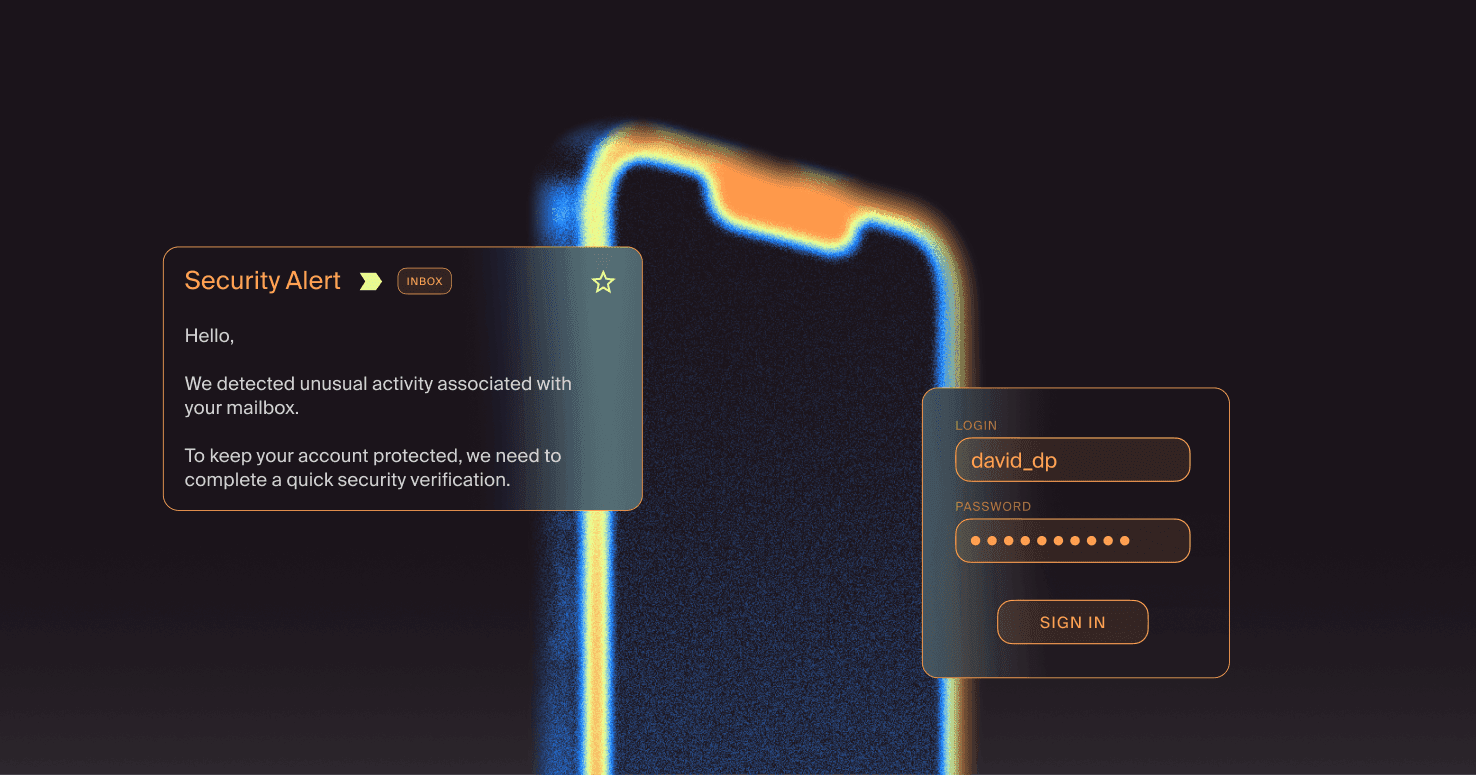
Adversaries don’t need to breach your network if they can just convince your customers, partners, or employees that a malicious lookalike is you. They weaponize the trust you’ve built to harvest credentials, reroute wire transfers, and distribute malware.
When organizations try to measure this impersonation risk, they almost always default to a legacy compliance checklist: counting registered trademarks, running an annual brand audit with the legal team, and sending a few cease-and-desist letters to obvious copyright infringers.
This approach is detached from the reality of cybercrime in 2026, though.
Impersonation risk is a tactical security mapping. To defend your brand against generative AI and automated threat syndicates, you have to look at your digital footprint exactly like a cybercriminal does.
You have to evaluate how easy an adversary can weaponize your brand identity across distribution channels.
Here’s how to conduct an impersonation risk assessment for your brand.
In the context of social engineering, an impersonation risk assessment is the evaluation of how easily a threat actor can clone your corporate identity to defraud stakeholders.
Forget about trademark infringement for a moment. We’re not talking about a competitor using a similar shade of blue in their logo. We’re talking about malicious actors creating pixel-perfect replicas of your digital infrastructure.
An effective assessment completely abandons the legal lens. Instead, it evaluates three core elements of the attacker's business model:
Establishing a strong security posture that defends against brand and executive impersonation requires a shift from passive observation to active threat hunting.
Here’s how the old way of thinking compares to the new reality:
Assessment Metric | Legacy Brand Audit | Impersonation Risk Assessment |
Primary Focus | Legal trademark and copyright protection | Active threat infrastructure and credential harvesting |
Asset Evaluation | Logos, slogans, and official brand guidelines | Executive social media footprints and dangling DNS records |
Takedown Strategy | Cease-and-desist letters drafted by legal counsel | API-driven, agentic infrastructure disruption at machine speed |
Pace of Review | Annual or quarterly compliance audits | Continuous, real-time threat graph monitoring |
Success Metric | Number of trademarks successfully filed | Decrease in the media time-to-takedown of malicious assets |
Trace the exact pathway an attacker takes to exploit your brand, from the initial staging ground to the final delivery mechanism.
Let’s explore the five-step framework to map your brand’s impersonation risk.
Before an attacker launches a campaign, they have to build the lure. They scrape your public footprint to gather the raw materials needed for their digital forgery.
Your first step is to assess exactly what is easily stolen.
Look at your primary web applications, specifically customer login portals and employee single sign-on (SSO) pages.
Ask these questions:
You need to establish a baseline of how easy it is for an adversary to achieve "believability" without ever breaching your perimeter.
A fake website needs a place to live. Attackers rely heavily on technical loopholes and abandoned infrastructure to make their fakes appear entirely legitimate to casual observers and basic security scanners.
Aggressively audit the technical foundation that supports your brand.
Start with your email infrastructure. Review your DMARC enforcement policies. If your DMARC isn’t set to 'reject,' an attacker can effortlessly spoof your exact email domain to send highly believable phishing messages to your vendors.
Next, scan your perimeter for dangling DNS records and abandoned subdomains. If your marketing team spun up a temporary subdomain for a promotional event last year and forgot to delete the routing records, an attacker can hijack that trusted subdomain to host their malicious payload.
Finally, identify unregistered typosquatting domains. Look for the common misspellings or alternative top-level domains (like .co instead of .com) that look nearly identical to your primary URL.
If you don’t own them, an attacker will buy them for $3 and use them as a staging ground.
A beautifully crafted, pixel-perfect fake website does nothing without traffic. The attacker has to put their malicious asset directly in front of your customers.
Assess where your brand is most vulnerable to impersonated distribution.
Don’t just look at organic search results. Attackers have massive budgets. Are they currently running fake sponsored advertisements on Meta, LinkedIn, or Google using your corporate logo to drive traffic to a credential-harvesting site?
Map the specific digital highways attackers are using to deliver the threat. If your security visibility ends at your corporate firewall, you’re blind to the distribution phase of the attack.
While this assessment focuses heavily on the corporate brand, you can’t ignore the individuals who serve as its public face. The brand and the C-suite are linked in the eyes of a threat actor.
Assess the public exposure of your executive leadership team.
Are their personal details — such as private phone numbers, home addresses, or family connections — easily scraped from data brokers or public social media profiles?
Attackers leverage this specific, highly personalized data to craft hyper-targeted business email compromise (BEC) campaigns. They use it to generate deepfake AI voice calls that target your IT help desk directly.
If your executives are highly visible and their data is highly accessible, your overall brand impersonation risk skyrockets.
This is the most critical metric in the entire assessment.
Assume the attacker succeeds in steps one through four. They build a flawless fake login portal, host it on a typosquatted domain, and launch a targeted ad campaign on LinkedIn to distribute it to your clients.
If that happens right now, how long does it take your current security stack to even notice it exists?
Once your team finally spots it, how long does it take to actually burn it down? Do you have to submit a manual ticket? Does your analyst have to beg a social media platform's abuse portal to take action? Are you waiting three weeks for a legal cease-and-desist letter to process?
If your time-to-takedown is measured in weeks or days, your brand is a highly profitable target. To defeat modern threat actors, your disruption capabilities should be measured in minutes and hours.
Knowing your risk profile is the first half of the battle. If your impersonation risk assessment reveals that attackers can easily clone your brand, distribute it globally, and keep it live for weeks without consequence, you have a massive operational liability.
But you can’t fix an automated, AI-driven threat with a manual, human-driven response.
Doppel propels security teams past passive assessments and compliance checkboxes directly into active disruption.
Doppel’s agentic AI-native platform provides continuous digital risk protection for brands and executives. Social engineering defense continuously maps the external threat graph, hunting for the exact staging grounds and distribution channels attackers use to exploit your brand.
When a malicious asset is identified, whether it is a spoofed domain, a deepfake social media ad, or a rogue mobile application, Doppel’s agentic AI executes machine-speed takedowns. We dismantle the threat across domains, ad networks, and social platforms simultaneously, destroying the attacker's infrastructure before brand damage occurs.
Don’t wait for your customers, partners, or employees to tell you your brand has been weaponized. Secure your footprint, automate your takedowns, and fight back — get a demo to see Doppel’s platform in action.