
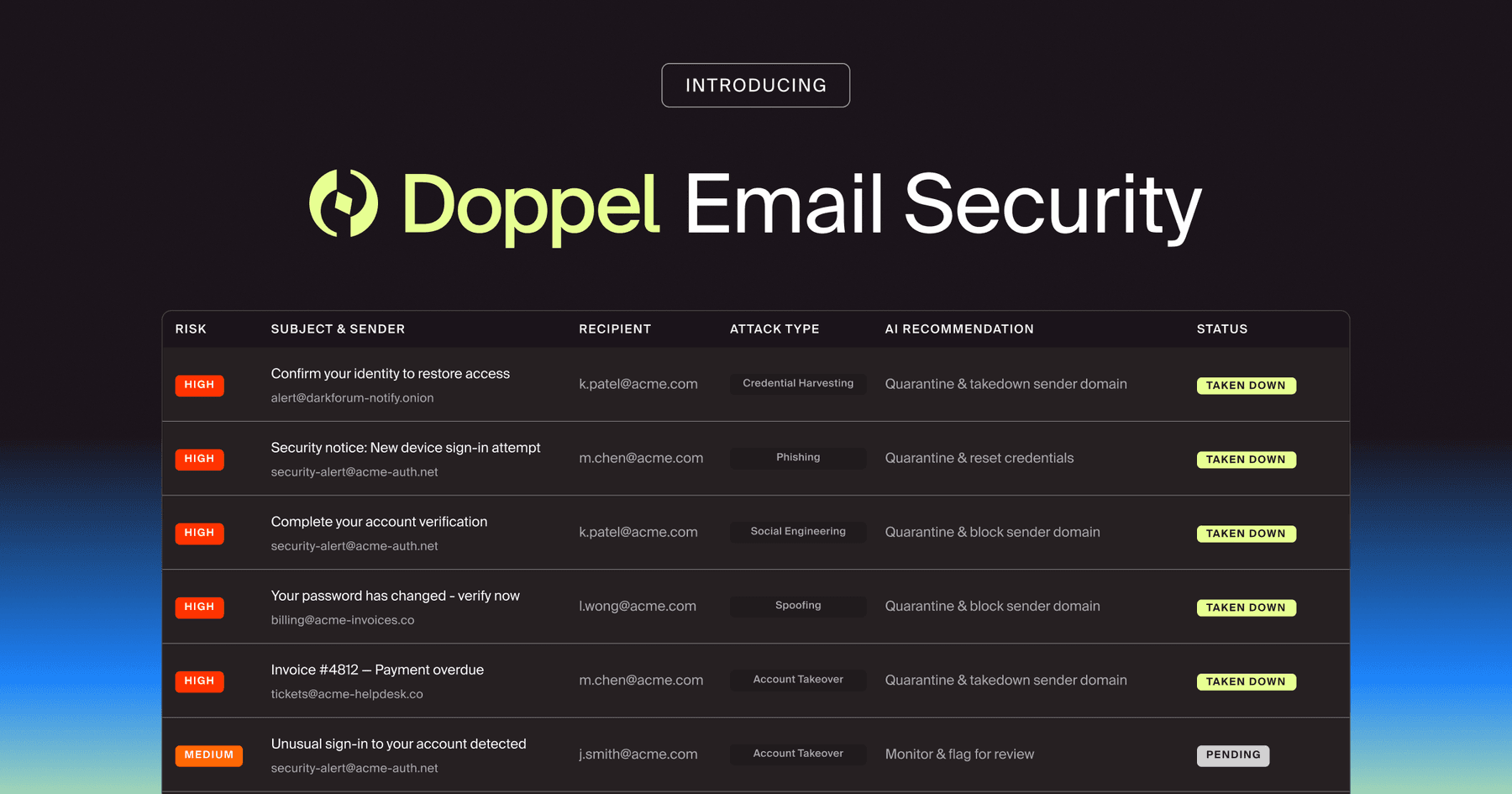
Doppel Email Security is now generally available
The agentic email security solution that empowers you to fight back against social engineering attacks. Detection isn't enough. Disruption is the difference.
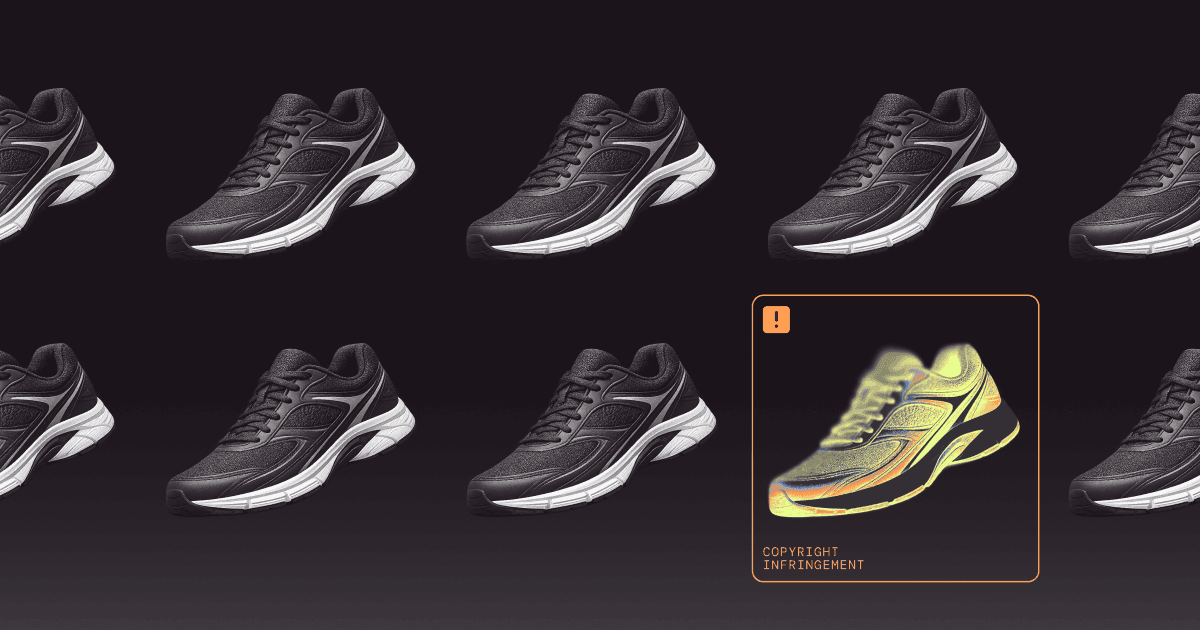
Counterfeit risk in retail is external brand abuse, where criminals impersonate your brand. Counterfeiters are no longer “selling fakes.” They are running full-on retail fraud operations with storefronts, ads, customer support, and a return policy that exists only in their imagination.
From our side of the fence, counterfeit risk management isn’t a compliance exercise. It’s a day-to-day fight to spot the fake storefronts, cloned social accounts, scam ads, and shady listings that put customers at risk. The goal is simple. Cut off the paths criminals use to reach shoppers, before a “too good to be true” deal turns into a chargeback, a safety issue, or a reputation mess your team has to clean up for weeks.
Counterfeit risk management is not just about removing fake products. It’s about detecting and disrupting the campaigns, domains, ads, listings, and impersonated support flows that route customers into counterfeit purchases and follow-on fraud.
Counterfeit risk is external brand abuse where criminals use your brand to sell fake, unsafe, or unauthorized goods. It includes counterfeit products and the infrastructure that makes the fake feel real, like lookalike domains, cloned storefronts, fake social profiles, scam ads, and support impersonation flows that extract payment or data after the click.
If it can harm a customer and leave your brand holding the bag, it belongs in your counterfeit risk management program.
The barrier to looking legitimate is basically gone. Creative can be generated in minutes. Storefront templates are copy-paste. Ad accounts rotate. Messaging apps make it easy to move the victim into a private channel where scrutiny drops and pressure goes up.
The uncomfortable truth is that a convincing fake no longer requires craftsmanship. It requires distribution, speed, and a steady supply of new surfaces to abuse.
They reach shoppers the same way legitimate retail does. Search, social, marketplaces, and paid acquisition. The difference is that the “product” is fraud, and the conversion event is a payment capture, data capture, or a handoff into a higher-pressure support scam that creates harm.
Counterfeit campaigns use the same acquisition channels as legitimate retail; the difference is that the conversion event is fraudulent.
Counterfeiters love places where a product can be listed quickly, duplicated endlessly, and re-listed under minor variations. Even when platforms are trying, enforcement is inconsistent. Bad actors exploit that gap by creating new seller accounts, making slight name changes, and recycling photos.
Scam ads are doing a lot of heavy lifting right now. The pattern is simple. A polished ad promotes a deal that feels just plausible enough. The click routes to a lookalike storefront. The checkout collects payment. Then the story splits. Either a fake product shows up, nothing shows up, or the customer is pushed into a support conversation that ends up being more fraud.
Retail counterfeit campaigns increasingly include impersonation of customer support. Fake order pages, fake delivery issues, fake refund workflows. It’s not only about selling a counterfeit item, but also about extracting maximum value from the customer once they’re engaged.
The earliest signals usually look like random noise until they don’t. A few angry comments on social. A spike in support tickets about orders you can’t find. Refund disputes for purchases that never happened on your site. Confused customers asking if a weird promo is real.
Then it graduates. Customer harm stories spread. Trust erodes. Your teams waste time proving a negative, like explaining that you did not run that ad, you do not own that domain, and no, your support team does not accept payment in gift cards.
Measure impact and velocity, not just volume. A thousand low-traffic fakes that no one sees are annoying. Ten highly distributed fakes tied to active ad spend are a fire.
If a counterfeit campaign relies on lookalike URLs, domain abuse becomes a priority. That overlaps directly with patterns like typosquatting, which is why we treat it as a campaign signal rather than a one-off artifact. See how these lookalike domain attacks work in practice in our guide to typosquatting.
If customers are being pushed into mobile-first flows, watch for SMS and messaging-based lures. A lot of counterfeit and scam retail traffic is now kicked off by texts that look like delivery updates, refunds, or “final notice” alerts. That is why smishing keeps showing up in retail investigations.
Counterfeit risk is a tax on your support, fraud, and brand teams. Track contact center volume tied to “is this real” questions, time-to-triage for external reports, and how often the same actor reappears with slightly different infrastructure.
If your only metric is the number of takedowns, you will end up optimizing for busywork.
A practical playbook has three goals. Detect fast, connect the dots, and disrupt at the infrastructure level so the actor can’t simply re-list the same scam tomorrow.
You need monitoring across the places counterfeit campaigns actually live, like domains, social, ads, marketplaces, app ecosystems, and fringe channels. The trick is quickly turning signals into validated incidents, because retail fraud moves at retail speed.
This is also where customer reports matter, if you can operationalize them. If your abuse inbox is a graveyard, you’re not alone. Brand AbuseBox helps retail teams triage, de-duplicate, and route user-reported scam signals into disruption workflows, rather than creating an endless ticket backlog.
Counterfeit activity is rarely a single page. It’s a cluster. A fake profile pushes an ad. The ad routes to a cloned storefront. The storefront uses a payment processor link. The support number moves victims to a messaging app. If you only remove one node, the rest of the flow stays alive.
Campaign mapping is how you stop playing whack-a-mole. It also tells you what matters most right now, which is the path customers are actually taking.
Disruption means removing the assets that enable conversion. Domains, profiles, ads, listings, and the connected infrastructure. If you are only removing content, not the enabling surfaces, you are merely inconveniencing the attacker, not stopping them.
Sometimes, DMCA notices can help when stolen product photos or copyrighted assets are the credibility engine behind a counterfeit storefront. It’s not a universal tool, because outcomes depend on ownership, platform policy, and how fast the actor rehosts the content, but it can be effective in the right scenario. If that’s part of your world, here’s how DMCA takedowns fit into brand impersonation response.
Most programs don’t fail because the team doesn’t care. They fail because the work shows up as a flood of small, disconnected problems across too many channels at once, and the response process is slower than the attackers. By the time a fake listing is confirmed, reported, and removed, the same actor has already spun up three new variants, pushed fresh ads, and moved customers into a private support scam that’s harder to trace and stop.
If every report and decision has to funnel through the same couple of people, response time balloons. Meanwhile, the scam keeps running. A strong program routes incidents based on the surface and the harm. Ads go one way. Domains go another way. Marketplace escalations go to the team that can actually push them.
If your program does not learn, the attacker does. The same creatives, the same language, the same routing patterns, the same infrastructure providers. Re-entry drops when you turn each incident into better monitoring rules and faster correlation the next time the pattern shows up.
Executives do not want a spreadsheet of 400 fake listings. They want to know what is actively harming customers, what is most likely to go viral, and what is tied to paid distribution. When you connect incidents into campaigns and prioritize based on exposure, you can be calm and fast at the same time. That combo is rare, and it matters.
We focus on mapping and dismantling impersonation, fraud, and counterfeit activity across the channels where retail brands get abused. The value is not “seeing more alerts.” The value is faster validation, campaign correlation, and takedowns that target the infrastructure, enabling customer harm.
For retail teams trying to move from reaction to disruption, we built our Brand Protection product to detect, correlate, and accelerate takedown workflows against the impersonation and counterfeit infrastructure actively harming customers across the channels where retail is abused.
If counterfeit activity is driving customer harm, causing chaos, and eroding trust, the fix is not another static policy deck. It’s faster detection, clearer prioritization, and takedowns that target the campaign behind the counterfeit.
If you want to see what that looks like against your brand’s real attack surfaces, book a demo with us, and we’ll walk through how we’d disrupt the flows that are costing you customer trust.