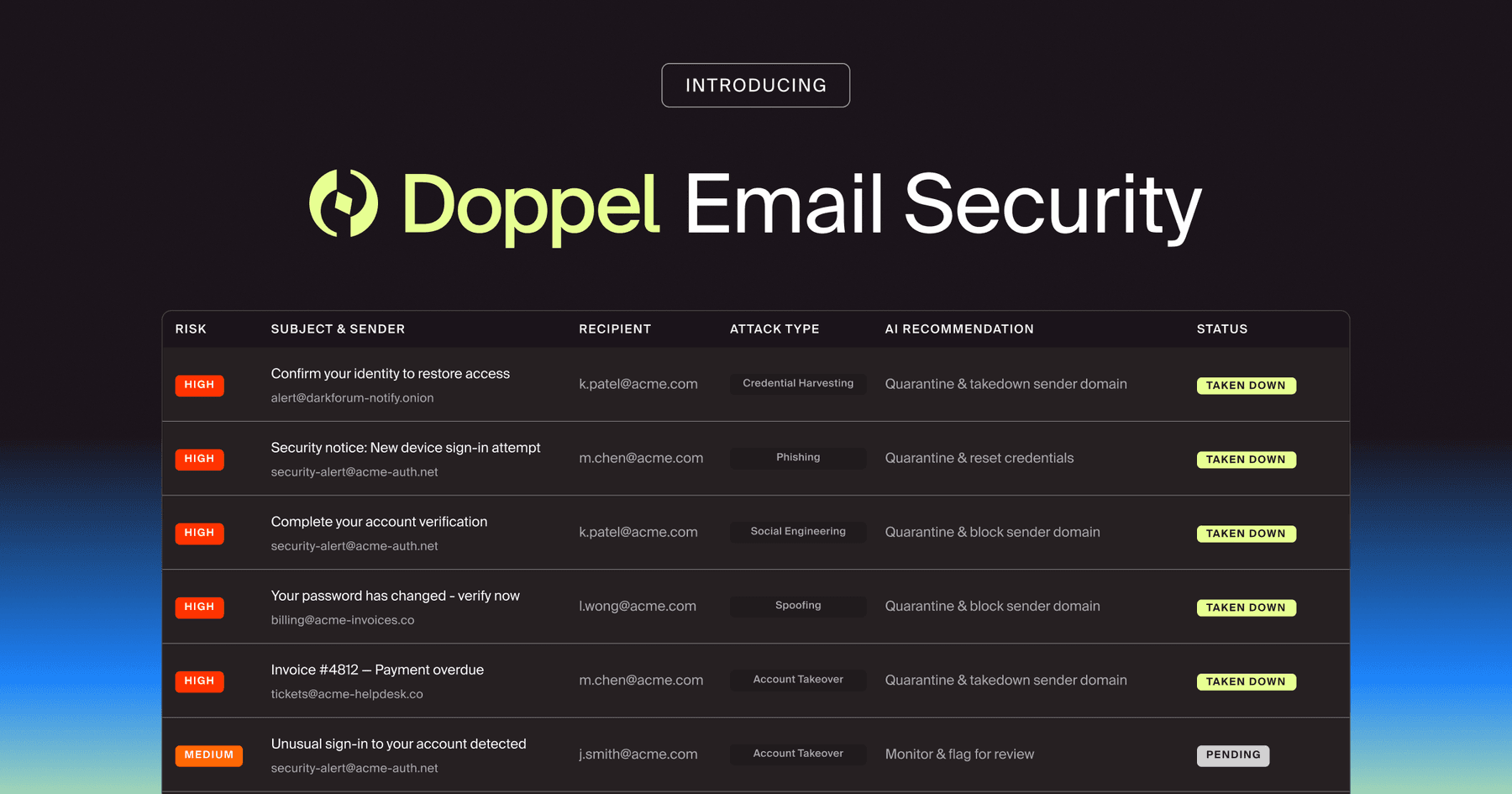
Doppel Email Security is now generally available
The agentic email security solution that empowers you to fight back against social engineering attacks. Detection isn't enough. Disruption is the difference.
The biggest threat against your organization isn't a zero-day exploit. It’s a 60-second conversation.
While you’re investing millions in the "gold standard" of technical controls, attackers have realized it is far more efficient to weaponize human trust than to breach a firewall.
It takes an average of 260 days to detect and contain a social engineering attack. For nearly nine months, adversaries can operate below the detection threshold, blending in with legitimate traffic using valid credentials.
In a recent webinar, Kendra Cooley, Doppel’s Global Head of Security, notes:
"The threat landscape has changed a lot faster than most of our security tools have. Legacy tools were built for a world that simply no longer exists."
This blog will analyze the structural failures of legacy DRP and SAT silos, the 95% drop in attacker overhead, and how a Unified Social Engineering Defense (SED) architecture can help you dismantle the social engineering kill chain at machine speed.
Nowadays, attacks are orchestrated ecosystems of deception across SMS, social media, voice (vishing), and collaboration tools.
Generative AI has fundamentally shifted the economics of cybercrime. Attacker costs have plummeted by 95%, allowing them to achieve hyper-personalization at a scale previously reserved for nation-states.
Attackers have never had such an easy time doing their jobs:
For many CISOs, the "war room" experience during a social engineering event is "chaos disguised as process." Telemetry is fragmented, and analysts are forced to manually stitch together timelines while the attacker moves at machine speed.
The traditional defensive model is hitting a breaking point due to three factors:
Legacy Security Awareness Training (SAT) exacerbates this by focusing on vanity metrics like phishing click rates. A low click rate on a predictable template proves nothing about an organization’s resilience against a targeted, multi-channel campaign.
To achieve operational resilience, organizations must transition from siloed, reactive tools to a Unified Social Engineering Defense (SED) platform. This approach integrates Digital Risk Protection (DRP) and Human Risk Management (HRM) into a single, closed-loop system.
Here’s how a unified approach compares side-by-side against legacy approaches.
Capability | Legacy DRP | Legacy SAT | Unified (DRP + HRM) |
SaaS & Brand Abuse | Reactive: Focused on domain spoofing; blind to abuse of trusted platforms (e.g., Canva, Dropbox). | Theoretical: Uses predictable templates that fail to simulate modern AI-driven lures. | Intent Analysis: Uses Agentic AI and a Threat Graph to identify malicious intent behind valid SaaS payloads. |
Channel Coverage | Siloed: Primarily monitors the web; ignores pivots to SMS, WhatsApp, and Telegram. | Static: Email-only simulations that lack the cross-channel context of real attacks. | Correlated: Unified visibility that links signals across Email, SMS, Social, and Messaging apps. |
Threat Response | Manual: Takedowns often take weeks of manual back-and-forth with registrars. | Passive: Focuses on hope and user reporting. Does nothing to neutralize the actual infrastructure. | Autonomous: Agentic AI triggers takedowns and infrastructure disruption in minutes. |
SOC Efficiency | Low: Acts as a ticket factory, forcing analysts to triage high-volume noise manually. | Neutral: Admin-heavy and provides zero automated relief for the security team. | High: Reduces SOC workloads by up to 80% via automated detection and resolution. |
Strategic Outcome | Identification: Catching the fire while it’s burning; high Mean Time to Contain (MTTC). | Compliance: Checking boxes for auditors using vanity metrics like click rates. | Resilience: Hardens the perimeter and reduces risk via an automated, closed-loop defense. |
Doppel’s AI-native platform unifies defense by bridging external intelligence with internal behavior:
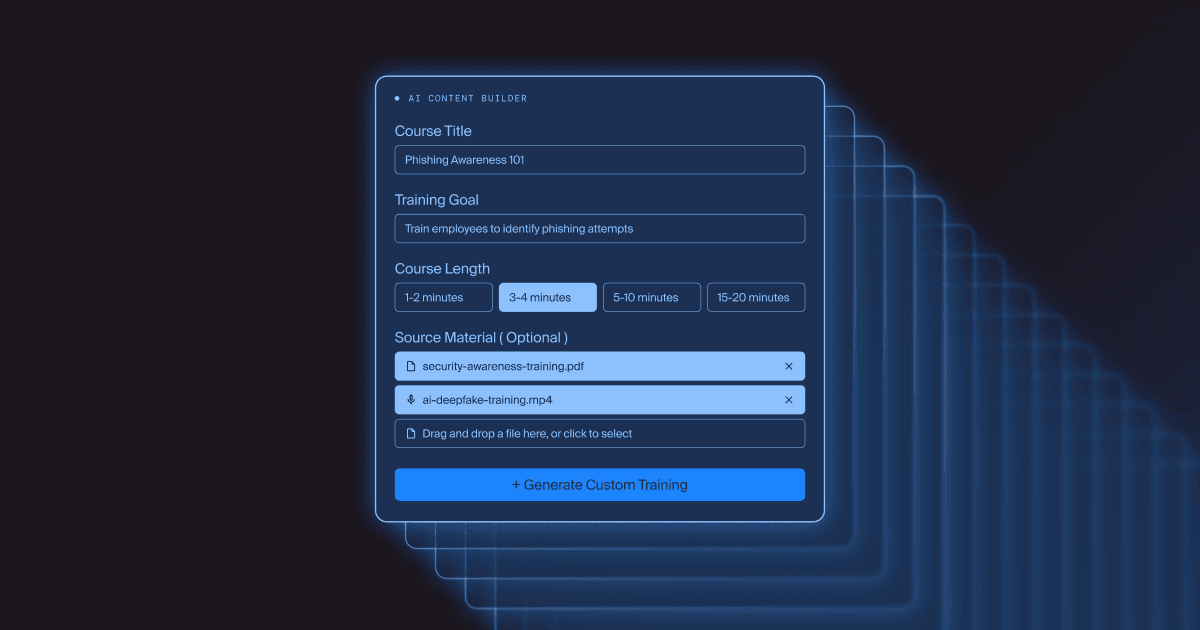
Instead of annual videos, we use hyper-realistic simulations (including AI voice clones) to build muscle memory and turn employees into dynamic sensors.
The limitations of legacy SAT were recently highlighted in a Doppel engagement with a Fortune 500 leader. Despite 100% of their workforce having passed traditional compliance training, the results of a modern stress test were jarring:
In contrast, by deploying Doppel's unified platform, the same organization uncovered over 700 active scams and achieved a 100% takedown rate for malicious infrastructure within 48 hours.
A unified SED strategy changes the narrative for the CISO.
Instead of reporting on how many people watched a video, leaders can report on material operational efficiencies, hard-cost reductions, and risk transfer. Here’s how:
Attackers don’t distinguish between people or infrastructure. They see your organization as a unified target and attack it across every dimension possible to get through.
You need to keep pace with threat actors, not lag, and that means unifying Digital Risk Protection (DRP) and Human Risk Management (HRM).
Doppel does both. That way, when your technical controls inevitably fail, your human and automated defenses are ready to close the loop.
Schedule a demo to see how to dismantle attacker infrastructure and harden your human perimeter in real-time.
BLOG
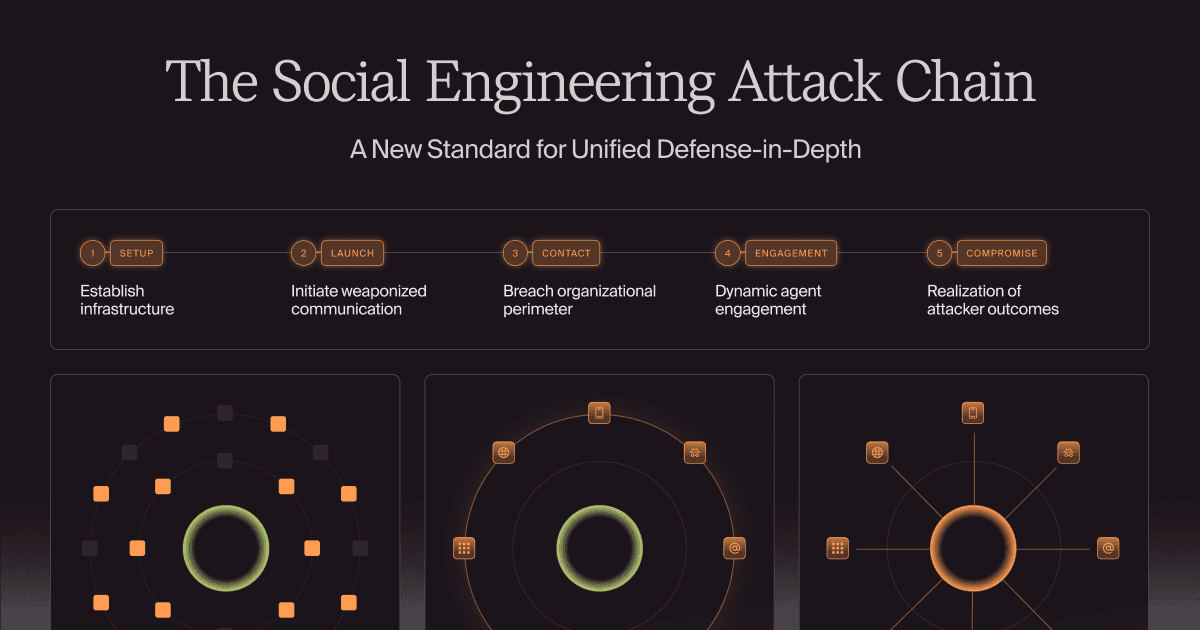
Modern social engineering is a relentless, AI-orchestrated lifecycle. Learn how to map the five-stage attack chain—from setup to contact—and why a unified defense platform is the only way to outpace AI-driven social engineering attacks.



by Bobby Ford, Rahul Madduluri, and Alvin Lin