
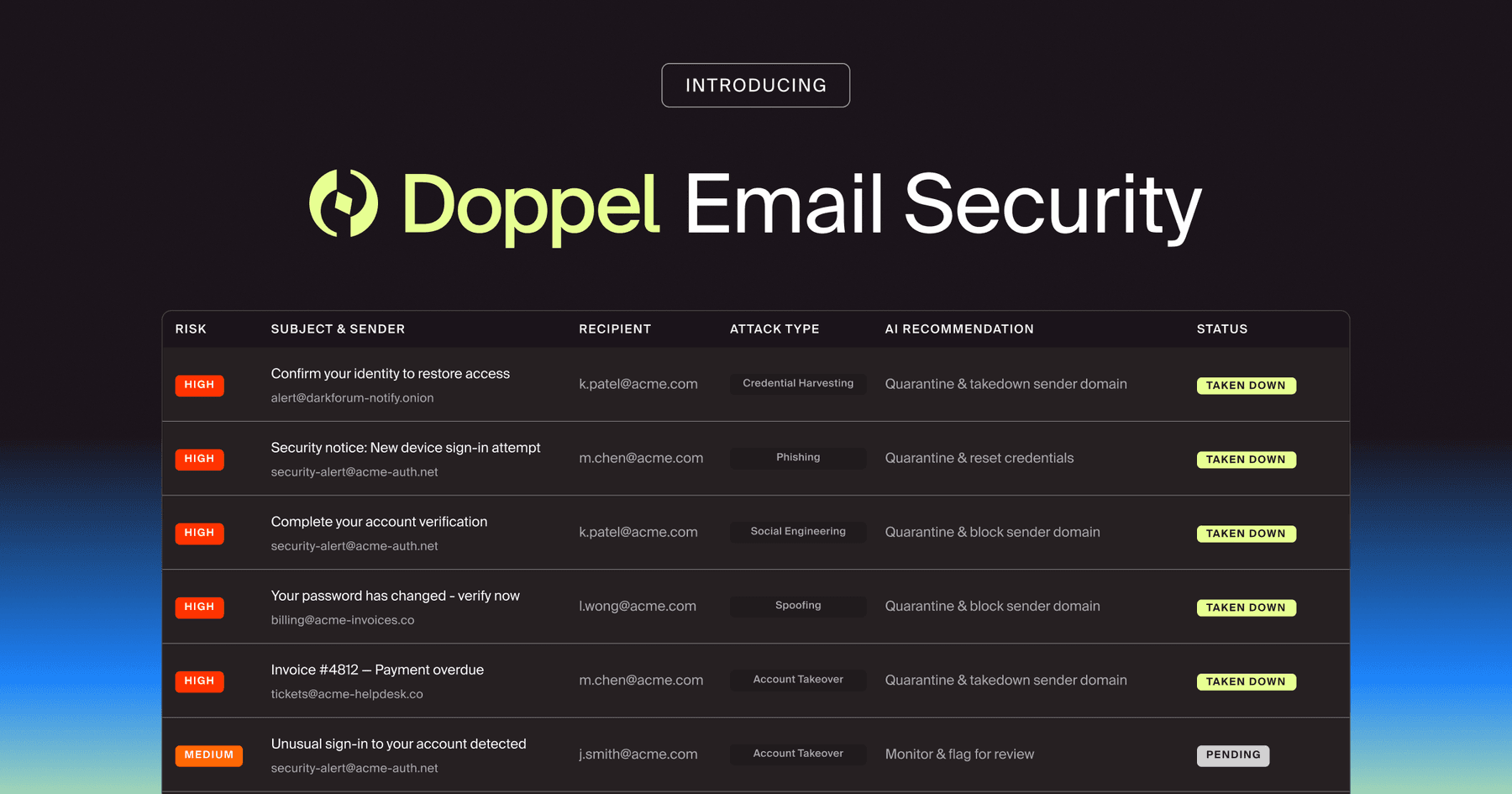
Doppel Email Security is now generally available
The agentic email security solution that empowers you to fight back against social engineering attacks. Detection isn't enough. Disruption is the difference.
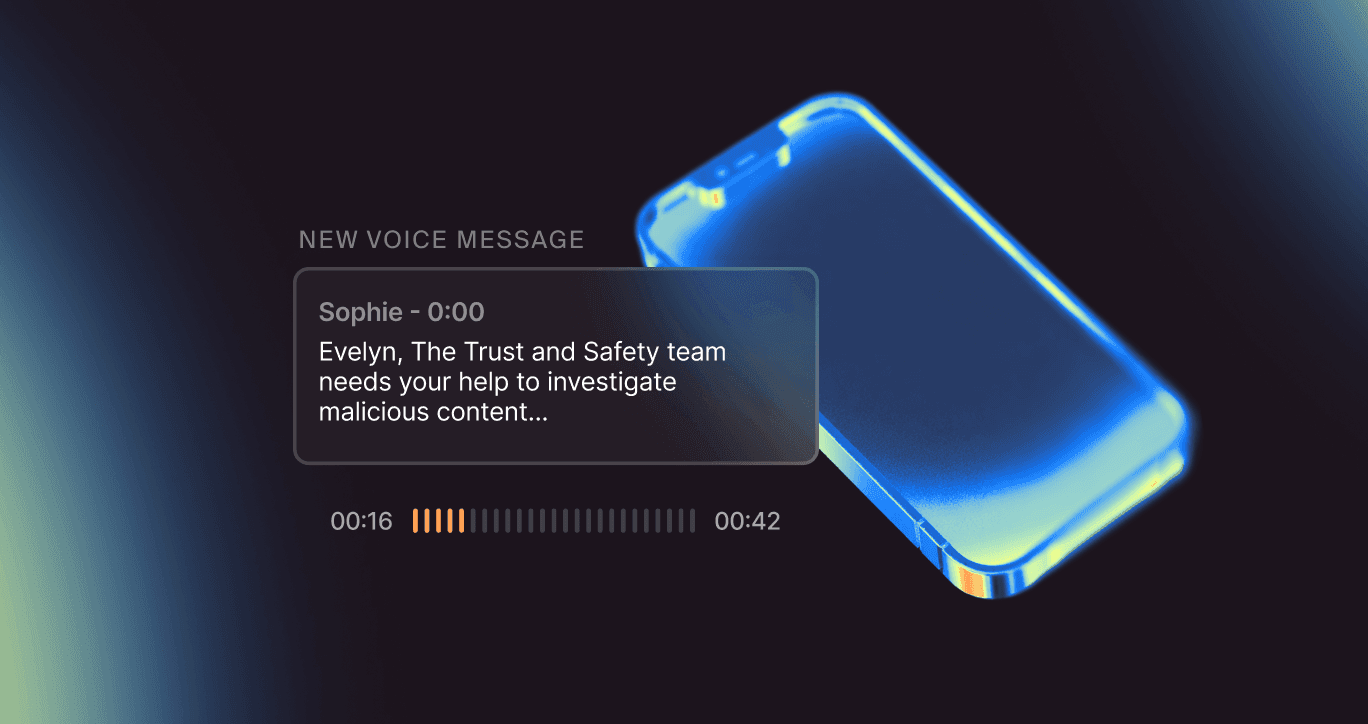
Deepfake scams used to sound like an edge-case problem. A strange voice memo. A fake video clip. A cloned executive voice that felt more like a headline than an operational risk. That window is closing fast.
Security teams are now dealing with a different kind of deception. It is more convincing, more scalable, and harder to dismiss in the moment. Attackers no longer need perfect malware or a long intrusion chain to cause damage. Sometimes they just need a believable voice, a familiar face, or a message that lands at exactly the wrong time.
That shift matters because deepfake scams do not target only systems. They target judgment. They target routine. They target the human shortcuts people take when a request feels urgent, familiar, and socially credible.
For Human Risk Management leaders, that changes the assignment. The job is no longer just teaching employees to spot suspicious emails. It is building a program that prepares people for AI-enabled impersonation and deception across voice, video, messaging, and customer-facing workflows. That requires a more realistic, attacker-informed approach to red teaming and simulation.
Deepfake scams are changing Human Risk Management by making social engineering more persuasive across the channels people trust most. Instead of relying on simple phishing tells, attackers can now impersonate executives, job candidates, vendors, customers, and support teams with synthetic audio, video, and conversational messaging. That raises the bar for HRM programs. Security teams need to test how people behave under realistic pressure, not just whether they can identify obvious red flags.
Deepfake scams are changing how social engineering works in practice. AI tools make it easier for attackers to create convincing voices, videos, and supporting content that reinforce a false identity across multiple channels. That doesn’t eliminate the need for planning, but it does lower the barrier to producing more persuasive impersonation at scale.
That matters because trust signals have changed. A voice note from a leader. A quick video on a collaboration platform. A call that sounds like a customer. A message thread that feels natural and informed. These are no longer strong proof points on their own.
In many organizations, the riskiest moment is not the first contact. It is the point where an employee decides the interaction feels legitimate enough to act. Approve the reset. Share the code. Move the conversation off-platform. Bend the workflow because the request sounds real.
Deepfake scams increase the odds that the decision will go the wrong way.
They hit Human Risk Management directly because the core control is human verification under pressure. Deepfake-enabled attacks are designed to distort that moment.
Traditional awareness programs often train people to look for bad spelling, suspicious links, or generic pretexts. Deepfake scams do not always look like that. They can sound polished. They can mimic internal language. They can borrow authority from recognizable people and familiar business processes.
That is why this is not only a content problem. It is a behavior problem.
A mature HRM program has to answer harder questions:
Deepfake scams test whether people follow verification steps when social pressure is high, and the deception feels authentic.
They are different because they reduce the friction that previously made impersonation easier to spot. Older scams often depended on obvious friction points that gave people time to pause. Deepfake scams reduce that pause.
Voice adds pressure because it feels immediate and personal. A request delivered in what sounds like a leader’s or colleague’s voice can make standard verification steps feel unnecessary or even awkward. That is exactly why voice cloning has become useful in fraud. It pushes people toward action before they slow down and verify.
That is especially dangerous in workflows like password resets, wire approvals, vendor changes, and executive support.
Video can create false confidence because many people still treat visual presence as a credibility signal. Even when a clip is imperfect, the appearance of a familiar face can be enough to move a request forward, especially when the target is rushed, distracted, or already expecting contact.
Messaging often completes the attack by providing the adversary with continuity. A cloned voice call can be followed by a text. A fake video request can be reinforced in chat. A customer impersonation scam can move from social media to phone to support workflow. That cross-channel progression is what makes these attacks so effective, and why HRM programs need to test behavior beyond email.
That multi-channel flow is exactly why deepfake scams belong inside modern HRM and red teaming programs, not in a separate awareness bucket.
Traditional security awareness is not enough because deepfake scams are not just about recognition. They are about response.
Most legacy programs are built around static lessons and narrow phishing tests. They measure whether someone clicked. They do not always measure whether someone verified their identity, escalated uncertainty, or followed the right process when the interaction became more realistic.
That gap matters.
A deepfake scam can fail at the content layer and still succeed at the workflow layer. The employee may suspect something is odd, but still take action because the process allows too much discretion, too little friction, or too much pressure to be helpful.
Human Risk Management has to go beyond awareness and into operational resilience. It should test how people behave when the request feels plausible, personalized, and time-sensitive. It should also show where policies break down in real conversations.
Red teaming in the deepfake era should look more like the attacks your people are actually going to face. That means dynamic, multi-channel, and behavior-focused.
The point is not to prove that users can spot cartoonishly fake content. The point is to learn whether they verify identities, slow down risky workflows, and report suspicious interactions before damage is done.
Attackers do not think in silos, so your testing cannot stay stuck in one channel. Deepfake-enabled scams often move across voice, SMS, chat, meeting apps, and email. The simulations should do the same.
Not every employee faces the same threat. Helpdesk teams, finance, executive assistants, recruiting, customer support, and outsourced service teams often sit in the blast radius first. Those roles need scenario design that reflects actual attacker tradecraft.
This is where Human Risk Management becomes more useful than generic awareness language. It frames the problem in terms of measurable behavior change and real-world attack pressure.
Teams should defend against deepfake scams by strengthening verification controls, testing people with realistic simulations, and using external threat intelligence to shape those scenarios. The point is not just to help employees recognize a fake. It is to make sure risky workflows cannot be bypassed by a convincing voice, video, or impersonation narrative.
The first priority is tightening high-risk workflows. If a voice or video request can shortcut approval, that process needs work. The second is making identity verification practical enough that employees will actually use it under pressure. The third is testing those controls repeatedly against realistic scenarios.
That is also where the external signal matters. If your brand, executives, or customer channels are already being impersonated in public, that intelligence should shape the internal scenarios you run next.
For example, brand monitoring and threat monitoring can reveal how attackers are abusing executive identities, support flows, public-facing channels, and customer trust signals. That gives security teams a much better starting point for simulation design than generic templates, because the scenarios reflect the tactics already being used against the organization or its customers.
It also helps explain why impersonation attack protection and HRM belong in the same conversation. One shows how attackers are presenting themselves externally. The other shows how your people respond when those same tactics reach them.
The highest risk usually appears where trust, urgency, and discretion intersect.
Support teams are trained to solve problems quickly. Attackers know that. A believable voice, a confident pretext, and a rushed explanation can turn a normal reset request into an access event.
When deepfake scams imitate authority, they often aim to obtain approvals, change payments, or request sensitive information. These teams are already under time pressure, which makes believable impersonation more dangerous.
Deepfake scams are also reshaping how organizations think about candidate fraud, vendor fraud, and customer impersonation. These are no longer isolated scenarios.
That is why content like deepfake scam prevention, deepfake AI voice and video scams, and phone impersonation scams fit naturally into a broader social engineering defense strategy.
Deepfake scams expose why brand protection and Human Risk Management can no longer operate as separate conversations. Many of these attacks begin as external impersonation, then succeed because someone inside or interacting with the business trusts the wrong signal.
A stronger approach connects external detection and disruption with internal testing. If attackers are using cloned voices, fake executive identities, spoofed phone numbers, or synthetic customer interactions in the wild, that intelligence should inform the simulations, training, and workflow controls that follow.
That is where Doppel’s approach is more useful than a generic awareness program. It connects brand monitoring, social engineering defense, and attacker-informed simulation so teams can measure how people respond to the same kinds of deception already targeting their brand, leaders, employees, and customers.
Security leaders should treat deepfake scams as a present-tense human risk problem, not a future trend to monitor from a distance.
Start with the workflows that matter most. Identify where voice, video, or messaging could trigger resets, approvals, exceptions, or trust-based overrides. Then test those paths with realistic scenarios that reflect how attackers are already operating. Measure whether people verify, escalate, and report. Fix the process where they cannot.
Deepfake scams are not changing Human Risk Management in theory. They are changing it in practice, one conversation at a time.
If your team is still training for obvious phishing while attackers are moving toward believable voice, video, and multi-channel impersonation, the gap is already there. Close it before someone else finds it first.
See how attacker-informed simulations can reveal where deepfake-driven social engineering is most likely to break your workflows, before a real campaign does. Schedule a demo.