
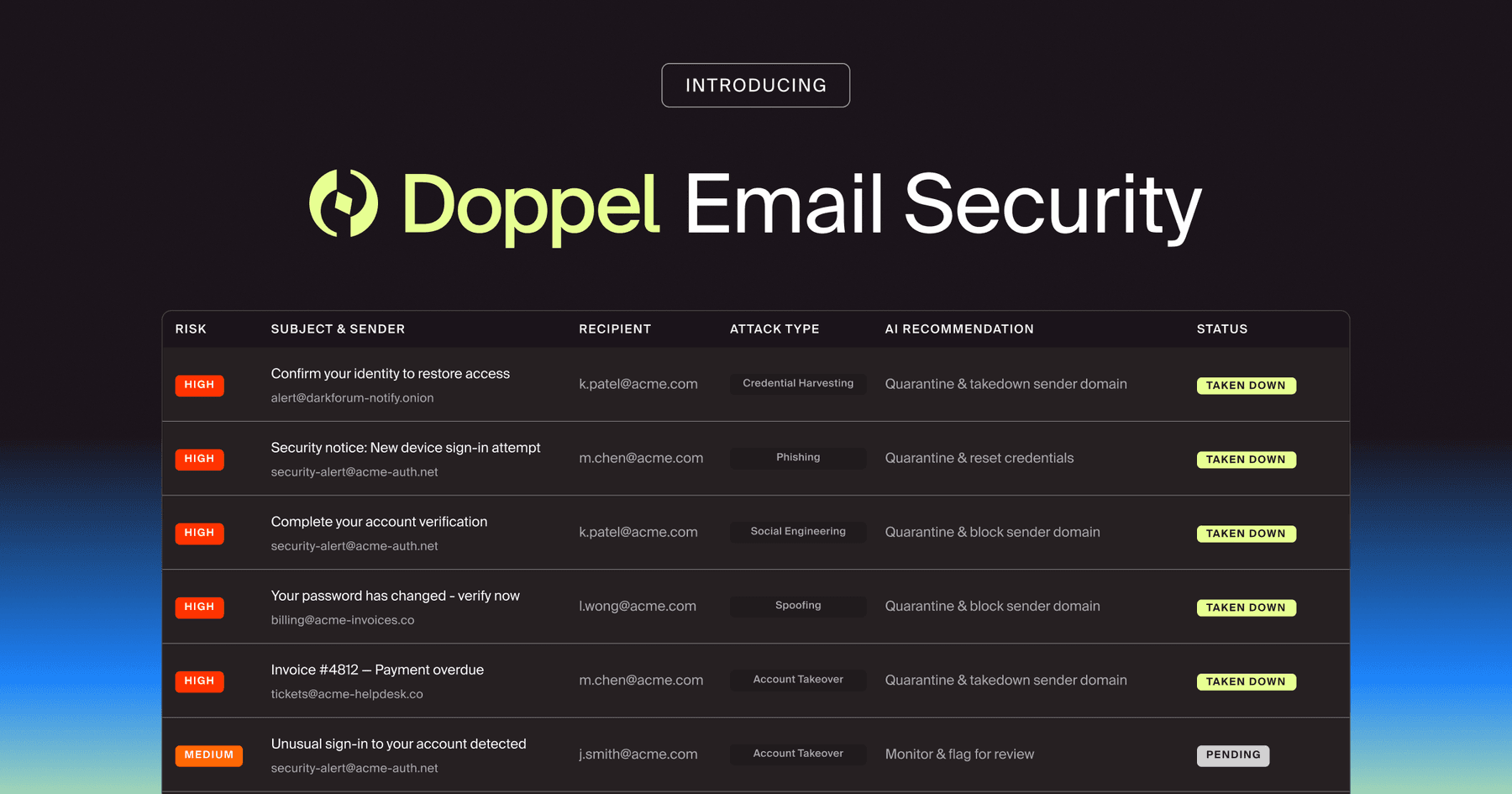
Doppel Email Security is now generally available
The agentic email security solution that empowers you to fight back against social engineering attacks. Detection isn't enough. Disruption is the difference.
A scam starts with your brand name and the customers who trust it.
If you’re not actively measuring impersonation risk, you’re basically relying on anecdotes while attackers run experiments on your identity across domains, ads, social profiles, and phone numbers.
Many teams don’t have a visibility problem. They have a prioritization problem. The signal is there, but it’s scattered across support tickets, fraud reports, paid search complaints, social escalations, and whatever a busy analyst happened to screenshot before the page disappeared. Meanwhile, impersonators are doing what they always do. They iterate fast, reuse infrastructure, and keep the version that converts.
That’s why an impersonation risk assessment matters. It turns a pile of weird incidents into a measurable, repeatable view of how easy it is to impersonate your brand, reach real customers, and cause harm. It also forces the hard conversations up front. Which channels actually drive victimization? Which “trust anchors” do attackers copy the most? Which teams own which fixes? And what reduced risk will look like in 30 days, not just at the end of the quarter.
At Doppel, we focus on social engineering defense: detecting impersonation across external channels and linking related assets into campaigns, so teams can prioritize what is most likely to cause customer harm and disrupt the underlying operation, not just individual artifacts.
An impersonation risk assessment is a structured way to measure how easy it is for attackers to mimic your brand, reach customers, and cause harm, and to translate those findings into prioritized fixes. The key is focusing on real attacker pathways. Inventory where impersonation shows up, identify the brand signals criminals copy, measure exposure and velocity, score likely impact, and leave with a short list of actions that reduce risk in the next 30 days, not just in the next budget cycle.
Impersonation risk is the probability that someone can convincingly impersonate your brand long enough to extract money, credentials, access, or trust.
The risk includes the obvious stuff like lookalike domains and fake support pages, plus the stuff that makes comms teams groan, like paid search ads that route to fake help desks, cloned social profiles, app store copycats, and phone-based scams that borrow your scripts and brand voice.
If customers can be moved from “I trust this” to “I complied” in a few clicks or a two-minute call, that’s part of your risk surface.
Some brands are surprised because they’re measuring the wrong thing. They count takedowns, they count tickets, and inbound complaints, and they call it visibility, but they don’t map exposure to the pathways attackers use to find victims and scale.
Attackers don’t need perfection. They need sufficient believability, distribution, and time. If your assessment doesn’t explicitly measure those three, it’s going to understate risk.
Treat impersonation like an external campaign problem with victim pathways, not a static asset list.
If your process starts and ends with “count the bad domains,” you’ll produce a gorgeous spreadsheet and still miss the scams that actually reach customers. The purpose of an assessment is to answer one question quickly: how easy is it for an attacker to convincingly impersonate us, and where should we reduce that risk first?
Here’s the mindset shift that makes it work. Build the assessment around how scams spread and convert, then work backward to the infrastructure that supports them. That means you’re tracking what criminals are doing, not what your internal org chart thinks they should be doing. It also means you’re not trying to catalog the entire internet. You’re defining a repeatable routine that surfaces high-signal threats, ties them to likely impact, and produces actions someone can own next week.
Focus on the three building blocks: attack surface, trust anchors, and potential harm.
Your first pass should be channel-first: domains and redirects, social profiles, paid ads, messaging, app stores, marketplaces, and voice. For each channel, capture what “brand-like” looks like, what enforcement looks like, and how quickly a scam can be re-established after removal.
List the assets and cues customers use to decide they’re really dealing with you: support numbers, help center URLs, login flows, payment instructions, email sender patterns, verification badges, and even the common language your agents use. Attackers copy the shortcuts customers rely on, not your brand guidelines PDF.
Get concrete. Harm might include direct fraud losses, account takeovers, chargebacks, support spikes, partner escalations, regulatory scrutiny, or reputational damage that manifests as churn. You can’t prioritize when every outcome is labeled “brand impact.”
You should measure exposure, velocity, and believability before you measure volume.
A thousand low-credibility fakes that never reach customers are annoying. Ten high-credibility assets promoted through ads or phone scripts can be catastrophic.
Here’s the part some teams miss. The best data sources don’t just tell you that impersonation exists. They tell you whether it’s being operationalized. That means evidence of setup, distribution, and iteration. The setup is what the attacker built. Distribution is how they present it to the victims. Iteration is how quickly they can pivot when something gets reported or removed.
So when you’re choosing “highest-signal” sources, you’re looking for places where criminals can do two things at once: look legitimate and reach people who are already primed to trust. If a source gives you both, it belongs at the top of your assessment. If it only gives you one, it’s still useful, but it shouldn’t drive your priorities.
Also, don’t ignore the boring operational signals. Support tickets that mention “I called the number on Google.” Payment disputes referencing an unusual invoice flow. Social escalations where the victim says they were moved into a DM. Those are often the earliest clues that a specific pathway is converting, even when the underlying scam assets are changing daily.
Once you anchor on that, your assessment stops being a scavenger hunt and starts being a decision engine. You’re not asking, “How many fakes are out there?” You’re asking, “Which sources reveal real victim pathways and scalable attacker behavior?”
Start with lookalike domains, newly registered variants, typos, and brand plus support patterns. Many high-risk impersonation flows rely on combosquatting, where attackers combine a real brand name with high-intent modifiers to create convincing support and verification portals. Then follow the redirects. Redirect chains tell you whether the operator is testing multiple landing pages, rotating infrastructure, or routing by geo and device. If your assessment stops at the first URL, you’re grading the cover, not the book.
Paid placement is a force multiplier. If scammers can buy intent, they don’t need to build trust slowly. They can show up exactly when a customer searches for “brand refund” or “brand login.” Include ad copy mimicry, landing page alignment, and how quickly reports result in action.
Fake profiles, impersonator accounts, and hijacked help pages often push victims into DMs. Your assessment should capture how often your brand is being imitated in bios, handles, profile images, and support threads, plus how quickly content spreads through replies and comments.
Phone scams matter because they compress trust into a conversation. If your brand has widely known support numbers, common scripts, or predictable verification steps, criminals will mirror them. Track spoofing patterns, callback scams, and whether customers can easily validate real numbers using a trusted source.
If you want a good model for what “sources” look like in brand fraud work, this breakdown is worth sharing with your team: threat intelligence sources for brand fraud.
You score risk by separating likelihood from impact, then using inputs that people can verify without trusting your gut.
If the score feels subjective, legal may treat it as opinion, security may challenge the methodology, and CX may ask how it maps to real customer harm. That’s not being difficult. That’s refusing to bet time and money on a number that can’t survive a second question.
The goal is a scoring model that’s simple enough to repeat monthly, but sharp enough to drive decisions. It should do three things well. First, it should make tradeoffs obvious. Second, it should point to actions, not just categories. Third, it should create shared language across teams that normally talk past each other.
The easiest way to get there is to score the mechanics of how impersonation succeeds, then score what it costs you when it does. That’s why the model below breaks into four parts. Exposure tells you how easy it is to impersonate you. Velocity tells you how quickly attackers can scale and reappear. Believability measures how convincing a scam is to a real customer. Impact shows what happens to the business when the scam succeeds. Together, those let you, with a straight face in a cross-functional meeting, say, “This is why this threat is top tier, and this is what we’re doing next.”
This score captures how available your brand is as raw material. It looks at factors such as how many places your identity can be copied, how sprawling your domain and subdomain footprint is, how consistent your official presence is across channels, and how many near-miss assets are already in circulation. Exposure is the reason some brands are easy targets even before a campaign starts.
This score measures how fast impersonation can spread and how quickly it regenerates after disruption. Paid distribution, automation, bulk domain registrations, reusable templates, rotating phone numbers, and rapid reappearance after takedown all belong here. Velocity is what turns a manageable problem into a daily incident queue.
This score evaluates whether a customer would realistically fall for it. Visual similarity, language match, realistic support flows, brand voice mimicry, and convincing verification steps are the obvious factors. The less obvious factor is whether your real customer journey is built with confusion. If your own process is hard to validate, attackers have room to “help.”
This score translates risk into consequences that legal, security, and CX can align on. Fraud loss potential, account takeover risk, chargebacks, support volume, customer trust damage, partner escalations, and regulatory sensitivity are typical inputs. Impact is the part that stops this from being a theoretical exercise and forces prioritization.
If you want the scoring to stick, define the tiers up front and tie each tier to an operational response. Tier 1 means immediate disruption and customer protection steps. Tier 2 means active threat monitoring plus targeted fixes to reduce believability or velocity. Tier 3 means track and backlog. When everyone knows what a score triggers, you spend less time debating numbers and more time reducing harm.
They break down when teams confuse “we found it” with “we reduced it.”
That sounds harsh, but it’s the pattern behind most brand risk programs that look busy and still get blindsided. The assessment becomes a reporting exercise. It produces artifacts people can circulate, but it doesn’t change what attackers can do tomorrow.
The second common failure is treating impersonation like a single-asset problem. A bad domain is removed; everyone high-fives, and the campaign quietly reroutes to a new domain, a new social profile, and a new phone number, using the same script. If the assessment can’t connect related assets and track reappearance, it’s grading symptoms and calling it progress.
The third breakdown is misaligned ownership. Risk shows up externally, but mitigation lives across teams. Security might own detections, legal might own escalations, CX might own customer comms, paid media might own brand keyword governance, and support might own verification language. If the assessment doesn’t end with named owners and a short list of changes each team can make, it becomes a shared document with no one accountable.
And then there’s the quiet killer: success metrics that reward activity instead of outcomes—counting takedowns without measuring reinfection, counting tickets without measuring customer harm, and measuring response time while ignoring whether the scam had already done its damage through ads, DMs, or phone calls. If the scorecard doesn’t reflect victim pathways and attacker velocity, it will push everyone toward the wrong work.
If you want one simple gut check, use this. After the assessment, can you clearly answer which impersonation pathways are most likely to hit customers this month, and what you’re changing in the next 30 days to make those pathways harder to exploit? If not, the assessment didn’t fail because you missed data. It failed because it didn’t force decisions.
“Good” looks like measurable friction for attackers and clearer validation for customers, not a prettier dashboard.
The assessment should make investigations faster. When impersonation pathways are clearly scored and clustered, brand fraud investigation becomes less reactive and more focused on dismantling the campaign rather than chasing a single threat.
If the first month ends with more meetings, more documentation, and the same scam pathways still converting, you didn’t run an assessment. You ran a retrospective in advance.
The right 30-day outcome is simple. Fewer customers get routed to impersonators. When impersonation assets appear, you detect them faster, connect them to the same underlying campaign, and disrupt them in a way that makes reappearance more expensive. You also clean up self-inflicted wounds, confusing brand touchpoints, and support flows that scammers exploit, because customers can’t always tell what’s legitimate.
This is where teams tend to overcomplicate things. You only need three kinds of improvements in the first month: harden what customers use to verify you, reduce attacker distribution leverage, and operationalize a repeatable disruption loop.
You should ship at least a few changes that reduce perceived risk and increase customer confidence. Publish a single canonical page that lists official support numbers and key URLs, then make it easy to find from search and your site navigation. Tighten or standardize support language so customers are not trained to trust fraudulent verification steps that criminals can imitate. Review paid search and monitor sponsored placements for brand plus support or refund patterns. If you run campaigns that create urgency or confusion, like refunds, shipping delays, or account holds, make sure your legitimate flows are consistent, because scammers love inconsistency.
You should also leave the first month with a working operating rhythm, not a heroic scramble, meaning documenting the minimum evidence required to escalate and defining who owns reporting and who owns action per channel. Setting a cadence for review that matches the attacker's speed. Weekly is usually the floor, not the ceiling. Most importantly, track reappearance and campaign linkage.
If the assessment was done correctly, the first 30 days should feel like a transition from reactive cleanup to controlled pressure. You’re not trying to eliminate impersonation forever. You’re trying to shrink the blast radius, reduce conversion, and make your brand a harder, less profitable target.
Next, turn the results into an operating rhythm that makes your brand harder to imitate and easier to defend. An impersonation risk assessment that ends as a slide deck is just a polite way to document future incidents. The value only becomes evident when the findings are repeatable, with owners, timeframes, and outcomes.
Start by converting your top risks into three concrete tracks:
Turn findings into a 30-day action list: Pick the top pathways that actually reach customers and ship fixes that reduce believability. Publish a canonical page for official support channels. Clean up confusing handoffs in support and login flows. Standardize support scripts to help customers spot off-script interactions faster. If you can’t implement all of it, prioritize the steps that reduce victim conversion, not the steps that make internal reporting cleaner.
Operationalize detection and triage: Define “high priority” using the same criteria from your assessment. Exposure, velocity, believability, and impact. Set a weekly review cadence at a minimum, and create a lightweight intake process so evidence isn’t trapped in screenshots and inbox threads. Make sure triage leads to an action path, not another queue.
Build campaign-level disruption, not one-off takedowns: Connect related assets so you can disrupt the underlying campaign, not just delete a single domain or profile. Track reappearance and reuse patterns, because that’s where leverage lives. When you anticipate the next move, you stop playing defense against the attacker's timing.
If you want to accelerate that last part, we can help. Our Brand Protection platform helps teams detect impersonation across channels, cluster related assets into campaigns, and operationalize disruption at scale.
If impersonation is hitting your customers and your teams are stuck in reactive takedowns, it’s time to shift to campaign disruption. Book a demo and bring your messiest cases.