When security leaders present ROI, they almost always rely on the same defensive metrics.
They’ll point to a dashboard and proudly announce that their perimeter gateway blocked 50,000 suspicious emails, calculate how many hours their automated sorting tools saved the security operations center from manual triage, and highlight a slightly reduced mean time to respond (MTTR) (opens in new tab).
On the surface, these numbers look like a success. The executive team nods in agreement, approves the security budget, and moves on to the next agenda item.
But this reporting structure has a flaw. These traditional metrics assume cybersecurity is an endurance exercise. You’re celebrating the fact that your shield held up against a barrage of automated arrows.
According to IBM’s 2026 Cost of a Data Breach Report, the global average cost of a data breach sits around $4.99 million (opens in new tab). When a CFO looks at that number, they view cybersecurity as a massive financial liability. But blocking a single threat doesn’t stop an adversary from causing that same financial damage tomorrow.
If a threat actor spends a few dollars spinning up automated infrastructure and fires a thousand deepfake phishing variants at your perimeter, and you block them all, the attacker has not truly lost anything. Their hosting remains active. Their typosquatted domains remain registered. Their malicious architecture is completely unharmed.
They’ll tweak their language model prompt, adjust their routing paths, and run the exact same automated script against your company tomorrow morning.
Traditional cybersecurity metrics measure how well we survive an onslaught. They completely fail to measure how effectively we disrupt the actual business model of cybercrime. To truly win this fight, security organizations must undergo a fundamental paradigm shift.
Stop viewing security as a passive defense mechanism. Start measuring your return on investment offensively, calculating exactly how quickly you can destroy the resources the attacker spent staging the campaign.
Unit economics of a modern cyberattack
In 2026, cybercrime is a massive, highly structured global service economy. Threat actors operate with precise profit margins, defined overhead costs, and strict capital expenditures just like any legitimate enterprise.
When a CISO evaluates a threat, they need to understand the attacker's operational expenditure stack. Recent threat intelligence proves just how commoditized this underground market has become.
Phishing has become a fully realized service economy, with adversaries buying ready-made infrastructure to launch campaigns at scale.
Consider the cost to attack. An adversary doesn’t need to know how to code a reverse proxy to steal a session cookie or bypass modern authentication. They rent an adversary-in-the-middle (AiTM) phishing kit on the dark web for a monthly subscription fee. These turnkey platforms come with bulletproof hosting, realistic lures, and administrative dashboards designed to bypass multi-factor authentication.
Beyond the kits themselves, attackers invest heavily in their operational supply chain:
- They purchase batches of LLM tokens to generate thousands of pristine, contextually accurate phishing lures in fractions of a second.
- They pay for residential proxy network bandwidth to rotate clean IP addresses and evade geographical blocking.
- They subscribe to automated CAPTCHA-solving APIs to scrape your executive data and build their target lists.
They also register lookalike domains, pay for anonymous hosting, and invest significant time and money aging those assets so they can cleanly bypass traditional newly registered domain filters.
Each step requires an upfront financial investment from the attacker. This creates a critical vulnerability in their operation, and if you can consistently destroy their infrastructure before they secure a return on their investment, you ruin their profit margin. You make targeting your organization mathematically unviable.
The flaw in defensive security metrics
When your security stack relies entirely on defensive triage, you’re playing directly into the adversary's economic model. The current asymmetry in cybersecurity favors the attacker.
The cost to attack is incredibly low, while the cost to defend is astronomically high.
Consider a standard legacy workflow: An employee receives a highly targeted phishing email and diligently clicks the report button. The email lands in a shared IT abuse inbox and sits there for several hours. Eventually, a human analyst reviews the email, identifies the malicious link, and quarantines the message.
From a defensive reporting standpoint, this is recorded as a definitive win. A threat was neutralized, and an incident was prevented. The SOC manager closes the ticket.
But look at the exact same scenario from the attacker's perspective. Their malicious domain is still perfectly active. Their phishing kit is still running. Their stolen credentials database is still online.
Because your legacy tool stopped at the perimeter and quarantined a single email, the attacker suffered absolutely zero financial consequences.
Relying on a quarantine-only defense is like a retail store measuring its anti-theft success by counting how many shoplifters dropped stolen goods at the front door before running away. The store might not have lost merchandise today, but the thief wasn't arrested. They didn’t pay a fine. They walked away, which means they'll absolutely come back tomorrow to try again.
They’ll take that exact same infrastructure and immediately pivot to target a different department in your company, or they will point it directly at one of your third-party vendors. The attacker retains all of their capital, meaning they can afford to keep rolling the dice until someone on your team finally makes a mistake.
You can’t win an economic war if you never actually return fire. If you only play defense, the adversary maintains an infinite profit margin.
Measuring the adversary capital destruction rate
Transitioning to an offensive security posture demands a new set of metrics designed for the balance sheet. Instead of measuring your own hours saved, measure the adversary capital destruction rate.
When you deploy native agentic AI to handle threat response, you move past simple quarantine protocols. You can execute autonomous takedowns at machine speed, actively destroying the attacker's capital across three specific pillars of their operational stack.
1. Burning the digital real estate
When a threat actor launches an attack, they’re leveraging domains they explicitly purchased for the campaign. They paid registrar fees, configured DNS routing, and invested weeks or months to let that domain mature and bypass legacy security scanners. This represents a high sunk cost.
If you use an agentic platform to instantly trace a phishing email back to its source and execute a takedown at the registrar level, you burn that asset to the ground. The attacker instantly loses the money they spent acquiring the domain.
More importantly, they lose the irreplaceable time they spent aging it. They go back to the drawing board, spend more capital acquiring fresh infrastructure, and wait months for it to become viable.
You don’t just stop the attack. You erase their historical investment.
2. Wasting the automation budget
Adversaries rely heavily on automated systems to generate high-velocity attacks. They pay for API access to unrestricted large language models to write their deceptive lures. They pay for automated data-scraping services. They burn through residential proxy bandwidth.
When you intercept and dismantle their campaigns at machine speed, every single token they spent generating those thousands of variants becomes completely worthless. You turn their own automation against them. By neutralizing the threat the absolute second it launches, you force them to burn through their operational budget with absolutely nothing to show for it.
You drive the attacker’s cost per compromised credential from pennies up to hundreds of dollars, breaking their internal economic model.
3. Dismantling the infrastructure subscriptions
The most expensive component of a modern attack is the backend architecture. As noted earlier, attackers are paying hundreds of dollars a month for advanced phishing kits that handle credential harvesting and reverse proxy routing.
By reporting malicious activity directly to hosting providers and immediately taking down command-and-control servers, you revoke the attacker's access to their own tools. You destroy their monthly subscription, forcing them to absorb the financial loss.
When you repeatedly burn down their hosting, the dark web vendors who supply these kits often ban the attacker for attracting too much heat, further disrupting their supply chain.
Defensive triage vs offensive economic destruction
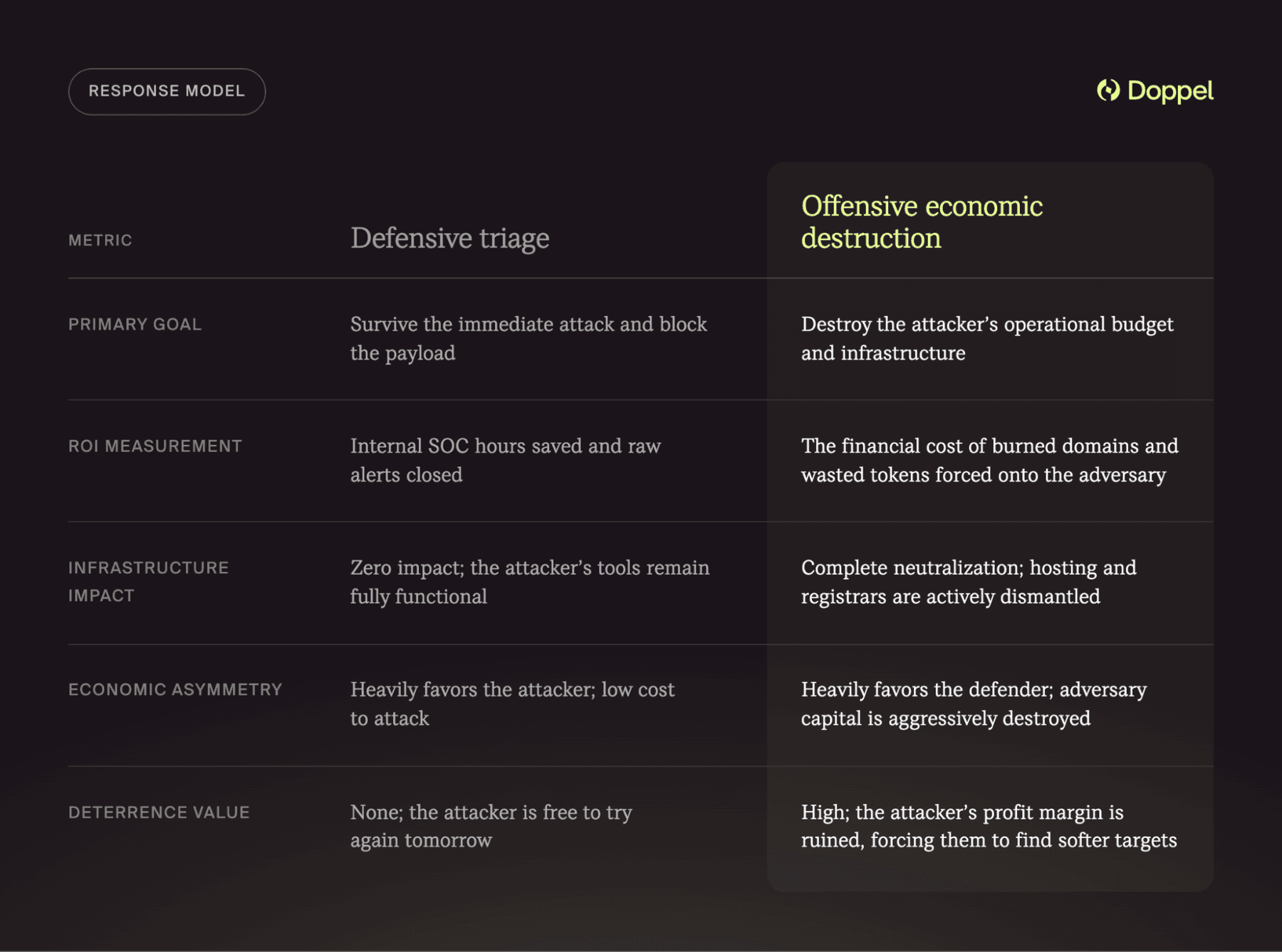
The difference between these two approaches is the difference between hiding behind a wall and actively dismantling the siege engines outside. It’s about shifting the asymmetry from the attacker to the defender.
Here’s how the operational reality of defensive triage stacks up against offensive economic disruption:
Doppel’s agentic advantage for social engineering defense
To actually execute this level of economic warfare, you need a system capable of operating significantly faster than the adversary. You can’t rely on human analysts to manually submit takedown requests to hosting providers. By the time a human fills out the required forms, the attacker has already extracted their value and moved on.
You need autonomous, agentic defense. This architectural reality is exactly why Doppel exists.
Doppel was not built to simply quarantine emails or generate polite summaries for your abuse inbox. We engineered our platform from the ground up to fundamentally break the business model of modern cybercrime.
Through the Doppel Threat Graph, our AI-native agents continuously monitor the open web for the exact infrastructure adversaries are building. We track typosquatted domains, dark web phishing kits, and fraudulent social media profiles before they are ever weaponized.
When the attacker finally launches their campaign, Doppel doesn't just block inbound traffic. Our agents operate on intent. They autonomously trace the threat straight back to its source and initiate machine-speed takedowns across the attacker's entire operational pipeline.
We strike their registrars. We burn their hosting. We dismantle their infrastructure globally, ensuring they cannot pivot and reuse their assets against anyone else.
Doppel destroys the money, time, and computational budget the attacker spent staging the campaign, completely ruining their return on investment.
Stop measuring your security success by how many punches you can take. Start measuring it by how effectively you can bankrupt the adversary.
Experience the structural difference of true economic disruption by scheduling a demo with Doppel. You’ll see how the agentic, AI-native platform executes multi-channel takedowns at machine speed, destroying the attacker's infrastructure before the damage is done.