Cybercrime is a business, and business is booming right now (opens in new tab). Americans lost nearly $21 billion in 2025, according to the FBI’s Internet Crime Report (opens in new tab).
Threat actors operate highly structured, profit-driven enterprises. They’re spending money to make (or take) real money.
An attacker incurs high overhead costs to launch a successful campaign. They pay subscription fees for phishing-as-a-service (PhaaS) platforms. They purchase aged, high-reputation domains. They invest capital to bypass enterprise spam filters and develop flawless, AI-generated lures.
Every attack is a calculated financial investment.
But the cybersecurity industry has historically focused on the technical payload rather than the business model. You buy expensive tools to block malicious emails or quarantine suspicious files, completely ignoring the economic engine driving the attack.
The only way to defeat a financially motivated adversary is to bankrupt them.
Organizations can finally rewrite the math of a cyberattack by combining digital risk protection (DRP) (opens in new tab) and human risk management (HRM) (opens in new tab). This approach creates a closed-loop defense that destroys both the attacker’s technical infrastructure and their human conversion rate, driving their profit margins straight into the ground.
There’s a Disconnect Between the SOC & Security Awareness
In most organizations, security operates in a siloed environment.
In one room, you have the security operations center (SOC). Highly technical analysts hunt external threats. They’re monitoring threat feeds, analyzing live intel, and attempting to take down spoofed domains and fraudulent social media profiles in the wild.
In another room, you have the security awareness or compliance team. This group is responsible for employee training (opens in new tab). They operate on a rigid calendar, sending out generic, multiple-choice phishing quizzes and outdated training videos twice a year. The scenarios they test their employees on, like a poorly spelled email from a fake foreign prince, have absolutely nothing to do with what the SOC is actually fighting on the front lines.
This disconnect creates a massive vulnerability.
The SOC might be tracking a highly sophisticated, AI-driven credential harvesting campaign impersonating the company's CEO. But because that intelligence is locked in a SOC dashboard, the general workforce remains completely blind to the exact campaign that is about to target them.
Here’s Why Inbox Quarantine is a Losing Game in 2026
When security teams operate in silos, their primary defense mechanism against social engineering (opens in new tab) usually defaults to the secure email gateway (SEG) (opens in new tab).
The strategy is simple: Identify the bad email and quarantine it before it reaches the employee’s inbox.
While blocking malicious emails is a necessary baseline control, relying on quarantine as a primary defense is a losing game. It traps the security team in an endless whack-a-mole cycle.
Quarantining an email doesn’t actually hurt the attacker. It is merely a minor, temporary inconvenience.
If your gateway blocks a malicious domain, you haven’t stopped the threat actor. You have only stopped that specific email. The attacker's infrastructure is still live. Their fake website is still up. Their spoofed social media ads are still running.
The velocity of generative AI makes this defensive strategy completely obsolete.
With modern automated scripts, an attacker can detect that you blocked their primary domain and immediately spin up fifty slightly tweaked variations of the lure from fifty newly registered domains. They execute this pivot in seconds.
If your primary defense is just blocking the inbox, you’re fighting a symptom. You aren’t fighting the disease.
To break the attacker's economics, go after the root infrastructure. Make attacking your organization so expensive that it’s unsustainably costly.
Closed-Loop Defense Rewrites the Math
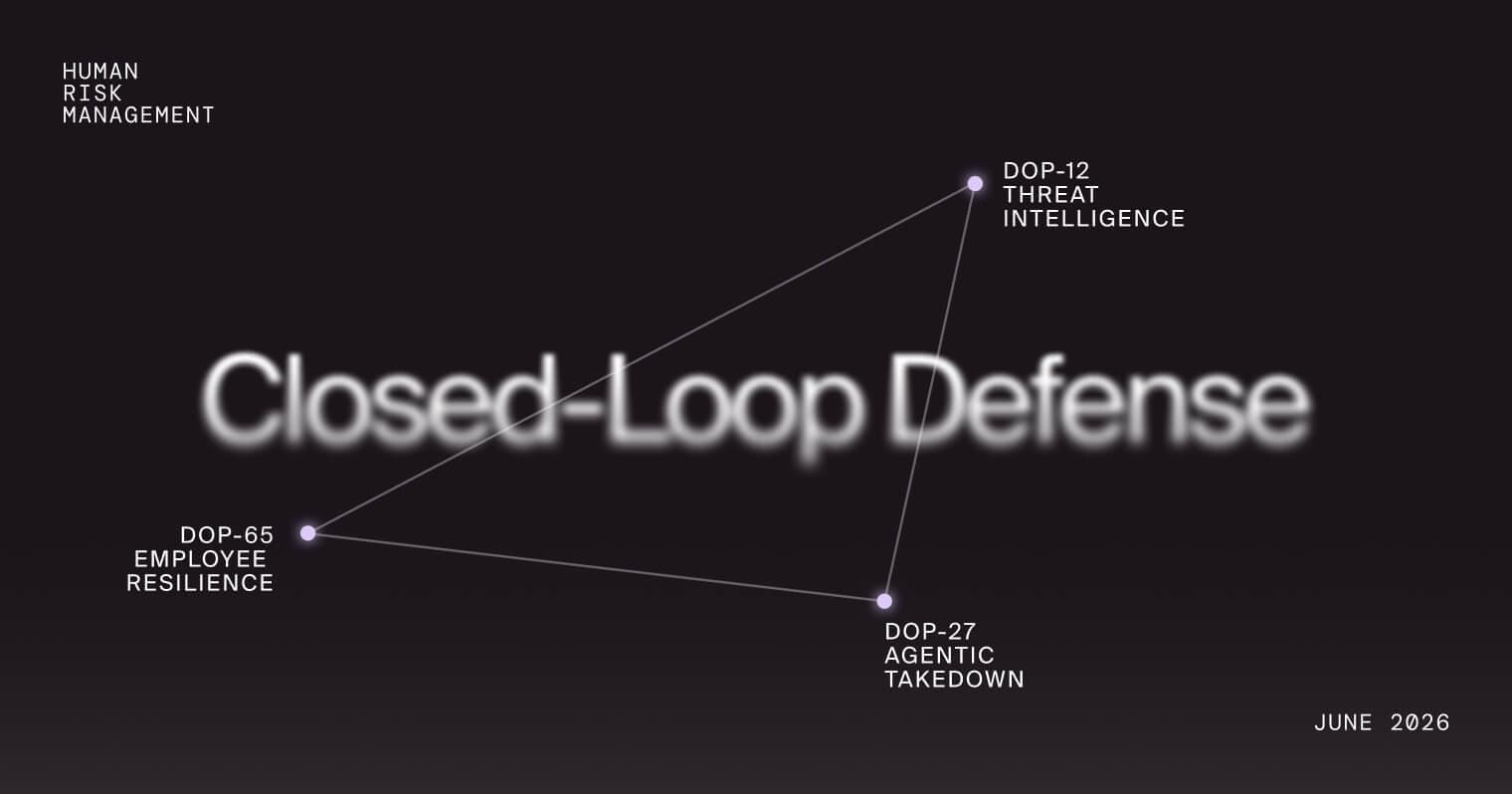
You need to answer this AI velocity problem with a closed-loop defense.
A closed-loop defense dismantles the internal silos. It directly connects external threat intelligence (from digital risk protection) with internal employee resilience (from human risk management). When these two disciplines are unified, your organization moves from passive quarantine to active retaliation.
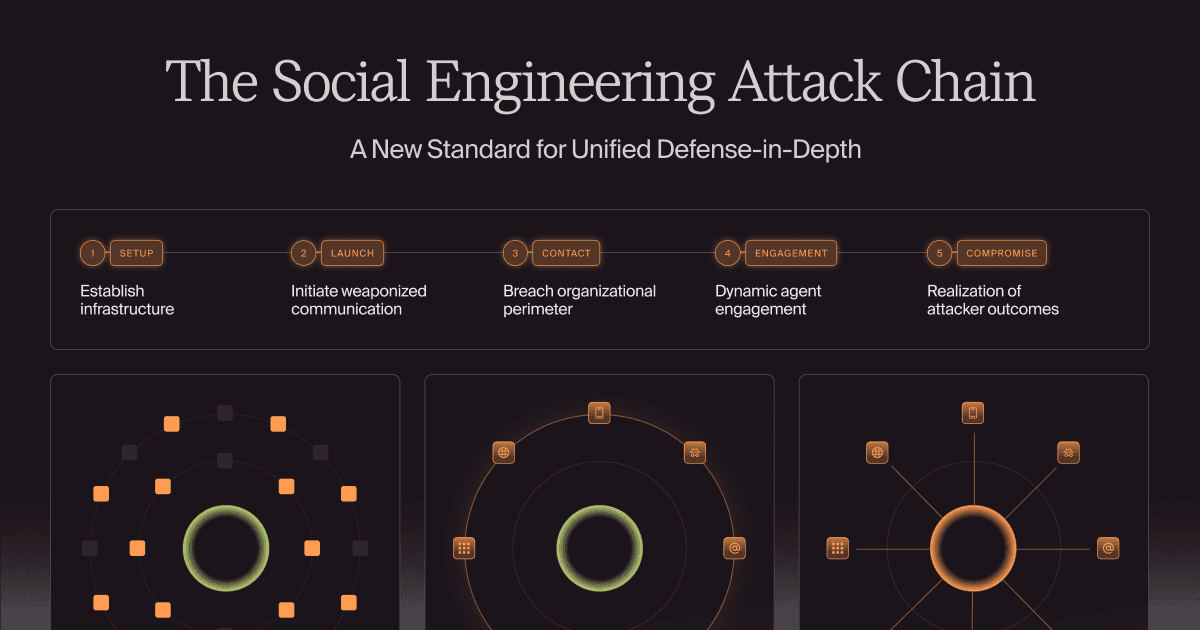
Here’s the exact, three-step playbook to bankrupt an active threat campaign.
Step 1: Detect the Threat in the Wild
You can’t wait for the phishing email to hit the gateway. Digital risk protection actively scans the open web, the dark web, and social platforms for brand abuse. The goal is to identify the lookalike domain, the spoofed executive profile, or the fraudulent social media advertisement before the attacker can fully weaponize it against your employees or customers.
Step 2: Trigger the Agentic Takedown
Once the malicious infrastructure is verified, the response is immediate. Legacy, manual takedown requests take weeks to process.
Instead, closed-loop defense uses agentic AI to initiate a multi-channel takedown at machine speed. AI interacts directly with registrars, hosting providers, and social networks to burn the attacker’s infrastructure to the ground.
This instantly destroys the attacker's sunk costs. The money they spent on domains and hosting is vaporized.
Step 3: Deploy the Real-Time Simulation
This is where the economics are permanently broken. As the agentic AI tears down the external infrastructure, the platform automatically converts the exact threat it intercepted into a live internal simulation (opens in new tab).
If the attacker built a fake Microsoft 365 login portal tailored to your company's brand, the system immediately uses that exact visual lure to test your employees.
You train the workforce on the campaign's specific terminology, visual cues, and urgency tactics while the threat is still actively circulating in your industry. You effectively vaccinate your employees using the attacker’s own weapon.
Digital Risk Protection & Human Risk Management: Breaking the Attacker’s Economics
Cybercriminals are entirely rational actors. They calculate their expected return on investment just like any legitimate business.
When you implement a closed-loop defense, you attack both sides of their ledger simultaneously. You maximize their operational expenses while completely eliminating their potential revenue.
Compare the expected financial outcome of a standard attack against the reality of a closed-loop defense:
First, you deliver a technical loss. The attacker loses the money and time spent setting up their infrastructure, and their operational overhead spikes because they’re constantly forced to rebuild their campaigns from scratch.
Second, you deliver a human loss. Even if the attacker manages to spin up a new domain and slip a message past the email gateway, the campaign still fails.
Because your workforce was just actively simulated and coached on the exact lure the attacker planned to use, the human conversion rate drops to absolute zero. The employees recognize the specific phrasing. They spot the behavioral anomalies. They report the message instead of clicking it.
The campaign's profit margin goes negative.
Unifying Security with Social Engineering Defense
Threat actors are ultimately looking for the path of least resistance. When they encounter an organization that actively destroys their infrastructure while simultaneously using their own lures to train its employees, their business model completely collapses.
Achieving this level of resilience requires abandoning fragmented security tools. If the team taking down external threats cannot instantly communicate with the team training the workforce, the economic advantage swings right back to the adversary.
The future of security relies on a unified front where external intelligence directly hardens internal behavior.
This is the foundation of comprehensive social engineering defense (SED) (opens in new tab). Operationalizing this strategy means blending digital risk protection and human risk management into a single, cohesive workflow.
Doppel’s AI-native platform (opens in new tab) is purpose-built for this closed-loop reality, continuously monitoring the digital landscape to identify external brand threats.
The moment a spoofed domain or fake profile appears, Doppel’s agentic AI executes a rapid, automated takedown to eradicate the infrastructure.
In that exact same motion, the platform ingests the live threat data and transforms the active campaign into a safe, highly contextual internal simulation.
This forces the attacker into a corner. Their sunk costs evaporate, and their carefully crafted lures become the exact training material that hardens your workforce.
Stop fighting individual payloads. Start dismantling their profit margins.
Are you ready to break the economics of cybercrime? See how digital risk protection and human risk management with Doppel (opens in new tab) secure your brand and build true behavioral resilience.