
What Is a Dirty Search Engine?
A dirty search engine is an informal term for a search service that indexes and returns stolen, leaked, or illicitly aggregated data: breached credentials, infostealer logs, ransomware leak-site dumps, and personal records scraped from data brokers.
The label also applies to a mainstream search engine when attackers pollute its results with SEO poisoning or malicious advertising, so a brand-name query returns an impersonating page in a top slot. Neither usage appears in NIST, CISA, or MITRE glossaries. More precise terms distinguish breach search engines and people-search sites from SEO poisoning.
How a dirty search engine works
The Lumma infostealer pulls saved passwords, session cookies, wallet files, and autofill data from an infected browser and packages them into stealer logs; Redline and Vidar do the same. Collectors buy or scrape those logs from Telegram channels and criminal marketplaces, then parse, deduplicate, and tag each record by harvest date and malware family before exposing it through a query interface
A buyer types a target domain or email address and gets back plaintext credentials, cookies, and device fingerprints.
A seized breach-search domain ran on this model: a search engine over stolen names, email addresses, usernames, phone numbers, and account passwords. Ransomware groups run the same model on their own dumps; one group built a searchable database (opens in new tab) of non-paying victims' stolen data so other criminals could find passwords and confidential company information faster.
In the second sense, the engine stays clean and the results get dirty. SEO poisoning builds malicious websites and uses SEO tactics to rank them prominently, so users searching for legitimate software land on phishing pages and malware downloads.
Cloaking layers serve a benign page to crawlers and ad-review bots while real visitors receive the payload. Storm-2561, active since May 2025, used this technique to push spoofed VPN sites (opens in new tab) at users searching for enterprise VPN software; the fake client displayed a convincing login screen and exfiltrated the credentials typed into it.
Why a dirty search engine matters
A credential index searchable by corporate domain turns a stolen employee password into a starting point for intrusion. Stealer logs are a principal source for initial access brokers (opens in new tab), who use them to gain corporate footholds and auction access on top-tier dark web forums. Stealer logs carry live session cookies alongside passwords, which lets an attacker resume an authenticated session and skip MFA entirely.
Once data leaks onto the dark web or into a criminal index, defenders generally cannot remove it (opens in new tab), so the defensive goal shifts to making the exposed data useless through credential resets and account hardening.
The same permanence applies to executive PII aggregated by people-search sites: corporate bios and property records give an attacker part of a ready-made blueprint for impersonation, and social profiles add to it.
Polluted search results reach employees who did nothing suspicious. SEO poisoning works because users place widespread trust (opens in new tab) in search engines' top results. Storm-2755 exploited that trust in April 2026 by poisoning results and running ads against a query as plain as "Office 365."
The campaign ended with Canadian employees' salary payments redirected (opens in new tab) into attacker-controlled bank accounts.
Types of dirty search engines
The term covers at least five distinct surfaces, each with its own established name:
- Breach and credential lookup services. Subscription lookup sites that index breach dumps and stealer logs and return plaintext credentials to paying buyers, alongside seized credential marketplaces and leak forums. Law enforcement has repeatedly targeted these marketplaces.
- Ransomware leak-site search functions. Ransomware groups have added searchable databases of stolen data to their leak sites and let visitors search for listed victim companies.
- Dark web search engines. Tools that index Tor .onion content unreachable by Google or Bing. Security teams use them to find leaked credentials, stealer logs, and cybercrime chatter, a category with substantial defender use too.
- People-search sites and data brokers. Legal surface-web services that aggregate names, addresses, phone numbers, and family connections from government and public (opens in new tab) sources.
- Poisoned mainstream results. Search engines whose rankings or sponsored slots carry impersonating pages. The established technique names are SEO poisoning (opens in new tab) (T1608.006) and the malvertising technique (opens in new tab) (T1583.008) in MITRE ATT&CK. AI answer engines are a target too: brand lookups in AI-generated summaries have returned links to live, attacker-controlled infrastructure.
Device-discovery engines such as Shodan sometimes get the "hacker search engine" label too, but they index exposed devices, not stolen data, a different surface again.
How to defend against dirty search engines
Treat any corporate credential found in a breach index as compromised. Continuous monitoring of dark web sources, Telegram channels, and stealer-log markets for corporate email domains and executive identities surfaces exposure before an attacker uses it. Respond by re-provisioning affected accounts, auditing access, and isolating the workstation, consistent with CISA's phishing guidance (opens in new tab).
For the polluted-results surface, monitor branded search terms on a schedule, checking both sponsored and organic slots for product and executive names, including support queries. Monitoring has to run continuously: removing one advertisement does not stop the advertiser from launching another version.
Pair search monitoring with lookalike domain detection: security teams should run Homoglyph Detection (opens in new tab) (D3-HD) and URL Reputation Analysis (D3-URA) across all identifier types, consistent with MITRE D3FEND countermeasures.
Platform reporting closes individual holes and has documented limits. Trademark complaints for Google Ads require brands to identify each infringing ad (opens in new tab) or advertiser, while Microsoft's paid-ad reporting covers paid placements only, not organic results (opens in new tab).
For executive PII, Google's Results about you (opens in new tab) tool and California's DROP platform (opens in new tab), live for consumers since January 1, 2026, both accept removal requests, though brokers can re-harvest public records (opens in new tab), so removal is an ongoing cycle.
How Doppel helps
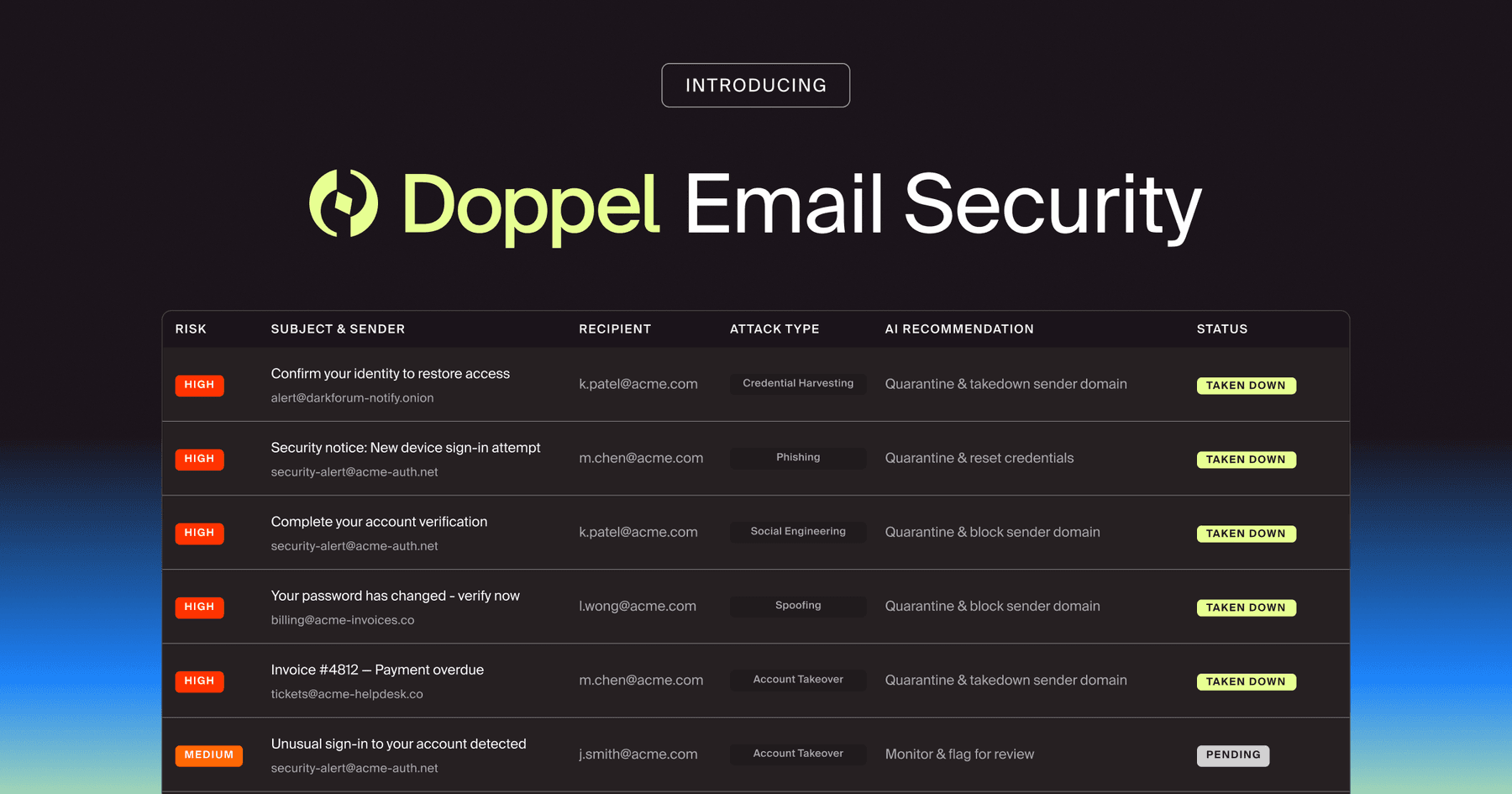
Doppel, the Frontier AI Social Engineering Defense (SED) platform that unifies Digital Risk Protection (DRP) and Human Risk Management (HRM), links the poisoned ad, the lookalike domain behind it, and the credentials it harvests into a single campaign view. Doppel Brand Protection detects brand impersonation across paid ads, domains, social profiles, and app stores, then dismantles the sponsored result and its landing page through automated takedown.
Executive Protection detects leaked executive credentials across dark web sources and executes automated opt-out and deletion requests to data broker sites, shrinking the personal footprint that people-search engines aggregate.
The Doppel Threat Graph connects the ad ID, the registrar record, and the credential dump into one attacker campaign. Its agentic AI correlates, prioritizes, and executes takedowns across registrars, hosts, ad networks, and social platforms at scale, so analysts handle only the complex escalations. Each campaign the platform dismantles feeds back into the graph, making repeated campaigns harder and more expensive to operate.
Request a demo to see the graph linking a poisoned ad to a lookalike domain, then the takedown running against that infrastructure.
Frequently asked questions about dirty search engines
What is a dirty search engine?
A dirty search engine is an informal name for a search service that indexes stolen, leaked, or illicitly aggregated data and lets a user query it by an email address, domain, or person's name. The category includes breach-credential lookup sites, searchable ransomware leak sites, dark web search engines, and people-search sites built on data broker records. The label sometimes extends to mainstream search engines after attackers manipulate their results through SEO poisoning or malicious ads. It has no formal definition in NIST, CISA, or MITRE glossaries.
What is a dirty search engine in cybersecurity?
In cybersecurity the term describes attacker-oriented indexes that return plaintext passwords, session cookies, and device fingerprints to paying buyers. Defender-oriented services check exposure without revealing the data. Have I Been Pwned uses a defender-oriented exposure-check process that hashes a password locally (opens in new tab) and transmits only a short hash prefix. Both types ingest the same criminal feeds and apply different exposure policies. Security teams monitor the attacker-oriented indexes for their own domains so exposed credentials can be reset before they are used.
Dirty search engine vs. dark web monitoring: what is the difference?
A dirty search engine is a queryable index of already-collected breach data that a user consults reactively to look up a specific identifier. Dark web monitoring is a continuous, automated service that crawls forums, Telegram channels, stealer-log marketplaces, and paste sites and alerts when a monitored asset appears. Monitoring catches newly leaked stealer logs, often circulating for weeks before breach indices catalogue them. Most enterprise programs use monitoring for detection and breach indices for confirmation and scoping.
What is an example of a dirty search engine attack?
Spoofed download sites for Ivanti, Cisco, and Fortinet (opens in new tab) enterprise VPN products appeared in search results after Storm-2561, a threat actor active since May 2025, used SEO poisoning. Employees searching for legitimate software landed on the fake pages, downloaded a trojanized client, and typed corporate credentials into a convincing login screen that sent them to attacker infrastructure. The payload chain became public in March 2026: a ZIP archive fetched from GitHub, with a Microsoft Installer (MSI) package that sideloaded a DLL and dropped a variant of the Hyrax infostealer.