
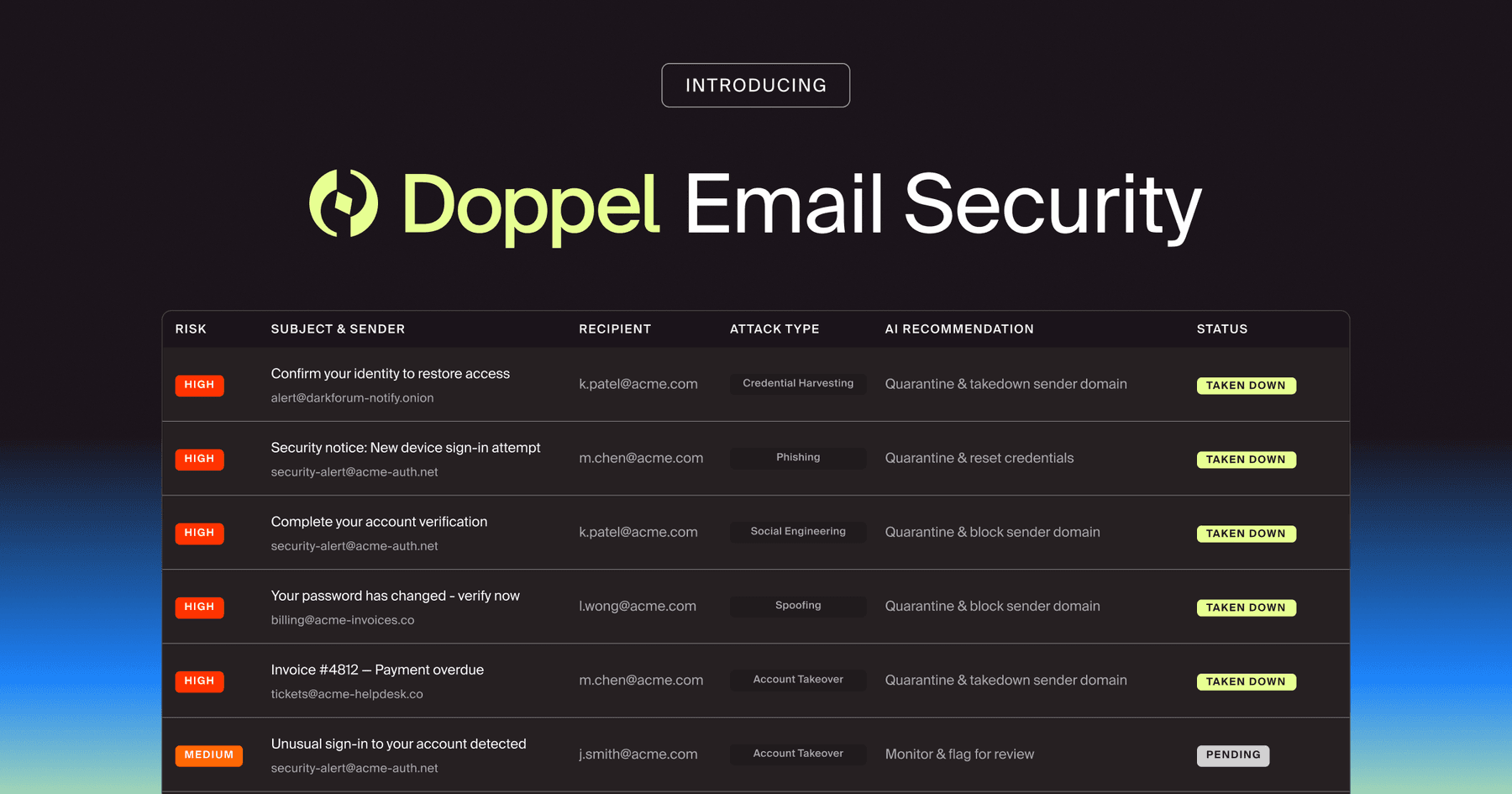
Doppel Email Security is now generally available
The agentic email security solution that empowers you to fight back against social engineering attacks. Detection isn't enough. Disruption is the difference.
Deepfake scams use AI-cloned voices and faces to bypass enterprise defenses. Learn how attacks unfold and what it takes to stop them.

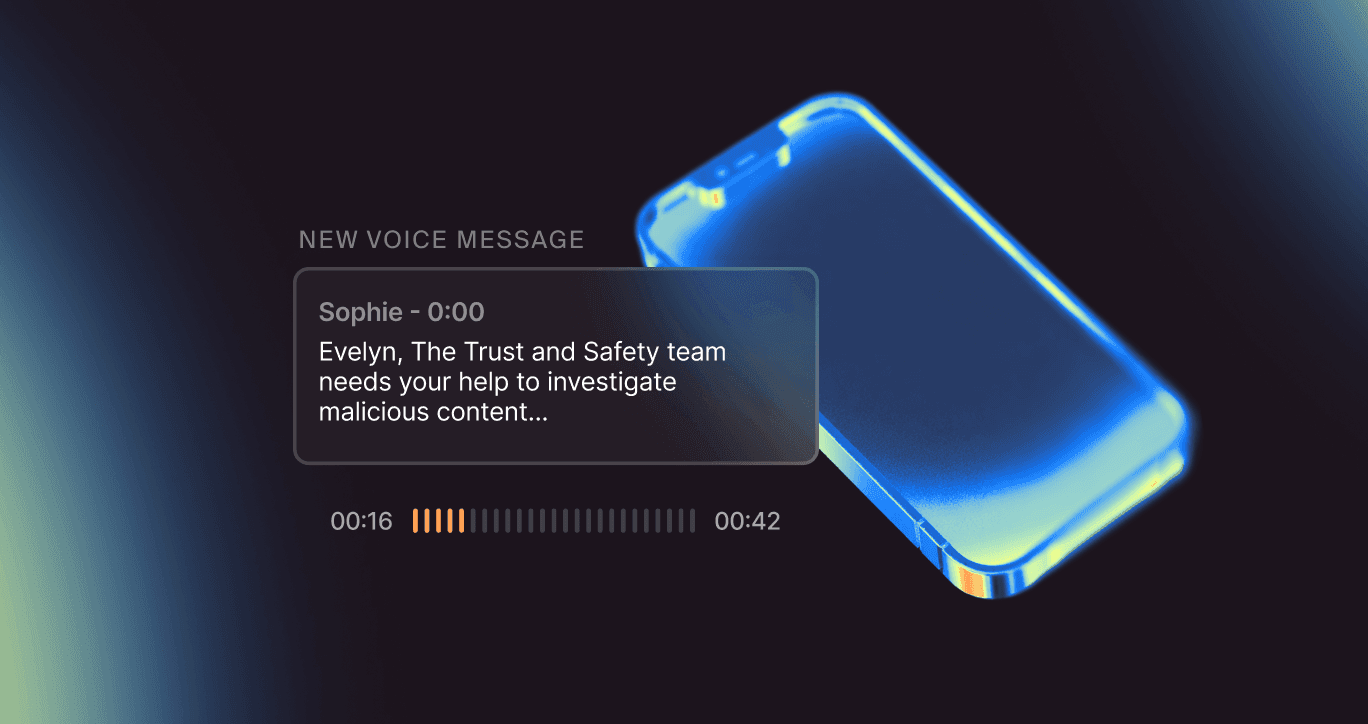
The IT helpdesk takes a call from a regional sales VP who is locked out of her account in an airport lounge, twenty minutes before a customer renewal call. The voice is hers. The caller knows her manager's name, her open deals, and the conference she is flying home from. The agent resets her credentials and wishes her a safe flight. The VP never called. Her voice was cloned from a podcast appearance, and the attacker logged in minutes later.
That is a deepfake scam, a social engineering attack that uses AI-cloned voices, faces, or footage of real people to impersonate someone the target trusts and convert that trust into money, credentials, or access. 62% of organizations (opens in new tab) experienced a deepfake attack involving social engineering in the 12 months prior to mid-2025, and the technology needed to build a working clone keeps getting cheaper and faster (opens in new tab).
A deepfake scam puts a synthetic clone of a real person at the center of an enterprise fraud playbook that the target already recognizes. The realism of the clone collapses the target's normal skepticism.
Current diffusion-based voice models can clone a target from very little source audio (opens in new tab), and attackers can assemble effective clones quickly from publicly available samples. Video is close behind. Open-source tools like DeepFaceLive and Avatarify (opens in new tab) enable real-time face swapping during live calls, and commercial platforms can create animated or face-swapped personas from user-supplied images and live input.
Cybercrime tools and services for both voice and video sit openly on underground forums at a wide range of price points.
Voice clones work over phone calls and meeting audio, where the target relies on vocal recognition. Real-time video deepfakes layer a synthetic face over the attacker's own during a live conference call. Fabricated footage produces pre-recorded clips for distribution through messaging or social channels.
Each format targets a different verification instinct, and attackers increasingly combine them (opens in new tab) in the same campaign.
A deepfake scam follows the same financial logic as business email compromise, which caused $2.77 billion (opens in new tab) in reported losses in 2024. The attacker impersonates an authority figure, creates urgency around a payment, and directs the target to move funds. A cloned voice or face on a live call carries far more persuasive weight than a spoofed email.
Enterprises give attackers public cloning material and high-value approvals that can move on a familiar voice. Distributed teams add another opening when the person on screen becomes a default proof of identity. Each condition is a byproduct of how modern enterprises operate, and attackers can exploit them without breaching a system first.
Executives at publicly traded companies produce large volumes of recorded public-facing content every quarter: earnings calls, conference keynotes, podcast appearances, and YouTube interviews all provide viable source material. Attackers do not need internal system access to collect this data.
They pull it from investor relations archives and media libraries, the same sources any analyst or journalist would use.
When a finance team member hears the CFO's voice on the phone or sees the CFO's face on a Zoom call walking through a transaction, the instinct is to comply. Wire transfers, vendor payment changes, and credential resets all sit behind formal approval and verification procedures, and a familiar voice is often enough to move those approvals.
Organizations train people to defer to authority and move quickly, and deepfake scams weaponize that compliance culture directly.
In a remote-first operating model, the screen has become a default identity layer. Video conferencing hosts the bulk of high-stakes decisions, and a distributed team spread across time zones rarely has the option to walk to someone's desk and verify a request in person.
A deepfake exploits exactly that assumption.
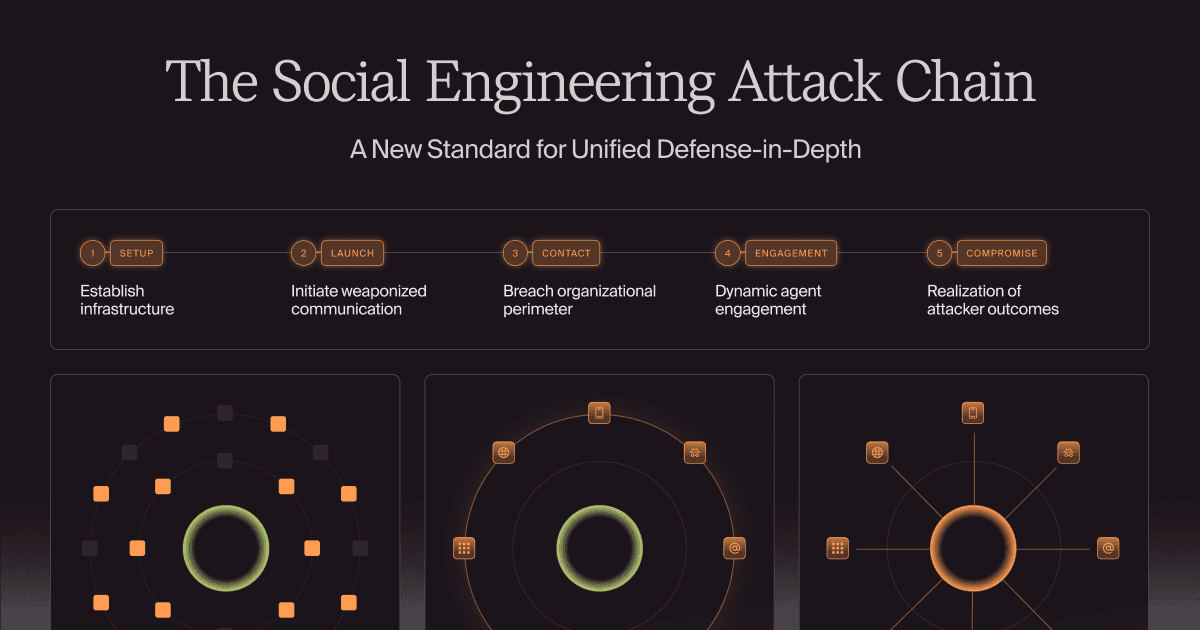
Deepfake scams move through the five stages of Doppel's social engineering attack chain: reconnaissance, weaponization, delivery, persuasion, and execution. Defenders can catch signals at every stage before funds move, and the social engineering attack examples Doppel has documented follow the same five-stage arc.
Attackers profile the target organization using public sources. LinkedIn reveals the reporting structure and identifies who approves payments. Earnings calls and conference recordings provide audio for voice cloning.
Corporate websites and press releases supply the internal context needed to build a believable pretext, such as deal names, partner relationships, and acquisition timelines that make the request feel current.
The collected audio trains a voice model. Facial imagery feeds a face-swap pipeline. Attackers configure VoIP caller ID spoofing to display a known internal number and set up the real-time voice conversion stack. In parallel, spoofed domains for follow-up emails and messaging accounts reinforce the pretext.
The attack reaches the target through a channel that looks routine. A calendar invite appears for a rescheduled meeting. A phone call comes from what appears to be the CFO's number. A WhatsApp message opens the first contact and then escalates to a Microsoft Teams call where deepfake voice and video build credibility, a pattern that has played out in recent enterprise incidents (opens in new tab).
The clone performs during the live interaction. The target hears or sees someone they recognize, and the conversation hits the internal context the target expects from that person. Urgency closes the window for second-guessing: the deal closes tomorrow, the payment has a cutoff, and the board needs this before the announcement.
Deepfake impersonation on a live call has already pushed finance staff to authorize wires, as one finance director's (opens in new tab) case shows.
The target acts within their own legitimate system access. They initiate the wire transfer, read credentials aloud, or approve the access request, because a trusted-looking authority asked them to. Lookalike or mirrored phishing pages often handle the credential capture itself.
From the perspective of most technical controls in the security stack, the transaction looks normal.
The controls enterprises rely on inspect email headers, sender reputation, and payload signatures (opens in new tab). A deepfake scam succeeds as a trusted face or voice on channels that those controls never see.
Email security gateways, DMARC, DKIM, and SPF protect the email layer. A deepfake voice call on a conferencing platform, a WhatsApp message, or a spoofed phone number generates no artifacts those controls can evaluate.
Legacy security awareness training often teaches employees to watch for suspicious links, lookalike domains, and cues like awkward phrasing or grammatical errors. Deepfake attacks replace those cues with the convincing voice and face of a trusted colleague.
Employees trained on those cues still expect synthetic audio to sound robotic, an assumption current voice-cloning tools no longer justify.
Multi-factor authentication (MFA) verifies system access events, and live voice and video sit outside that boundary. When a deepfake CFO instructs a wire transfer, no MFA prompt fires because no authentication event is occurring.
The employee is acting within their own authorized access, and callback verification remains vulnerable to caller ID spoofing and voice cloning.
Security leaders need four capabilities working as a single system: a smaller executive PII footprint, impersonation infrastructure detected and dismantled across every channel, out-of-band verification for high-stakes approvals, and a workforce rehearsed against live synthetic media.
Any one of these in isolation leaves gaps that the attack chain will route around.
Every public recording of an executive's voice and face is potential training data for an attacker's model, and every exposed personal detail feeds the pretext that makes the clone believable. Earnings calls and keynotes cannot be pulled back, so the exposure that can be removed has to be.
Continuous detection and dismantling of executive PII across data broker sites, dark web forums, and public repositories shrinks the raw material that attackers mine, and the same logic extends to family members, whose exposed data routinely feeds the pretext that ultimately reaches the executive.
Federal cybersecurity guidance on digital footprint reduction exists for exactly this reason.
A deepfake scam relies on supporting infrastructure: spoofed domains for follow-up emails, fake social profiles to establish credibility, VoIP numbers for caller ID spoofing, and messaging accounts for initial contact.
Detecting and neutralizing that infrastructure before the clone performs breaks the campaign at the staging layer. Legacy takedown workflows most often skip telco and messaging infrastructure, which leaves the SMS and WhatsApp legs of a campaign live even after a domain comes down.
A security program that detects on only one channel leaves gaps when the attacker operates across many simultaneously.
Any request involving financial transfers, credential resets, or sensitive data access needs verification through a separate, pre-established channel using a known contact method. Security teams should not assume pre-shared verbal passphrases will hold against modern voice-cloning attacks.
Risk-based verification for high-risk transactions is already standard in interagency guidance (opens in new tab) for financial institutions, yet voice and video still sit inside many authorization chains unverified.
Standard phishing simulations that send a fake email do not prepare employees for a live deepfake voice call, applying pressure in real time. Realistic preparation mirrors how real attacks unfold: a calendar invite that stages a meeting before the call, a voice clone built from the same publicly available audio attackers would use, and mid-call pivots from voice to SMS or email when a target hesitates.
Effective training requires exposure to high-quality synthetic voice and video, practice invoking out-of-band verification protocols under pressure, and testing whether the verification chain actually functions when someone who sounds like the CFO is on the line.
Doppel is the AI-native Social Engineering Defense platform that unifies Digital Risk Protection and Human Risk Management to deliver the four capabilities above as a single system. Doppel Executive Protection identifies and dismantles exposed executive PII across data broker sites, dark web forums, and public repositories to shrink the cloning surface attackers depend on.
The platform also detects deepfake and impersonation campaigns targeting leadership, correlates the attacker infrastructure behind them, and dismantles that infrastructure across social, messaging, and domain channels.
The Doppel Threat Graph correlates signals across channels into campaign-level views. It connects a fake LinkedIn profile, a phishing domain, a Telegram account, and a spoofed voice number into a single campaign instead of four isolated alerts. Agentic AI correlates, prioritizes, and executes takedowns at scale.
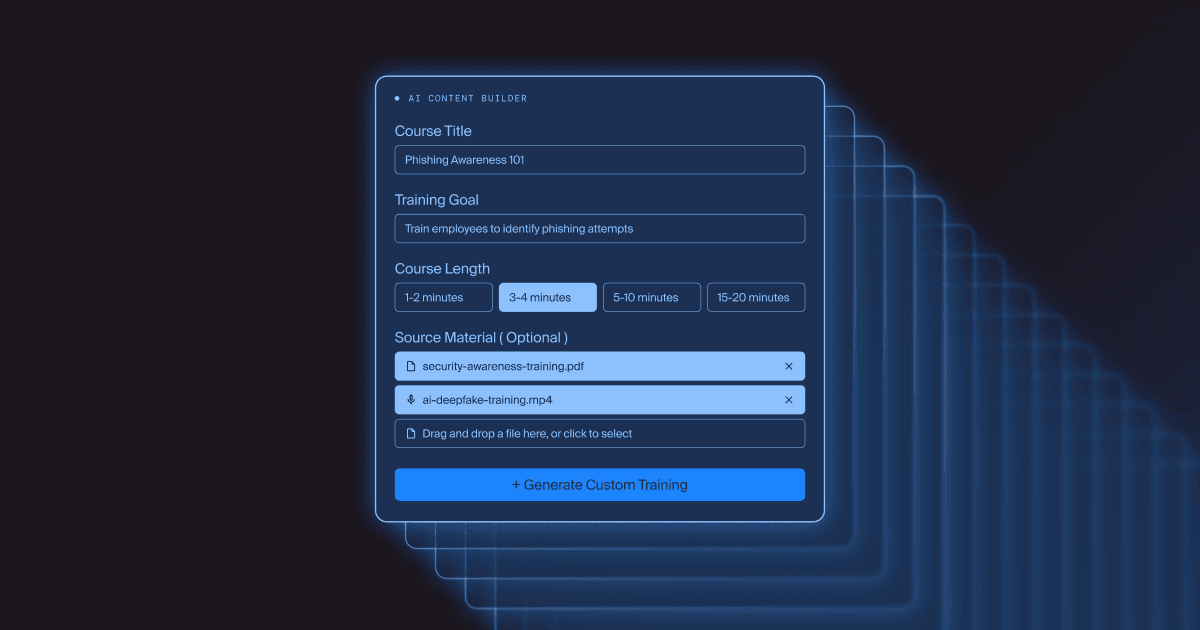
Doppel Dynamic Simulation uses AI-generated voices to run deepfake-enabled vishing and video simulations across voice, SMS, Microsoft Teams, and Zoom. Security teams can convert a detected deepfake campaign targeting the CFO into an employee training scenario with one click.
The same lure runs as a defanged simulation while the live campaign is still in motion, and that closed loop between external detection and internal training compounds the value of running both pillars on a single platform.
Voice and video, once the highest-trust verification channels available, now carry the same spoofability as email. The organizations that pull ahead will defend the executive footprint and the workforce's response as a single system and dismantle the impersonation infrastructure between them until cloning the enterprise costs more than it pays.
Request a Demo to see how Doppel defends your brand, your executives, and your workforce against deepfake scams.
BLOG
Modern social engineering is a relentless, AI-orchestrated lifecycle. Learn how to map the five-stage attack chain—from setup to contact—and why a unified defense platform is the only way to outpace AI-driven social engineering attacks.



by Bobby Ford, Rahul Madduluri, and Alvin Lin