Threat actors operate very differently from even just a few years ago. In 2026, they’re going much further than just using generative AI to write better phishing emails.
Cybercriminals now deploy interconnected, multi-agent frameworks to automate the entire attack chain, from the initial target research to the final extraction of personal information or funds.
Attacks by AI-enabled adversaries surged by a massive 89% year-over-year, according to CrowdStrike’s 2026 Global Threat Report (opens in new tab).
There’s no other way to say it: Human-speed defense is outmatched. If your SOC relies on manual analysts to spot lookalike domains or triage phishing alerts, you’re far from prepared to keep up.
To neutralize autonomous attack orchestration, only agents catch agents.
What autonomous attack orchestration looks like
Threat actors have realized that standardizing and automating their workflows drastically increases their return on investment. They deploy specialized AI agents, much like a legitimate tech company deploys specialized microservices, to handle different phases of the attack.
Here’s a breakdown of how this autonomous machine operates.
1. Reconnaissance agents: Infinite scrapers
In the past, an attacker had to stalk a target on LinkedIn to craft a spear phishing lure. Now, they unleash reconnaissance agents to do all the heavy lifting at scale.
These AI bots endlessly scrape social media platforms, public data brokers, and dark web credential dumps. They map out your entire organizational chart, identifying exactly who handles wire transfers and who has administrative access to your cloud infrastructure.
The data they’re pulling is highly actionable. The Constella 2026 Identity Breach Report (opens in new tab) found that nearly 70% of all breached credentials in 2025 were exposed in plaintext.
Reconnaissance agents scoop up this plaintext data, cross-reference it with your employees' digital footprints, and build hyper-personalized psychological profiles for thousands of targets simultaneously.
2. Staging agents: Infrastructure builders
Once the targets are acquired, the staging agents take over. Their only job is to build the operational infrastructure required for the attack, and they do it in seconds.
These bots autonomously register typosquatted domains that look nearly identical to your primary corporate URL. They configure the necessary DNS records, provision SSL certificates to make the fake sites look secure, and deploy adversary-in-the-middle (AiTM) reverse proxies.
This process is entirely automated, so staging agents can spin up dozens of fresh, clean lookalike domains the exact moment an older one gets blocked by a secure web gateway. They ensure the syndicate always has a live staging ground ready for action.
3. Real-time persuasion agents: Closers
Orchestration gets terrifying here.
When a victim clicks a link or answers a phone call, they aren't interacting with a human scammer reading from a script. They’re engaging with a real-time persuasion agent.
These LLM-powered bots can dynamically respond to a victim's questions over chat or email, perfectly mimicking the tone and vocabulary of a trusted executive. If the attack shifts to a phone call, voice-cloning agents step in to execute highly convincing vishing (voice phishing) attacks.
The persuasion agent’s goal is simple: manipulate the victim into bypassing security controls, handing over an active session token, or approving a fraudulent wire transfer, all without breaking character.
Account takeover at scale
Every cybercriminal's objective in this autonomous orchestration is account takeover (ATO).
If an attacker can steal a live, authenticated session token using an AiTM proxy, they bypass multi-factor authentication (MFA) (opens in new tab). There’s no need to hack your firewall if they can simply log in as your VP of Finance.
The scale of this threat is hard to overstate. According to Sift's Q3 2025 Digital Trust Index (opens in new tab), 83% of organizations experienced at least one account takeover incident in 2024, with projected global losses climbing to an astronomical $17 billion.
When AI agents are running the show, ATO campaigns can hit tens of thousands of employees across hundreds of companies simultaneously, searching for the single weak link in the human perimeter.
Machine-speed disconnect
Security teams with legacy training and simulations are struggling to stop these automated attacks, and it all comes down to velocity.
Cybersecurity has historically been a game of human reaction times. An alert is generated, a ticket is created, an analyst reviews the log, and an action is taken.
That workflow is obsolete. CrowdStrike's 2026 data (opens in new tab) reveals that the average "breakout time,” the speed at which an adversary moves laterally through a network after the initial compromise, has plummeted to just 29 minutes. The fastest recorded breakout took 27 seconds.
If your SOC analyst is grabbing a cup of coffee when the alert fires, the attacker has already exfiltrated the data and sold the access on a dark web forum before the analyst even sits back down at their desk.
Let’s be clear: You can’t defeat a machine-speed attack with a human-speed defense.
AI-native agentic defense: Matching fire with fire
Shift your defensive posture. You need a threat intelligence platform, like Doppel, that doesn't just passively collect data and generate alerts, but actively hunts down attacker infrastructure and executes takedowns autonomously.
Doppel’s agentic SOC neutralizes autonomous attack orchestration by deploying specialized AI agents to counter the adversary's agents at every single stage of the attack chain.
Neutralizing reconnaissance
Doppel’s intelligence agents continuously monitor the open web, dark web forums, and illicit Telegram channels. By knowing exactly what data the attacker's reconnaissance bots have scraped, we can predict exactly which employees are about to be targeted.
Dismantling the staging ground
We don’t wait for a phishing email to hit your secure email gateway (SEG) (opens in new tab). Doppel's agents detect the unauthorized registration of lookalike domains and the deployment of AiTM proxies the moment they hit the domain registrar.
The platform executes automated, machine-speed API takedowns, interfacing directly with hosting providers to burn the attacker's staging infrastructure to the ground before it can ever be weaponized.
Hardening the human perimeter
You can’t eliminate every single threat externally, so your workforce needs to be prepared for the lures that slip through.
Doppel operates as an advanced AI social engineering attack simulation platform. We take the live threat intelligence gathered by our agents and instantly convert it into safe, proactive internal simulations. We test your employees using the exact same multi-channel, agentic lures the syndicates are actively staging.
This bridges the gap between written compliance policies and actual human resilience, ensuring your team is trained dynamically against real-world threats.
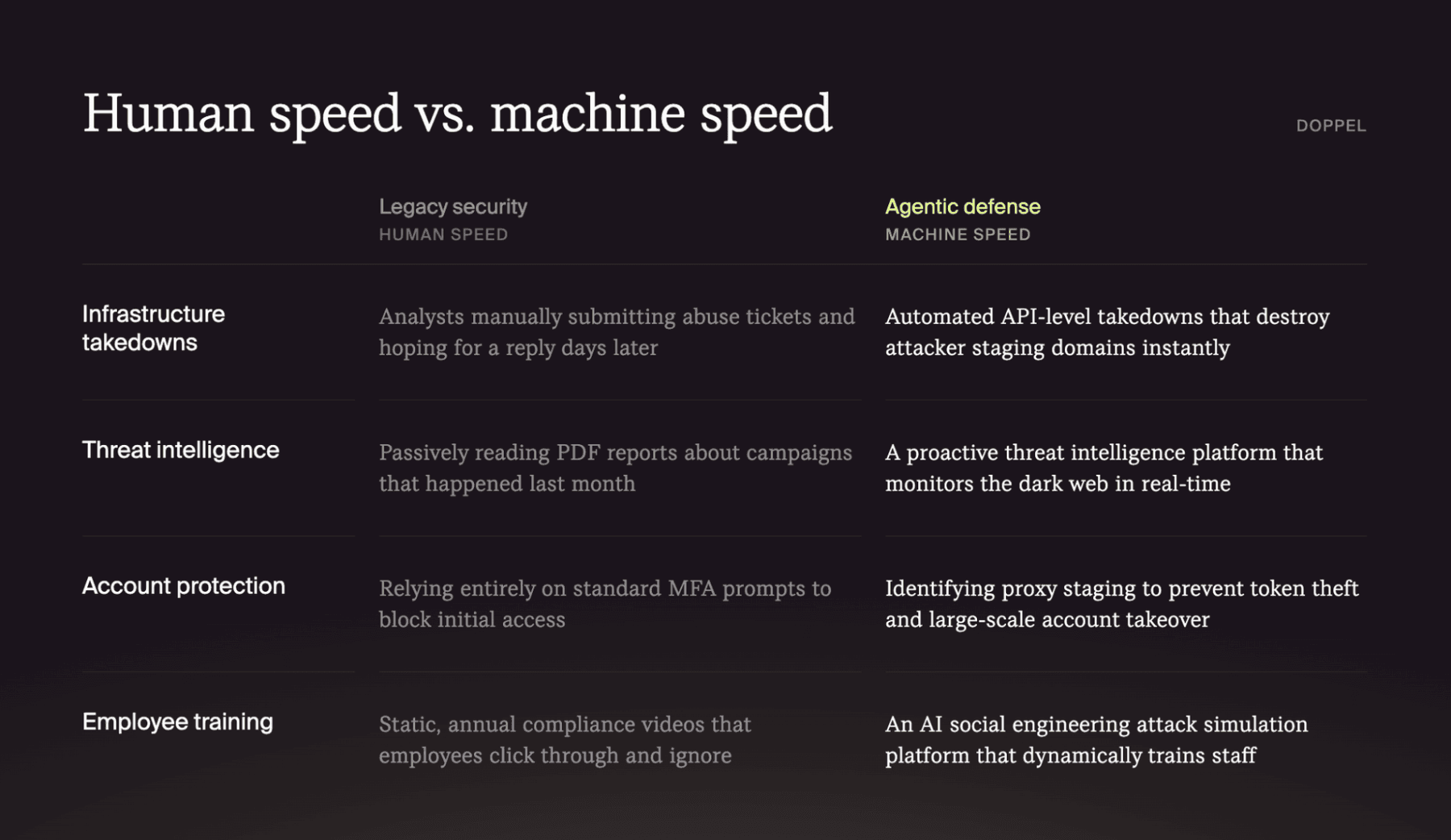
Legacy security workflows vs. agentic defense
Here’s a look at how an agentic defense fundamentally outperforms legacy security workflows.
Deploy Doppel’s agents against autonomous attacks
Cybercriminals have fully embraced the power of autonomous agents, using them to scale their operations, perfectly mimic trusted executives, and bypass traditional security controls with terrifying efficiency.
Still asking human analysts to manually click through alerts and file abuse reports? You’re giving the adversary the upper hand.
In 2026, stop playing whack-a-mole with symptoms and start dismantling the attack orchestration itself. By deploying Doppel’s agentic AI, you can catch the adversary's bots, destroy their infrastructure, and secure your digital perimeter at machine speed.
See how Doppel neutralizes automated social engineering campaigns and executes machine-speed takedowns by scheduling a demo here.