A finance director joins a video call with her CFO and colleagues. The conversation references a deal the board discussed that morning. She authorizes a series of wire transfers totaling millions of dollars across multiple bank accounts. Attackers keep the impersonation hidden for days because every person on the call is synthetic.
62% of organizations experienced a deepfake attack (opens in new tab) involving social engineering in the 12 months prior to mid-2025. The losses arrive as fraudulent wire transfers, stolen credentials, and regulator inquiries. They also erode something harder to recover: customers and partners stop trusting what they see and hear from your brand.
This article defines deepfake brand protection, walks through how AI-generated brand impersonation unfolds, explains why legacy monitoring and email security tools leave it active, and lays out what an effective defense requires.
Key Takeaways
- Deepfake brand attacks now run as multi-channel campaigns spanning paid social ads, messaging apps, voice calls, and video conferences.
- Attackers harvest publicly available footage and audio to clone voices, swap faces, and fabricate synthetic spokespeople, each exploiting a different trust signal customers and employees rely on.
- Stopping AI-generated impersonation requires four capabilities working together: multi-channel detection, campaign-level correlation, coordinated enforcement across platforms and telcos, and workforce resilience trained on live attacker lures.
- Doppel unifies these capabilities in a single platform, dismantling attacker infrastructure across every channel and converting detected lures into employee simulations through one-click threat-to-simulation conversion.
What Is Deepfake Brand Protection?
Deepfake brand protection is the discipline of detecting, attributing, and dismantling AI-generated content that impersonates a brand or its executives across the channels attackers use to monetize fraud. It combines digital risk protection, workforce resilience, and executive protection into a single operational problem focused on preventing deepfake fraud.
Effective protection has to cover every asset an attacker can forge, because each one exploits a different trust signal. Attackers now fabricate three distinct asset types:
Protection that watches only one of these assets leaves the other two open, which is why deepfake brand protection has to span voice, video, and image together.
Deepfake Brand Protection vs Traditional Brand Monitoring
Deepfake brand protection covers a wider surface than brand monitoring. Traditional monitoring watches for trademark violations, domain squatting, and keyword mentions. Deepfake brand protection adds synthetic likenesses: a cloned voice that sounds like your CEO, a fabricated video of your spokesperson endorsing a product you never sold, a deepfake of your CISO used to socially engineer your own employees
Because the tell is a face or a voice rather than a text string, detection has to read the media itself.
The harder gap is where these forgeries run. The "Quantum AI" campaign generated synthetic video of UK financial commentator Martin Lewis and Elon Musk endorsing a fake investment scheme, then used paid advertising on Facebook to push the forgeries to targeted audiences, driving losses that public reporting (opens in new tab) links to social media scams.
Campaigns like these run on paid social, messaging apps, and voice channels that trademark monitoring and secure email gateways never inspect, so protection has to watch the channels themselves, not just registered assets.
How AI-Generated Brand Fraud Actually Unfolds
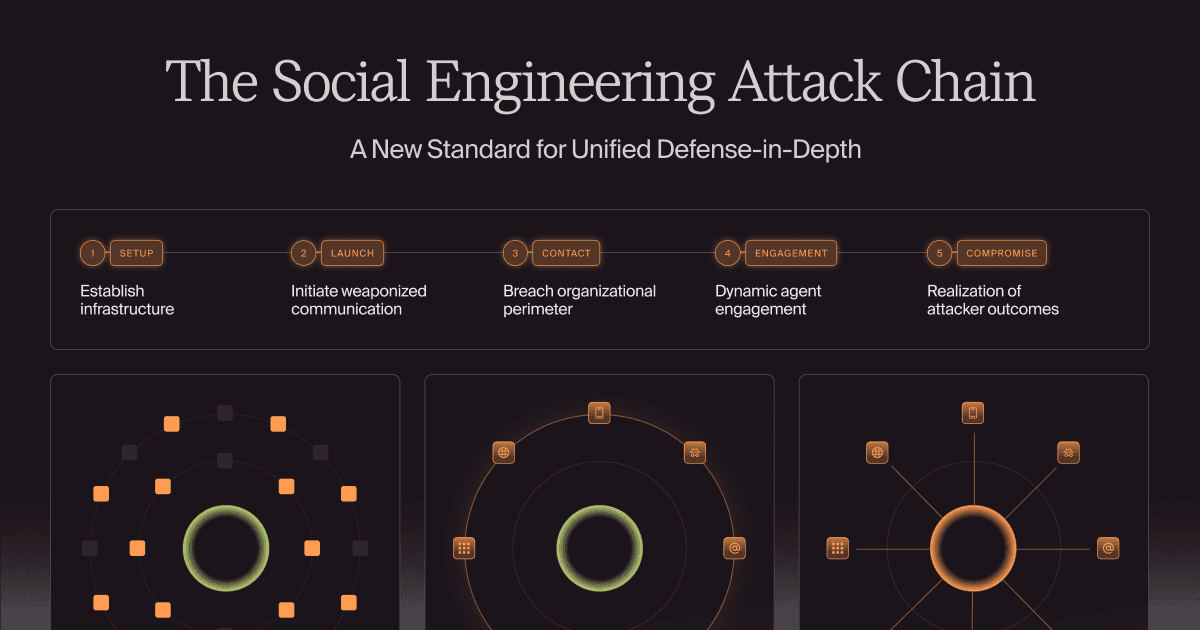
These campaigns move through the five stages of the social engineering attack chain: reconnaissance, weaponization, delivery, persuasion, and execution. Each stage feeds the next.
Attackers start by profiling the target from publicly available content. Earnings call recordings, conference keynotes, YouTube appearances, and webinars posted publicly all become raw material. This stage leaves few traces and needs no contact with the target organization, so most victims never know they have been profiled until the attack lands.
That reconnaissance feeds the forgeries. Speech-synthesis engines need only minutes of public audio to clone an executive's pitch, tone, and cadence, while video models map facial geometry to produce real-time or recorded impersonations.Deepfake voice calls (opens in new tab) built from a few minutes of public audio have already reached finance executives.
Stage 3: Delivery Across Social, Ads, Messaging, and Voice
The forgeries then deploy across multiple channels at once. Paid social ads reach retail investors, WhatsApp and Telegram messages reach customers directly, and phone calls reach finance teams and executive assistants. One campaign targeted WPP's CEO (opens in new tab) through a fake WhatsApp account that paired a cloned voice with YouTube footage to deceive senior staff. Each channel reinforces the credibility of the others.
Stage 4: Persuasion Through Authority and Urgency
Delivery only pays off when the target acts, so the campaign leans on authority and urgency. The synthetic executive issues a request that fits the target's job, references real context like a deal discussed that morning, and applies time pressure before anyone can verify. The more familiar the voice and face, the less reason the target has to pause.
Stage 5: Execution and the Speed of the Payout
The payout lands fast: a fraudulent wire, a credential handed over, or network access granted. The gap between the moment a victim acts and the moment the organization spots the impersonation is where the financial damage concentrates, often before any alert reaches the security team.
Why Legacy Brand and Email Defenses Miss Deepfake Attacks
Most organizations already own tools built for an older threat model: domain-based phishing, trademark infringement, and malicious links. That model assumes attackers leave the artifacts those tools were trained to find. Deepfakes don't, so four gaps open at once:
- Technical controls log the call without verifying the caller. Voice and video tools can confirm that a call took place. They cannot tell whether the person on the line is a real human or a deepfake.
- Brand monitoring misses synthetic likenesses. Legacy monitoring scans for trademark matches, logo hashes, and domain strings. A generated face or voice is a brand-new artifact that sits outside any registered asset, and a deepfake ad may never use the brand name at all.
- Email security stops at the inbox. Gateways scan attachments, links, and headers, but deepfake fraud plays out on video calls, voice channels, and messaging apps. A business email compromise message often carries no malicious link at all, so the inbox check passes while the fraud happens elsewhere.
- Manual takedown lags AI-speed attacks. Human review, legal sign-off, and platform notification move slower than generative tools create and distribute new forgeries, and human reviewers struggle to reliably detect audio deepfakes even when they are looking for them.
Adding analysts does not close these gaps, because each one is structural rather than a matter of headcount.
What Effective Deepfake Brand Protection Requires
Stopping AI-generated brand impersonation takes four capabilities working together: detection, correlation, enforcement, and resilience. Each covers a gap the legacy tools leave open.
Detect Synthetic Content Across Voice, Video, Image, and Text
Detection has to work on the content itself, across every format a forgery can take. That means checking media for the signs of synthetic generation and, where it exists, the provenance data that shows how a file was made. AI-based detection can flag a manipulated voice or video in real time, before an employee acts on it. The voice channel is the widest gap, because most organizations have treated it as inherently trustworthy and built it for convenience rather than verification.
Correlate Isolated Forgeries Into a Single Campaign
Isolated forgeries are usually one campaign wearing different masks. A deepfake video ad, a spoofed social profile, and a cloned-voice call hitting the same brand in the same week typically share hidden infrastructure.
Treating each as a separate incident hides that link and lets the operation keep running. Campaign-level visibility is what turns three unrelated alerts into one attacker to dismantle.
Detection only matters if it ends in a takedown. Enforcement has to reach platform abuse teams, ad-network escalation paths, registrars, and telcos at once. Telcos are the most commonly forgotten: a domain takedown that ignores them leaves the WhatsApp and SMS legs of the campaign live, and the attacker rebuilds from there.
Build Workforce Resilience on Real Attacker Lures
Detection tools will always trail the newest generation models, which makes a trained workforce the defense that lasts. Regulators increasingly expect security awareness training to address deepfake attacks directly, delivered through simulated phishing and liveimpersonation exercises (opens in new tab).
Training built on the lures employees actually receive changes behavior; generic compliance content does not.
How Doppel Operationalizes Deepfake Brand Protection
Doppel is the AI-native Social Engineering Defense (SED) platform that unifies Digital Risk Protection and Human Risk Management on the Doppel Intelligence Layer, covering all four requirements just described: detection, correlation, enforcement, and resilience.
- Detection and correlation across every channel. The Doppel Threat Graph ingests signals across domains, social, paid ads, messaging apps, telco, dark web, and voice, then correlates isolated forgeries into one view of attacker infrastructure. When a deepfake video ad, a spoofed executive profile, and a cloned-voice vishing call share infrastructure, the Threat Graph surfaces the whole operation instead of three unrelated alerts.
- Autonomous enforcement at attack speed. The platform's agentic AI correlates, prioritizes, and executes takedowns across registrars, social platforms, ad networks, and telcos, leaving analysts to handle only the escalations that need human judgment.
- Upstream disruption of reconnaissance. Executive Protection removes the raw material attackers harvest to build forgeries: exposed PII across data broker sites, leaked credentials on the dark web, and impersonation accounts targeting named leaders and their families. Thinning that surface raises the cost of producing a convincing forgery and disrupts the attack before fabrication begins.
- A closed loop into workforce resilience. Doppel turns a detected deepfake lure targeting your CFO into an employee training scenario in minutes through one-click threat-to-simulation conversion, delivered across email, voice, SMS, Microsoft Teams, and Zoom. The simulations come from live attacks, not generic templates.
Each capability strengthens the others: every takedown teaches the Threat Graph, and every detected lure becomes the next training scenario.
Outpace the Attackers Impersonating Your Brand
The shift for brand and security leaders is from watching brand mentions to dismantling generative impersonation campaigns. Alerts that stop short of action leave attacker infrastructure standing. An effective defense pairs campaign correlation with coordinated enforcement across every channel and training that hardens the workforce against the same lures.
The goal is to make your brand too costly to attack. Every campaign Doppel dismantles raises the attacker's cost of rebuilding, and every takedown sharpens detection for every customer. Request a demo to see how Doppel dismantles deepfake brand attacks before they reach your customers.