An hour before an overseas board dinner, the CEO's phone buzzes with a text that mirrors the company's IT alerts: a new-device sign-in is holding up tomorrow's earnings materials and needs approval now. The CEO taps approve. The attacker timed the message to the trip and the earnings calendar, and now sits inside the CEO's mailbox, ready to email the finance team in the CEO's own voice.
That is a whaling attack: a social engineering campaign that impersonates a senior executive, or targets one directly, to convert executive trust into a wire transfer or account access.
Deepfake-enabled social engineering has reached the executive tier, with 62% (opens in new tab) of organizations reporting a deepfake attack involving social engineering or automated-process exploitation in the 12 months prior to mid-2025. Whaling targets the executives whose authority can turn a single compromised message into the largest individual payouts.
Key Takeaways
- Whaling is spear phishing aimed at executives and the people authorized to act for them, designed to convert one trusted message into a wire transfer, credentials, or persistent account access.
- The executive's public footprint (earnings calls, LinkedIn, SEC filings, podcast appearances) is the raw material attackers use to build pretexts, clone voices, and time lures to real business events.
- Secure email gateways and generic awareness training miss whaling because the lure carries no technical indicator and often arrives on channels that email security never inspects, including SMS, WhatsApp, Microsoft Teams, and Zoom.
- Stopping whaling requires three connected capabilities: shrinking the executive's public attack surface, dismantling impersonation infrastructure across every channel before delivery, and training the finance and helpdesk staff who act on executive authority against live attacker tactics.
What Is a Whaling Attack?
Whaling is spear phishing aimed at the most senior people in an organization. It concentrates significant reconnaissance on a single, high-value target because the return on that investment dwarfs what a broad campaign produces.
Whales Are Executives, Board Members, and the People Who Act for Them
Whales are the people whose authority makes them worth concentrated effort, and the category extends well beyond the C-suite. CEOs, CFOs, general counsel, and board members qualify, but so do executive assistants and the finance or helpdesk staff authorized to act on executive requests. Attackers target anyone with access or authority they can convert into money, data, or system control.
Whaling Both Impersonates Executives and Targets Them Directly
Whaling runs in two directions. In the first, an attacker impersonates the CEO to instruct a finance director to wire funds. In the second, the attacker targets the executive directly to capture credentials or device access.
The scenario that opened this article is the second type. The wire transfer that follows is the first. Many campaigns chain both together.
Whaling Is Spear Phishing Scaled to the Top of the Org Chart
Whaling differs from broader spear phishing in the target's position and the access that position gives attackers. A senior executive's mailbox is a high-value intelligence target because it grants the authority to issue financial instructions, access board communications, and maintain visibility into the organization's direction.
Why Executives Are the Most Profitable Targets
Executives are profitable targets because their authority moves requests quickly and their public profiles make impersonation easier. Their inboxes also put money and sensitive data within reach.
Executive Authority Turns a Single Request Into Action
When a CFO emails the finance team, the request moves. The same deference-to-authority dynamic that makes organizations function is the mechanism whaling exploits. A single compromised message from an executive account can authorize a wire transfer, override a security protocol, or grant system access with no second approval required.
Executives Control the Money, Deals, and Data Attackers Want
Executives sit at the intersection of financial authority and strategic information. M&A timelines, earnings data, board deliberations, and vendor relationships all flow through their inboxes. A compromised executive account gives an attacker both the intelligence to craft credible follow-on business email compromise attacks and the authority to execute them.
A Public Profile Makes Executives Straightforward to Impersonate
A senior executive leaves a larger public trail than almost anyone else in the company. Earnings calls, conference keynotes, LinkedIn activity, SEC filings, and media interviews create a detailed public footprint that lower-profile employees never generate.
That abundance is what makes executives cheap to impersonate: the more material an attacker can study, the more convincing the voice, the timing, and the pretext become.
How a Whaling Attack Unfolds
A whaling attack moves through the social engineering attack chain: reconnaissance, weaponization, delivery, persuasion, and execution. Each stage generates executive-specific signals that a defender can act on.
That public footprint becomes the attack blueprint through AI-accelerated open-source intelligence. LinkedIn provides reporting structures and vendor relationships, including job-change events that signal when internal processes are in flux, and AI-assisted workflows now convert that public data into targeted spear-phishing material (opens in new tab) faster than a security team can triage an alert. U.S. SEC filings name executive officers, directors, and other people with financial or managerial authority.
Earnings call transcripts reveal communication style, and earnings call recordings provide audio samples for voice cloning. Dark web credential dumps and data broker sites fill in personal details such as phone numbers and family member names. Attackers assemble those details into highly convincing impersonation packages.
Weaponization: Research Converts Into Impersonation Infrastructure
Reconnaissance converts into attack infrastructure. Attackers can register lookalike domains quickly after a public announcement, stand up fake social profiles with the executive's name, photo, and title, and generate voice clones from short audio clips. They also impersonate company executives over live calls, including a Zoom call (opens in new tab).
Delivery: The Lure Arrives on Channels Outside Normal Security Monitoring
Whaling lures often arrive on channels outside normal security monitoring. Attackers have used text messages and AI-generated voice impersonation against senior U.S. government officials, and IC3 guidance (opens in new tab) warns that these campaigns push targets onto separate messaging platforms, including encrypted apps such as Signal, Telegram, and WhatsApp, to continue the attack.
Physical mail (opens in new tab), Microsoft Teams calls, and Zoom meetings have all served as delivery channels in recent incidents.
Persuasion: Authority and Urgency Short-Circuit Verification
The lure works because it combines two forces: the authority of the impersonated executive and a time constraint that discourages verification. Attackers now pressure employees over live calls, including Zoom meetings where AI-generated deepfakes (opens in new tab) impersonated the CFO and multiple senior colleagues with realistic video and audio.
The presence of multiple familiar faces (opens in new tab) can eliminate the instinct to verify through a separate channel, and the targeted employee wired a major transfer.
Execution: Trust Converts Into Wire Transfers or Account Access
Once the target acts, the damage compounds. A wire transfer moves to a mule account, and attackers can move it onward quickly (opens in new tab). Stolen credentials give the attacker persistent mailbox access to launch follow-on attacks in the executive's voice.
In one confirmed espionage operation against a major global stock exchange, a threat actor maintained access to a senior executive's Outlook mailbox, assembled a near-complete picture of the executive's working life and the organization's near-term direction, and remained undetected for months (opens in new tab).
Why the Controls Protecting Your Workforce Miss Whaling
The defenses scoped for high-volume phishing miss whaling on three fronts: the secure email gateway, generic awareness training, and the inbox-bound scope that limits both. Each addresses a different attack surface, and all three share one blind spot: the assumption that the threat carries a detectable technical indicator.
Secure Email Gateways Score for Volume and Find Nothing to Flag
Secure email gateways were engineered to detect known-bad indicators: malicious attachments, flagged domains, suspicious payload signatures, and high-volume spam patterns. A whaling email often carries none of these. The message itself is the weapon, a single precision-crafted text to one recipient that generates no statistical anomaly against volume-based detection baselines.
BEC incidents often surface (opens in new tab) through financial reconciliation, third-party notification, or human reporting rather than technical controls, because the message carries no payload for the gateway to score.
Generic Security Awareness Training Rehearses the Wrong Lure
Standard security awareness training teaches employees to spot classic phishing red flags: suspicious links, poor grammar, unfamiliar senders, and generic salutations. Whaling attacks invert those heuristics. The message arrives from a familiar name on a near-identical domain and references real internal context, often with no payload to trigger suspicion.
AI eliminates the grammatical and contextual errors that training programs teach employees to identify. The executive population is also the group least likely to engage consistently with generic, compliance-driven training.
Inbox-Bound Controls Can't See the Impersonation Infrastructure Behind the Lure
Every control in this category operates inside the email channel, and the whaling campaign operates outside it. LinkedIn direct messages, WhatsApp voice clones, deepfake Zoom calls, and physical mail all bypass email security entirely. A CEO voice-clone attack arrived via WhatsApp on an employee's personal phone (opens in new tab), a channel no inbox-bound tool monitors.
The lookalike domains and fake social profiles behind the lure draw on data broker listings and other surfaces email security never inspects.
What It Takes to Stop Whaling Attacks
Stopping whaling takes three connected capabilities working as one platform: shrinking the executive's public attack surface, dismantling impersonation infrastructure across every channel before delivery, and training the people who act on executive authority. Each addresses a different stage of the attack chain, and none produces the full defensive effect without the other two.
Shrink the Executive's Public Attack Surface
Every exposed data point is reconnaissance material that expands the executive's attack surface. PII on data broker sites and leaked credentials on the dark web lower the cost of building a credible pretext, as do dormant impersonation accounts on social platforms. Continuous removal of exposed executive data, including family member information, directly reduces the raw material attackers need.
Family coverage matters because attacker reconnaissance routinely starts with relatives. Their personal data is easier to find, and attackers turn it into pretexts that ultimately reach the executive.
Dismantle Impersonation Infrastructure Across Every Channel Before Delivery
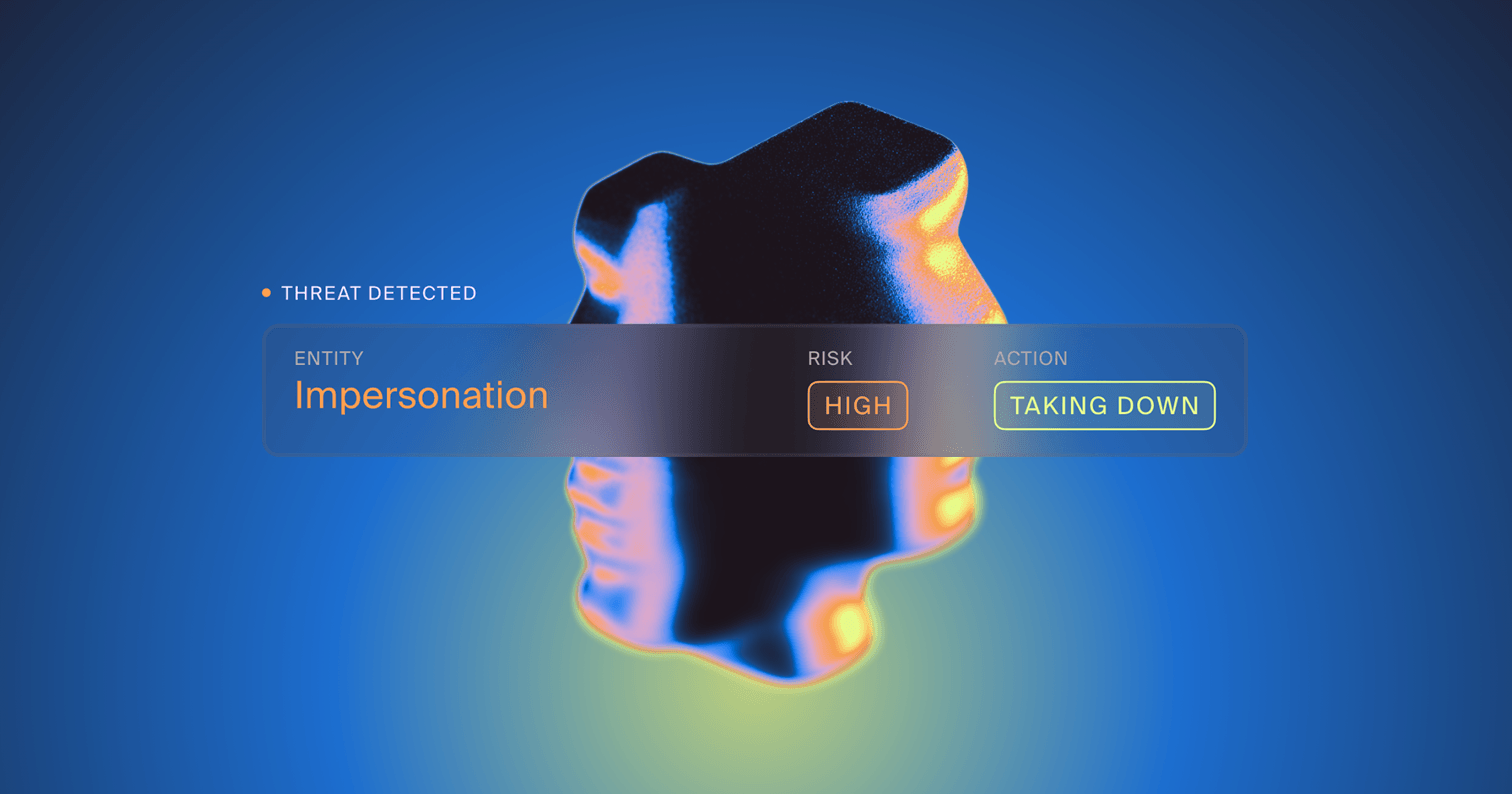
Attackers assemble lookalike domains and fake social profiles, plus spoofed voice infrastructure, before the lure lands. Intelligence without action leaves the campaign intact. The defense has to dismantle the full campaign across domains, social media, messaging apps, telco, and the dark web in a single coordinated action so the attacker loses the entire campaign infrastructure.
Legacy takedown workflows most often leave telcos out, which keeps the SMS and WhatsApp legs of a whaling campaign live even after the domain comes down.
Train the People Who Act on Executive Authority Against Live Whaling Tactics
The people most exposed to whaling are those who act on executive authority: finance teams and the assistants or helpdesk staff who process MFA resets. Training must test the exact scenarios these roles face, including deepfake voice calls and urgent wire-transfer or credential-reset pretexts, across the channels where those attacks arrive.
Threat-informed simulations built from live attack intelligence produce recognition reflexes calibrated to the exact tactics in play.
How Doppel Disrupts Whaling Attacks
Doppel is the AI-native Social Engineering Defense platform. It unifies Digital Risk Protection and Human Risk Management to defend executives and the people who act on their authority.
Doppel Executive Protection detects exposed executive PII across hundreds of data broker sites, including family member coverage, and correlates leaked credentials and impersonation accounts across the dark web and social media. The Doppel Threat Graph links related assets, such as a fake LinkedIn profile and a lookalike domain, into a single campaign view.
Doppel's agentic AI then dismantles that infrastructure by executing coordinated actions across registrars, social platforms, telcos, and ad networks simultaneously, so the attacker loses the standing campaign in one action rather than one asset at a time. Analysts focus on the complex escalations that require human judgment.
The closed loop between detection and training reduces residual risk. When the platform identifies a live threat targeting your organization, it can turn that intelligence into a multi-channel simulation with a single click.
Voice agents handle IVR menus, hold times, and line transfers to test helpdesk staff under realistic conditions, and custom voice clones of the impersonated executive test the finance teams and assistants most likely to act on their authority.
Make Your Executives Too Costly to Attack
Security leaders need to defend the executive's external footprint and the workforce's response to executive authority as a single, connected problem. When the defense dismantles impersonation infrastructure before it reaches a target and trains the people who act on executive requests against the live tactics in play, the cost of attacking a leader exceeds the return.
Request a Demo to see Doppel in action.