In healthcare, cybercriminals don’t need to exploit software vulnerabilities when they can exploit human trust. When trust breaks down in a medical network, the clinical, operational, and financial damage is catastrophic.
Healthcare institutions have traditionally built their defensive walls around a highly specific definition of cybersecurity: locking down electronic health records (EHR), enforcing endpoint security on medical devices, and pushing clinicians through generic, annual compliance videos.
But despite billions of dollars funneled into these technical parameters, healthcare data breaches reached historic crisis levels, with over 192.7 million (opens in new tab) individuals compromised in a single landmark industry breach alone.
The financial toll is equally staggering: The average cost of a healthcare data breach has hit a record-breaking $9.77 million (opens in new tab), the highest of any industry for 14 consecutive years.
Why do these multi-million dollar perimeters fail? Attackers aren’t trying to smash through the technical wall. They’re walking through the administrative front door using generative AI.
This blog will cover how threat actors weaponize the high-stakes urgency of medical workflows to deploy sophisticated, multi-channel social engineering campaigns that impersonate the very people hospitals are built to trust: patients and medical vendors.
The Social Engineering Capital of the World
Social engineering drove a 88% (opens in new tab) of material losses in healthcare cyber incidents. Average claim severity exceeded $2 million per incident, with extortion demands climbing as high as $4 million.
These numbers reflect a structural shift in cybercriminal operations. Generative AI has dropped the cost of building a highly tailored, enterprise-grade deception campaign to near zero. Attackers use automated tools to scrape clinical directories, extract public vendor relations records, and analyze hospital administration structures.
The result isn’t an obvious, poorly worded phishing email caught by a secure email gateway. Now, attacks are highly credible, multi-channel campaigns spanning email, SMS (smishing), and real-time voice cloning (vishing). They’re designed to exploit the operational cracks where technical tools have blind spots.
The Anatomy of a Healthcare Attack
How does an AI-native social engineering campaign exploit healthcare administrative security?
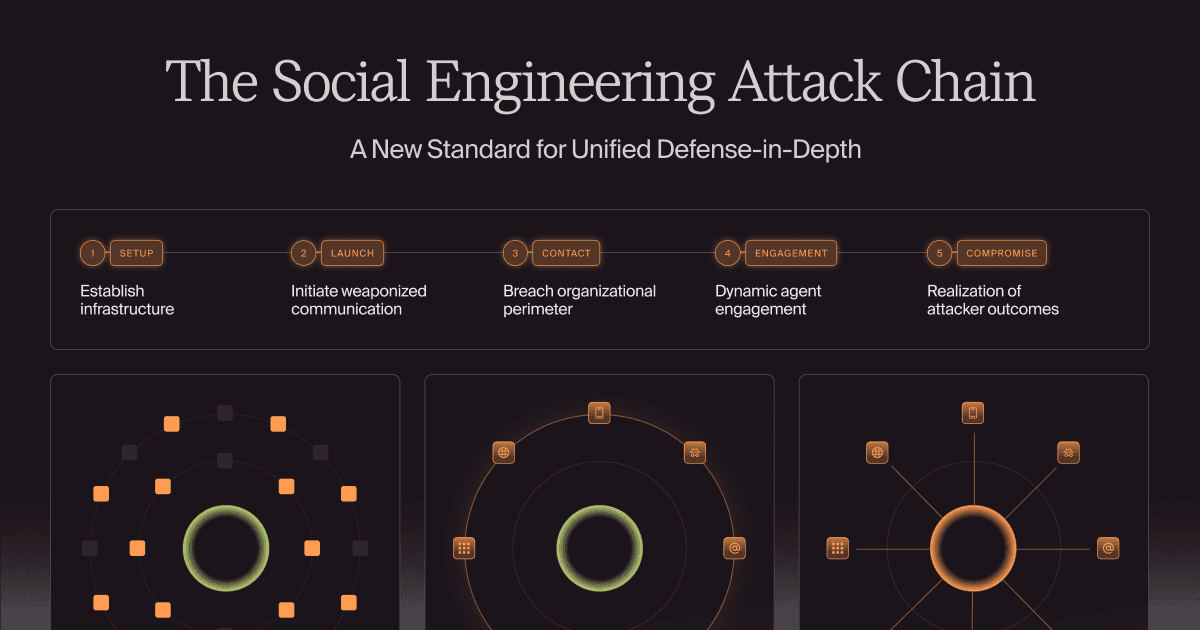
Consider three highly prevalent attack vectors that bypass standard technical controls: attacks targeting 1. patients, 2. administrative staff, and 3. the supply chain.
1. The Synthetic Patient Identity Crisis
Hospital registration desks, patient billing departments, and scheduling coordinators handle hundreds of incoming communications a day, operating under intense clinical urgency.
Attackers exploit this volume by using generative AI to spin up automated lookalike patient portals or send realistic SMS scams directly to consumers.
By tricking patients into entering their credentials on these spoofed domains, cybercriminals harvest protected health information (PHI), extract insurance numbers, and compromise legitimate user accounts before a provider even realizes their digital footprint has been cloned.
2. Deepfake Patient Impersonation
Instead of targeting the patient, this vector weaponizes customer service workflows by targeting the hospital staff directly.
Using AI voice cloning (vishing), an attacker impersonates a panicked, high-stress patient calling the clinic helpdesk, claiming they can’t log into their portal to access urgent pre-op documentation.
Eager to help and operating under extreme time pressure, the staff member overrides standard verification protocols. This single administrative concession allows attackers to bypass technical perimeters and gain direct entry into internal healthcare systems.
3. Vendor Impersonation and Payer Portals
Healthcare networks rely on a vast web of third-party vendors for software, processing, and medical supplies.
Recent breaches have highlighted the severity of this vulnerability, such as the major security compromise involving Gainwell Technologies' Husky provider portal (opens in new tab), which exposed the data of over 22,500 patients after bad actors compromised employee credentials to access interconnected payer systems.
Similarly, a breach at Cognizant's TriZetto Provider Solutions (opens in new tab) exposed sensitive data belonging to more than 3.4 million patients when unauthorized actors targeted web portals to access insurance eligibility verification transactions.
In these scenarios, attackers don’t attack the vendor directly. Instead, they create deceptive lookalike domains and impersonate billing managers or IT support representatives from a trusted vendor.
They contact the hospital’s revenue cycle or IT helpdesk, requesting an "immediate update" to payment routing details or an MFA reset for a "system migration." Because the conversation looks and sounds perfectly real, the change is approved, and millions of dollars in Medicaid or insurance payments are diverted directly into criminal accounts before anyone notices.
Why Legacy Defense Systems Fail the Human Perimeter
When faced with these multi-channel, infrastructure-heavy attacks, legacy security models break down entirely.
Traditional security tools look backward. They rely on reactive text-matching and public domain feeds, often creating massive manual queues for already overwhelmed security teams. When a threat spans across an email inbox, a text message chain, and a spoofed domain, legacy systems see three isolated, low-level anomalies rather than a single, coordinated campaign.
This technical blindness is only compounded by a human one: while software fails to connect the dots, the workforce is left equally unprepared to spot the trap. Legacy compliance training relies on topline metrics, dated simulations, and bare-bones testing. Sending a busy nurse an annual, generic simulation about a fake parcel delivery does absolutely nothing to prepare them for a clone-voiced CFO or an incredibly specific medical vendor invoice lure.
Building Measurable Resilience with HRM
Healthcare security must move away from static compliance and shift toward Human Risk Management (HRM) if they want to turn security education into an active, measurable layer of defense.
HRM redefines the human perimeter by combining advanced multi-channel simulation, next-gen security awareness training, and deep behavioral risk modeling into one continuous, intelligence-backed cycle.
A threat-informed HRM strategy builds clinical and operational resilience by focusing on three core pillars:
Traditional testing relies on generic templates that bear zero resemblance to what threat actors actually deploy. An effective HRM strategy relies on live threat intelligence to build simulations.
By taking real-world exploits observed in the wild and rapidly mirroring them in a controlled environment, organizations can train staff against the precise, hyper-personalized playbooks currently targeting the healthcare ecosystem.
2. Validating Readiness Across Every Surface
Modern deception campaigns do not respect technical boundaries. Because adversaries actively cross-hop between email, SMS, messaging apps, and deepfake voice calls, human defense testing must be equally multi-channel.
True behavioral validation requires dynamic, multi-step scenarios, such as an automated text following up on a phone call, to pressure-test whether administrative and helpdesk protocols hold up under multi-surface conditions.
But validating readiness isn’t just about testing failures. It’s equally important to measure reporting behavior. By integrating Phishing Triage, organizations can turn employee reporting into an active, machine-speed defense layer that automatically analyzes, validates, and remediates submitted threats in seconds instead of drowning the SOC in manual alert queues.
3. Risk Modeling > Click Rates
Topline click rates are vanity metrics. They treat a click from a temporary clinical contractor the same as a click from a network administrator with deep privileged access.
HRM implements context-aware risk modeling that tracks user, team, and department behaviors over time. This data-driven visibility allows security leaders to isolate structural weak spots, deliver targeted micro-coaching where exposure is highest, and reward vigilant behavior to build a self-healing security culture.
Secure Healthcare Trust at Machine Speed
Doppel HRM meets the moment when it comes to healthcare defense. With Doppel, the threats detected outside your perimeter instantly become the multi-channel, deepfake-enabled simulations your clinicians and helpdesk agents train against.
Don't wait for an AI-driven impersonation or a lookalike portal to compromise your clinical data and disrupt operations.
Schedule a demo to see how Doppel’s AI-native Human Risk Management builds lasting workforce resilience.