

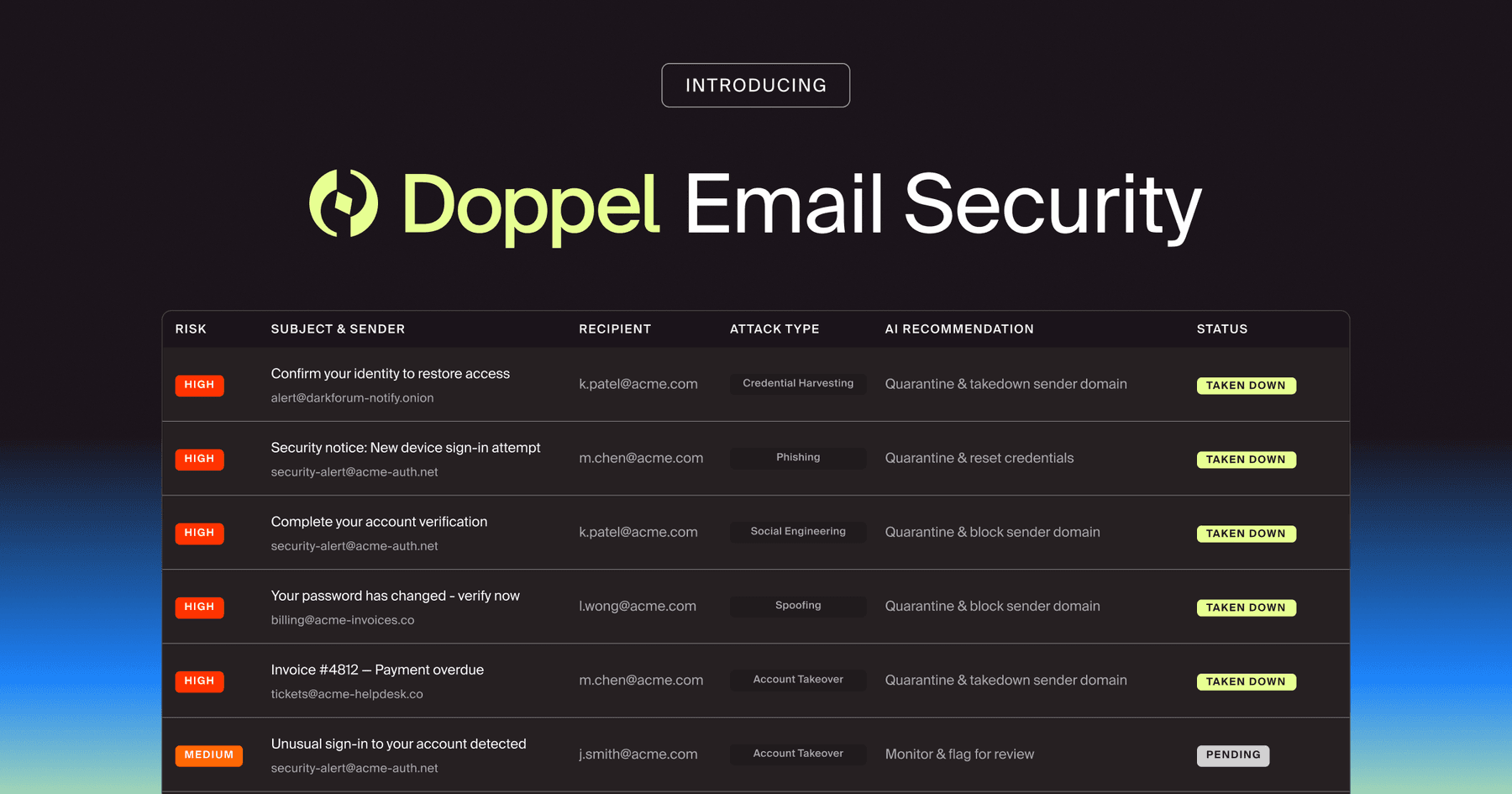
Doppel Email Security is now generally available
The agentic email security solution that empowers you to fight back against social engineering attacks. Detection isn't enough. Disruption is the difference.
Compliance training alone doesn't reduce human risk. Learn how realistic simulations reveal whether employees can stop social engineering attacks.
Security and compliance teams are under pressure to prove that training works. Completion rates look clean in a dashboard. Audit records show that employees completed the module, answered the quiz, and acknowledged the policy. But none of that proves what matters most. It does not prove that someone will challenge a suspicious request, follow verification steps, or slow down when an attacker is using urgency to force a mistake.
That gap is getting harder to ignore.
Attackers are not testing whether employees remember policy language. They are testing whether people will trust the wrong identity, approve the wrong action, or miss the warning signs inside a realistic interaction. They use email, SMS, fake domains, social platforms, voice, and help desk pretexts to manipulate human behavior at scale. A workforce can be fully compliant on paper and still be exposed in practice.
That is why compliance training and real human risk reduction are not the same thing. One shows that content was delivered. The other shows whether people can apply judgment when the request feels legitimate.
Compliance training documents coverage. Real human risk reduction measures whether people can recognize, resist, and report attacks in realistic conditions.
Organizations still need compliance training. It helps establish baseline expectations, communicate policy, and satisfy regulatory or internal requirements. But when companies treat completion as proof of resilience, they create a false sense of security. Human risk goes down only when teams can see how people behave under pressure, where attackers are most likely to succeed, and which controls actually change outcomes.
The organizations making the most progress are moving beyond static training alone. They are validating behavior with realistic simulations, role-based testing, and continuous measurement tied to the attack paths that matter most.
The difference is simple. Compliance training is about delivery and documentation. Human risk reduction is about behavior and outcomes.
Compliance training usually answers questions like these: Did employees complete the assigned module? Did they acknowledge the policy? Did they pass the quiz? Those metrics matter for governance, but they do not show whether a person can spot a deepfake callback to the help desk or recognize a fraudulent brand impersonation attempt targeting customer support.
Human risk reduction asks tougher questions. Can employees identify manipulation in context? Do they follow verification steps when the pressure is real? Do they escalate suspicious activity before damage spreads? Are high-risk teams improving over time against the same tactics attackers are already using?
That shift matters because modern attacks are built around human decisions. They target trust, urgency, convenience, and routine. A short annual training module does not reliably prepare employees for that kind of pressure.
It doesn’t reduce risk on its own because exposure lives in behavior, not participation.
Training can explain policy. It can define approved processes. It can even improve awareness. But awareness is not the same as operational resistance. Someone may know that impersonation attacks exist and still fall for one when the message appears to come from an executive, a coworker, a customer, or a trusted vendor at exactly the wrong moment.
That is especially true when attackers use channels that feel informal or urgent. A fake password reset request. A voice message that sounds familiar. A rushed DM asking for help with the account. A fraudulent domain that looks close enough to pass at a glance. These are not abstract scenarios. They are the exact kinds of human-layer attacks that slip through when organizations confuse policy acknowledgment with real preparedness.
Training also tends to flatten risk across the organization. In reality, risk is uneven. Help desk staff, customer-facing teams, trust and safety teams, finance, recruiting, and executives do not face the same threats. If everyone gets the same generic content, the people most likely to be targeted often remain the least realistically tested.
It suggests that people can perform under realistic attack conditions.
That means organizations are not just assigning content. They are pressure-testing the decisions employees make when timing, identity, and context are manipulated. They are looking at whether people follow verification workflows, whether they pause before acting, whether they escalate correctly, and whether repeated exposure improves resilience over time.
Real human risk reduction is also continuous. It is not a once-a-year event tied to a policy deadline. Threats change too quickly for that. Attackers adapt their pretexts, rotate channels, and borrow tactics from fraud, phishing, impersonation, and social engineering campaigns that are already succeeding in the wild. If a company wants a meaningful reduction, its testing and reinforcement need to keep pace.
Most importantly, real risk reduction is tied to specific attack scenarios. It does not stop at broad awareness. It gets concrete about where the business is vulnerable and how people are likely to be exploited.
They are rethinking it because completion metrics are easy to defend but hard to trust.
A compliance dashboard can show 98 percent completion and still tell you almost nothing about whether employees can handle a realistic impersonation attempt. That disconnect creates a reporting problem and a security problem. Leaders want evidence that their programs change behavior, not just that the content was delivered on time.
This is where compliance and security start to converge. Compliance teams increasingly need proof that controls are effective in practice. Security teams need to know where human decisions create openings for fraud, account compromise, or brand abuse. Both groups benefit from a model that goes beyond acknowledgments and measures what people actually do.
That is also why programs tied only to quizzes and attestation feel increasingly outdated. Attackers do not care whether the employee got 9 out of 10 questions right in a training module three months ago. They care whether that employee can be manipulated today.
They should measure real human risk through observed behavior in realistic scenarios.
That starts with scenario-based testing that reflects how attacks actually happen across the business. Instead of asking whether employees remember policy wording, organizations should test whether they can apply verification, escalation, and judgment under pressure. The right scenarios vary by role, channel, and exposure.
Organizations should test how employees respond to impersonation, urgency, authority signals, and multi-channel deception.
Simulated phishing still has value, but email-only measurement is too narrow for modern social engineering risk. Teams need broader coverage that includes text-based requests, fake customer interactions, spoofed executive outreach, suspicious domains, social platform impersonation, and support-related pretexts. The goal is not to trick people for sport. It is to understand where behavior breaks down before a real attacker gets there.
This is where content like social engineering defense naturally supports the program. If the organization already knows that attackers are exploiting trust and identity, training and measurement should reflect that reality.
Clicks are easy to count, but verification behavior is what protects the business.
A person who does not click a phishing link is not automatically low risk. A person who receives a suspicious request and independently validates identity, follows the process, and escalates quickly may be far more resilient. Strong programs track whether employees use the right controls, not just whether they avoid one obvious mistake.
This is also why teams should connect measurement to workflows like password resets, account recovery, vendor changes, payment requests, and customer communications. These are decision points where human judgment matters. They are also places where attackers routinely target operational gaps.
The most useful scenarios are the ones that mirror real attacker behavior against your people, your brand, and your workflows.
Organizations learn the most when simulations reflect the environments attackers actually exploit. That means the best tests are not generic. They are tied to the company’s communication channels, approval paths, public footprint, brand exposure, and high-risk employee groups.
Help desk and support workflows often reveal human risk quickly because attackers know those teams are trained to be helpful.
A rushed password reset request, a believable callback, or a spoofed internal escalation can reveal whether agents consistently follow verification steps. This is especially important when attackers use familiarity, urgency, or emotion to push around standard controls. A training module may explain the right process. A realistic simulation shows whether the process holds up under stress.
That makes identity verification a critical topic within compliance and human risk programs. The issue is not whether employees can define verification. It is whether they can execute it when the interaction feels legitimate.
Brand abuse creates human risk inside and outside the enterprise because attackers exploit trust in the company’s name.
Fake domains, impersonation on social platforms, fraudulent storefronts, and lookalike support channels can all influence employee decisions and customer actions. If teams are not testing how internal staff respond to brand-linked deception, they are missing a major part of the problem. Employees are often the first line of defense when suspicious external activity touches internal operations.
That is why it helps to connect human risk programs with broader brand protection efforts. External impersonation and internal decision-making are not separate problems. Attackers use one to amplify the other.
Executives and high-trust roles face a different class of social engineering risk because attackers assume their requests will move faster.
That makes executive impersonation, privilege-related requests, and urgent approvals especially important to test. Real human risk reduction means identifying where authority changes behavior. If employees skip verification when a request appears to come from leadership, the issue is not a lack of training coverage. It is a measurable operational weakness.
It improves compliance programs by showing whether control objectives hold up in realistic conditions.
Traditional compliance efforts often focus on whether a process exists, whether it was documented, and whether employees were trained on it. Threat-informed simulations and red-team-style exercises add a harder layer of validation. They ask whether the process survives contact with realistic attacker tactics. That is a more honest way to assess effectiveness.
This approach is especially valuable in human risk management because people are not static controls. They respond differently depending on workload, timing, authority, channel, and context. Red teaming brings those variables into view. It exposes where training is too abstract, where policies are not translating into action, and where specific teams need more targeted reinforcement.
It also produces stronger evidence for stakeholders. Instead of reporting that the workforce completed training, teams can report how employees performed in realistic attack scenarios, which behaviors improved, and which business processes remain exposed.
A modern program should include training, realistic simulations, role-based testing, measurement, and continuous reinforcement.
Training still matters. It creates shared language and baseline expectations. But it should not stand alone. Organizations need a model that connects knowledge to observable behavior and adjusts as threats evolve.
Different teams need different scenarios because attackers target them differently.
Customer support, trust and safety, finance, recruiting, executives, and IT all face distinct social engineering pressure points. A modern program maps scenarios to those functions so measurement reflects real exposure.
Attackers do not stay in one channel, so testing should not either.
Email-only exercises miss how deception moves across SMS, social platforms, voice, fake login pages, and support interactions. Better programs test the environments where employees actually communicate and approve work.
Reports should show behavior change and operational risk, not just completion percentages.
The most useful reporting highlights which teams are improving, where verification breaks down, which scenarios are most effective against the workforce, and what actions reduced exposure. That is the kind of reporting executives, compliance leaders, and security teams can all use.
Programs that mature in this direction often end up looking more like human risk management than traditional awareness training. That is because the objective is no longer content delivery. It is measurable resistance to manipulation.
They should stop treating completion as proof and start measuring whether people can apply judgment when it matters. Training is the foundation, not the finish line. Real reduction happens when organizations test realistic attack scenarios, measure actual behavior, and reinforce the actions that prevent fraud, impersonation, and human-driven compromise.
For teams dealing with modern social engineering threats, the question is no longer whether employees completed the module. The question is whether they can hold the line when an attacker makes the request feel real.
Doppel helps organizations pressure-test human risk where it actually lives. Across channels, identities, and attack scenarios derived from the social engineering and brand impersonation tactics already targeting modern businesses. If your program can only prove that training was assigned, it is time to measure how your people and workflows perform under real pressure.