

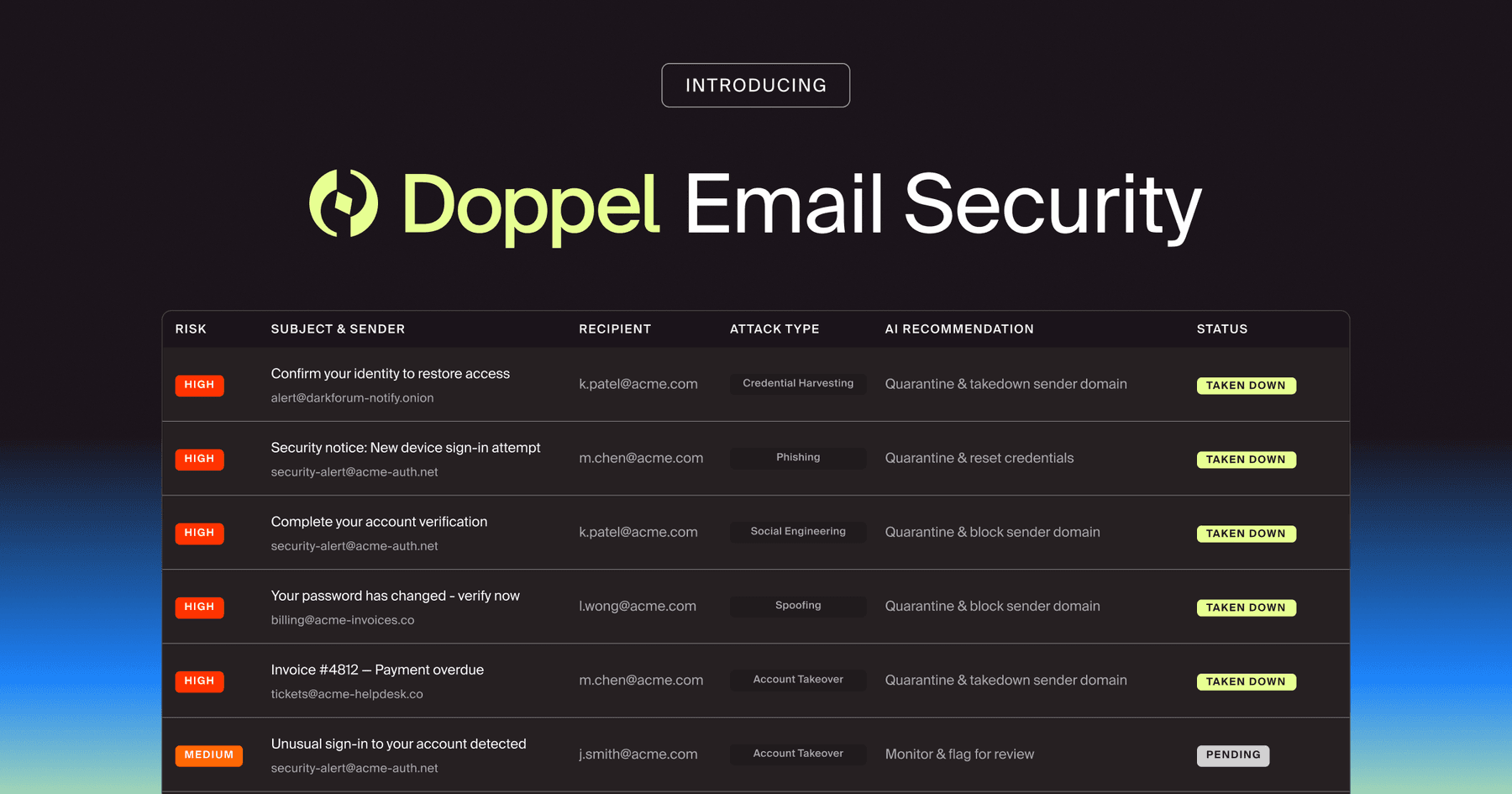
Doppel Email Security is now generally available
The agentic email security solution that empowers you to fight back against social engineering attacks. Detection isn't enough. Disruption is the difference.
Compare the true cost of stitching together DRP, HRM, and email security with a unified platform that shares context and coordinates action.

The point-solution strategy isn't irrational. Digital risk protection, human risk management, and email security are distinct disciplines, and specialized vendors can offer deep capabilities in each.
The problem appears when a collection of strong products is expected to behave like one defense. A stack can look complete on a procurement sheet and still leave analysts moving evidence between dashboards, reconciling duplicate alerts, and trying to connect activity that each tool sees only in part.
That operational work is easy to underestimate because it rarely appears in the license price. It shows up later as engineering upkeep, analyst time, slower response, and gaps between external threats, employee behavior, and inbox activity.
The real comparison isn't point solution versus platform in the abstract. It's the total cost and defensive value of a fragmented stack versus a system in which signals can change what other controls do.
The hidden costs tend to accumulate in four places:
None of these costs mean a point solution is bad. They mean the architecture needs to account for the labor and delay required to make separate products operate together.
Consider a campaign that begins with a lookalike domain and a fake executive profile. The attacker uses that infrastructure to send a targeted email, then moves the conversation to a messaging app or voice call.
In a fragmented stack, the DRP tool may flag the domain and create one ticket. The email gateway may catch a message days later and create another. The HRM platform may continue running a generic simulation that has nothing to do with the campaign unfolding against the organization.
Each product may be doing its assigned job. The failure is in the handoffs.
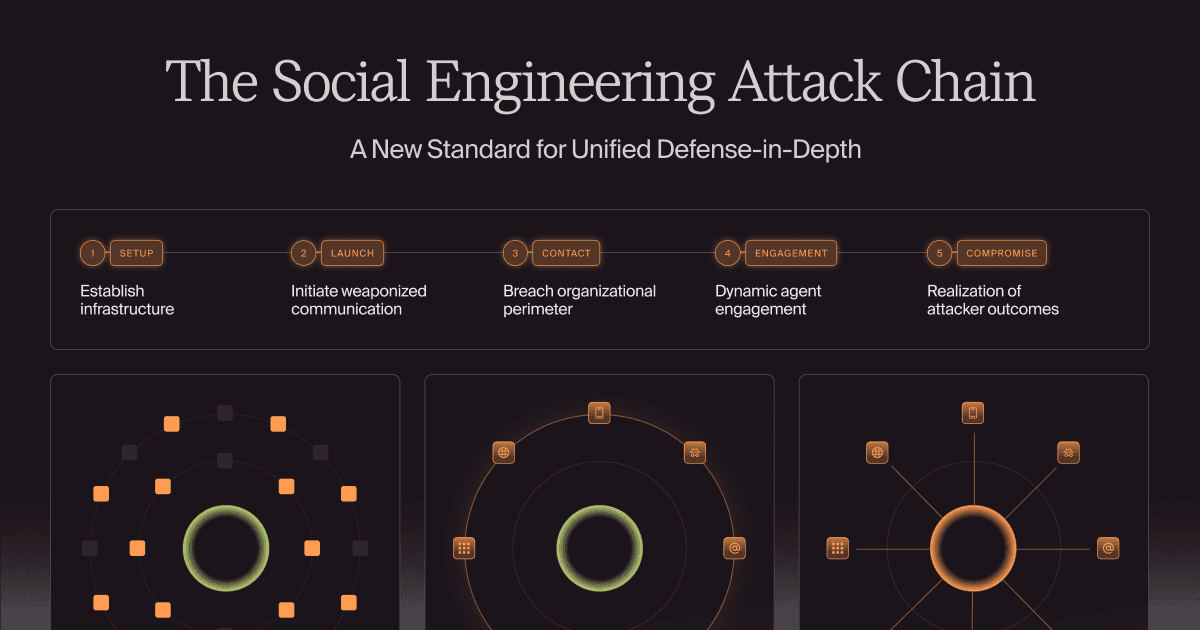
The social engineering attack chain crosses channels and control categories by design. When the systems don't share campaign context, the security team becomes the integration layer. Analysts copy indicators, compare timestamps, open additional consoles, and decide which tools need to act.
That delay gives the attacker room to reuse infrastructure, vary the lure, and approach more people before the organization sees one coordinated operation.
Feature checklists are useful, but they don't reveal how much work a security team will have to perform between products. Buyers should evaluate the operating model with questions such as:
A platform earns the label only when the connections change the outcome. Putting three products behind one login is consolidation. Sharing intelligence and coordinating action is integration.
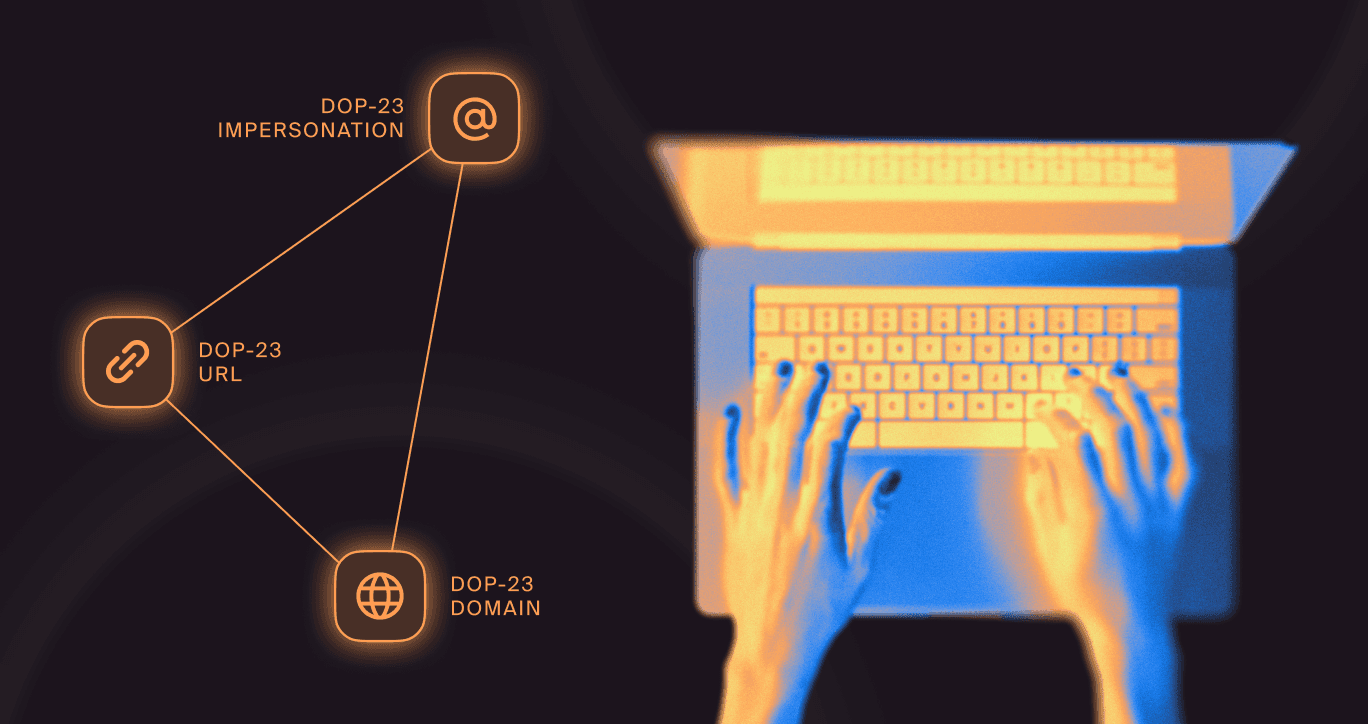
Doppel's social engineering defense platform connects digital risk protection, human risk management, and email security through the Doppel 360° Layer. The Doppel Threat Graph gives those capabilities shared campaign context rather than leaving domains, profiles, messages, and employee behavior as isolated artifacts.
That shared context creates practical feedback loops. A live impersonation or lookalike domain found through Digital Risk Protection can inform a targeted simulation. An employee report can strengthen phishing detection and reveal related messages. Email headers can expose infrastructure that should be mapped and disrupted outside the inbox.
One signal sharpens the next defense. The goal isn't merely to reduce the number of consoles. It's to shorten the path from detection to understanding to action.
The platform is designed around that operating model: Connect signals at the campaign level, automate repeatable triage and response, and preserve human oversight for the decisions that need it.
Platform consolidation isn't automatically the right decision for every organization. A highly mature team may need specialized depth for a narrow threat vector. A regulated environment may have a control that can't be replaced easily. An existing point product may be tightly integrated enough that switching would create more near-term risk than value.
The tradeoff should be explicit. Keeping separate tools means accepting responsibility for the connective layer: integrations, data normalization, correlation, workflow ownership, and unified reporting.
For some teams, that control is worth the effort. For others, the maintenance burden and slower cross-channel response outweigh the benefit of specialization. The right answer depends on the team's maturity, attack surface, and ability to keep the handoffs working under pressure.
When evaluating a platform, ask one question that feature grids often miss: Can a signal discovered in one control automatically change what another control does, without an analyst moving the data between them?
If the answer depends on a future integration, a custom script, or a manual export, the buyer is still purchasing the connective work. That may be acceptable, but it belongs in the cost model.
Attackers coordinate domains, identities, messages, and conversations as one campaign. Defenses should be judged by how well they coordinate across the same chain. The strongest platform isn't the one with the longest feature list. It's the one that helps the team see the operation sooner and act before the gaps become the attacker's advantage.
Doppel connects DRP, HRM, and email security in an agentic AI-native social engineering defense platform. See how by requesting a demo.
BLOG
Modern social engineering is a relentless, AI-orchestrated lifecycle. Learn how to map the five-stage attack chain—from setup to contact—and why a unified defense platform is the only way to outpace AI-driven social engineering attacks.



by Bobby Ford, Rahul Madduluri, and Alvin Lin

BLOG
As attackers leverage AI to deceive at unprecedented speed, Doppel’s evolved brand embodies our commitment to outpace what’s next. It brings sharper focus, energy, and clarity to how we protect organizations from social engineering.

by Gina Jee