Digital Risk Protection: A Framework for Detecting and Dismantling External Threats
Attackers reach your customers and executives through infrastructure that lives outside your perimeter. Spoofed domains pull payment details from customers searching for your brand. Lookalike social profiles run scams in your CEO's name. Deepfaked executives authorize wire transfers on video calls. Leaked credentials on the dark web lead to account takeovers weeks before anyone in your SOC detects a signal. None of it triggers an EDR alert or appears in a SIEM dashboard.
Digital risk protection (DRP) defends those external surfaces directly, where $16.6 billion (opens in new tab) in cybercrime losses were reported in 2024. This guide walks through what DRP is, the threats it addresses, how to build a program, and what operational execution looks like.
Key Takeaways
- Attackers can reach your customers and executives without triggering EDR, SIEM, or email security.
- Generative AI has expanded the threat surface, making brand impersonation, executive deepfakes, phishing, and smishing attacks easier and cheaper to execute.
- DRP programs run a five-stage lifecycle: detect, correlate, prioritize, takedown the entire campaign in one motion, and dismantle the connected attacker infrastructure.
- When evaluating DRP platforms, look for multi-channel detection, AI-driven correlation, automated takedown workflows, configurable detection logic, and dedicated operational support.
What Is Digital Risk Protection?
Digital risk protection (DRP) is the set of technologies, workflows, and operational practices security teams use to identify, correlate, and dismantle threats targeting their organization's external footprint. That footprint spans social platforms, paid ad networks, mobile app stores, telco channels, code repositories, the dark web, and the open internet.
DRP exists because the security perimeter has dissolved as brands now operate across dozens of channels they don't own. Executives have public personas that attackers can clone. Customers transact through apps and links delivered over channels you don't see. DRP provides security teams with visibility and enforcement across those surfaces.
Why Digital Risk Protection Is Important
The cost of ignoring external threats has moved beyond reputational damage into direct financial and operational loss. The average cost of a data breach in the United States surged 9% to USD 10.22 million (opens in new tab), and 86% of breached organizations experienced operational disruptions, including the inability to process orders, deliver customer service, or maintain production lines.
A well-run DRP program offsets that cost across five concrete dimensions:
- Customer trust and revenue protection. Impersonation campaigns can convert your brand equity into attacker revenue. Every day, a fake checkout page or counterfeit app stays live; customers transact with the attacker instead of you; and the chargebacks, refunds, and churn land on your balance sheet.
- Executive and employee safety. Deepfaked executives, cloned social profiles, and targeted smishing campaigns put named individuals at risk of fraud, extortion, and reputational harm. DRP extends protection to the people attackers single out, not just the systems they sit behind.
- Faster response to emerging threats. Continuous monitoring of domains, social platforms, app stores, telco channels, and the dark web compresses the window between an attacker standing up infrastructure and your team neutralizing it, often from weeks to hours.
- Regulatory and board-level accountability. Frameworks like DORA, NIS2, and CIRCIA increasingly expect organizations to manage third-party and brand-abuse risk, and boards expect security leaders to report on external exposure with the same rigor as internal controls.
- Cost efficiency at scale. Manually hunting impersonations across dozens of channels does not scale. A DRP program consolidates detection, correlation, and takedown into one workflow, so analyst hours go toward strategic work rather than chasing individual assets.
Without DRP, the first signal of an external attack is usually the harm itself. With it, security teams move from reactive cleanup to proactive dismantlement.
How Digital Risk Protection Works
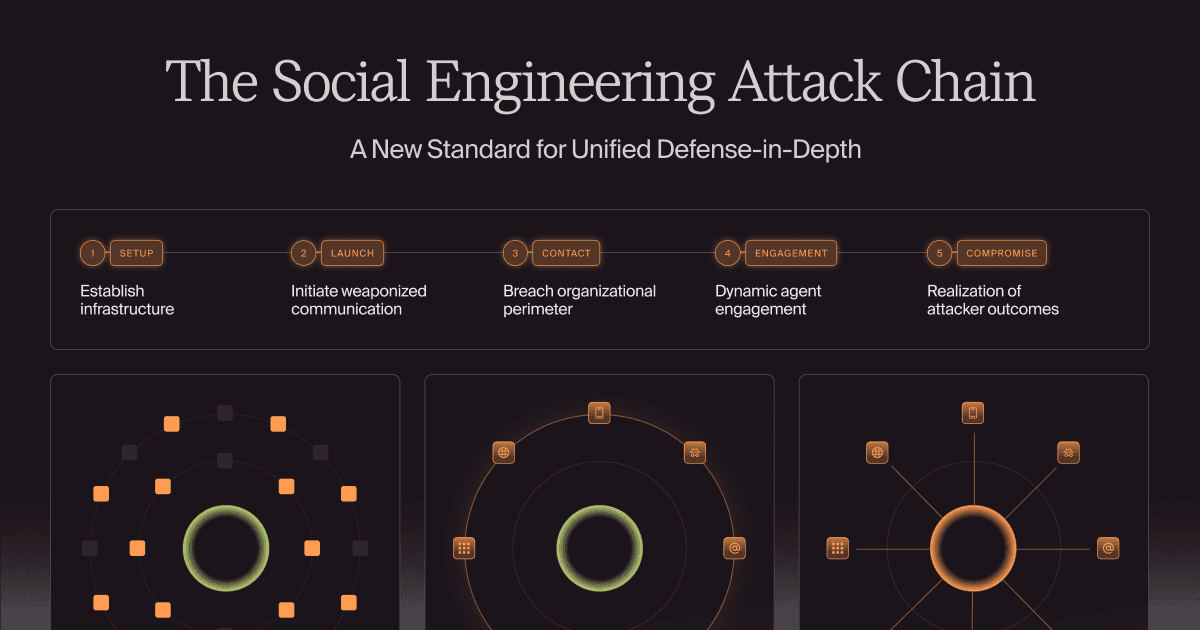
DRP programs run a five-stage lifecycle across every channel they cover, moving from detection through coordinated takedown in a single motion:
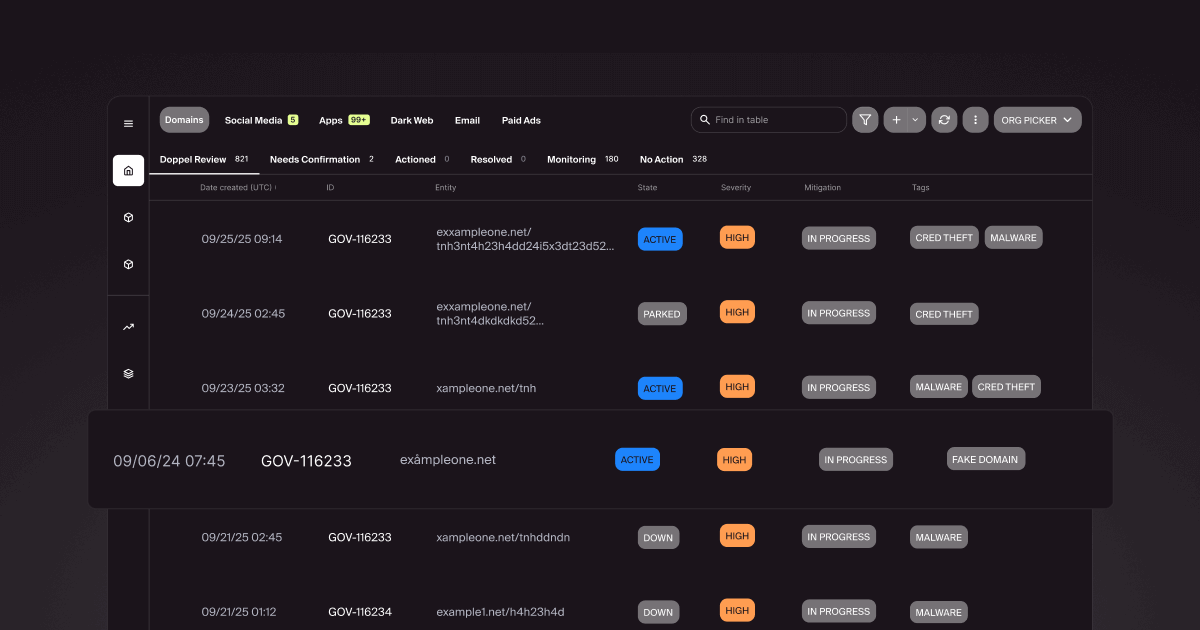
- Detect impersonation across the external surface. The platform continuously crawls domains, social profiles, paid ads, app stores, dark web forums, telco channels, and code repositories, using brand and logo detection, reverse image analysis, and OCR to surface matching assets.
- Correlate signals into campaigns. A single fraudulent domain is rarely the whole campaign. DRP platforms map connected infrastructure, including linked telco numbers, ad campaigns, social profiles, and dark web mentions tied to the same actor.
- Prioritize assets that show malicious state changes. Most permutations of a brand's assets are dormant when first discovered. A per-channel rubric surfaces only the assets that have become active, so analysts are not drowned out by noise.
- Take down the campaign in one motion. Coordinated kill switches fire across every connected provider simultaneously, including registrars, social platforms, ad networks, telcos, and app stores, so the domain, social, ad, telco, and app legs of the campaign all go dark together.
- Dismantle the persistent infrastructure to prevent rebuild. Go upstream to remove the registrar accounts, hosts, recycled telco numbers, and threat actor identifiers that the threat actor can use to reconstitute the campaign, raising the cost of rebuilding until the attacker moves on.
Run end-to-end, this lifecycle turns scattered external signals into dismantled campaigns, so the same motion that finds attacker infrastructure also takes it down and prevents its return.
The External Threats That DRP Addresses
The DRP threat surface has expanded sharply over the past few years, driven by generative AI, deepfake-as-a-service tooling, and the ease of standing up convincing imposter infrastructure at scale. Six categories now define it:
1. Brand Impersonation
Attackers set up fake social accounts, fraudulent paid ads, counterfeit domains, and lookalike mobile apps to exploit your brand's reputation. The goal of brand impersonation is to deceive customers into handing over credentials, payments, or personal data. Generative AI has lowered the cost of producing convincing collateral, so a single threat actor can run impersonation campaigns across multiple channels in parallel.
2. Executive Impersonation and Deepfake Fraud
Cybercriminals can impersonate senior executives and board members to authorize fraudulent transfers, extract sensitive data, or run social engineering against employees and customers. AI-powered deepfakes have changed the economics here, with a single deepfake video call resulting in a $25 million wire fraud (opens in new tab) against the engineering firm Arup.
3. Phishing, Smishing, and Vishing
Phishing (email), smishing (SMS), and vishing (voice) attacks are popular delivery mechanisms for credential theft and fraud. The infrastructure behind them, including registered domains, telco numbers, hosting, and cloned login pages, sits on external surfaces that a DRP platform can detect and dismantle before the lure reaches an inbox or a phone. Anti-phishing software catches these campaigns at the infrastructure layer rather than the inbox.
4. Dark Web Exposure
Stolen credentials, leaked customer data, intellectual property, and insider chatter can move through dark web forums and marketplaces well before they're operationalized. Continuous monitoring of these surfaces gives security teams a window between exposure and exploitation.
5. Fraudulent Mobile Apps and Counterfeit Domains
Lookalike mobile apps in third-party app stores, sideloaded packages, and typo-squatted domains funnel customers into credential harvesting and malware. Detection has to span the long tail of regional app stores and registrars, not just the major platforms.
6. Supply Chain and Third-Party Impersonation
Attackers increasingly impersonate vendors, partners, and service providers in the supply chain through fake invoice domains, spoofed partner portals, and lookalike vendor social accounts to slip into trusted workflows. The share of breaches involving a third party has doubled to 30% (opens in new tab), driven in part by zero-day exploits in vendor software and software supply chain compromises affecting downstream organizations.
Other surfaces, including counterfeit goods listings, code repo leaks, and crypto and NFT impersonation, round out the picture and are folded into a mature DRP program once the core six are covered.
How DRP Differs from Traditional Cybersecurity
Traditional cybersecurity, including EDR, SIEM, firewalls, and IAM, defends what your organization owns and operates. DRP defends against what attackers can stand up to impersonate you. The two are complementary, not redundant:
- EDR and XDR watch endpoints for malicious behavior. DRP watches external infrastructure for impersonation behavior.
- SIEM and SOAR correlate internal telemetry. DRP correlates external attacker signals into campaigns.
- Email security filters phishing content reaching your inboxes. DRP dismantles the phishing infrastructure before messages get sent.
DRP shifts detection upstream, but if your stack only watches inward, the first signal of an external attack is usually a customer complaint or a wire transfer that has already cleared.
Why DRP Belongs in Your Security Stack
The argument for DRP is that your existing stack has a structural blind spot, and the threats moving through it are the ones reaching your customers and executives.
- External attack surface visibility. DRP gives security teams the same monitoring discipline for external surfaces, including impersonation infrastructure, lookalike domains, and dark web exposure, that they already apply to internal ones.
- Reduced dwell time on impersonation infrastructure. Once a threat actor stands up an impersonation campaign, every additional day live is more customer fraud, more credential theft, more brand damage. Detection-and-takedown workflows compress the window from weeks to hours.
- Protection for people outside the perimeter. Your customers, partners, and executives are targeted on channels you don't own. DRP defends them on those channels where internal controls cannot reach.
- Regulatory expectation alignment. DORA, NIS2, and CIRCIA extend cybersecurity risk management obligations to third-party exposure and brand abuse. DRP supplies the visibility regulators increasingly assume you have.
Each of these gaps maps to a specific category of harm that a traditional stack will not catch in time, which is why DRP has moved from an optional add-on to a core layer of the security program.
How to Build a Digital Risk Protection Program
Building a DRP program is a sequence, not a tool purchase. The steps below give security teams a clean path from zero to operational coverage:
- Map your external attack surface. Catalog every brand, sub-brand, executive, domain, and channel where your organization has a legitimate presence, along with the surfaces attackers are most likely to mimic.
- Define scope and priority. Decide which surfaces require active enforcement (auto-takedown), which require human review, and which are monitored only. The scope shapes everything downstream.
- Set platform selection criteria. Build a buyer-facing rubric that ties required capabilities to the surfaces in scope before evaluating vendors.
- Integrate with the existing stack. Connect DRP detections to your SOC workflow across ticketing, SOAR, and SIEM, so external alerts route the same way as internal ones.
- Define playbooks. Decide in advance what happens when a typo-squat goes live, when an executive deepfake surfaces, or when leaked credentials appear on a forum. Codify the response.
- Measure and adapt. Track time-to-detection, time-to-takedown, and reduction in repeat infrastructure. Tune the per-channel rubric as detection coverage matures.
A program built this way scales from a single brand to a global portfolio without the workflow breaking.
The capabilities below separate platforms that dismantle attacker infrastructure from platforms that only surface alerts:
- Multi-channel detection. Coverage across social, paid ads, domains, mobile app stores, telco, dark web, code repositories, and crypto surfaces, not just a subset.
- AI-driven correlation. The platform should map connected infrastructure into campaigns, not deliver one-off alerts.
- Automated takedown workflows. Direct provider integrations with registrars, social platforms, ad networks, telcos, and app stores, with the option to auto-submit on tuned categories.
- Dark web and deep web coverage. Continuous monitoring across forums, marketplaces, and paste sites.
- Executive and family protection. Coverage that treats individuals as monitored assets, including PII removal from data brokers.
- Configurable detection logic. A per-customer, per-channel rubric you can tune from manual review to autonomous handling as coverage matures.
- Workflow and SOC integrations. Clean handoffs into your existing ticketing, SOAR, and SIEM stack.
- Operational support. Solutions architects, SOC analyst coverage, and provider-relationship teams that carry the operational depth so your team doesn't run the platform alone.
If a platform misses two or three of these, the missing capabilities show up as either coverage holes or analyst overhead within the first quarter of deployment.
How to Operationalize DRP with Doppel
Doppel is the AI-native platform for Social Engineering Defense that unifies Digital Risk Protection and Human Risk Management on a single intelligence layer. It runs the full lifecycle end-to-end, from detection through dismantlement:
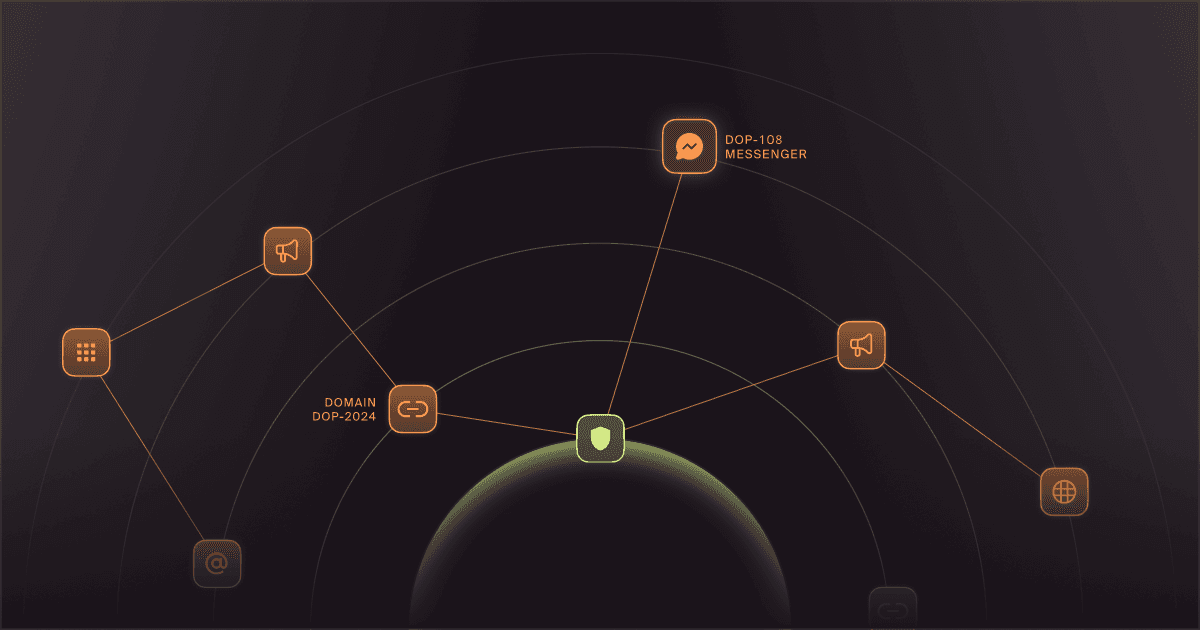
- The Threat Graph maps every connected piece of attacker infrastructure tied to a single campaign, including linked telco numbers, WhatsApp accounts, social profiles, ad campaigns, and dark web mentions. A takedown action removes the entire campaign in one motion, not one asset at a time.
- The detection rubric is built collaboratively at onboarding and tuned per channel category. Customers progress from a noisy initial state, where most alerts require human confirmation, to a tuned end state, where entire categories such as paid ads, telco impersonation, and lookalike domains are handled autonomously.
- Kill switches push takedown requests through direct provider APIs across registrars, social platforms, ad networks, telcos, and app stores simultaneously. Telco coverage matters in particular: a domain takedown that ignores the WhatsApp and SMS legs of a campaign leaves it live.
- Executive Protection treats every protected individual as a monitored asset, with continuous data broker removal, social platform impersonation detection, and family coverage extending up to five members per executive by default.
- Dedicated Solutions Architects bring operational depth across rubric tuning, workflow integration, takedown escalation, and threat-actor analysis, so your security team can focus on strategic oversight rather than tactical firefighting.
The combined effect: Campaigns are dismantled rather than detected, and the cost of rebuilding pushes threat actors away from your brand entirely.
Get Ahead of External Threats
External impersonation infrastructure compounds your blind spot until it results in fraud, a breach, or reputational damage. A DRP program puts security teams ahead of the curve and replaces alert-only platforms that leave attacker infrastructure up and running.
The shift that matters is from detect-and-alert to detect-and-dismantle. A DRP platform that surfaces alerts without removing the underlying infrastructure forces analysts to chase assets one at a time, while the campaign continues to reach customers. The longer that infrastructure stays live, the more fraud, credential theft, and brand damage stack up.
Doppel runs detection, correlation, and dismantlement on a single intelligence layer, so attacker infrastructure is removed at the campaign level rather than asset by asset.
Request a demo to see how Doppel dismantles the social engineering campaigns targeting your brand, executives, and customers.
Frequently Asked Questions About Digital Risk Protection
What Is Digital Risk Protection?
Digital risk protection is the practice of detecting, correlating, and dismantling threats targeting an organization's external footprint across social platforms, domains, mobile app stores, telco channels, and the dark web.
How Does DRP Differ From Traditional Cybersecurity?
Traditional cybersecurity defends internal systems and endpoints. DRP defends the external surfaces attackers use to reach your customers, executives, and brand.
What Are the Four Types of Digital Risk?
The four core types are cybersecurity risk (breaches, malware, credential theft), reputational risk (brand impersonation and fraud), compliance risk (regulatory exposure from data leaks), and third-party risk (vendor and supply chain impersonation).
What Are the Major Components of Digital Risk Protection?
The major components are detection across external surfaces, correlation of attacker infrastructure into campaigns, prioritization based on a per-channel rubric, and takedown enforcement through provider integrations.
The major components are detection across external surfaces, correlation of attacker infrastructure with campaigns, prioritization based on a per-channel rubric, coordinated campaign-level takedown, and dismantling the persistent upstream infrastructure that enables attackers to rebuild.