
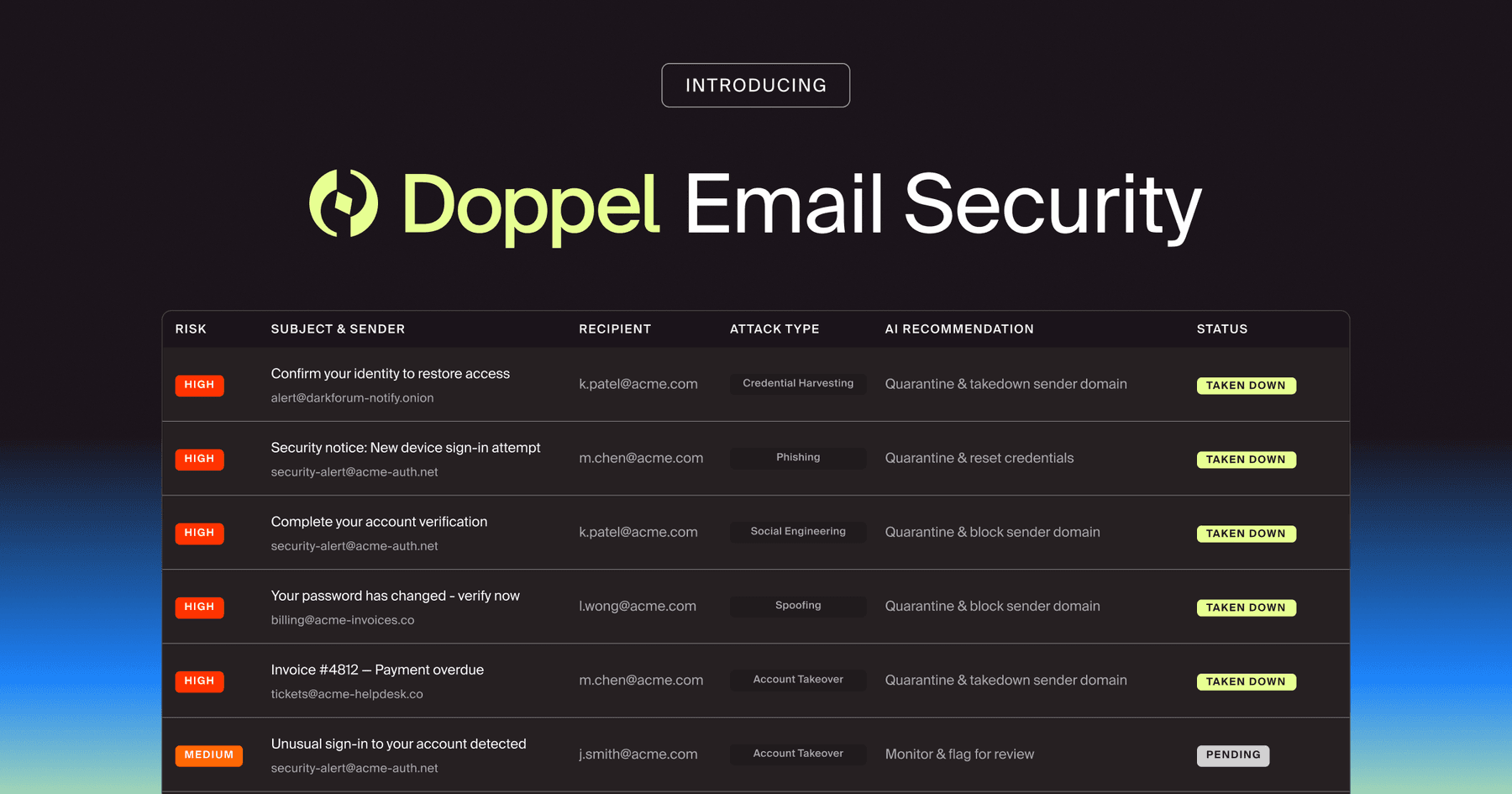
Doppel Email Security is now generally available
The agentic email security solution that empowers you to fight back against social engineering attacks. Detection isn't enough. Disruption is the difference.
Supply chain complexity is a top barrier to operational resilience. Learn how attackers use lookalike domains for invoice fraud and how a social engineering defense platform, like Doppel, stops them.

Picture your accounts payable team on the last Friday of the quarter frantically clearing a massive backlog of complex, fast-moving global procurement transactions. The pressure is on to finalize the books, ensure raw materials are paid for, and keep the factory lines moving without disruption.
Amidst the chaos, an email lands in the queue from your primary microchip supplier. It casually mentions a sudden update to their wire transfer instructions for an upcoming $2 million payment.
The email signature is flawless, the invoice number perfectly matches your internal procurement system, and the domain looks completely legitimate at a quick glance. There are no glaring spelling errors, and the tone matches previous communications perfectly.
So, the AP specialist updates the routing number in the vendor management system and hits send.
Your operational technology (OT) (opens in new tab) network wasn’t breached, no malware was downloaded, and the firewall held up perfectly. But you just funded a cybercriminal's early retirement.
Manufacturers and global enterprises have to stop relying solely on busy AP teams to spot lookalike domains. You have to start continuously monitoring your external vendor ecosystems before the email even arrives.
When industry leaders talk about supply chain security, the conversation usually revolves around protecting physical logistics, securing factory floor endpoints, or ensuring third-party software doesn't contain malicious code.
But attackers know the absolute easiest way to disrupt a supply chain is to target the money moving through it. Why spend months trying to hack a hardened industrial control system when you can simply ask the finance department to wire you the money directly?
The financial impact of this tactic is staggering. According to the FBI's 2025 Internet Crime Report (opens in new tab), business email compromise (BEC) resulted in a massive $3.04 billion in reported losses across 24,768 complaints last year.
For U.S.-based companies, roughly 86% of BEC funds move specifically via wire transfer or ACH. This means these attacks are landing directly inside real, high-value financial workflows.
A specialized subset known as vendor email compromise (VEC) (opens in new tab) has surged. Attackers have completely evolved past sending generic phishing blasts and now execute highly targeted, intelligence-driven operations:
Global manufacturing relies on sprawling, heavily interconnected networks of third-party vendors. This massive web of dependencies makes supply chain complexity one of the top barriers to operational resilience.
Attackers explicitly weaponize this complexity and the cognitive overload it creates for your staff.
An average enterprise AP team processes hundreds of invoices a week. They’re constantly dealing with different international currencies, shifting payment terms, customs delays, and constant communication from dozens of different suppliers across multiple time zones.
Fraudsters know that in a battle between security and business velocity, the AP department will almost always choose speed. If your procurement teams have to pause and manually verify every single routing number change by calling an international vendor, the entire supply chain grinds to an absolute halt.
The attacker is counting on the AP clerk being too busy, too stressed, or too focused on closing out the week to notice that the email came from a slightly altered domain. They rely on the sheer volume of legitimate transactions to camouflage their fraudulent one.
Most organizations believe their current security stack protects them from VEC. They have a secure email gateway (SEG) (opens in new tab) in place, they require multi-factor authentication (MFA) (opens in new tab) for internal logins, and they occasionally run phishing simulations for the finance team.
The problem is that VEC attacks often bypass these controls entirely.
If an attacker registers a brand-new lookalike domain, configures the proper email authentication protocols for that fake domain, and sends a plain-text email with no malicious attachments, your email gateway will likely let it through. To the gateway, it looks like a perfectly valid email from a newly registered business.
You can’t force your external vendors to adopt strict security standards. Even if your internal security is flawless, you can’t control whether your supplier's email accounts are compromised. If an attacker breaches the supplier and sends a fraudulent invoice from their actual email account, your defenses won't catch it.
If your primary defense against a multi-million dollar VEC attack is hoping a tired employee spots a subtle typo on a Friday afternoon, your financial perimeter is exposed.
Here’s how the legacy approach stacks up against modern, agentic security:
Defensive capability | Legacy procurement security | Full ecosystem defense |
Threat detection | Relying on AP clerks to manually spot subtle typos in email addresses or invoice PDFs | Continuous AI monitoring of domain registrars for spoofed suppliers and lookalike infrastructure |
Verification speed | Manual phone calls to vendors to verify routing numbers, severely slowing down supply chain velocity | Automated detection that neutralizes threats at the source, allowing AP teams to operate without friction |
Remediation strategy | Updating static gateway blocklists days after a fraudulent payment is reported by a vendor | Machine-speed API takedowns of the attacker's external staging infrastructure before the lure is sent |
Visibility scope | Monitoring only the internal corporate network and the immediate email inbox | Mapping and protecting the broader vendor ecosystem across the open web and external channels |
Doppel goes on the offensive. The agentic AI-native platform continuously monitors the open web, domain registrars, and DNS records. We actively monitor your corporate vendor ecosystem for unauthorized domain transfers or typosquatted versions of your trusted suppliers.
Here’s how Doppel shuts down financial fraud before your payment cycles even run:
An attacker doesn’t need to hack your robotics controllers or breach your secured OT network if they can just trick your finance team into handing over the cash.
As global supply chains grow increasingly complex and fast-paced, threat actors will continue to exploit the seams between organizations. They’ll weaponize trust, leverage lookalike domains, and use the sheer volume of global procurement to hide their multi-million dollar heists.
Operational resilience requires protecting the financial supply chain just as fiercely as the physical one.
Right now, take the burden of threat detection off your accounts payable team. Actively monitoring your vendor ecosystem and executing automated takedowns against attacker infrastructure shuts down invoice fraud before it starts.
Stop vendor email compromise and secure your global vendor ecosystem. See how Doppel monitors lookalike domains and shuts down financial fraud at the source.