Conventional wisdom states that if the alert queue is too long, you just need to hire more Tier-1 analysts to clear the backlog. It's a comforting thought, suggesting that with a slightly larger budget and a few more resumes, an organization can finally get ahead of the threat landscape.
But here’s the reality: In 2026, you're no longer fighting a slow, methodical human adversary who manually crafts single phishing lures. You're fighting autonomous machines.
When an attacker uses artificial intelligence to spin up 500 unique, contextually accurate variants of a social engineering campaign in seconds, throwing human headcount at the problem becomes mathematically unwinnable.
Human scaling is strictly linear: If you hire one analyst, you get one analyst's worth of output. Adversary automation, by contrast, is virtually infinite.
Security leaders face a harsh operational truth. If your defense relies on a human manually clicking through a shared abuse inbox to determine which alerts matter, you’ve already lost the race. You can’t hire your way out of an infinite automation attack.
The only way to survive is to replace manual triage with autonomous AI agents that fight at machine speed.
The broken math of alert fatigue and turnover
Look at the raw numbers defining a SOC today. The volume of incoming threats has reached a critical mass, creating a catastrophic structural failure known as alert fatigue.
A typical SOC processes an average of 3,832 alerts per day (opens in new tab), according to Cyber Sierra, and Secure.com (opens in new tab) notes that individual analysts are expected to manually evaluate up to 174 alerts in a single shift.
No human team can meaningfully investigate that volume of data, so a massive portion of the queue is completely ignored because the sheer volume makes it impossible to address.
To make matters worse, the alerts that do manage to get reviewed are overwhelmingly benign. Studies consistently show that 50% to 80% of alerts are false positives. Your highly compensated security professionals spend grueling shifts manually verifying legitimate marketing emails, forgotten password resets, and benign internal human resources communications.
The human toll of this incredibly broken workflow is devastating to the industry. The Tines Voice of the SOC Analyst report (opens in new tab) found that 71% of analysts experience some level of burnout. The same report notes that 64% say they are likely to switch jobs in the next year.
You're bleeding exceptional talent because you're treating brilliant engineers like human spam filters.
Consider the hidden costs of this churn cycle: A security operations manager will spend three to six months recruiting, hiring, and onboarding a new Tier-1 analyst, only for that analyst to burn out and resign nine months later because the work is repetitive and soul-crushing. You're permanently stuck in a training loop while your mean time to acknowledge (MTTA) and mean time to remediate (MTTR) (opens in new tab) continue to balloon out of control, resulting in constant service level agreement (SLA) breaches.
When a critical alert fires amid hundreds of daily alerts, it doesn't arrive with a spotlight and a siren. It arrives as alert number 437 of the day, formatted exactly like all the benign noise that came before it.
Friction of the swivel-chair effect
Even when an analyst finds a genuine threat, manual triage is painfully slow and deeply fragmented.
When a suspicious email drops into the abuse inbox, the analyst can't simply read the message and decide. They suffer from the swivel-chair effect, forced to constantly pivot between five to seven disconnected security consoles just to piece together the context of a single alert.
They start in the ticketing dashboard. Then they pivot to the corporate SIEM to check for related network traffic. They jump over to an endpoint detection platform to investigate anomalous behavior. They open an open-source threat intelligence feed to manually check the sender's domain reputation. They might log into a sandbox to detonate a suspicious file. Finally, they log into the email gateway to block it.
This manual context switching destroys productivity. It turns what should be an instantaneous decision into a grueling 15-minute investigation.
Meanwhile, the attacker isn't waiting. While your analyst is busy jumping between tabs to verify one phishing lure, the adversary's automated script has already delivered hundreds of other variants to the rest of your organization.
Inside a 500-variant attack
The adversaries targeting your organization understand exactly how your manual triage process works. They know your Tier-1 analysts are exhausted, overwhelmed, and completely buried under a massive backlog of tickets. They use this exact dynamic against you by deploying infinite automation to flood the zone with evasion tactics specifically designed to break legacy filters.
In the past, an attacker would craft a single, highly persuasive phishing lure and send it to your entire company. Today, threat actors use generative AI to completely automate the attack lifecycle. They feed your corporate hierarchy into an LLM and instruct the system to generate five hundred distinct, hyper-personalized lures.
But these aren't copy-and-paste jobs. The automated system uses dynamic semantic perturbation. It constantly alters the language, tone, and sentence structure of every single email to ensure that natural language processing keyword filters cannot detect a pattern.
The AI also employs dynamic image-based phishing techniques. Instead of placing a malicious link in the body of the text, the automated system renders the text and the link into a scalable vector graphic (SVG) or an embedded image. This completely blinds legacy text parsers, letting the malicious payload slip past your email security gateway.
The attacker ensures that every single variant uses a unique routing path. They program the automated system to generate unique zero-reputation redirect chains and custom QR codes for every individual recipient.
Even if your analyst manages to manually trace and block one specific redirect chain, the other four hundred and ninety-nine variants remain completely unaffected.
If your defense strategy relies on manual review, this automated onslaught immediately breaks your security posture.
The cost for the attacker to scale their operation is virtually zero, while the cost for you to scale your human defense is astronomical. You're bringing a manual shovel to an avalanche, hoping you can dig fast enough to survive.
Manual triage vs agentic defense
Continuing to rely on human triage for high-velocity attacks actively damages your organization. You grant the adversary their most valuable asset: dwell time.
When threats sit in a chronologically sorted backlog while a human finishes lunch, a critical zero-day credential-harvesting campaign might sit directly beneath twenty benign spam reports.
Here’s how manual triage compares to an autonomous, agentic defense model.
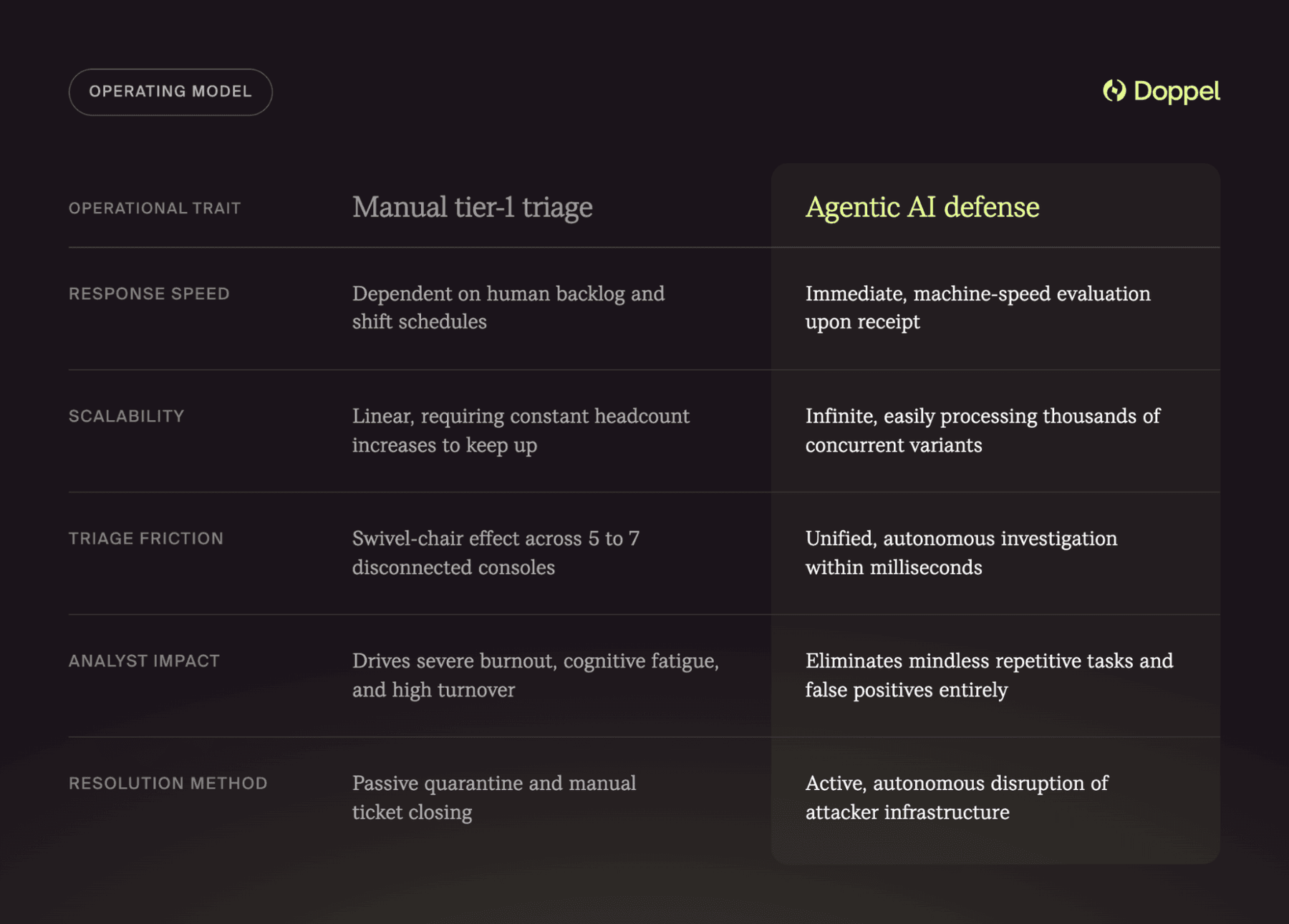
To defeat an adversary using artificial intelligence to automate their attacks, use native, agentic AI to automate your defense. You have to remove the human bottleneck entirely from the initial triage process.
Doppel's agentic AI-native platform completely eliminates the traditional abuse inbox bottleneck. We don't rely on rigid, hardcoded rules or brittle playbooks that shatter the moment an attacker changes a single variable. Doppel is built on reasoning-based, agentic loops that operate entirely on intent.
When an employee reports a suspicious message, a Doppel AI agent takes over immediately. The agent doesn't wait in a queue. It autonomously reads the email, extracts the indicators of compromise, and cross-references the telemetry against our global threat graph in milliseconds. The agent dynamically investigates the campaign's full state, easily identifying all five hundred automated variants the attacker launched, no matter how heavily they used semantic perturbation or dynamic SVG rendering.
Because Doppel uses native AI to reason through the investigation, it filters out false positives. Your human analysts never even see the benign marketing newsletters or internal human resources announcements.
But Doppel doesn't stop at triage. Filtering the noise is only half the battle. To defeat infinite automation, destroy the infrastructure powering it.
The moment Doppel's agent verifies the malicious campaign, it initiates a machine-speed takedown. Our agents autonomously strike the attacker's registrar and hosting providers. We burn down their typosquatted domains and dismantle their redirect chains globally. We neutralize the adversary's automated campaign before it can cause damage, ensuring they cannot simply pivot and try again.
We stop managing backlogs and start dismantling attacker infrastructure.
Security managers instantly solve the unwinnable math equation by deploying Doppel. You eliminate the alert fatigue driving your best talent out the door. You free your analysts to focus on proactive threat hunting and strategic defense. Most importantly, you meet the adversary's automated attacks with an infinitely scalable, autonomous defense.
It's time to stop throwing human headcount at a machine-speed problem.
Experience the structural difference of true agentic defense by scheduling a demo with Doppel.