

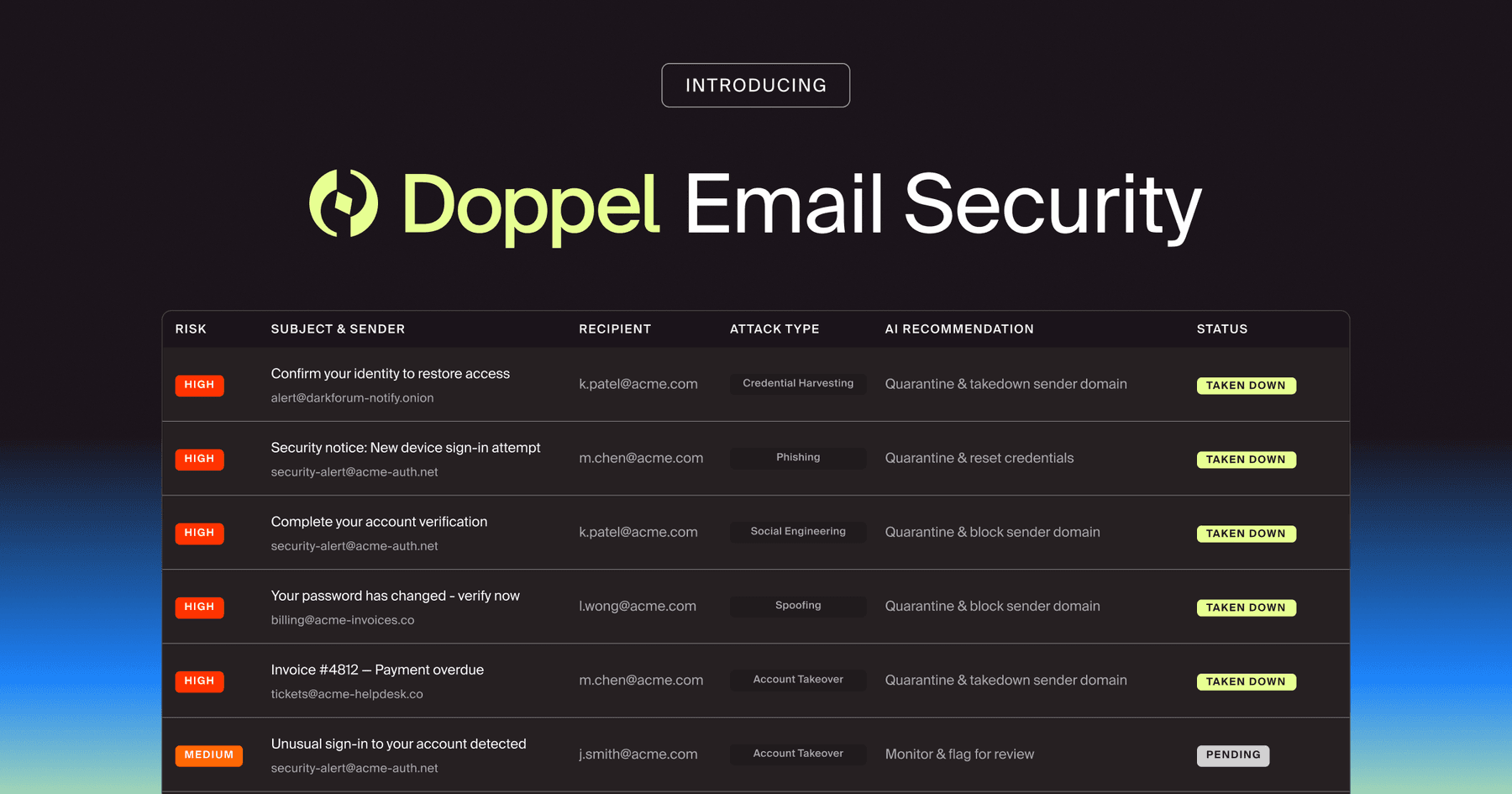
Doppel Email Security is now generally available
The agentic email security solution that empowers you to fight back against social engineering attacks. Detection isn't enough. Disruption is the difference.
Spotted a lookalike domain spoofing your brand? Use this 60-minute response playbook to preserve evidence, assess risk, and start disrupting the infrastructure.
It’s 2:15 PM on a random Thursday, and an alert pops up in your Slack channel.
Someone just registered your corporate domain with a swapped vowel or a sneaky .co extension. The site looks sleek, carries your official logos, and sits right in the path of your customers and employees.
The SOC’s collective blood pressure climbs. One person wants to click the link from a work laptop “just to see.” Another is drafting a scorched-earth email to the registrar’s abuse inbox. Legal is already looking for a meeting slot.
Take a breath. Keep the link off your work device. Then stop guessing.
A lookalike domain creates a race, but panic doesn’t make you faster. While a company debates ownership and waits on a ticket queue, an attacker can change infrastructure, launch a lure, or move to the next domain. The first hour is about preserving options: capture evidence, assess intent, warn the right people, and start disruption.
What you do in the first 60 minutes determines whether this incident ends as a quiet, neutralized non-event or a very uncomfortable conversation with your chief financial officer.
Here's your minute-by-minute playbook.
Curiosity creates expensive unforced errors here. Your job is to gather enough evidence to judge the threat without exposing your corporate network (or your investigation) to the operator.
In the first 10 minutes, it’s all about discipline:
Gathering this initial intelligence without tipping your hand is crucial. Think of it like a digital stakeout: You want to take high-resolution pictures of the getaway car, but you absolutely do not want to walk up and knock on the window.
Once you've safely preserved the raw evidence without spooking the threat actor, you can start digging into their infrastructure.
Next, pull technical telemetry. This is where you map the attacker’s operational infrastructure and look for the telltale signs of a high-velocity campaign.
By minute 30, you should have a defensible working picture: what the domain is doing, who it appears to target, which providers sit behind it, and which signals justify escalation. “Working picture” matters. Incident response rarely hands out crystal balls.
Now, it's time to break their toys.
You’ve preserved the evidence and profiled the infrastructure. The final 30 minutes focus on execution: dismantling the setup and closing internal vulnerabilities before the attacker extracts value.
If you hit all these steps, you've successfully disrupted the immediate threat and warned your people before the trap could snap shut. But as any seasoned security pro knows, threat actors are stubbornly persistent.
Knocking down one domain may only earn you a sequel. That’s where a fully manual process starts to buckle.
Here’s a breakdown of how your technical objectives map out across the initial sprint:
Time window | Primary objective | Key actions | Critical escalation trigger |
0 to 10 minutes | Isolation and triage | Sandbox the link, capture source code, and determine the target audience | Domain actively hosts a live clone of an internal SSO portal |
10 to 30 minutes | Infrastructure fingerprinting | Execute WHOIS queries, inspect MX records, and hunt for social variants | Active MX records detected, and the domain is weaponized for outbound mail |
30 to 60 minutes | Multi-tier takedowns | File abuse reports across the host/CDN, alert all teams, and track re-registrations | Threat actor actively rotates DNS or routes traffic through reverse proxies |
Running through this checklist manually every single time a lookalike domain pops up is exhausting, stressful, and totally unscalable.
Detection without context or action leaves analysts in a reactive loop: copy registration data, rebuild evidence packages, chase providers, update tickets, repeat. Takedown timing varies by provider and case, so the real advantage comes from connecting related assets, automating repetitive work, and keeping human judgment focused on the messy exceptions.
That's why tracking malicious state changes matters. A state-change-aware system doesn't wait for an employee to report a bad link. It would have flagged the MX record activation the exact moment the attacker flipped the switch, long before your first hour fire drill even started.
You won’t remove human judgment from incident response (and you shouldn’t). You can remove a remarkable amount of copy-paste.
Doppel’s brand protection continuously monitors external channels for impersonation, including suspicious domains, cloned sites, ads, social accounts, and connected campaign infrastructure. Doppel Threat Graph then helps teams see the campaign, not just a pile of unrelated alerts.
When a malicious domain surfaces, Doppel helps gather and connect evidence, prioritize the risk, and move validated abuse into automated and expert-supported takedown workflows. You still get the audit trail. You just don’t have to make artisanal abuse reports one at a time.
Stop scrambling through emergency fire drills and permanently disrupt the adversary’s infrastructure before they even have a chance to launch.
Ready to make lookalike-domain response less manual? Schedule a demo with Doppel to see how the platform connects campaign infrastructure, accelerates takedowns, and gives your team fewer tabs to babysit.