

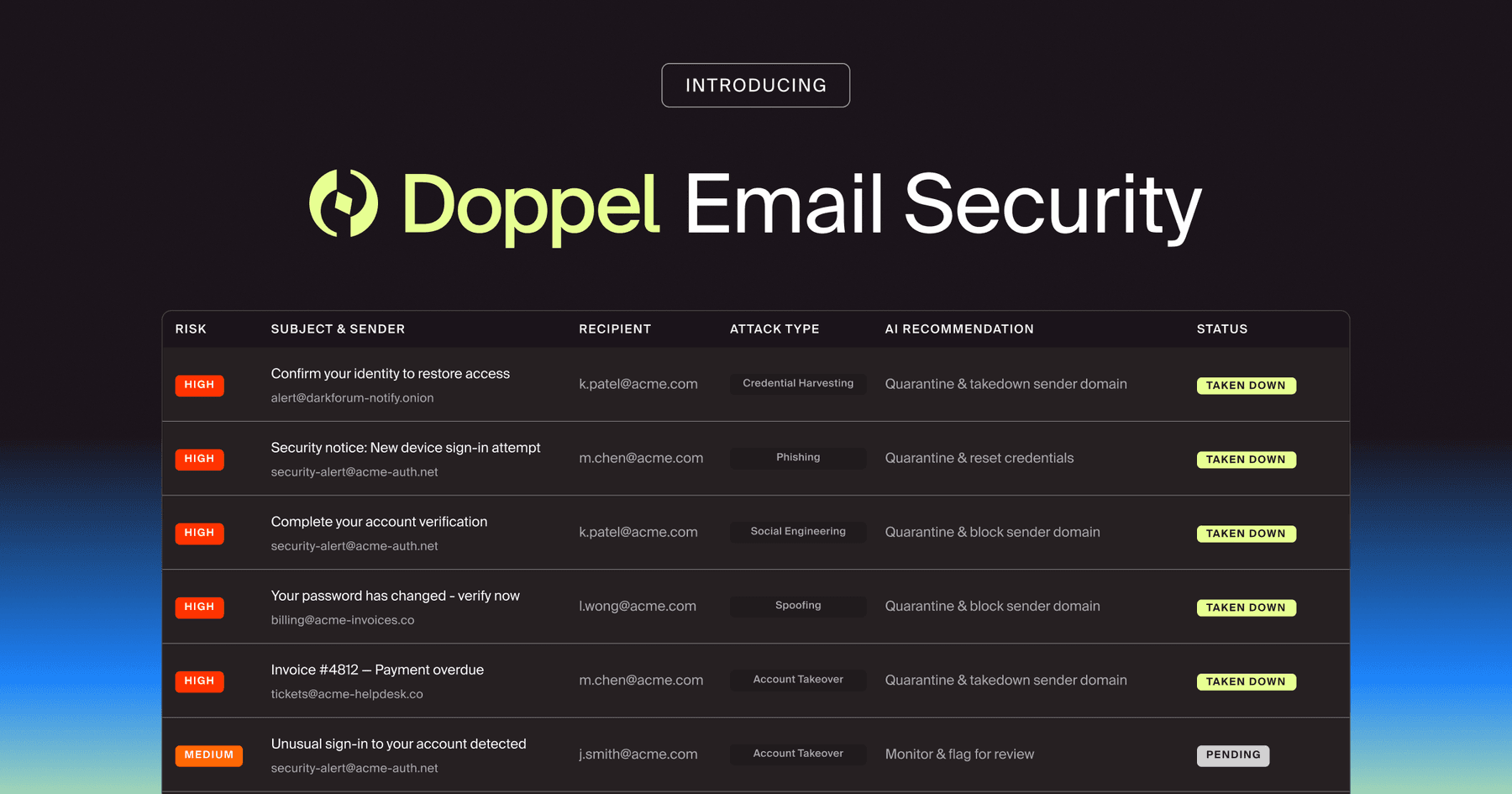
Doppel Email Security is now generally available
The agentic email security solution that empowers you to fight back against social engineering attacks. Detection isn't enough. Disruption is the difference.
Firms are facing an epidemic of VIP impersonation and social engineering. Learn why fraud warning banners and pop-ups aren't enough, and how to protect your brand.

In the legal and business services sector, trust is the product you sell.
Clients don’t just hire a firm for legal acumen or financial processing capabilities. They hire you because your brand name carries weight, authority, and discretion. Your partners are viewed as elite professionals, and your communications are treated as gospel.
Threat syndicates know exactly how valuable that reputation is, and they’re currently weaponizing it at an unprecedented scale.
Instead of spending months trying to brute-force their way through your enterprise firewalls to steal data, today’s attackers are hijacking your firm's identity. They’re cloning the personas of your managing partners, spoofing your corporate domains, and launching devastating, AI-powered social engineering campaigns that target both your internal staff and the general public.
The legal sector is currently facing a massive social engineering epidemic. If you want proof, you don’t have to look at a dark web forum. You just have to look at the homepages of the law firms themselves.
A law firm’s website was once the digital equivalent of a marble lobby: stately, professional, and confidence-inspiring. Now, you’re just as likely to be greeted by a blaring digital siren.
Across the industry, legal teams are being forced to plaster their own websites with disclaimers. There are banners and pop-ups stating that scammers are impersonating attorneys and other employees, falsely offering their services.
But putting a fraud warning on your website isn’t all that helpful.
While it’s a necessary reactive step for legal liability, this completely fails to address the root of the problem. If your first interaction with a prospective high-net-worth client involves warning them that your brand is currently being used to run a criminal syndicate, your digital perimeter has already failed.
Law firms are prime targets because they sit in the middle of massive financial transactions and possess highly sensitive corporate intelligence. Attackers exploit this position through a variety of sophisticated social engineering tactics.
Here’s how threat attackers hijack legal services brands in 2026:
Let's look at a recent incident from a major national law firm. The firm found itself in the crosshairs of a highly targeted, relentless impersonation campaign focused on one of its partners.
Threat actors set up incredibly convincing fake social media profiles for the partner, blasting out posts that promised victims of previous scams, "We'll help you get your money back." Once a desperate victim took the bait, the scammers quickly funneled them off the social platform and into encrypted, untraceable channels like Telegram to execute the real grift.
And these attackers weren't just running a set-it-and-forget-it bot. They were actively paying attention. They continuously piggybacked on the firm's real-world news coverage and public topics to spin up fresh, highly contextual impersonation campaigns.
This was an unrelenting, reputation-damaging operation.
When the firm's Head of Information Security compared Doppel and a competitor to stop the bleeding, the competitor failed to surface a single active threat. Doppel identified the live campaigns quickly and proactively, completely crushing the legacy competition and shutting the attackers down.
While warning banners might help protect the general public from external scams, they do nothing to protect your own workforce.
In the legal industry, the human perimeter is incredibly vast and notoriously vulnerable. Law firms rely heavily on a sprawling network of paralegals, junior associates, legal assistants, and contractors. These employees are operating in a high-stress, high-velocity environment where responsiveness to senior partners is demanded.
These are the perfect psychological conditions for social engineering.
If a junior associate receives a frantic text message or a spoofed email from someone appearing to be the firm's managing director, demanding immediate access to a sensitive client case file, the associate is highly likely to comply without questioning it. They don’t want to be the bottleneck holding up a multi-million-dollar deal.
Traditional perimeter defenses, like secure email gateways and endpoint firewalls, are completely blind to this type of attack. A firewall can’t stop an employee from reading a spoofed LinkedIn message, and a spam filter can’t intercept a deepfake voicemail.
To survive this threat landscape, CISOs at legal and business services firms have to rethink their defensive posture. As we noted in our case study on a global law firm, you cannot secure an enterprise simply by locking down the hardware; you have to actively harden the human element against AI-driven manipulation.
When a law firm realizes one of its partners is being impersonated online, or a lookalike domain is being used to scam clients, the standard IT response is painful.
The security team enters a miserable game of digital whack-a-mole.
An analyst has to manually identify the fake LinkedIn profile, fill out a clunky abuse reporting form, and hope the platform's support team reviews it within a week. Meanwhile, the attacker has already spun up three more fake profiles on different platforms. If a lookalike domain is registered, the firm's legal team has to draft cease-and-desist letters to offshore hosting providers who have absolutely no intention of complying.
This approach to security awareness training relies entirely on human effort to combat automated, AI-driven attacks.
By the time the manual takedown request is finally processed, the threat actor has already extracted the wire transfer, vanished, and left the law firm to deal with the furious clients and the reputational fallout.
Firms need to stop apologizing for scammers and start aggressively dismantling their infrastructure. You can’t control whether a cybercriminal decides to target your brand, but you can control exactly how long their campaign survives in the wild.
Instead of relying on a reactive, manual workflow, Doppel leverages an agentic SOC to provide active, autonomous social engineering defense.
Here’s how an agentic defense shifts the balance of power back to your firm:
Defensive posture | Legacy approach | Agentic approach |
Initial response | Plastering a desperate "Fraud Warning" banner or pop-up on the homepage, hoping clients read it | Autonomously identifying the spoofed domain and executing a machine-speed API takedown to kill the site |
VIP protection | Finding out a managing partner was impersonated on LinkedIn only after a victim complains | Continuous, cross-channel monitoring to catch and flag fake executive profiles the exact second they go live |
Operational burden | Legal and IT teams wasting billable hours manually filing individual abuse reports with uncooperative hosts | AI autonomously navigating the complex global takedown process, destroying the attacker's infrastructure |
Human risk management | Running generic, once-a-year compliance videos that associates click through as fast as possible | Converting live, real-world impersonation lures into proactive internal simulations to train staff dynamically |
In legal and business services, your reputation is your revenue.
When threat syndicates hijack your brand to run cryptocurrency scams or launch highly targeted social engineering campaigns, they’re stealing the trust you’ve spent countless hours building. A warning banner on your website shows your clients that you are aware of the problem, but it also signals that you’re entirely powerless to stop it.
It’s time to move past passive warnings and embrace active threat disruption.
By deploying Doppel's agentic platform, legal and business services can continuously monitor their external attack surface, secure their human perimeter against sophisticated AI lures, and execute automated takedowns at machine speed. You can stop playing whack-a-mole, protect your VIPs, and ensure that when a client interacts with your brand, they’re actually interacting with you.
Take your firm’s identity back from cybercriminals. See how Doppel’s agentic AI eliminates VIP impersonation, dismantles lookalike domains, and protects your reputation.
BLOG
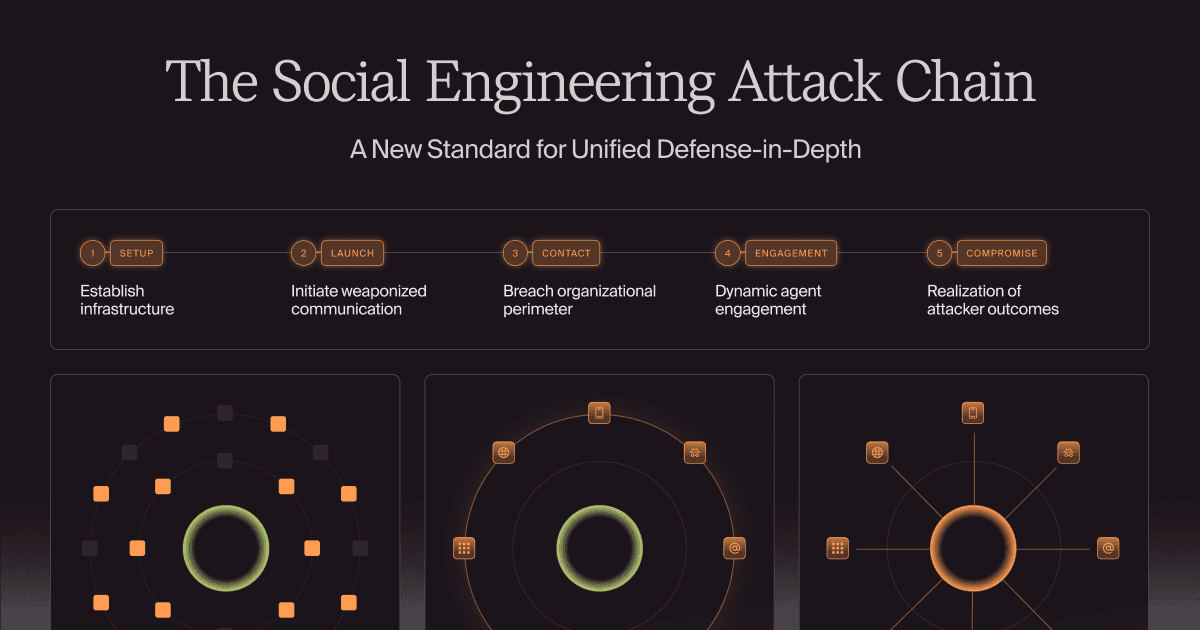
Modern social engineering is a relentless, AI-orchestrated lifecycle. Learn how to map the five-stage attack chain—from setup to contact—and why a unified defense platform is the only way to outpace AI-driven social engineering attacks.



by Bobby Ford, Rahul Madduluri, and Alvin Lin